
NVIDIA Generative AI Technology Used by Google DeepMind and Google Research Teams Now Optimized and Available to Google Cloud Customers WorldwideSAN FRANCISCO, Aug. 29, 2023 (GLOBE NEWSWIRE) …
Category: Misc
Janice K. Lee, a.k.a Janice.Journal — the subject of this week’s In the NVIDIA Studio installment — is a TikTok sensation using AI to accelerate her creative process, find inspiration and automate repetitive tasks.
Companies are discovering how accelerated computing can boost their bottom lines while making a positive impact on the planet. The NVIDIA RAPIDS Accelerator for Apache Spark, software that speeds data analytics, not only raises performance and lowers costs, it increases energy efficiency, too. That means it can help companies meet goals for net-zero emissions of Read article >
 Since 2018, NVIDIA DLSS has leveraged AI to enable gamers and creators to increase performance and crank up their quality. Over time, this solution has evolved…
Since 2018, NVIDIA DLSS has leveraged AI to enable gamers and creators to increase performance and crank up their quality. Over time, this solution has evolved to include groundbreaking advancements in super resolution and frame generation.
Now, the AI neural rendering technology takes the next step forward with DLSS 3.5. This update includes an important new feature called Ray Reconstruction.
Ray Reconstruction is a new neural network for all GeForce RTX GPUs that further improves the image quality of ray-traced images. Trained on 5x more data than DLSS 3, DLSS 3.5 replaces hand-tuned denoisers with an NVIDIA supercomputer-trained AI network that generates higher quality pixels in between sampled rays.
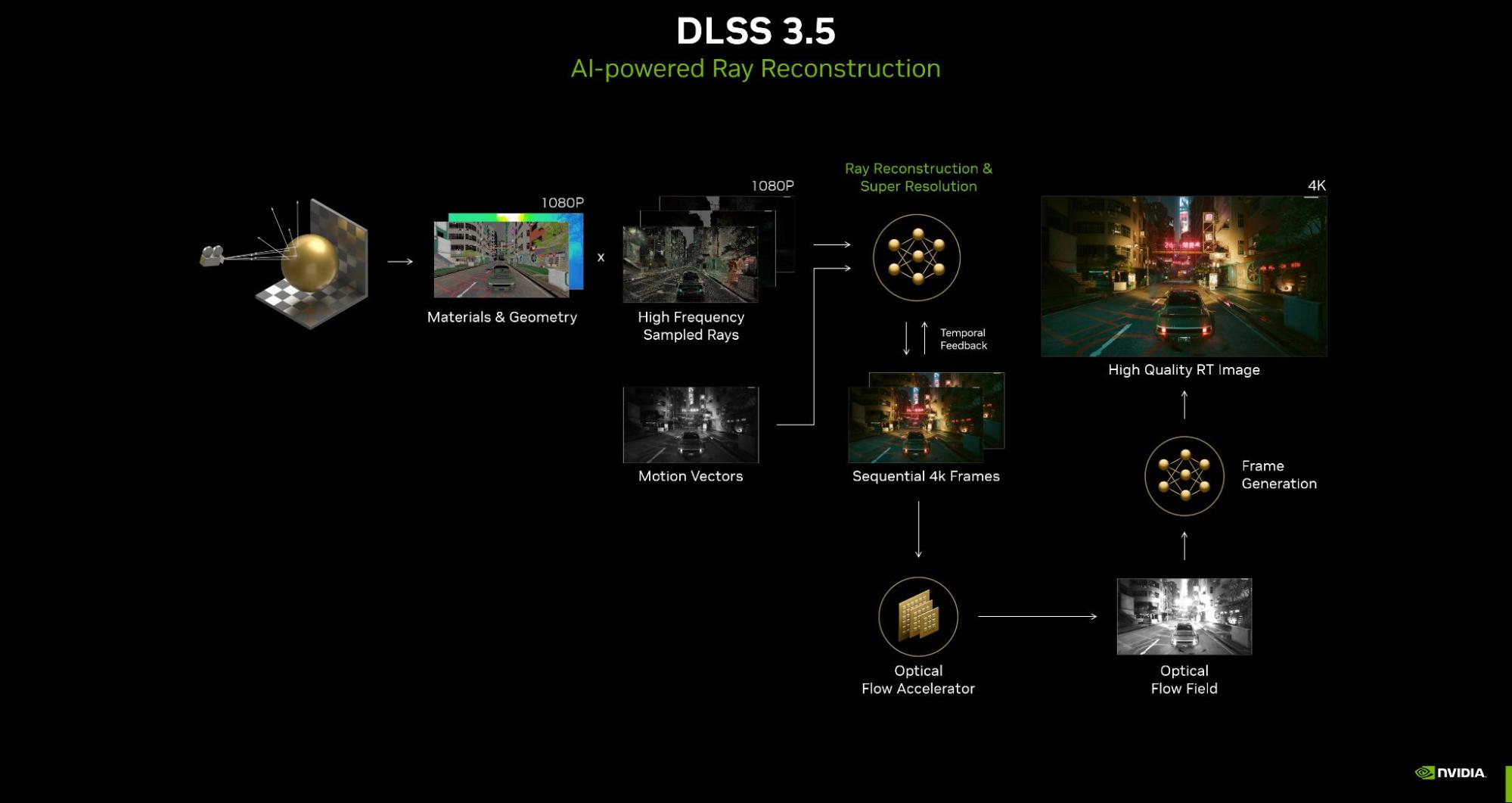
Cyberpunk 2077, Cyberpunk 2077: Phantom Liberty, Alan Wake 2, and Portal with RTX, all coming this fall, will include Ray Reconstruction.
DLSS 3.5 also adds Auto Scene Change Detection to Frame Generation. This feature aims to automatically prevent Frame Generation from producing difficult-to-create frames between a substantial scene change. It does this by analyzing the in-game camera orientation on every DLSS Frame Generation frame pair.
Auto Scene Change Detection eases integration of new DLSS 3 titles, is backwards compatible with all DLSS 3 integrations, and supports all rendering platforms. In SDK build variants, the scene change detector provides onscreen aids to indicate when a scene change is detected so the developer can pass in the reset flag.
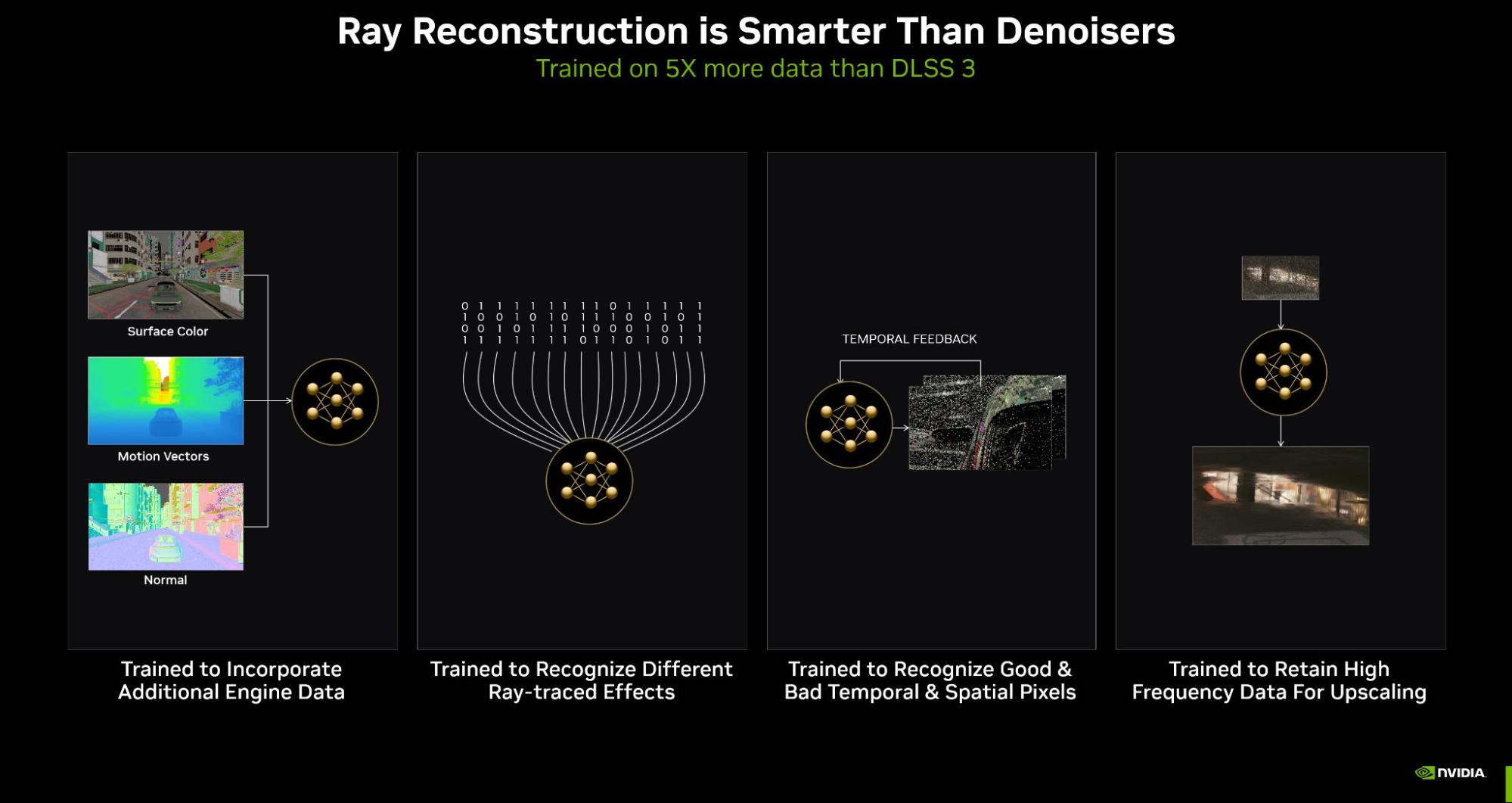
With these new features, you can achieve even better results with ray tracing, and more effectively manage fast scene changes.
Integration into a custom engine is developer-friendly with the Streamline 2.2 SDK, an open-source cross-IHV framework. Simply identify which resources are required for the decided Streamline plug-in. In the game’s rendering pipeline, you can then trigger when to execute the plug-in.
For Unreal Engine titles, simply install the plug-in into your project and most of the work is done. For a step-by-step guide to integration, see How to Successfully Integrate NVIDIA DLSS 3.
Ray Reconstruction will soon be available to all game developers—sign up to be notified. Auto Scene Change Detection is available now in DLSS 3.5 through the Streamline 2.2 SDK and Unreal Engine plug-in.
SANTA CLARA, Calif., Aug. 24, 2023 (GLOBE NEWSWIRE) — NVIDIA will present at the following events for the financial community: Goldman Sachs Communacopia & Technology ConferenceTuesday, Sept. …
As part of NVIDIA and Microsoft’s collaboration to bring more choice to gamers, new Microsoft Store integration has been added to GeForce NOW that lets gamers stream select titles from the Xbox PC Game Pass catalog on GeForce NOW, starting today. With the Microsoft Store integration, members will see a brand-new Xbox button on supported Read article >
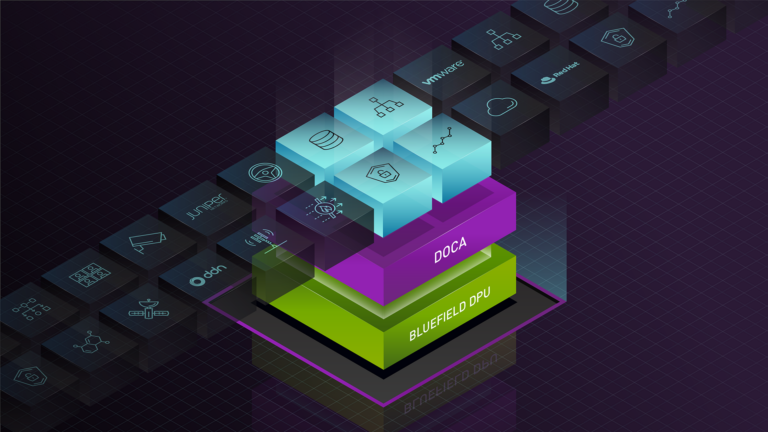 The NVIDIA DOCA framework aims to simplify the programming and application development for NVIDIA BlueField DPUs and ConnectX SmartNICs. It provides high-level…
The NVIDIA DOCA framework aims to simplify the programming and application development for NVIDIA BlueField DPUs and ConnectX SmartNICs. It provides high-level abstraction building blocks relevant to network applications through an SDK, runtime binaries, and high-level APIs that enable developers to rapidly create applications and services.
NVIDIA DOCA Flow is a newly updated set of software drivers and a steering library in the DOCA Framework. It runs in user space and enables offloading of networking-related operations from the CPU. This in turn enables applications to process high-packet throughput workloads with low latency, conserving CPU resources and reducing power usage.
DOCA Flow also efficiently optimizes the utilization of BlueField DPUs and ConnectX SmartNICs. DOCA is the key to unlocking the potential of BlueField’s acceleration engines, while DOCA Flow grants rapid access to the acceleration engine for packet-steering logic.
Simplify and expedite development
DOCA Flow offers C library APIs for defining hardware-based packet processing pipelines, abstracting the hardware capabilities of BlueField DPUs and ConnectX SmartNICs. This enables developers to construct high-performance and scalable applications for data center and cloud networks, programmatically defining and controlling network traffic flows, implementing network policies, and efficiently managing resources.
DOCA Flow complements and expands upon the core programming capabilities of DPDK, providing additional optimized features tailored specifically for NVIDIA DPUs and NICs. Further, DOCA Flow simplifies the complexities of the networking stack by offering building blocks for implementing basic packet processing pipelines for popular networking use cases, as well as for more sophisticated ones such as Longest Prefix Matching (LPM), Internet Protocol Security (IPsec) encryption or decryption, and creation or modification of entries in the Access Control List (ACL).
Using pre-created networking building blocks enables you to focus on creating your applications instead of writing low-level packet processing routines. This reduces TTM and frees you to focus on the core of your application, as the building blocks are already efficiently optimized for performance. DOCA Flow building blocks make software development easier, and can be used by developers of all experience levels.
Why DPUs are needed
Modern workloads and software-defined networking lead to significant networking overhead on CPU cores. Data centers and cloud networks now start at speeds of 25 or 100 Gbps and scale up to 200 and even 400 Gbps, requiring CPU cores to handle classification, tracking, processing, and steering of network traffic at immense speeds.
Compute virtualization amplifies networking requirements by generating more east/west traffic internally between host VMs and containers, and adding overlay network encapsulation plus microsegmentation to external communication with other servers or storage devices. As a result, much more networking demand is placed on the CPU.
CPU cores come with a significant cost and are not well-suited for efficient network packet processing. High-bandwidth tasks consume more CPU cores, placing unnecessary strain on the server’s valuable compute infrastructure, which could otherwise be utilized more productively for tenant workloads and application data processing.
In contrast, specialized hardware like SmartNICs and DPUs are specifically designed to efficiently handle fast data movement at scale, with reduced power consumption, heat, and overall cost compared to standard CPUs.
Execution pipes
The DOCA Flow library provides APIs that use hardware functions within the BlueField DPU and ConnectX SmartNICs to build generic and reusable execution pipes, where each pipe may consist of match criteria (packet classification) and a set of actions.
Classification enables identifying incoming packets to which logic should be applied, while actions vary and implement the logic that fits each packet’s classification. Using classifications and actions as building blocks provides a flexible method for developing hardware-accelerated network applications including gateways, firewalls, load-balancers, and others.
As mentioned, the actions in the DOCA Flow execution pipe vary and may include, as an example, packet manipulations such as applying Network Address Translation (NAT) logic on MAC addresses, changing source or destination IP addresses, applying overlay network encapsulation, changing header fields, incrementing a counter to measure traffic, and more. Actions may include monitoring traffic through the use of policies, forwarding traffic to different queues–either software queues or hairpin targets, port mirroring or packet sampling for debugging and lawful interception, and dropping packets to enforce policies or access control–all completely offloaded to the DPU or NIC hardware.
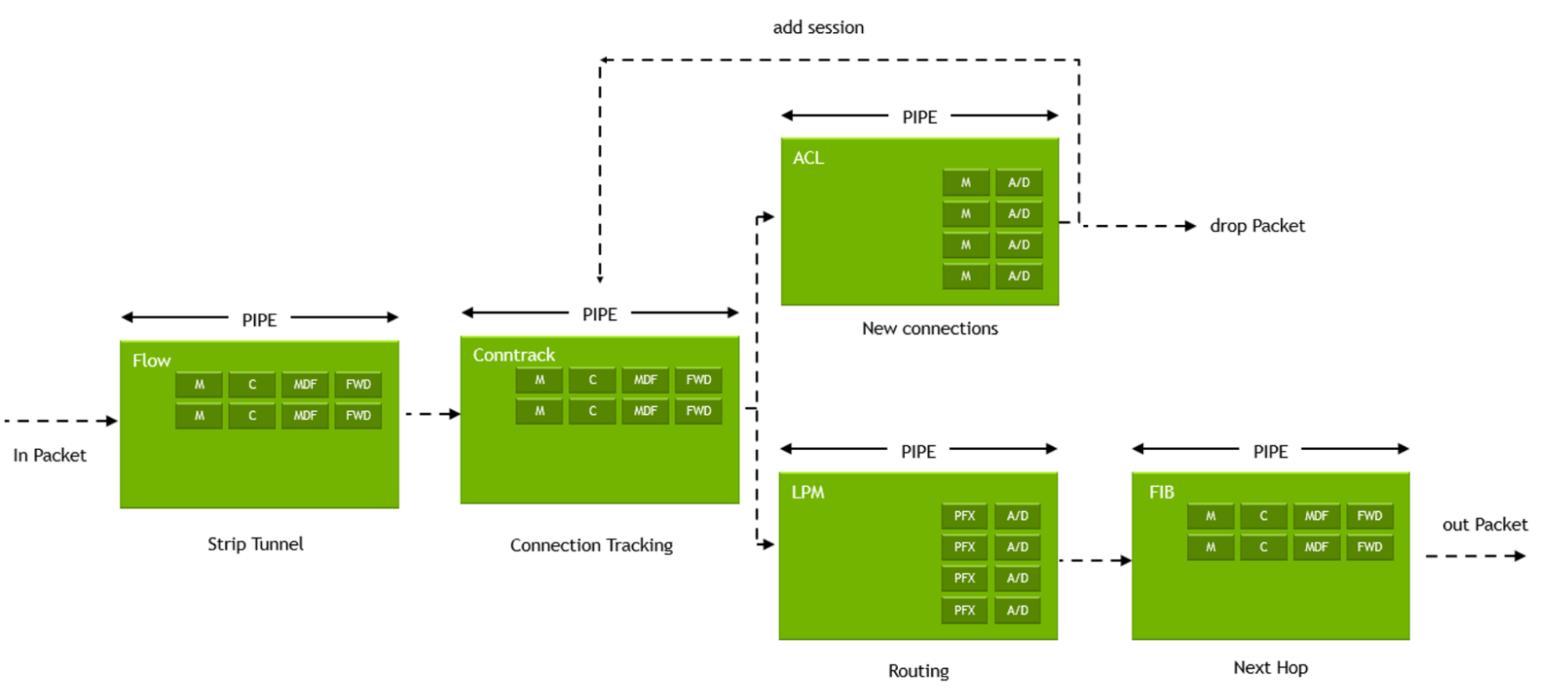
Pipes may be chained together through forwarding actions from one pipe to another to form a complete steering tree that defines paths for incoming packets. After executing a predefined action on a packet, the packet may be forwarded to another pipe for further action or inspection, to a software queue, to a hardware hairpin queue, or sent down the wire or dropped.
Steering trees
A steering tree can be used to create hardware-based network applications on a DPU or NIC by implementing common network function logic. This enables packets to be effectively categorized so the appropriate action can be applied to each one. Using the steering tree concept provides multiple benefits, including:
- Customized processing logic for each data flow
- Versatility in directing packets to specific actions or destinations
- Adaptable structure that’s easily resized for changing conditions
- Flexible framework that allows adding new pipe types to meet evolving requirements
- Optimized resource use, minimizing redundancy and enabling shared matches and actions
NVIDIA DOCA Flow use cases
When developing network pipelines for BlueField DPUs and ConnectX SmartNICs, DOCA Flow serves as a fundamental element in simplifying application development efforts. Use cases are applicable across enterprise data centers, telco, and cloud environments, particularly those that are focused on network infrastructure and security that require efficient packet processing.
Additionally, it is designed to handle scenarios involving establishing and removing pipelines at an extremely high rate, and can manage millions of packet exchanges per second. This accommodates software-defined networking applications, data analytics, virtual switching, AI inferencing, cybersecurity, and other packet processing applications. It enables operations like ingesting, examining headers and payloads, tracking connections, and inspecting, rerouting, copying, or dropping packets based on predetermined policies or other criteria.
Open vSwitch virtual switching
Open vSwitch (OVS) enables massive network automation through programmatic extension, and is designed to enable efficient network switching in virtualized environments such as virtual machines (VMs) and containers. Through DOCA Flow, a DPU-accelerated virtual switch (vSwitch) can be implemented in the user space data plane, allowing any server with a DPU to act as a network switch, router, or stateful load balancer.
This provides the flexibility of having a vSwitch available to multiple VNFs, while also significantly increasing small packet throughput and reducing latencies, thus expediting and accelerating communication through enhanced networking performance from the DPU and facilitating both north-south traffic for connecting to users, and east-west traffic for AI and distributed applications.
Next-generation firewall
Modern firewalls are required to inspect data at higher rates in order to combat new threats. However, with increased network speeds, more load is placed on the CPU. This can lead to increased latency, dropped packets, and reduced network throughput. To support higher speeds and more stringent security requirements without sacrificing latency is complex and deploying enough traditional firewalls capable of handling the increased traffic is cost-prohibitive.
DOCA Flow enables the development of an intelligent network filter for each server hosting a DPU. With this filter, the parsing and steering of traffic flows is based on predefined policies, with no CPU overhead. It can be used to create a distributed next-generation firewall (NGFW) that can achieve close to 100 Gbps throughput per server by using dedicated accelerators and Arm cores on the DPU to filter and forward packets based on their appropriate flow, as well as managing the data plane offloads and control plane of the NGFW.
Using DOCA Flow can provide a cost-effective solution to offload packet processing from the CPU to the DPU to increase performance and reduce costs beyond traditional hardware solutions. It offers advanced security features, like intrusion prevention, without sacrificing server performance. It also enables faster network flow inspection within the NIC/DPU.
Virtual network functions
DOCA Flow can accelerate virtualized network functions (VNFs), such as routers, load balancers, firewalls, content delivery network (CDN) services, and more. Telco vendors can replace proprietary hardware and execute virtualized workloads on commodity servers by developing VNFs that run on BlueField DPUs.
By using DPUs for VNF acceleration, a more efficient and flexible solution is achieved, leading to reduced equipment, space, heat, and power requirements compared with commodity servers. All this helps resolve limitations based on cooling and space constraints, enabling new opportunities with 5G, AI, IoT, and edge computing.
Edge applications
DOCA Flow is an ideal solution for edge workloads that require high network speeds and I/O processing capabilities, such as content delivery networks and video analytics systems. Host applications for the edge can be designed using DOCA Flow to run on DPUs installed within general-purpose servers, eliminating the need for expensive proprietary hardware appliances. By utilizing the DPUs acceleration and Arm cores, fewer server CPU cores are needed, allowing for smaller servers that consume less energy, require less cooling, and occupy less rack space. This approach offers cost savings in terms of both CapEx and OpEx.
Summary
The DOCA Flow library can be instrumental for developers by simplifying the development of modern applications that offer accelerated network throughput and latency improvements in packet processing. This is especially true for applications replacing proprietary bare-metal hardware solutions with virtualized applications hosted on commercial-off-the-shelf (COTS) server platforms.
The library consists of several building blocks for efficient networking offloads, including implementing basic packet processing pipelines, Longest Prefix Matching (LPM), and Internet Protocol Security (IPsec) encryption or decryption. Enhancements will be added soon to Connection Tracking (CT) and Access Control List (ACL) to create or modify access control entries. For a sampling of DOCA Flow reference applications, see the DOCA Reference Applications documentation.
By harnessing the capabilities of DOCA Flow, organizations can minimize cost, accelerate service deployment, and optimize hardware utilization within use cases that demand high throughput and low latency.
To learn more, explore the following resources:
NVIDIA today reported revenue for the second quarter ended July 30, 2023, of $13.51 billion, up 101% from a year ago and up 88% from the previous quarter.
 Delve into how TMA Solutions is accelerating original ML and AI workflows with RAPIDS.
Delve into how TMA Solutions is accelerating original ML and AI workflows with RAPIDS.
 The advent of cloud computing has ushered in a paradigm shift in our data storage and utilization practices. Businesses can bypass the complexities of managing…
The advent of cloud computing has ushered in a paradigm shift in our data storage and utilization practices. Businesses can bypass the complexities of managing their own computing infrastructure by tapping into remote, on-demand resources deftly managed by cloud service providers. Yet, there exists a palpable apprehension about sharing sensitive information with the cloud.
While traditional cryptographic methods such as AES can help preserve data privacy, they stifle the cloud’s capacity to undertake meaningful operations on the data. In an encryption system, a message, also referred to as plaintext, is transformed using a key into a scrambled version known as ciphertext. The encryption methods in place assure that malicious entities can’t decrypt the message without the correct key and can’t gain access to its contents. Without decryption, a ciphertext is essentially nonsensical.
Fortunately, there is a solution: fully homomorphic encryption (FHE), a sophisticated and potent encryption technique. It serves as a comprehensive shield for data, whether in transit, at rest, or in use. Homomorphic encryption is a unique design that enables operations to be performed on the ciphertext while still preserving its security. This type of operation modifies a ciphertext in such a way that, after decryption, the result is the same as if the operation was carried out on the plaintext itself.
Frequently referred to as the ultimate goal of cryptography, FHE can carry out any computational function on the ciphertext. This remarkable technology has the capability to run thousands of algorithms directly on encrypted data, all without compromising the underlying plaintext. It confronts the pivotal privacy issues linked with cloud computing head-on, while simultaneously enabling intricate outsourced computations.
However, operations performed with FHE encryption tend to be slower than those conducted over standard unencrypted data. Also, the current applications of this technology can be somewhat challenging for non-specialists to set up and manage effectively.
ArctyrEX: Accelerated encrypted execution
A recent effort by NVIDIA Research aims to address the efficiency problems associated with encrypted computing. The proposed solution, ArctyrEX, is an end-to-end framework that enables you to specify algorithms in C++ using standard data types and automatically convert this algorithm into an FHE representation that can be launched on arbitrary numbers of GPUs for efficient evaluation.
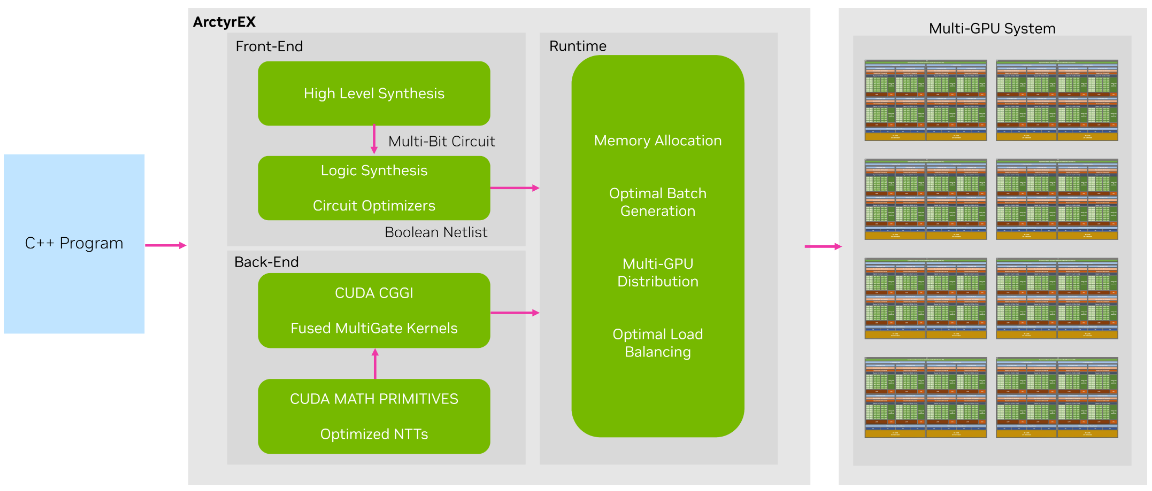
ArctyrEX is composed of three parts:
- A frontend responsible for converting input programs to the encrypted domain
- A runtime library that sends encrypted workloads to GPU workers
- A backend that consists of an implementation of the state-of-the-art CGGI cryptosystem.
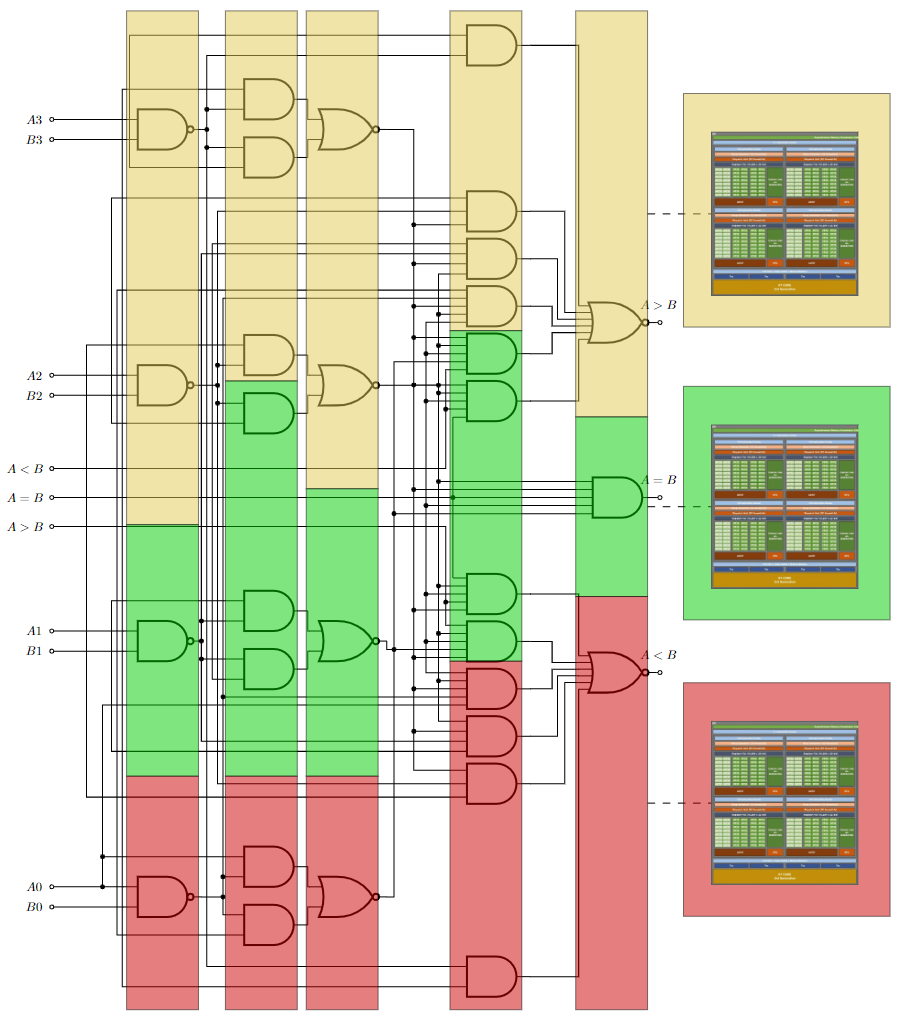
The CGGI cryptosystem encrypts single bits of plaintext and enables encrypted Boolean operations between ciphertexts. Therefore, the programming model for CGGI is akin to constructing Boolean circuits composed of logic gates. For more information, see TFHE: Fast Fully Homomorphic Encryption over the Torus and TFHE.
The frontend takes advantage of decades of hardware development research to convert C++ programs to equivalent Verilog files, which provide a description of a circuit at a high level of abstraction. Then it converts the files to optimal Boolean circuits. This process uses well-established techniques in the form of high-level synthesis (HLS) and register-transfer level (RTL) or logic synthesis.
The ArctyrEX runtime library takes the generated Boolean circuit, divides it into distinct levels, and creates batches of approximately identical size to distribute to GPU workers. In some cases, the ciphertexts corresponding to an output wire of a gate at an intermediate level may have to serve as input to a workload assigned to a different GPU during the next level. ArctyrEX is capable of seamlessly coordinating these transfers efficiently.
Lastly, the ArctyrEX backend consists of an optimized CUDA kernel capable of executing batches of gates concurrently while minimizing CPU-GPU synchronizations. The output is composed of a set of ciphertexts that represent the output wires of the gates in the assigned batch.
Run programs with ArctyrEX up to 40x faster
ArctyrEX shows great scalability with the use of more GPUs for two key reasons:
- Abundant primitive-level parallelism that is a natural trait of most FHE operations.
- Circuit-level parallelism, which is a characteristic commonly displayed in Boolean circuits.
To attain speedy evaluation with Boolean FHE, the circuit must have wide levels, meaning that there should be many gates that can operate simultaneously, and it should have a minimal critical path. To show this, compare an encrypted dot product operation between two vectors with an encrypted vector addition operation.
To actualize these programs in ArctyrEX, you can write C++ code at a high level in an intuitive manner. Here, the pragma is necessary to unroll the loop before the HLS pass. You can employ HLS tools like Google XLS, which are designed to make digital design more approachable and efficient. XLS provides the means to specify digital logic at a higher level like C++ than traditional hardware description languages (like Verilog or VHDL), making the entire process simpler and more efficient.
As an example, observe the differences between an encrypted dot product between two vectors and an encrypted vector addition. To implement these programs in ArctyrEX, you can intuitively write high-level C++ code in the following way, where the pragma is required to unroll the loop before the HLS pass handled by Google XLS:
void vector_addition(int x[500], int y[500], int z[500]) {
  #pragma hls_unroll yes
  for (int i =0; i
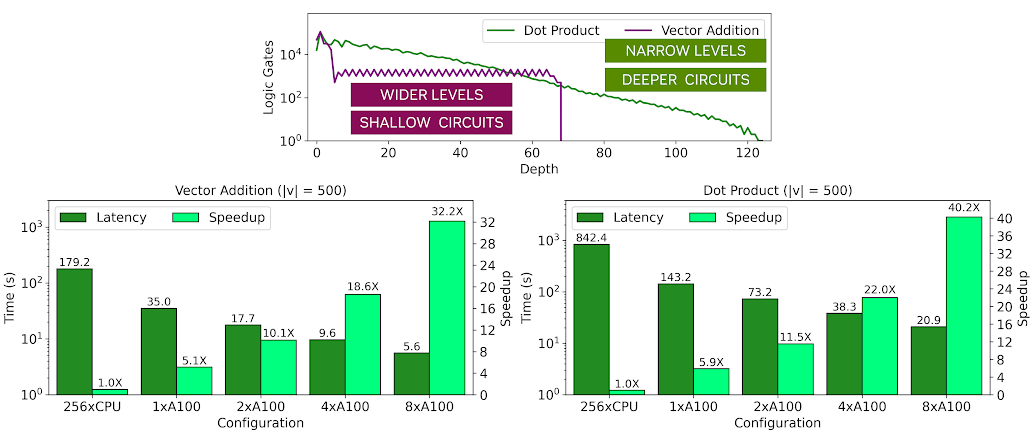
Figure 3 shows the characteristics of both circuits, specifically the number of logic gates at each level of the circuit. In the chart, |v| indicates the vector length and M refers to the dimensions of the matrices. You can see that a dot product of two vectors has a higher critical path with a depth of approximately 120 levels and the width of subsequent levels decreases gradually, limiting the parallelism possible to exploit in the later stages of the circuit.
On the other hand, vector addition has a critical path that is approximately 2x shorter than the dot product, and the width of each level remains relatively constant. As a result, the vector addition runs approximately 4x faster than the dot product, although both exhibit high speedups over a parallel CPU baseline with multiple GPUs. These interesting performance trends are shown in the topology graphs earlier. The light green bars show the speedup relative to a 256-threaded CPU baseline while the dark green bars show the execution time of the homomorphic application.
Summary
In summary, ArctyrEX represents a comprehensive solution for encrypted computation across various applications, harnessing the power of GPU acceleration and implementing innovative techniques for efficient FHE algorithm execution. Tasks like neural network inference demonstrate linear acceleration with the augmentation of GPUs, attributed to the inherent circuit-level parallelism, the newly introduced dispatch paradigm, and the extensive primitive-level parallelism harnessed by the CUDA-accelerated CGGI backend.
For more information, see the Accelerated Encrypted Execution of General-Purpose Applications paper and the live NVIDIA GTC 2023 presentation, ArctyrEX: Accelerated Encrypted Execution of General-Purpose Applications on GPUs.
Acknowledgments
We thank all authors of ArctyrEX for their contributions, especially Charles Gouert (Ph.D. candidate) and Prof. Nektarios Georgios Tsoutsos from the University of Delaware. We’d also like to thank members of Zama, CryptoLab, Google, and Duality Tech for their insightful discussions, particularly Ilaria Chillotti, Jung Hee Cheon, Ahmad Al Badawi, Yuri Polyakov, David Cousins, Shruti Gorantala, and Eric Astor.