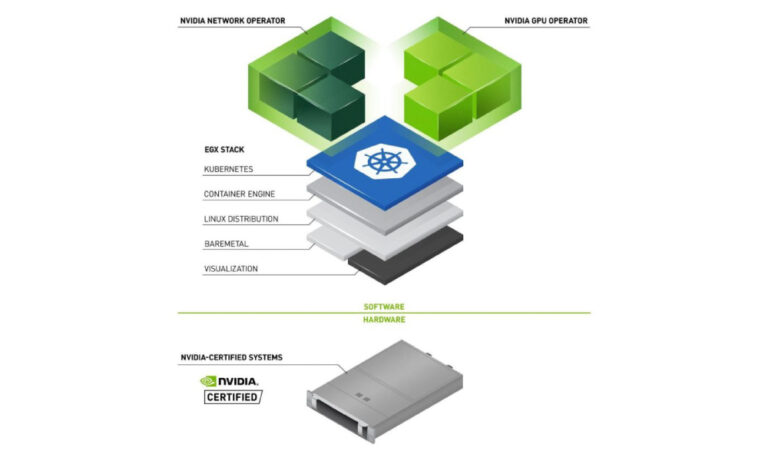
GPU Operator 1.9 includes support NVIDIA DGX A100 systems with DGX OS and streamlined installation processes.
NVIDIA GPU Operator allows organizations to easily scale NVIDIA GPUs on Kubernetes.
By simplifying the deployment and management of GPUs with Kubernetes, the GPU Operator enables infrastructure teams to scale GPU applications error-free, within minutes, automatically.
GPU Operator 1.9 is now available and includes several key features, among other updates, that allow users to get started faster and maintain uninterrupted service.
GPU Operator 1.9 includes:
Support for NVIDIA DGX A100 systems with DGX OS
Streamlined installation process
Support for DGX A100 with DGX OS
With 1.9, the GPU Operator automatically deploys the software required for initializing the fabric on NVIDIA NVSwitch systems, including the DGX A100 when used with DGX OS. Once initialized, all GPUs can communicate with one another at full NVLink bandwidth to create an end-to-end scalable computing platform.
The DGX A100 features the world’s most advanced accelerator, enabling enterprises to consolidate training, inference, and analytics into a unified, easy-to-deploy AI infrastructure. And now, with GPU Operator support, organizations can take their applications from training to scale with the world’s most advanced systems.
Streamlined installation process
With previous versions of GPU Operator, organizations using GPU Operator with OpenShift needed to apply additional entitlements from Red Hat in order to successfully use the GPU Operator. As entitlement keys expired, users would need to re-apply them to ensure that their workflow was not interrupted.
GPU Operator 1.9 now supports entitlement-free driver containers for OpenShift. This is done by leveraging Driver-Toolkit images provided by RedHat with necessary kernel packages preinstalled for building NVIDIA kernel modules. Users no longer need to ensure that valid certificates with an RHEL subscription are always applied for running GPU Operator. More importantly for disconnected clusters, it eliminates dependencies on private package repositories.
Version 1.9 also includes support for preinstalled drivers with the MIG Manager, support for preinstalled MOFED to use GPUDirect RDMA, automatic detection of container runtime, and automatic disabling of NOUVEAU – all designed to make it easier for users to get started and continue GPU-accelerated Kubernetes.
Additionally, GPU Operator 1.9 automatically detects the container runtime installed on the worker node. There is no need to specify the container runtime at install time.
GPU Operator requires Nouveau to be disabled. With previous GPU Operator versions, the K8s admin had to disable Nouveau as documented here. GPU Operator 1.9 automatically detects if Nouveau is enabled and disables it for you.
GPU Operator Resources
The following resources are available for using NVIDIA GPU Operator:
AI can design chips no human could, said Bill Dally in a virtual keynote today at the Design Automation Conference (DAC), one of the world’s largest gatherings of semiconductor engineers. The chief scientist of NVIDIA discussed research in accelerated computing and machine learning that’s making chips smaller, faster and better. “Our work shows you can Read article >
There’s an old axiom that the best businesses thrive during periods of uncertainty. No doubt, that will be tested to the limits as 2022 portends upheaval on a grand scale. Pandemic-related supply chain disruptions are affecting everything from production of cars and electronics to toys and toilet paper. At the same time, global food prices Read article >
I’m at my wits end, every single tutorial for classification I find for Tensorflow 1.x is a goddamn MNIST tutorial, they always skip the basics, and I need the basics.
I have a test set with 6 numerical features and a label that is binary 1 or 0.
With Tensorflow 2.0 I can easily just use something like this
model = tf.keras.Sequential([ tf.keras.layers.Dense(21, activation="tanh"), tf.keras.layers.Dense(10, activation="sigmoid"), tf.keras.layers.Dense(1, activation="sigmoid") ]) model.compile( loss=tf.keras.losses.binary_crossentropy, optimizer=tf.keras.optimizers.Adam(0.001), metrics=['accuracy'] ) history = model.fit(X_train, y_train, epochs=25)
For the life of me I don’t know how to go about doing this in Tensorflow 1.x.
At the forefront of AI innovation, NVIDIA continues to push the boundaries of technology in machine learning, self-driving cars, robotics, graphics, and more.
At the forefront of AI innovation, NVIDIA continues to push the boundaries of technology in machine learning, self-driving cars, robotics, graphics, and more. NVIDIA researchers will present 20 papers at the thirty-fifth annual conference on Neural Information Processing Systems (NeurIPS) from December 6 to December 14, 2021.
Here are some of the featured papers:
Alias-Free Generative Adversarial Networks (StyleGAN3) Tero Karras, Miika Aittala, Samuli Laine, Erik Härkönen, Janne Hellsten, Jaakko Lehtinen, Timo Aila | Paper | GitHub | Blog
StyleGAN3, a model developed by NVIDIA Research, will be presented on Tuesday, December 7 from 12:40 AM – 12:55 AM PST, advances the state-of-the-art in generative adversarial networks used to synthesize realistic images. The breakthrough brings graphics principles in signal processing and image processing to GANs to avoid aliasing: a kind of image corruption often visible when images are rotated, scaled or translated.
Video 1. Results from the StyleGAN3 model
EditGAN: High-Precision Semantic Image Editing Huan Ling*, Karsten Kreis*, Daiqing Li, Seung Wook Kim, Antonio Torralba, Sanja Fidler | Paper | GitHub
EditGAN, a novel method for high quality, high precision semantic image editing, allowing users to edit images by modifying their highly detailed part segmentation masks, e.g., drawing a new mask for the headlight of a car. EditGAN builds on a GAN framework that jointly models images and their semantic segmentations, requiring only a handful of labeled examples, making it a scalable tool for editing. The poster session will be held on Thursday, December 9 from 8:30 AM – 10:00 AM PST.
Video 2. The video showcases EditGAN in an interactive demo tool.
SegFormer: Simple and Efficient Design for Semantic Segmentation with Transformers Enze Xie, Wenhai Wang, Zhiding Yu, Anima Anandkumar, Jose M. Alvarez, Ping Luo | Paper | GitHub
SegFormer, a simple, efficient yet powerful semantic segmentation framework which unifies Transformers with lightweight multilayer perception (MLP) decoders. SegFormer has two appealing features: 1) SegFormer comprises a novel hierarchically structured Transformer encoder which outputs multiscale features. It does not need positional encoding, thereby avoiding the interpolation of positional codes which leads to decreased performance when the testing resolution differs from training. 2) SegFormer avoids complex decoders. The poster will be presented on Tuesday, December 7 from 8:30 AM – 10:00 AM PST.
Video 3. The video shows the excellent zero-shot robustness of SegFormer on the Cityscapes-C dataset.
DIB-R++: Learning to Predict Lighting and Material with a Hybrid Differentiable Renderer Wenzheng Chen, Joey Litalien, Jun Gao, Zian Wang, Clement Fuji Tsang, Sameh Khamis, Or Litany, Sanja Fidler | Paper
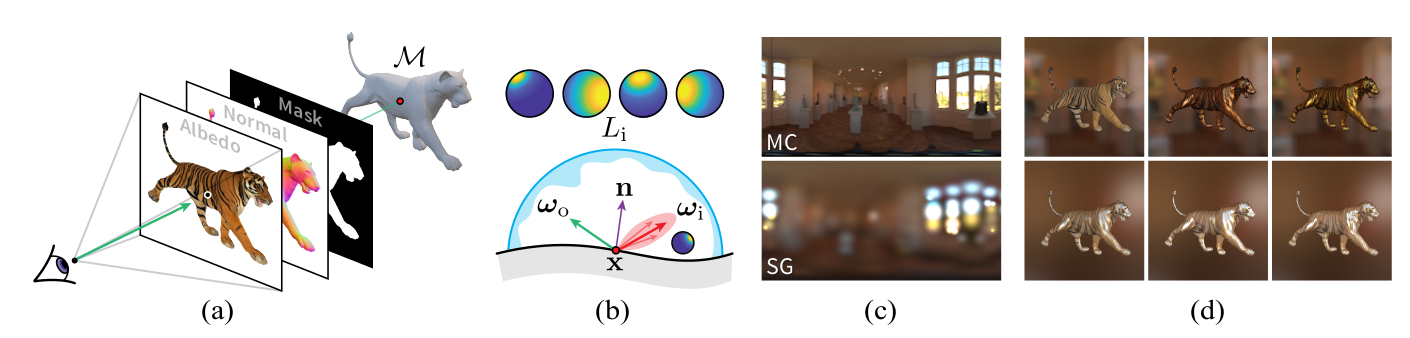
DIB-R++, a deferred, image-based renderer which supports these photorealistic effects by combining rasterization and ray-tracing, taking advantage of their respective strengths—speed and realism. The poster session is on Thursday, December 9 from 4:30 PM – 6:00 PM PST.
Image 1. DIB-R++ is a hybrid renderer that combines rasterization and ray tracing together. Given a 3D mesh M, we employ (a) a rasterization-based renderer to obtain diffuse albedo, surface normals and mask maps. In the shading pass (b), we then use these buffers to compute the incident radiance by sampling or by representing lighting and the specular BRDF using a spherical Gaussian basis. Depending on the representation used in (c), we can render with advanced lighting and material effect (d).
In addition to the papers at NeurIPS 2021, researchers and developers can accelerate 3D deep learning research with new Kaolin features:
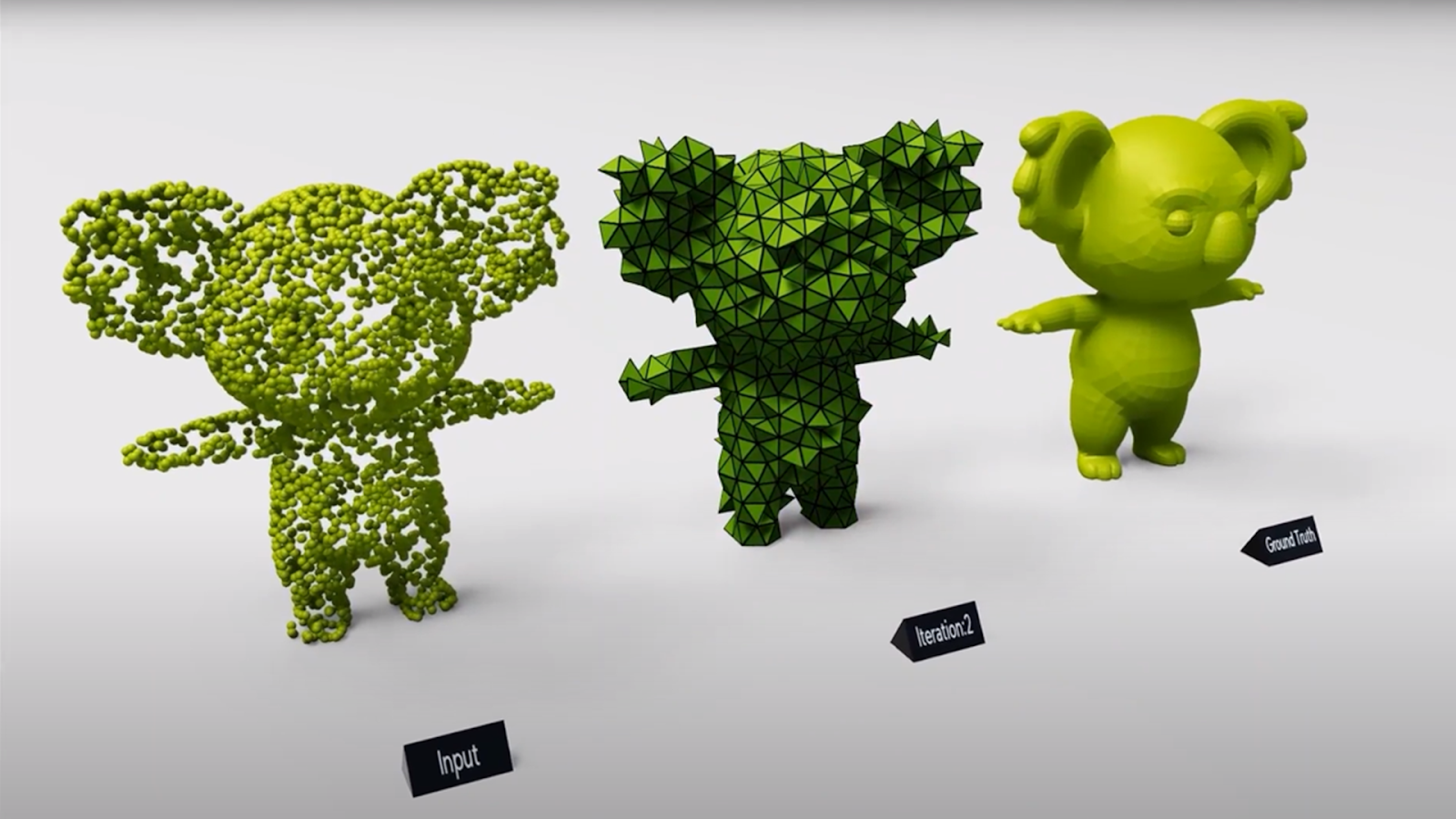
Kaolin is launching new features to accelerate 3D deep learning research. Updates to the NVIDIA Omniverse Kaolin app will bring robust visualization of massive point clouds. Updates to the Kaolin library will include support for tetrahedral meshes, rays management functionality, and a strong speedup to DIB-R. To learn more about Kaolin, watch the recent GTC session.
Image 2. Results from NVIDIA Kaolin
To view the complete list of NVIDIA Research accepted papers, workshop and tutorials, demos, and to explore job opportunities at NVIDIA, visit the NVIDIA at NeurIPS 2021 website.
I am trying to increase the training speed of my model by using mixed precision and the nvidia gpu tensor cores. For this, I just use the keras mixed precision, but the speed increment is only of 10%. Then I found the nividia ngc container, which is optimized for their gpus, and with mixed precision I can increase the training speed a 60%, although with float32 the speed in lower than native. I would like to have at least the speed increase of ngc container natively, what do I need to do?
hi, i tried to load model on cpu with tf.device while inference of 500 images , the cpu usage resches to 100% , inference time is 0.6sec and how do I minimize the inference time and also the utilization of cpu .
Dive deep into the new features and use cases available for networking, security, storage in the latest release of the DOCA software framework.
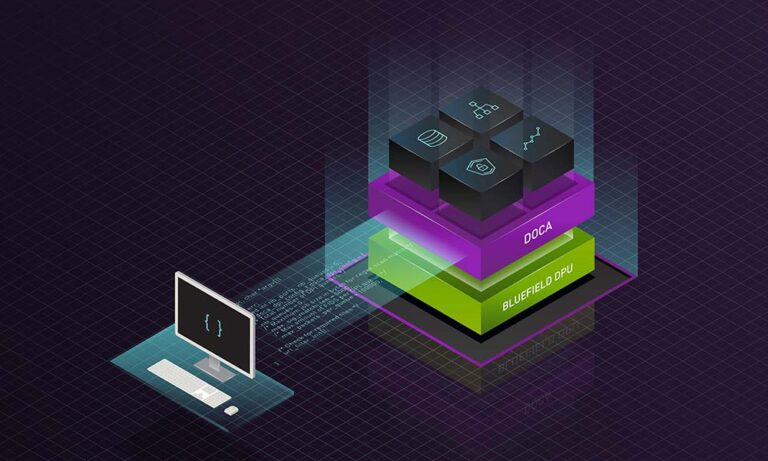
Today, NVIDIA released the NVIDIA DOCA 1.2 software framework for NVIDIA BlueField DPUs, the world’s most advanced data processing unit (DPU). Designed to enable the NVIDIA BlueField ecosystem and developer community, DOCA is the key to unlocking the potential of the DPU by offering services to offload, accelerate, and isolate infrastructure applications services from the CPU.
DOCA is a software framework that brings together APIs, drivers, libraries, sample code, documentation, services, and prepackaged containers to simplify and speed up application development and deployment on BlueField DPUs on every data center node. Together, DOCA and BlueField create an isolated and secure services domain for networking, security, storage, and infrastructure management that is ideal for enabling a zero-trust strategy.
The DOCA 1.2 release introduces several important features and use cases.
Protect host services with adaptive cloud security
A modern approach to security based on zero trust principles is critical to securing today’s data centers, as resources inside the data center can no longer be trusted automatically. App Shield enables detection of attacks on critical services in a system. In many systems, those critical services are responsible for ensuring the integrity and privacy of the execution of many applications.
Figure 1. Shield your host services with adaptive cloud security
DOCA App Shield provides host monitoring enabling cybersecurity vendors to create accelerated intrusion detection system (IDS) solutions to identify an attack on any physical or virtual machine. It can feed data about application status to security information and event management (SIEM) or extended detection and response (XDR) tools and also enhances forensic investigations.
If a host is compromised, attackers normally exploit the security control mechanism breaches to move laterally across data center networks to other servers and devices. App Shield enables security teams to shield their application processes, continuously validate their integrity, and in turn detect malicious activity.
In the event that an attacker kills the machine security agent’s processes, App Shield can mitigate the attack by isolating the compromised host, preventing the malware from accessing confidential data or spreading to other resources. App Shield is an important advancement in the fight against cybercrime and an effective tool to enable a zero-trust security stance.
BlueField DPUs and the DOCA software framework provide an open foundation for partners and developers to build zero-trust solutions and address the security needs of the modern data center. Together, DOCA and BlueField create an isolated and secure services domain for networking, security, storage, and infrastructure management that is ideal for enabling a zero-trust strategy.
Create time-synchronized data centers
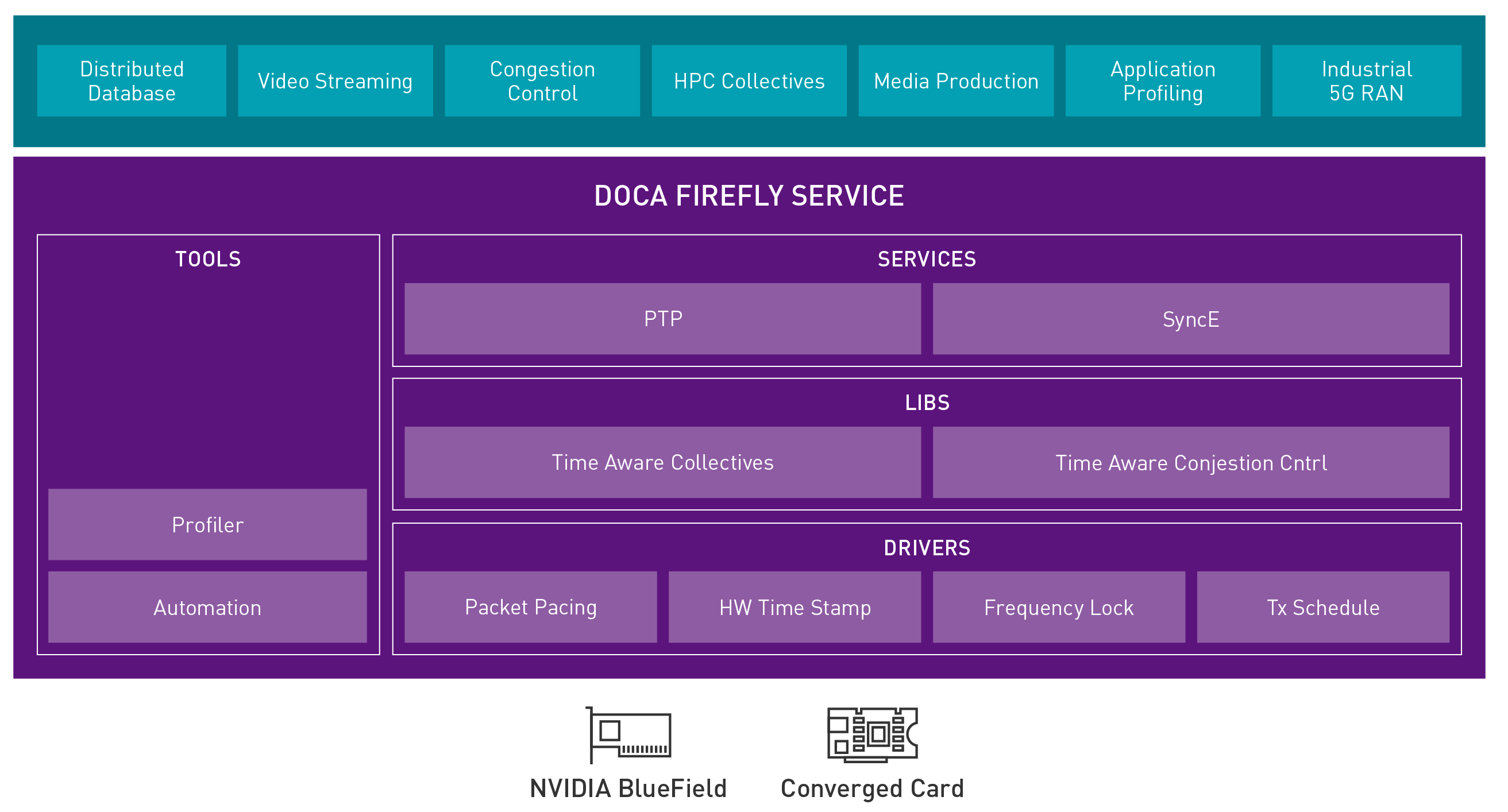
Precision timing is a critical capability to enable and accelerate distributed apps from edge to core. DOCA Firefly is a data center timing service that supports extremely precise time synchronization everywhere. With nanosecond-level clock synchronization, you can enable a new broad range of timing-critical and delay-sensitive applications.
Figure 2. Precision time-synchronized data center service
DOCA Firefly addresses a wide range of use cases, including the following:
High-frequency trading
Distributed databases
Industrial 5G radio access networks (RAN)
Scientific research
High performance computing (HPC)
Omniverse digital twins
Gaming
AR/VR
Autonomous vehicles
Security
It enables data consistency, accurate event ordering, and causality analysis, such as ensuring the correct sequencing of stock market transactions and fair bidding during digital auctions. The hardware engines in the BlueField application-specific integrated circuit (ASIC) are capable of time-stamping data packets at full wire speed with breakthrough nanosecond-level accuracy.
Improving the accuracy of data center timing by orders of magnitude offers many advantages.
With globally synchronized data centers, you can accelerate distributed applications and data analysis including AI, HPC, professional media production, telco virtual network functions, and precise event monitoring. All the servers in the data center—or across data centers—can be harmonized to provide something that is far bigger than any single compute node.
The benefits of improving data center timing accuracy include a reduction in the amount of compute power and network traffic needed to replicate and validate the data. For example, Firefly synchronization delivers a 3x database performance gain to distributed databases.
DOCA HBN beta
The BlueField DPU is a unique solution for network acceleration and policy enforcement within an endpoint host. At the same time, BlueField provides an administrative and software demarcation between the host operating system and functions running on the DPU.
With DOCA host-based networking (HBN), top-of-rack (TOR) network configuration can extend down to the DPU, enabling network administrators to own DPU configuration and management while application management can be handled separately by x86 host administrators. This creates an unparalleled opportunity to reimagine how you can build data center networks.
DOCA 1.2 provides a new driver for HBN called Netlink to DOCA (nl2doca) that accelerates and offloads traditional Linux Netlink messages. nl2doca is provided as an acceleration driver integrated as part of the HBN service container. You can now accelerate host networking for L2 and L3 that relies on DPDK, OVS, or now kernel routing with Netlink.
NVIDIA is adding support for the open-source Free Range Routing (FRR) project, running on the DPU and leveraging this new nl2doca driver. This support enables the DPU to operate exactly like a TOR switch plus additional benefits. FRR on the DPU enables EVPN networks to move directly into the host, providing layer 2 (VLAN) extension and layer 3 (VRF) tenant isolation.
HBN on the DPU can manage and monitor traffic between VMs or containers on the same node. It can also analyze and encrypt or decrypt then analyze traffic to and from the node, both tasks that no ToR switch can perform. You can build your own Amazon VPC-like solution in your private cloud for containerized, virtual machine, and bare metal workloads.
HBN with BlueField DPUs revolutionizes how you build data center networks. It offers the following benefits:
Plug-and-play servers: Leveraging FRR’s BGP unnumbered, servers can be directly connected to the network with no need to coordinate server-to-switch configurations. No need for MLAG, bonding, or NIC teaming.
Open, interoperable multi-tenancy: EVPN enables server-to-server or server-to-switch overlays. This provides multi-tenant solutions for bare metal, closed appliances, or any hypervisor solution, regardless of the underlay networking vendor. EVPN provides distributed overlay configuration, while eliminating the need for costly, proprietary, centralized SDN controllers.
Secure network management: The BlueField DPU provides an isolated environment for network policy configuration and enforcement. There are no software or dependencies on the host.
Enabling advanced HCI and storage networking: BlueField provides a simple method for HCI and storage partners to solve current network challenges for multi-tenant and hybrid cloud solutions, regardless of the hypervisor.
Flexible network offloading: The nl2doca driver provided by HBN enables any netlink capable application to offload and accelerate kernel based networking without the complexities of traditional DPDK libraries.
Simplification of TOR switch requirements: More intelligence is placed on the DPU within the server, reducing the complexity of the TOR switch.
Additional DOCA 1.2 SDK updates:
DOCA FLOW – Firewall (Alpha)
DOCA FLOW – Gateway (Beta)
DOCA FLOW remote APIs
DOCA 1.2 includes enhancements and scale for IPsec and TLS
DLI course: Introduction to DOCA for the BlueField DPU
In addition, NVIDIA is introducing a Deep Learning Institute (DLI) course: Introduction to DOCA for the BlueField DPU. The main objective of this course is to provide students, including developers, researchers, and system administrators, with an introduction to DOCA and BlueField DPUs. This enables students to successfully work with DOCA to create accelerated applications and services powered by BlueField DPUs.
Try DOCA today
You can experience DOCA today with the DOCA software, which includes DOCA SDK and runtime accelerated libraries for networking, storage, and security. The libraries help you program your data center infrastructure running on the DPU.
The DOCA Early Access program is open now for applications. To receive news and updates about DOCA or to become an early access member/partner, register on the DOCA Early Access page.
For more information, see the following resources:
Researchers create a neural network that automatically detects tectonic fault deformation, crucial to understanding and possibly predicting earthquake behavior.
Researchers at Los Alamos National Laboratory in New Mexico are working toward earthquake detection with a new machine learning algorithm capable of global monitoring. The study uses Interferometric Synthetic Aperture Radar (InSAR) satellite data to detect slow-slip earthquakes. The work will help scientists gain a deeper understanding of the interplay between slow and fast earthquakes, which could be key to making future predictions of quake events.
“Applying machine learning to InSAR data gives us a new way to understand the physics behind tectonic faults and earthquakes,” Bertrand Rouet-Leduc, a geophysicist in Los Alamos’ Geophysics group said in a press release. “That’s crucial to understanding the full spectrum of earthquake behavior.”
Discovered a couple of decades ago, slow earthquakes remain a bit of a mystery. They occur at the boundary between plates and can last from days to months without detection due to their slow and quiet nature.
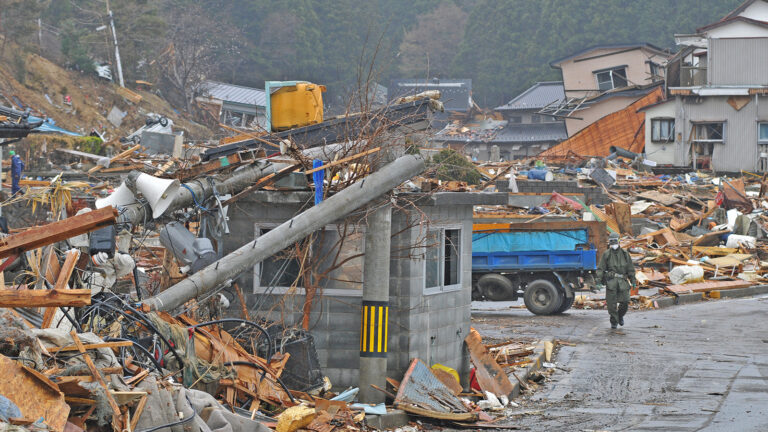
They typically happen in areas where faults are locked due to frictional resistance, and scientists believe they may precede major fast quakes. Japan’s 9.0 magnitude earthquake in 2011, which also caused a tsunami and the Fukushima nuclear disaster, followed two slow earthquakes along the Japan Trench.
Scientists can track earthquake behavior with InSAR satellite data. The radar waves have the benefit of penetrating clouds and also work effectively at night, making it possible to track ground deformation continuously. Comparing radar images over time, researchers can detect ground surface movement.
But these movements are small, and existing approaches limit ground deformation measurements to a few centimeters. Ongoing monitoring of global fault systems also creates massive data streams that are too much to interpret manually.
The researchers created deep learning models addressing both of these limitations. The team trained convolutional neural networks on several million time series of synthetic InSAR data to detect automatically and extract ground deformation.
Using cuDNN-accelerated TensorFlow deep learning framework distributed over multiple NVIDIA GPUs, the new methodology operates without prior knowledge of a fault’s location or slip behavior.
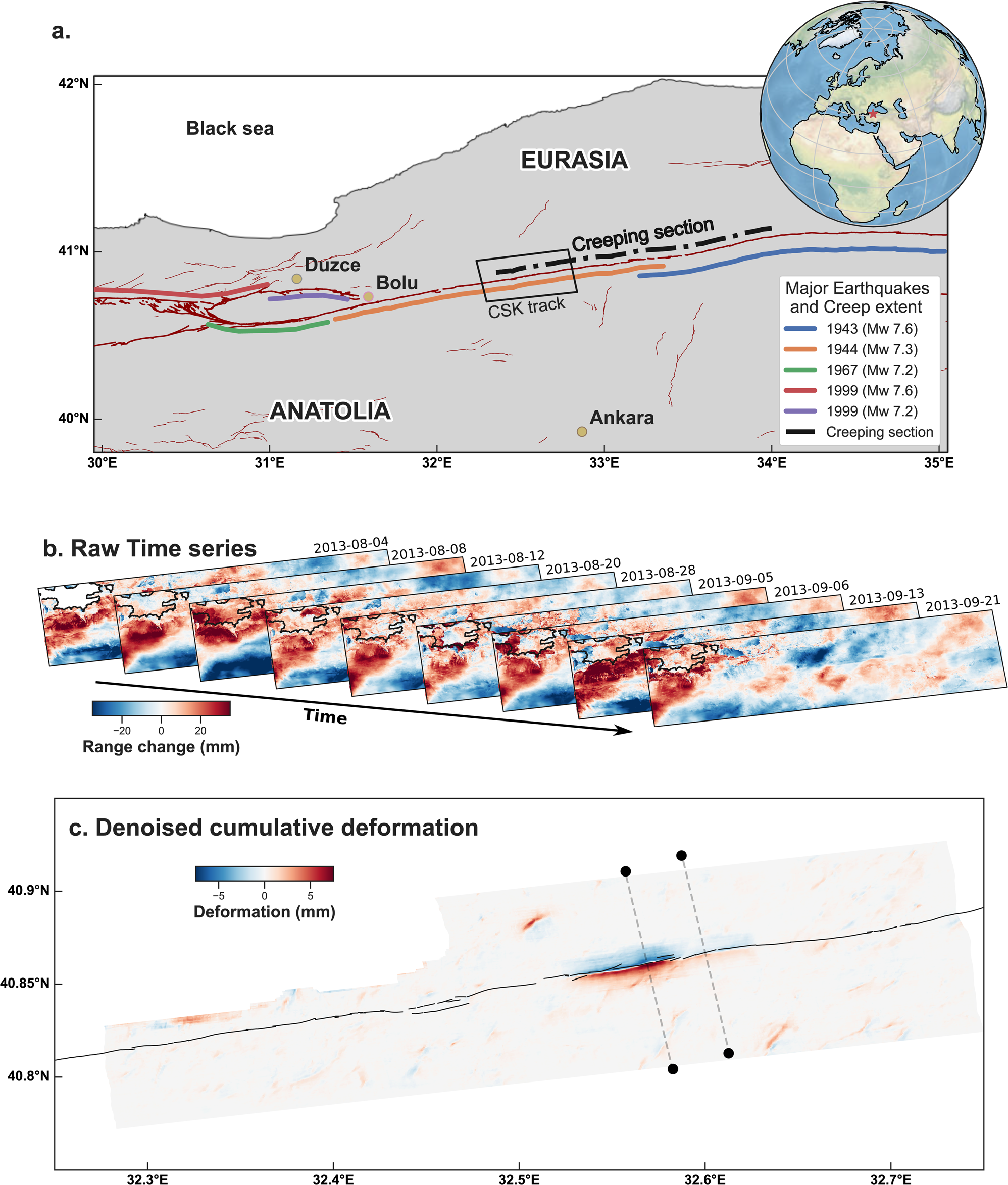
Figure 1. Application to real data shows the North Anatolian Fault 2013 slow earthquake.
To test their approach, they applied the algorithm to a time series built from images of the North Anatolian fault in Turkey. As a major plate boundary fault, the area has ruptured several times in the past century.
With a finer temporal resolution, the algorithm identified previously undetected slippage events, showing that slow earthquakes happen much more often than expected. It also spotted movement as small as two millimeters, something experts would have overlooked due to the subtlety.
“The use of deep learning unlocks the detection on faults of deformation events an order of magnitude smaller than previously achieved manually. Observing many more slow slip events may, in turn, unveil their interaction with regular, dynamic earthquakes, including the potential nucleation of earthquakes with slow deformation,” Rouet-Leduc said.
The team is currently working on a follow-up study, testing a model on the San Andreas Fault that extends roughly 750 miles through California. According to Rouet-Leduc, the model will soon be available on GitHub.

 GPU Operator 1.9 includes support NVIDIA DGX A100 systems with DGX OS and streamlined installation processes.
  At the forefront of AI innovation, NVIDIA continues to push the boundaries of technology in machine learning, self-driving cars, robotics, graphics, and more.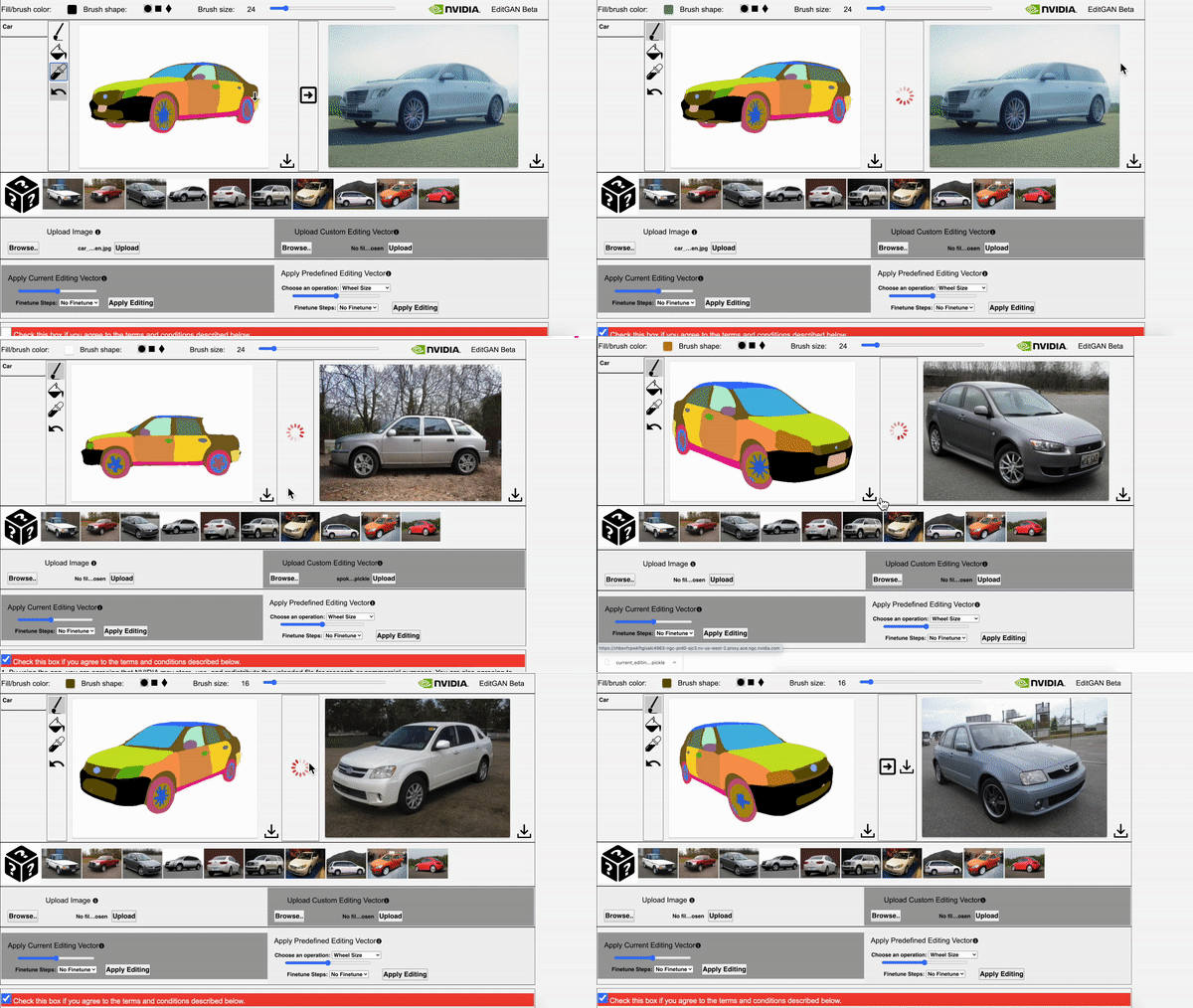
 Dive deep into the new features and use cases available for networking, security, storage in the latest release of the DOCA software framework.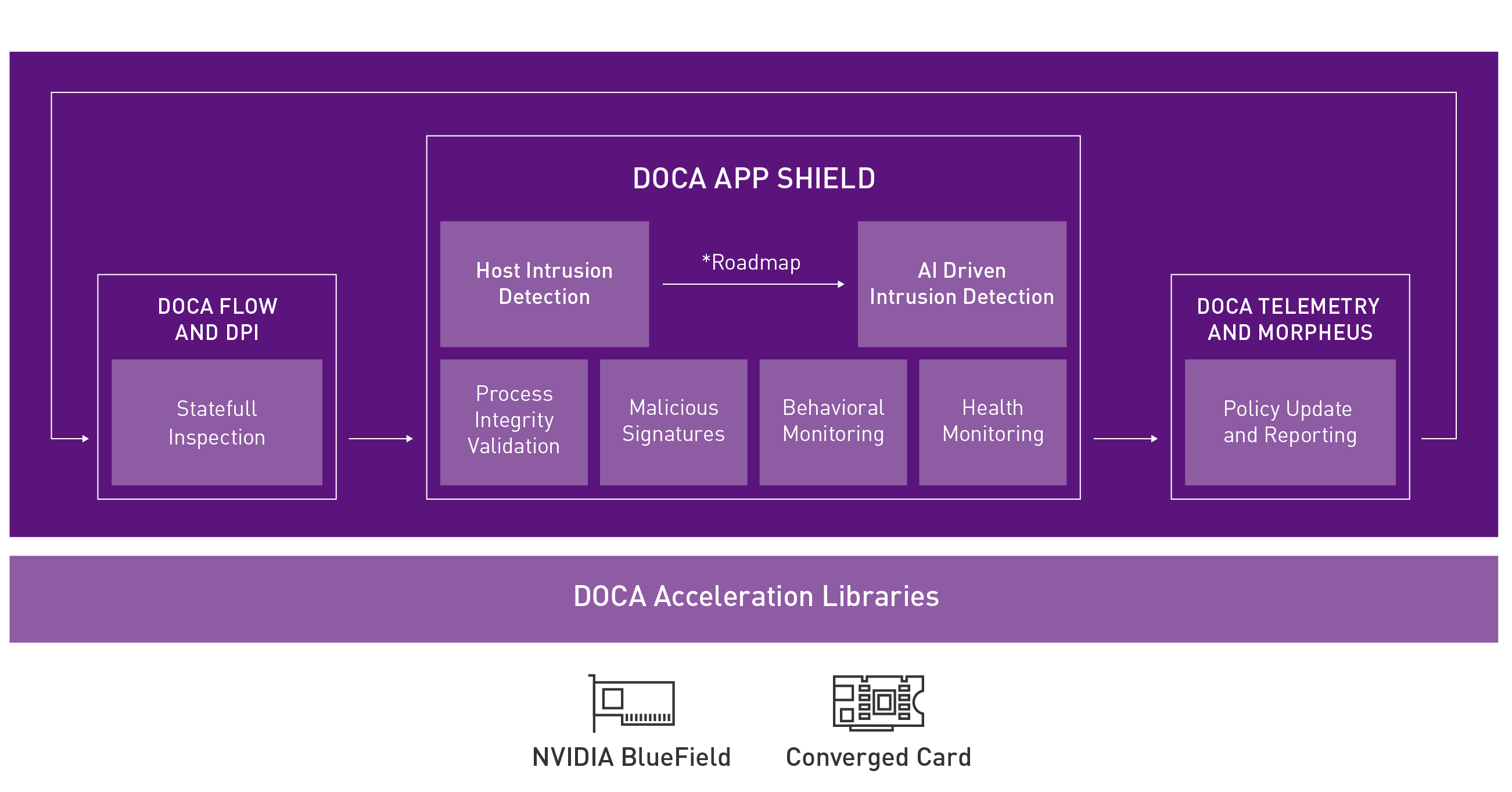
 Researchers create a neural network that automatically detects tectonic fault deformation, crucial to understanding and possibly predicting earthquake behavior.