Categories
Misc

Close Knowledge Gaps and Elevate Training with Digital Twin NVIDIA Air

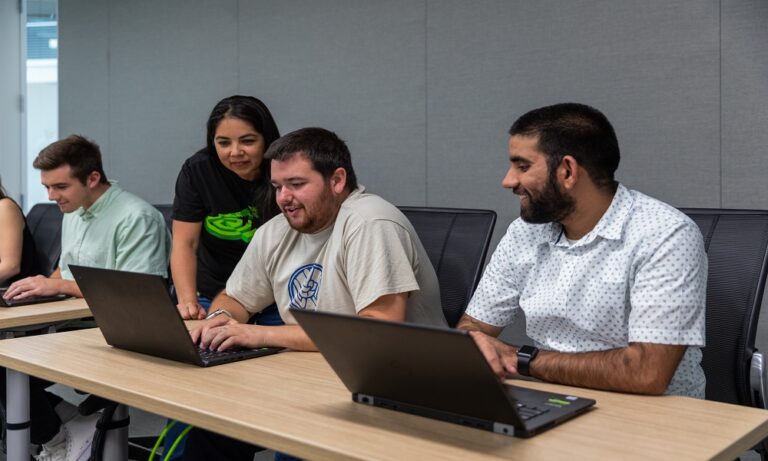
4 people sitting around laptops in an office.Learn about the NVIDIA Air platform, a fully functional digital twin of a production environment.4 people sitting around laptops in an office.

Training resources are always a challenge for IT departments. There is a fine line between letting new team members do more without supervision and keeping the lights on by making sure no mistakes are made in the production environment. Leaning towards the latter method and limiting new team members’ access to production deployments may lead to knowledge gaps. How can new team members learn if they never get time on the network?

To close the knowledge gaps, IT teams can leverage a networking digital twin. A digital twin provides a fully functional replica of a production deployment, so each member of the team can learn in a safe and sandboxed environment. A digital twin eliminates the risk of making mistakes that could materially impact the business. Changes can be implemented and validated in a sandbox environment before pushing any changes to production, providing a new level of confidence.

Train with NVIDIA Air

NVIDIA has such an offering with the Air Infrastructure Simulation Platform (Air). The program supports organizations training their staff by leveraging a digital twin approach and providing a full production experience for all team members. With everyone able to contribute (either by training in Air or working directly in production), IT departments can use staff more effectively and boost operational efficiency. 

With the use of NVIDIA Air, IT teams give team members their own replica of the production environment on which to learn. No more waiting for hardware resources to be racked and stacked, or balancing limited lab time across multiple users. Staff can use the platform for free, build an exact network digital twin, validate configurations, confirm security policies, and test CI/CD pipelines. In addition to CLI access, the platform provides full software functionality and access to the core system components such as Docker containers and APIs. 

This allows less-skilled team members to be an integral part of the network operation, helping them to catch up with the team’s experience, enhance the sense of belonging within the team, and gain confidence to work on production when the time is right. 

Get Started

Air is free to use and easy to work with. Build your own digital twin today, and help your team to learn the production environment, practice procedures, and test changes without introducing risk.

Categories
Misc

Gordon Bell Finalists Fight COVID, Advance Science With NVIDIA Technologies

Two simulations of a billion atoms, two fresh insights into how the SARS-CoV-2 virus works, and a new AI model to speed drug discovery. Those are results from finalists for Gordon Bell awards, considered a Nobel prize in high performance computing. They used AI, accelerated computing or both to advance science with NVIDIA’s technologies. A Read article >

The post Gordon Bell Finalists Fight COVID, Advance Science With NVIDIA Technologies appeared first on The Official NVIDIA Blog.

Categories
Misc

Universities Expand Research Horizons with NVIDIA Systems, Networks

Just as the Dallas/Fort Worth airport became a hub for travelers crisscrossing America, the north Texas region will be a gateway to AI if folks at Southern Methodist University have their way. SMU is installing an NVIDIA DGX SuperPOD, an accelerated supercomputer it expects will power projects in machine learning for its sprawling metro community Read article >

The post Universities Expand Research Horizons with NVIDIA Systems, Networks appeared first on The Official NVIDIA Blog.

Categories
Misc

Siemens Energy Taps NVIDIA to Develop Industrial Digital Twin of Power Plant in Omniverse

Siemens Energy, a leading supplier of power plant technology in the trillion-dollar worldwide energy market, is relying on the NVIDIA Omniverse platform to create digital twins to support predictive maintenance of power plants. In doing so, Siemens Energy joins a wave of companies across various industries that are using digital twins to enhance their operations. Read article >

The post Siemens Energy Taps NVIDIA to Develop Industrial Digital Twin of Power Plant in Omniverse appeared first on The Official NVIDIA Blog.

Categories
Misc

Atos and NVIDIA to Advance Climate and Healthcare Research With Exascale Computing

Atos and NVIDIA today announced the Excellence AI Lab (EXAIL), which brings together scientists and researchers to help advance European computing technologies, education and research.

Categories
Misc

Training Object Detection Model for Tensorflow Lite on Raspberry Pi

I have succesfully setup Tensorflow Lite object detection on my Raspberry Pi 3b+, I have tested it on some google sample models and can confirm it works properly.

I am looking to create my own custom Object Detection model and I am looking for the absolute easiest way to do this (preferably on Ubuntu but can use Windows). Does anyone have any good methos or tutorials. I have tried a couple Github tutorials as well as the Tensorflow Lite Model maker Colab with no luck.

Has anyone used any of these tools or have any experience/advice for training my own Tensorflow Lite Object detection Model for my Pi.

submitted by /u/MattDlr4
[visit reddit] [comments]

Categories
Misc

`ValueError: Data cardinality is ambiguous: ` after running `model.fit`

submitted by /u/Guacamole_is_good
[visit reddit] [comments]

Categories
Misc

Input pipeline performances

Hi Reddit

I’m comparing 2 input pipelines. One is built using tf.keras.utils.image_dataset_from_directory and the other build “manually” by reading files from a list using tf.data.Dataset.from_tensor_slices. My first intuition was that the tf.data.Dataset.from_tensor_slices should be faster, as demonstrated here.

But this is not the case. The image_dataset_from_directory is approximatively x6 time faster for batches of 32 to 128 images. Similar performance factor on Collab and on my local machine (run from PyCharm).

So far, I tried to avoid the “zip” of two dataset by having a read_image to output both the image and the label at once. Did not change anything.

Can you help me to build a decent input pipeline with tf.data.Dataset.from_tensor_slices. I would like to work with a huge dataset to train a GAN, and I do not want to loose time with the data loading. Did I code something wrong or are the test from here outdated ?

To be pragmatic, I will use the fastest approach. But as an exercise, I would like to know if my input pipeline wiht tf.data.Dataset.from_tensor_slices is ok.

Here are the code. data_augmentation_train is a sequential network (same in both approaches)

================================= Approach n°1: tf.keras.utils.image_dataset_from_directory ================================= AUTOTUNE = tf.data.AUTOTUNE train_ds = tf.keras.utils.image_dataset_from_directory( trainFolder, validation_split=0.2, subset="training", seed=123, image_size=(img_height, img_width), batch_size=batch_size) class_names = train_ds.class_names print(class_names) train_ds = train_ds.cache() train_ds = train_ds.shuffle(1000) train_ds = train_ds.map(lambda x, y: (data_augmentation_train(x, training=True), y), num_parallel_calls=AUTOTUNE) train_ds.prefetch(buffer_size=AUTOTUNE) 

======================================= Approach n°2:tf.data.Dataset.from_tensor_slices ======================================= def read_image(filename): image = tf.io.read_file(filename) image = tf.image.decode_jpeg(image, channels=3) image = tf.image.resize(image, [img_height, img_width]) return image def configure_dataset(filenames, labels, augmentation=False): dsfilename = tf.data.Dataset.from_tensor_slices(filenames) dsfile = dsfilename.map(read_image, num_parallel_calls=AUTOTUNE) if augmentation: dsfile = dsfile.map(lambda x: data_augmentation(x, training=True)) dslabels=tf.data.Dataset.from_tensor_slices(labels) ds = tf.data.Dataset.zip((dsfile,dslabels)) ds = ds.shuffle(buffer_size=1000) ds = ds.batch(batch_size) ds = ds.prefetch(buffer_size=AUTOTUNE) return ds filenames, labels, class_names = readFilesAndLabels(trainFolder) ds = configure_dataset(filenames, labels, augmentation=True) 

submitted by /u/seb59
[visit reddit] [comments]

Categories
Misc

NVIDIA to Build Earth-2 Supercomputer to See Our Future

The earth is warming. The past seven years are on track to be the seven warmest on record. The emissions of greenhouse gases from human activities are responsible for approximately 1.1°C of average warming since the period 1850-1900. What we’re experiencing is very different from the global average. We experience extreme weather — historic droughts, Read article >

The post NVIDIA to Build Earth-2 Supercomputer to See Our Future appeared first on The Official NVIDIA Blog.

Categories
Misc

NVIDIA Omniverse Enterprise Delivers the Future of 3D Design and Real-Time Collaboration

For millions of professionals around the world, 3D workflows are essential. Everything they build, from cars to products to buildings, must first be designed or simulated in a virtual world. At the same time, more organizations are tackling complex designs while adjusting to a hybrid work environment. As a result, design teams need a solution Read article >

The post NVIDIA Omniverse Enterprise Delivers the Future of 3D Design and Real-Time Collaboration appeared first on The Official NVIDIA Blog.