Categories
Misc

AI in the Sky: NVIDIA GPUs Help Researchers Remove Clouds from Satellite Images

Satellite images can be a fantastic civil engineering tool — at least when clouds don’t get in the way.  Now researchers at Osaka University have shown how to use GPU-accelerated deep learning to remove these clouds.  The scientists from the university’s Division of Sustainable Energy and Environmental Engineering used a “generative adversarial network” or GAN.  Read article >

The post AI in the Sky: NVIDIA GPUs Help Researchers Remove Clouds from Satellite Images appeared first on The Official NVIDIA Blog.

Categories
Misc

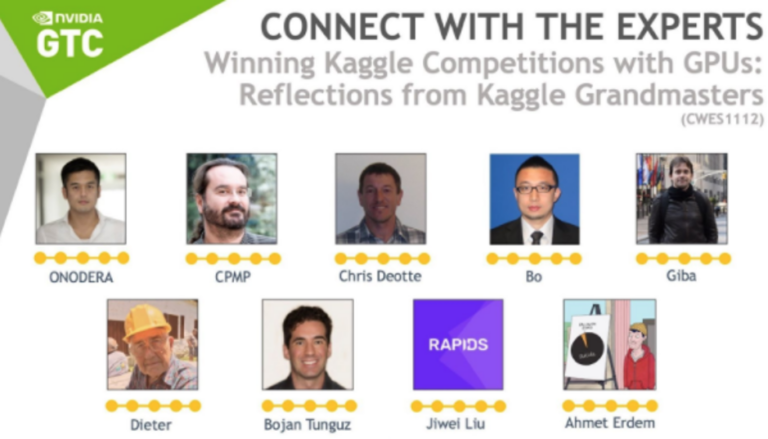
Competition and Community Insights from NVIDIA’s Kaggle Grandmasters

In this post, we summarize questions and answers from GTC sessions with NVIDIA’s Kaggle Grandmaster team.  Additionally, we answer audience questions we did not get a chance during these sessions. Q: How do you decide which competitions to join? Ahmet: I read the competition description and evaluation metric. Then I give myself several days to … Continued

In this post, we summarize questions and answers from GTC sessions with NVIDIA’s Kaggle Grandmaster team.  Additionally, we answer audience questions we did not get a chance during these sessions.

Q: How do you decide which competitions to join?

Ahmet: I read the competition description and evaluation metric. Then I give myself several days to think about if I have any novel ideas that I can try on. If I do not have any interesting ideas, then I do not join. But sometimes I just join for learning and improving my skills.

Q: Is mathematics mandatory for winning a competition?

Kazuki: Not mandatory, but you may want to understand the competition metric and how machine learning models work. For example, the linear model and tree model are totally different. So those would generate good results when ensembling.

Q: How do you approach a competition?

Bojan: On the first day, I always submit a sample so that I am on the leaderboard. Traditionally, I have not been very big on data analysis or EDA, which is one of my weaknesses. But recently, I started doing more and changing my approach.

One thing I always do is see how easy it is to ensemble different models in a competition. This dictates my strategy in the long run. If ensembling slightly different models can give a nice boost, it means that building many diverse models is important. However, if ensembling does not give you a big boost, then feature engineering or coming up with creative features is more important in the long run.

One of the strategies is to try to improve a single model as much as you can, and only ensemble once you are satisfied with it.

Jean-Francois: It is a good idea to read what people share in the forum in every competition. This means to read what the host writes, including comments. And to read top solutions in similar recent competitions. Surprisingly, some competitions are won by models that are publicly shared from previous competitions and adapted to the new one. People do not read enough. You can also try to find papers on the topic, especially for science competitions where there are often relevant papers.

Giba: Download the data and run some EDA. Get insights about feature and target distribution in order to find the best validation strategy. Random KFold is usually good for most of the problems, but usually it is necessary to groupedKFold or time split Kfold. Once you find the best validation strategy, run a simple model using it and submit to check the leaderboard score. Usually this is the most important thing in a competition, all metric improvements made locally should be translated to Kaggle leaderboard if validation is robust and made correctly. After that you must work on feature engineering and build a diverse set of models with different dataset and training algorithms. Usually, an ensemble of a model trained with ANN and a GBDT is good enough to rank high in LB. Search for target leakage is unfortunately part of Kaggle competition.

Q: Which deep learning framework would you recommend starting with?

Jean-Francois: I think the best one is Keras because it is very abstract. You can build rather complex models and train them in a few lines of code. Then you may want to move to PyTorch or TensorFlow for two reasons: to have better control of your models and customize your layers as well as the ability to reuse pretrained models. For that, I have the impression that PyTorch is taking the lead. What we do on Kaggle is mostly model prototyping. Maybe today, TensorFlow is better at model deployment, but it is not relevant at Kaggle.

Jiwei: I would add that PyTorch Lightning is a user-friendly package based on PyTorch, especially for new users. It abstracts the details of training and provides convenient APIs for advanced features such as Multi-GPU, TPU, and mixed precision.

Audience poll showed that 66% preferred PyTorch and 31% preferred TensorFlow.

Q: How do you prevent overfitting when using pseudo-labeling? Is it okay to use that strategy with an ensemble?

Bo: In the recent RANZCR competition, our team won using both pseudo-labeling and ensemble. It’s ok to use both, but you should be very careful doing so in order to prevent overfitting.

  • First, you want to split the original data into five folds and split external data into five folds. In both stages, there will be five models.
  • In Stage 1, train the model on the original data, and do inference on the external data to have external data prediction. Do this five times.
  • In Stage 2, combine the original data (with original labels) and external data (with Stage 1 predictions as pseudo labels) and train the models again.

The important thing is, when we make pseudo labels, we want to make five copies of the pseudo labels. For Stage 2’s fold0 model (trained on combined fold1,2,3,4 and validated on combined fold0), we want to make sure it never had fold0’s information, so the pseudo labels used for this model need to come from Stage 1’s fold0 model (train on original fold1,2,3,4). This way you will never have any leakage.

It is ok to use ensemble together with pseudo-labeling. In the RANZCR competition, we used ensembles in both stages.

Chris: pseudo-labeling is one of the things that I specifically learned at Kaggle because none of the books I had read talked about it. Kaggle is a great place to learn practical tricks like pseudo-labeling.

Q: What are commonly used post-processing techniques?  How can I improve my score on multi-label classification problems?

Chris: I’ll take a first stab at this. Recently a Kaggler has called me the Post-processing Grandmaster because I just got my fifth gold medal specifically using post-processing. It was a solo gold medal. [The criteria for competition grandmaster are five gold medals including at least one solo gold medal.] I will share a few secrets.

The first thing is to study the competition metric. Some metrics are called the ranking metrics (like AUC). For these metrics, the absolute predicted values do not matter. Only the relative orders matter. For a multi-label classification problem, the first thing to ask is whether the predictions are ranked per label, or altogether. In the recent Rainforest competition where we predict animal sounds in rainforests, all the predictions are ranked across labels. So it is important that the model knows which animals are common and which are rare.

Other types of metrics are based on mean values, like Mean Squared Error. If the test data have different mean than the training data, shifting the predictions can improve the metrics.

For metrics like recall and precision, you should know their meanings. Always know your metrics. Each metric requires you to do different things and apply different post-processing. Personally, I really enjoy doing this. I come from a mathematical background. Metrics are mathematical equations and I like to think about what is important to optimize.

Bo: I’d like to add one thing. If the metric is log loss, sometimes it helps to clip extreme values. Models can make confident predictions with values close to 0 or 1, but if there are label errors, the penalty by log loss can be huge. So, it may be a good idea to clip the predictions at 0.01/0.99 or 0.02/0.98. But always find the optimal clip thresholds in local validation.

Q: How can explainability be used when working with deep learning ensembles?

Christof: I would say, that strongly depends on the ensemble method. I often use a simple average of single models. So, if single models are explainable, so probably is the ensemble as a simple combination of them. But on the other hand, I agree, that ensembles introduce another aspect to explain, like why specific models contribute more to the ensemble than others despite a mediocre individual performance.

Q: How do you do the hyperparameter optimization, feature engineering and feature selection cycle in practice?

Chris: Personally, I do not spend too much time optimizing hyperparameters. I will explore the important parameters when building XGB or NN models. (For example, I will adjust max_depth, subsample, and colsample_bytree with XGB. And loss, learning rate and scheduler with NN). But when trying to improve models, I will spend more time exploring feature engineering with XGB and data augmentation, architecture design, and/or TTA with NN.

Q: How can you get the best performance out of a Neural Network?

Jean-Francois: Work on data pre-processing (including augmentations) and post-processing. Newcomers often focus too much on hyperparameter tuning or choice of optimizer.  I almost always stick to Adam with a cosine learning schedule.

Jiwei: Multi-head multi-loss function is another common trick to improve the performance of NN. It works as a way of regularization.

Bo: I want to point to this great post by Andrej Karpathy where he shared many NN tricks: http://karpathy.github.io/2019/04/25/recipe/

Q: What is the best way to learn from Kaggle as a beginner?

Bojan: Check out the notebooks that people post, read topics that are being discussed, and try running models that are shared and improve them using the ideas that are discussed. These are the few steps that can get you pretty far in your machine learning skills, if not your Kaggle performance.

Bo: A good way for beginners to get started is to team up. Of course, this depends on personality. Some people prefer working alone, like bestfitting. But for many people I think teaming up is a good way to learn because different people have different skill sets. They can often complement each other. You can always pick up a thing or two from each teammate. Of course you need to do some work before requesting a team merge. Do not ask people on top of the leaderboard to team up with you without doing much. Try to ask people who are close to your leaderboard position.

Chris: I concur. I did many solo competitions, but recently I have been doing more teaming up. In every single team-up, I learned stuff. Even if it is as simple as watching how people organize their code, or what computer language they are using. It can just be learning how they approach the problem, or how they set up their experiments. There is just so much to learn when working with someone else that can help you become a better data scientist.

Jean-Francois: Do not be shy. Just jump into the water. You will learn how to swim. There is one last thing I recommend. When you join Kaggle, you are asked to create a user name. You can use an alias if you are afraid your friends or colleagues see you struggle when you begin. That is what I did. I only disclosed my real name once I became comfortable. So just sign up, choose a pseudonym, learn, and try. After a competition, do not just go to the next one. Read what people share. Try to think about what you could have done better, why you could have thought of this cool idea you just read. The few days after a competition end is when you will learn the most.

Q: Do you recommend building your own machine or buying a pre-built system for deep learning?

Jean-Francois: Building is often cheaper, but it requires more skills and time.  If you have both then build your gear.  There are shops that will build custom PCs to your configuration for you. I personally did not have the time and skills and bought a custom-made PC with a GTX 1080 Ti and was very happy with it.  Nowadays, you can find PCs, including laptops, with good GPU from major PC makers.

Jiwei: Another option is an external GPU box. I used to train deep learning models on a laptop, which connected to an external GPU box with a desktop level GPU card.

Q: What do you enjoy the most about Kaggle?

Chris: The community. Kaggle is a unique place to meet great quality data scientists where you cannot elsewhere.

Jean-Francois: Kaggle is definitely the place to go if you want to know the state-of-the-art in modeling actual problems using machine learning.  And it is addictive.

Jiwei: To learn new algorithms, new modeling techniques in practice. I find myself more motivated and focused when I can apply new models from papers to solve real-world problems.

Bo: Reading top solution posted by Kagglers after each competition. Every time I can learn some new tricks.

Bojan: It is an amazing platform for learning. I do not think there is any other platform where you can learn as much and as quickly as on Kaggle.

Giba: The ability to work on the most diverse problems, and at the same time to learn and apply the state-of-the-art algorithms to solve them.

Kazuki: I enjoy getting knowledge which I’m interested in.

Christof: To solve very complex problems and come up with innovative solutions.

Ahmet: I enjoy Kaggle’s problem diversity, and I enjoy climbing the leaderboard.

Categories
Misc

Upcoming Webinar: Introduction to Building Conversational AI Applications

Join the Emerging Chapters Educational Series webinar on conversational AI concepts and building efficient pipelines.
NVIDIA is hosting a webinar with live Q&A at 10 am PDT on Oct. 14 as a part of the Emerging Chapters Educational Series. 

This technical session is open to anyone looking to learn beginner and intermediate level concepts and applications that show how to build efficient conversational AI pipelines.  

Highlights Include:

  1. Building conversational AI apps and services using NVIDIA TAO and open-source toolkits such as NeMo 
  2. Deploying apps using NVIDIA RIVA 
  3. Machine translation demos 

Register now >>

Categories
Misc

Doing the Math: Michigan Team Cracks the Code for Subatomic Insights

In record time, Vikram Gavini’s lab crossed a big milestone in viewing tiny things. The three-person team at the University of Michigan crafted a program that uses complex math to peer deep into the world of the atom. It could advance many fields of science, as well as the design for everything from lighter cars Read article >

The post Doing the Math: Michigan Team Cracks the Code for Subatomic Insights appeared first on The Official NVIDIA Blog.

Categories
Misc

Teamwork Makes the Dream Work: GFN Thursday Celebrates Team17 Titles Streaming From the Cloud

GFN Thursday is all about bringing games powered by GeForce NOW’s GPUs in the cloud to gamers. Today, that spotlight shines on Team17, the prolific publisher behind many games in the GeForce NOW library. The party gets started with their newest release, a day-and-date launch of Sheltered 2, streaming on the cloud alongside the 12 Read article >

The post Teamwork Makes the Dream Work: GFN Thursday Celebrates Team17 Titles Streaming From the Cloud appeared first on The Official NVIDIA Blog.

Categories
Misc

Removing TensorFlow filters

With Python 3.8 and TensorFlow 2.5, my objective is to remove filters/kernels having lowest L2 norms. Sample code for this is:

 # Generate random 1 image/data point sample- x = tf.random.normal(shape = (1, 5, 5, 3), mean = 1.0, stddev = 0.5) x.shape # TensorShape([1, 5, 5, 3]) # Create conv layer- conv = Conv2D( filters = 3, kernel_size = (3, 3), activation='relu', kernel_initializer = tf.initializers.GlorotNormal(), bias_initializer = tf.ones_initializer, strides = (1, 1), padding = 'same', ) # Pass input through conv layer- out = conv(x) out.shape # TensorShape([1, 5, 5, 3]) out = tf.squeeze(out) out.shape # TensorShape([5, 5, 3]) 

According to my understanding, the output consists of three (5, 5) matrices stacked together. However, printing ‘out’ shows five (5, 3) matrices stacked together:

 out.numpy() ''' array([[[1.45877 , 0. , 1.9293344 ], [0.9910869 , 0.01100129, 1.7364411 ], [1.8199034 , 0. , 1.3457474 ], [1.219409 , 0.22021294, 0.62214017], [0.5572515 , 0.7246016 , 0.6772853 ]], [[1.161148 , 0. , 2.0277915 ], [0.38071448, 0. , 2.2438798 ], [2.2897398 , 0.1658966 , 2.3147004 ], [1.2516301 , 0.14660472, 1.6381929 ], [1.1554463 , 0.72516847, 1.6170584 ]], [[0. , 0. , 1.2525308 ], [0.4337383 , 0. , 0.91200435], [0.71451795, 0. , 2.093022 ], [2.265062 , 0. , 2.7562256 ], [0.82517993, 0. , 1.8439718 ]], [[0.7089497 , 0. , 1.041831 ], [0. , 0. , 1.2754116 ], [0.41919613, 0. , 0.88135654], [0. , 0. , 0.71492153], [0.18725157, 0.27108306, 0.11248505]], [[0.86042166, 0.45840383, 1.084069 ], [0.53202367, 0.42414713, 1.2529668 ], [1.2257886 , 0.31592917, 1.3377004 ], [0.36588144, 0. , 0.6085663 ], [0.3065148 , 0.574654 , 1.0214479 ]]], dtype=float32) ''' 

So, if I use the code out[:, :, 0], out[:, :, 1] & out[:, :, 2], do they refer to the first, second and third filters?

And if yes, is computing L2-norm using:

 tf.norm(out, ord = 'euclidean', axis = (0, 1)).numpy() # array([5.275869 , 1.4290226, 7.545658 ], dtype=float32) 

the correct way?

submitted by /u/grid_world
[visit reddit] [comments]

Categories
Misc

Are there any unofficial slacks or chat rooms where people post questions to use tensorflow, especially federated tensorflow?

So, like the title says. Just wondering if there is anything like this. I know that StackOverflow has stuff like that, but rather ask on slack or something similar.

submitted by /u/Throooaway10
[visit reddit] [comments]

Categories
Misc

Proving Superior Cloud, AI, and Storage Performance with NVIDIA Spectrum-3 Switches

Independent IT lab The Tolly Group compared the cloud, AI, and storage performance of an NVIDIA Ethernet switch to the performance of a comparable switch built with commodity silicon.
Does the switch matter?

The network fabric is key to the performance of modern data centers. There are many requirements for data center switches, but the most basic is to provide equal amounts of bandwidth to all clients so that resources are shared evenly. Without fair networking, all workloads experience unpredictable performance due to throughput deterioration, delay, slow distributed workloads, and so on.

To answer the question of whether the switch matters, the Tolly Group benchmarked the cloud, AI, and storage workload performance of the NVIDIA Spectrum-3 12.8Tbps Switch. It compared the results to the performance of a typical (commodity) 12.8 Tbps data center switch, in an apples-to-apples comparison.

The Tolly Group

The Tolly Group, a third-party, independent IT industry lab, has been conducting performance tests and hands-on evaluations of IT products for more than 30 years. The Tolly Group is positioned to provide evidence that products meet or exceed marketing claims and they won’t produce reports that conflict with The Tolly Group’s Fair Testing Charter. This proof-of-performance lets customers know they can deploy with confidence.

Distributed workload performance (AI and SPARK)

Every switch has a buffer to prevent packet loss. The buffer also protects application performance by absorbing packet bursts whenever more traffic is sent into the switch than can be sent out of the switch. This is sometimes referred to as incast traffic patterns. Distributed workloads like AI and Spark, by their nature, are plagued by incast traffic patterns.

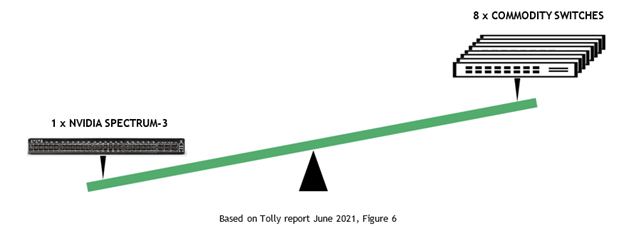
Both switches claimed identical buffer sizes on their datasheets. However, The Tolly Group found that NVIDIA Spectrum-3 was able to absorb 4-8x more packets than the typical data center switch. Eight commodity switches would be needed to provide the packet absorption capabilities equal to a Spectrum-3 switch.

You need eight commodity switches to provide the packet absorption capabilities equal to a Spectrum-3 switch.
Figure 1. NVIDIA Spectrum-3 and commodity silicon

Maximum absorption capability is important but not enough. It is crucial that the switch evenly absorbs the microburst from all senders, because slowing down one node slows down the entire cluster.

The Tolly Group found that Spectrum-3 evenly absorbed microburst traffic from all senders in all cases while the commodity switch slowed down multiple nodes, resulting in under-utilized compute resources.

Public and private cloud performance

The noisy neighbor problem crops up in public and private cloud environments, where multiple tenants use a shared resource, like CPU cycles or network bandwidth, and a “noisy neighbor” tenant shows up and hogs those resources.

The result of the noisy neighbor problem could be that one tenant can degrade the experience of another tenant due to the inadequate capability of the switch to isolate between them. A data center switch must protect tenants from the activities of other tenants, both from nefarious attacks as well as noisy neighbors.

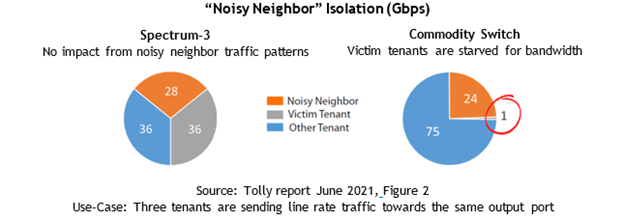
The Tolly Group found that the Spectrum-3 switch fully protected each tenant. The competitor switch failed to protect tenants, allowing the bandwidth of some tenants to be victimized and get fully starved by the traffic pattern of the noisy neighbor.

When scaling out multitenant environments, Spectrum-3 protected each tenant. However, the noisy neighbor problem-scale was way bigger with the commodity switch and can be expanded to half the total number of switch ports. In other words, up to 70 ports can be victimized and starved.

If a switch is not capable of protecting tenants from a noisy neighbor, that switch is not matching a basic requirement from a cloud fabric switch.

With Spectrum-3, there is no effect from noisy neighbor traffic patterns. With the commodity switch, victim tenants are starved for bandwidth.
Figure 2. Noisy neighbor isolation

(ALT: With Spectrum-3, there is no effect from noisy neighbor traffic patterns. With the commodity switch, victim tenants are starved for bandwidth.)

Storage performance

Today, most storage traffic in the data center runs on Ethernet. More specifically, storage typically uses 9-KB jumbo frames. As a result, this packet size has become more important than ever, and most every switch now supports a default packet size of 9 KB.

However, just because a typical data center switch supports 9-KB packets, doesn’t mean they are optimized for storage workloads. To measure and compare the storage performance levels of each switch, The Tolly Group used 9 KB packets with standard network test tools from IXIA.

The Tolly Group found that Spectrum-3 provided predictable and fair performance across all storage nodes in all cases. The commodity switch showed unfair traffic sharing with 9-KB packets, forcing one storage node to run 17x slower than the other storage nodes. These unpredictable results harshly affect storage performance.

This has real-world implications. Think about the time it takes to run a storage backup. What if your planned and expected 2-hour backup time starts taking 34 hours to complete?

Mixed application performance

Most data centers run many different applications, each with their own packet sizes. Even a single application uses a variety of packet sizes. Adding in control traffic patterns, you will probably end up encountering an even greater variety of packet sizes on your fabric.

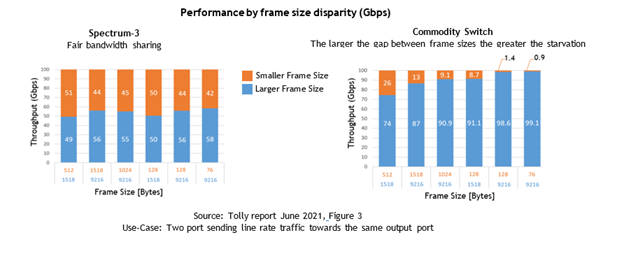
The Tolly Group found that Spectrum-3 provided fairness regardless of the packet size, while the commodity switch tended to starve applications that used smaller packet sizes. Even worse, as the difference in packet sizes increased, the worse it got for the smaller packets.

Spectrum-3 treats packets of different sizes equally by providing them equitable throughput. With the commodity switch, smaller packets suffer through uneven throughput distribution.
Figure 3. Performance by frame size disparity

For the commodity switch, mixed packet size starvation adversely affects the cloud, storage, and distributed workloads.

But why?

Architecture. Simple as that.

The Spectrum switches have a modern fully shared buffer architecture and flexible pipeline architecture that were designed to optimize data center application performance and security. For more information about the results, download the new Tolly Group Performance Evaluation report. It explains the architecture of Spectrum switches and commodity switches, along with their advantages and disadvantages.

Architecture is indeed a zero-sum game. However, unlike many other vendors, NVIDIA develops both the ASIC and the switch. As a result, we have managed to eliminate tradeoffs and provide the superior results that The Tolly Group has verified.

Learn more

The switch matters and it can make a huge difference, either leveraging your workloads or adversely affecting them. For more information, join the Tolly Report webinar, download the Tolly Group Performance Evaluation report, or see The Tolly Group website.

Categories
Misc

Introducing Profiling Enhancements with the Latest NVIDIA Nsight Systems

The latest update to NVIDIA Nsight Systems is now available and introduces several improvements aimed to enhance the profiling experience. 
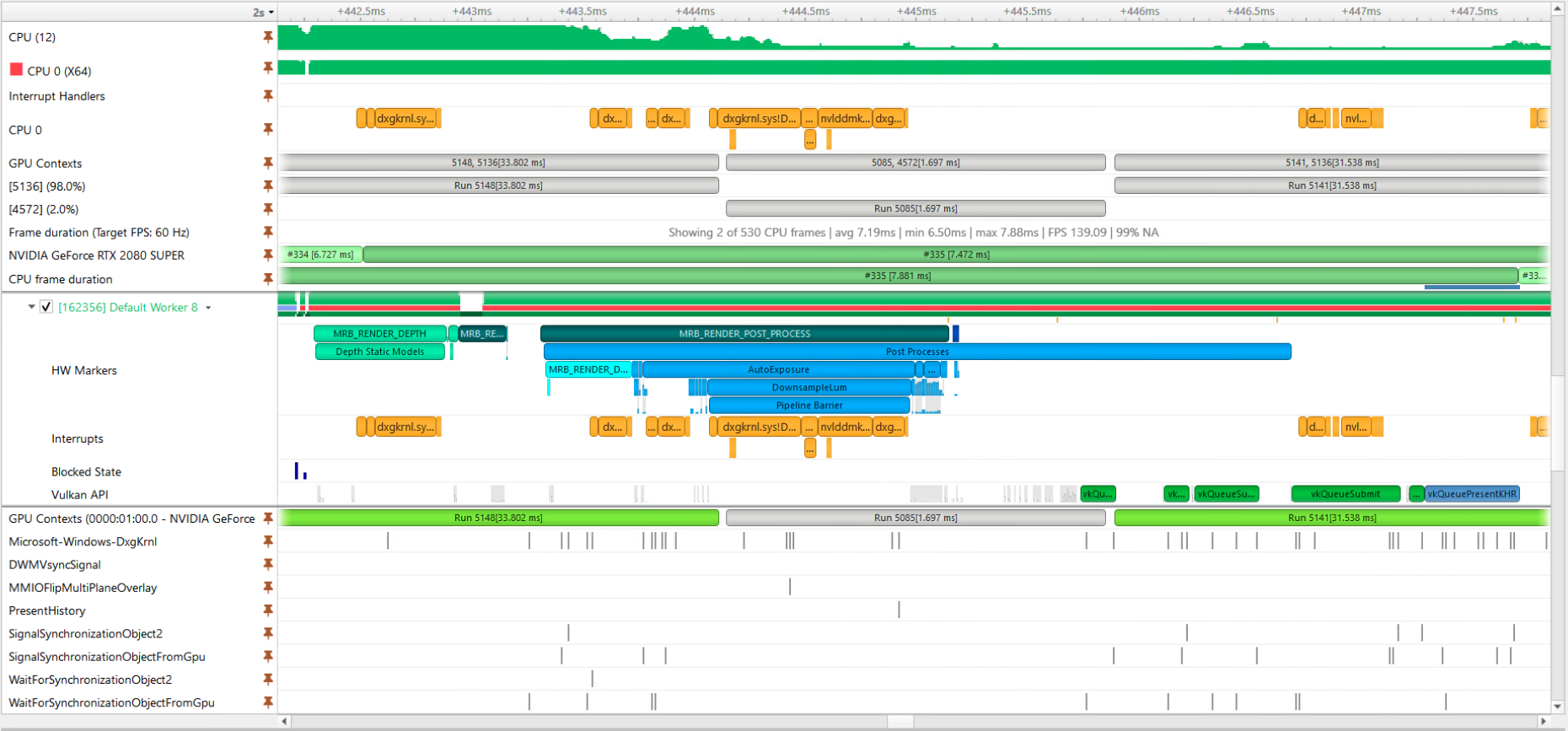
The latest update to NVIDIA Nsight Systems—a performance analysis tool—is now available for download. Designed to help developers tune and scale software across CPUs and GPUs, this release introduces several improvements aimed to enhance the profiling experience. 

Nsight Systems is part of the powerful debugging and profiling NVIDIA Nsight Tools suite. A developer can start with Nsight Systems for overall system view and avoid picking less efficient optimizations based on assumptions and false-positive indicators. 

2021.4 Highlights Include:

  • Windows ISRs and DPCs trace
  • Windows GPU hardware-based scheduling trace 
  • Windows Direct3D12 and Vulkan correlation to WDDM events
  • NVTX event categorization support – to enable viewing of categories in isolated rows
  • Multi-report loading for multinode, VM, container, rank, and process investigations

Nsight system 2021.4 added features to help users understand how timing of other range-based events are affected by the OS interruptions to better account for jitter in statistics or consider binding their processes and threads to core with less frequent ISR and DPC processing. 

Figure 1. Windows interrupt trace lets users see when the kernel is operating within your CPU thread. 

This release also added data capture that will help users understand when, where, and how deep packets are queued.

Figure 2. Improved graphics correlation allows users to explicitly follow API work submissions through WDDM queue packets and to their GPU workloads, rather than inferring it via timing.

More Information 

Categories
Misc

Furthering NVIDIA Performance Leadership with MLPerf Inference 1.1 Results

A look at NVIDIA inference performance as measured by the MLPerf Inference 1.1 benchmark. NVIDIA delivers leadership performance across all workloads and scenarios, and in an industry-first, has delivered results on an Arm-based server in the data center category. MLPerf Inference 1.1 tests performance and power efficiency across usages including computer vision, natural language processing and recommender systems.
AI continues to drive breakthrough innovation across industries, including consumer Internet, healthcare and life sciences, financial services, retail, manufacturing, and supercomputing. Researchers continue to push the boundaries of what’s possible with rapidly evolving models that are growing in size, complexity, and diversity. In addition, many of these complex, large-scale models need to deliver results in real time for AI-powered services like chatbots, digital assistants, and fraud detection to name a few.

Given the wide array of uses for AI inference, evaluating performance poses numerous challenges for developers and infrastructure managers. For AI inference on data center, edge, and mobile platforms, MLPerf Inference 1.1 is an industry-standard benchmark that measures performance across computer vision, medical imaging, natural language, and recommender systems. These benchmarks were developed by a consortium of AI industry leaders, providing the most comprehensive set of peer-reviewed performance data available today, both for AI training and inference.

To perform well on the wide array of tests in this benchmark requires a full-stack platform with great ecosystem support, both for frameworks and networks. NVIDIA was the only company to make submissions for all data center and edge tests and deliver leading performance across the board.

One of the great byproducts of this work is that many of these optimizations have found their way into inference developer tools like TensorRT and NVIDIA Triton. The TensorRT SDK for high-performance deep learning inference includes a deep learning inference optimizer and runtime that delivers low latency and high throughput for deep learning inference applications.

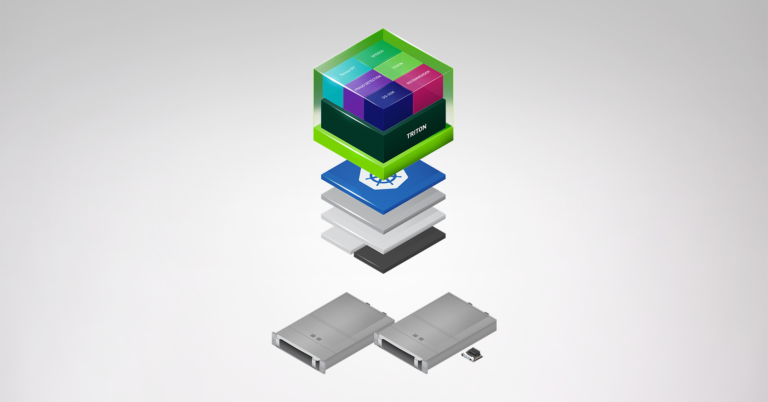
The Triton Inference Server software simplifies the deployment of AI models at scale in production. This open-source inference serving software enables teams to deploy trained AI models from any framework from local storage or cloud platform on any GPU– or CPU-based infrastructure.

By the numbers

Across the board in both data center and edge categories, NVIDIA took top spots in performance tests with the NVIDIA A100 Tensor Core GPU and all but one with our NVIDIA A30 Tensor Core GPU. Over the last year since results for MLPerf Inference 0.7 were published, NVIDIA delivered up to 50% more performance from software improvements alone.

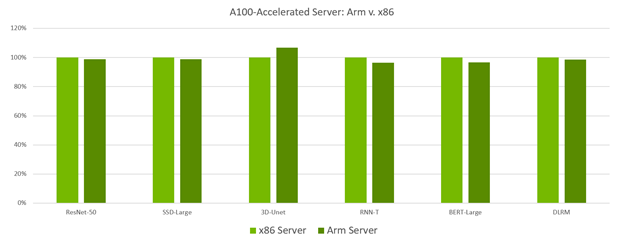
In another industry first, NVIDIA made the first-ever datacenter category submissions with a GPU-accelerated Arm-based server, which supported all workloads and delivered results equal to those seen on a similarly configured x86-based server. These new Arm-based submissions set new performance world records for GPU-accelerated Arm servers. This marks an important milestone for these platforms as they have now proven themselves in a peer-reviewed industry-standard benchmark to deliver market-leading performance. It also shows the performance, versatility, and readiness of the NVIDIA Arm software ecosystem for tackling computing challenges in the data center.

Figure 1. Arm-based server using Ampere Altra CPUs delivers performance on par with similarly equipped x86-based server

MLPerf v1.1 Inference Closed; Per-accelerator performance derived from the best MLPerf results for respective submissions using reported accelerator count in Data Center Offline. x86 Server: 1.1-034, Arm Server: 1.1-033 MLPerf name and logo are trademarks. Source: www.mlcommons.org.​

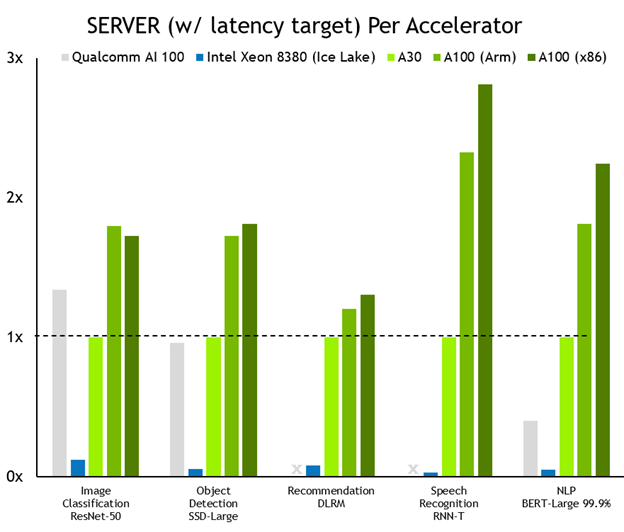
A look at overall performance shows that NVIDIA leads across the board. Figure 2 shows results for the server scenario, where inference work for the system-under-test is generated using a Poisson distribution to model real-world workload patterns more closely.

NVIDIA brings up to 104x (two orders of magnitude) more inference performance than current-generation CPUs. That advantage translates into many fewer server nodes to do the same work, or the ability to inference very large models in real time.
Figure 2. NVIDIA performance compared to CPU-only servers

MLPerf v1.1 Inference Closed; Per-accelerator performance derived from the best MLPerf results for respective submissions using reported accelerator count in Data Center Offline and Server. Qualcomm AI 100: 1.1-057 and 1.1-058, Intel Xeon 8380: 1.1-023 and 1.1-024, NVIDIA A30: 1.1-43, NVIDIA A100 (Arm): 1.1-033, NVIDIA A100 (x86): 1.1-047. MLPerf name and logo are trademarks. Source: www.mlcommons.org.​

NVIDIA outperforms CPU-only servers across the board, by as much as 104x. This performance advantage translates into an ability to run inference on larger, more complex models, as well as multiple models run in real-time jobs in conversational AI, recommender systems, and digital assistants.

Optimizations behind the results

Our engineering team implemented several optimizations to make these great results possible. For starters, all these results—both for Arm–based and x86-based servers—were generated using TensorRT 8, which is now generally available. Of particular interest was the use of non-power-of-two kernels, which was implemented to speed up workloads such as the BERT-Large Single Stream scenario test.

NVIDIA submissions take advantage of the new host policy feature added to the NVIDIA Triton Inference server. You can specify a host policy while configuring the NVIDIA Triton server that enables thread and memory pinning in the server application. With this feature, NVIDIA Triton can specify the optimal location of inputs for every GPU in the system. The optimal location can be based on the non-uniform memory architecture (NUMA) configuration of the system, in which case there is a query sample library on every NUMA node.

You can also use the host policy to enable the start_from_device configuration setting, where the server will pick up the input on the GPU chosen for execution. This setting can also land network inputs directly into GPU memory, entirely bypassing the CPU and system memory copies.

Inference power trio: TensorRT, NVIDIA Triton, and NGC

NVIDIA inference leadership comes from building the most performant AI accelerators, both for training and inference. But just as important is the NVIDIA end-to-end, full-stack software ecosystem that supports all AI frameworks and more than 800 HPC applications.

All this software is available at NGC, the NVIDIA hub with GPU-optimized software for deep learning, machine learning, and HPC. NGC takes care of all the plumbing so data scientists, developers, and researchers can focus on building solutions, gathering insights, and delivering business value.

NGC is freely available through the marketplace of your preferred cloud provider. There, you can find the latest versions of both TensorRT as well as NVIDIA Triton, both of which were instrumental in producing the latest MLPerf Inference 1.1 results.

For more information about the NVIDIA inference platform, see the Inference Technical Overview paper that covers the trends in AI inference, challenges around deploying AI applications, and details of inference development tools and application frameworks.