Talk about a magic trick. One moment, NVIDIA CEO Jensen Huang was holding forth from behind his sturdy kitchen counter. The next, the kitchen and everything in it slid away, leaving Huang alone with the audience and NVIDIA’s DGX Station A100, a glimpse at an alternate digital reality. For most, the metaverse is something seen Read article >
NVIDIA today announced a major expansion of NVIDIA Omniverse™ — the world’s first simulation and collaboration platform that is delivering the foundation of the metaverse — through new integrations with Blender and Adobe that will open it to millions more users.
Using the torch just-in-time (JIT) compiler, it is possible to query a model trained in R from a different language, provided that language can make use of the low-level libtorch library. This post shows how. In addition, we try to untangle a bit of the terminological jumble surrounding the topic.
Using machine learning and visual psychophysics, researchers are developing AI models capable of transcribing ancient manuscripts.
Looking to reveal secrets of days past, historical scholars across the globe spend their life’s work translating ancient manuscripts. A team at the University of Notre Dame looks to help in this quest, with a newly developed machine learning model for translating and recording handwritten documents centuries old.
Using digitized manuscripts from the Abbey Library of Saint Gall, and a machine learning model that takes into account human perception, the study offers a notable improvement in the capabilities of deep learning transcription.
“We’re dealing with historical documents written in styles that have long fallen out of fashion, going back many centuries, and in languages like Latin, which are rarely ever used anymore. You can get beautiful photos of these materials, but what we’ve set out to do is automate transcription in a way that mimics the perception of the page through the eyes of the expert reader and provides a quick, searchable reading of the text,” Walter Scheirer, senior author and an associate professor at Notre Dame said in a press release.
Founded in 719, the Abbey Library of Saint Gall holds one of the oldest and richest library collections in the world. The library houses approximately 160,000 volumes and 2,000 manuscripts, dating back to the eighth century. Hand-written on parchment paper in languages rarely used today, many of these materials have yet to be read—a potential fortune of historical archives, waiting to be unearthed.
Machine learning methods capable of automatically transcribing these types of historical documents have been in the works, however challenges remain.
Up until now, large datasets have been necessary to boost the performance of these language models. With the vast number of volumes available, the work takes time, and relies on a relatively small number of expert scholars for annotation. Missing knowledge, such as the Medieval Latin dictionary that has never been compiled, poses even greater obstacles.
The team combined traditional machine learning methods with the science of visual psychophysics, which studies the relationship between the physical world and human behavior, to create more information-rich annotations. In this case, they incorporated the measurements of human vision into the training process of the neural networks when processing the ancient texts.
“It’s a strategy not typically used in machine learning. We’re labeling the data through these psychophysical measurements, which comes directly from psychological studies of perception—by taking behavioral measurements. We then inform the network of common difficulties in the perception of these characters and can make corrections based on those measurements,” Scheirer said.
To train, validate, and test the models the researchers used a set of digitized handwritten Latin manuscripts from St. Gall dating back to the ninth century. They asked experts to read and enter manual transcriptions from lines of text into custom designed software. Measuring the time for each transcription, gives insight into the difficulty of words, characters, or passages. According to the authors, this data helps reduce errors in the algorithm and provides more realistic readings.
All of the experiments were run using the cuDNN-accelerated PyTorch deep learning framework and GPUs. “We definitely could not have accomplished what we did without NVIDIA hardware and software,” said Scheirer.
The research introduces a novel loss formulation for deep learning that incorporates measurements of human vision, which can be applied to different processing pipelines for handwritten document transcription. Credit: Scheirer et al/IEEE
There are still areas the team is working to improve. Damaged and incomplete documents, along with illustrations and abbreviations pose a special challenge for the models.
“The inflection point AI reached thanks to Internet-scale data and GPU hardware is going to benefit cultural heritage and the humanities just as much as other fields. We’re just scratching the surface of what we can do with this project,” said Scheirer.
Talk about a signal boost. Creative Technology is tackling 4K and 8K signals, as well as new broadcast workflows, with the latest NVIDIA networking technologies. The London-based firm is one of the world’s leading suppliers of audio visual equipment for broadcasting and online events. Part of global production company NEP Group, CT helps produce high-quality Read article >
Enterprises challenged with running accelerated workloads have an answer: NVIDIA-Certified Systems. Available from nearly 20 global computer makers, these servers have been validated for running a diverse range of accelerated workloads with optimum performance, reliability and scale. Now NVIDIA-Certified Systems are expanding to the desktop with workstations that undergo the same testing to validate their Read article >
This post discussing pros and cons of distinct memory layouts as well as memory pools for asynchronous memory allocation to enable zero-copy functionality.
Introduction
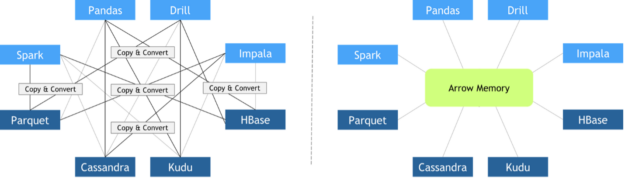
Efficient pipeline design is crucial for data scientists. When composing complex end-to-end workflows, you may choose from a wide variety of building blocks, each of them specialized for a dedicated task. Unfortunately, repeatedly converting between data formats is an error-prone and performance-degrading endeavor. Let’s change that!
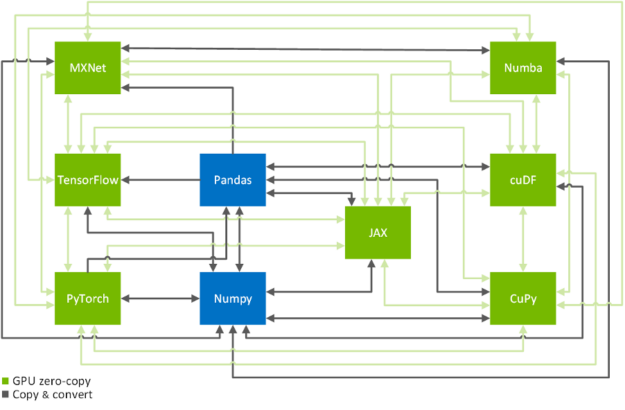
Figure 1: Interoperability between data science and machine learning frameworks.
In this post series, we discuss different aspects of efficient framework interoperability:
We start with this post discussing pros and cons of distinct memory layouts as well as memory pools for asynchronous memory allocation to enable zero-copy functionality.
In the second post, we highlight bottlenecks occurring during data loading/transfers and how to mitigate them using Remote Direct Memory Access (RDMA) technology.
In the third post, we dive into the implementation of an end-to-end pipeline demonstrating the discussed techniques for optimal data transfer across data science frameworks.
Zero-copy functionality is a crucial technique to efficiently copy data across GPU-accelerated data science frameworks: TensorFlow, PyTorch, MXNet, cuDF, CuPy, Numba, and JAX (see Figure 2). In the following, we will show you how to achieve that in a systematic manner. If you are only here to look up the commands on how to transfer data from one framework to another, you might want to have a look at this conversion table.
Figure 2 Conversion paths between data science and machine learning frameworks.
Memory layouts, data formats and memory pools
Memory Layouts
Before we start talking about how to copy data efficiently, let’s discuss how to store tabular data. In practice, all data formats inherit from one of the two major memory layouts known to computer scientists (see Figure 3):
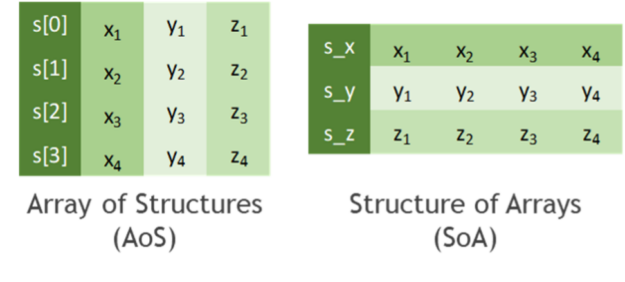
Array of Structures (AoS): A sequence of one or more data points x, y, z, … of potentially distinct type is represented as a structureS. Several instances of those data points are allocated as an array s of the new data type S. The original list of points x, y, z, … of the k-th instance is then accessed through the members s[k].x, s[k].y, s[k].z, … of the struct instance s[k].
Structure of Arrays (SoA): Several instances of data points x, y, z, … are stored in separated arrays s_x, s_y, s_z, … The original points x, y, z, … of the k-th instance are then accessed by s_x[k], s_y[k], s_z[k], … Finally, these arrays can be interpreted as a single instance of a (merely virtually existing) structure, hence the name SoA.
Figure 3: Comparison of AoS (left) and SoA (right) memory layouts. White arrows denote the read order in linear memory. Note that AoS and SoA are isomorphic through transposition.
While the AoS layout looks more structured (pun intended) than SoA from a programmatic and abstraction point of view, it tends to be less suited for massively parallel algorithms in terms of achievable performance. This can be explained by a less efficient utilization of cache lines when consistently accessing a subset of the structure members, for example, during the reduction of values along one coordinate axis. You can even find cases in the literature where on-the-fly AoS-to-SoA conversion can significantly improve performance compared to plain processing in an AOS memory layout.
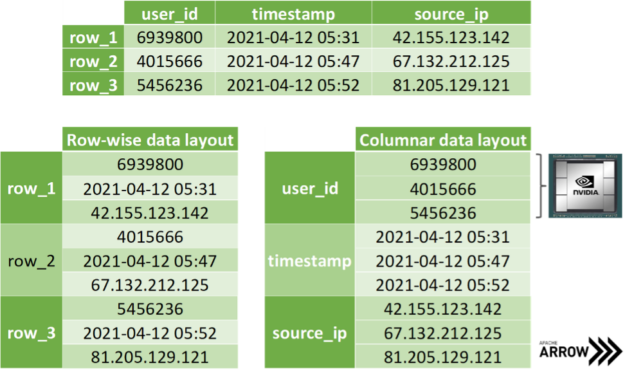
The SoA memory layout exhibits further advantages when copying coordinate-slices of the data. Assume you want to transfer all the x-coordinates at once, then you can access the corresponding array without the time-consuming slicing of members in the AoS layout. Even better, one can avoid allocating auxiliary memory when transferring data by simply exposing the address of the array in memory without copying a single byte. Apache Arrow is built on top of this methodology: storing data of distinct data types in different arrays for the discussed reasons (see Figure 4). Note that mainstream data science frameworks treat the entries of an array in the SoA layout as if they were stored in columns instead of rows, as depicted in Figure 3. However, this is merely a convention as we all know that virtually all memory is linearly ordered.
Figure 4: Comparison of row-wise (AoS, left) and column-wise (SoA, right) memory layouts for the same table shown on top. SoA is ideally suited for massively parallel processing on GPUs.
Data formats and zero-copy mechanism
In recent years, different libraries have been developed to address different needs. At the same time, data science pipelines have become more and more complex, requiring the usage of multiple libraries to accomplish a wide variety of tasks. Unfortunately, when these libraries were designed, interoperability between frameworks was not conceived as a top priority. As a result, there was a lack of standardized data formats suitable for data science tasks. Some people were concerned about data standards at that moment, like Wes McKinney, creator of the pandas project. In 2011, he published this post about a future roadmap for rich scientific data structures in Python.
Since every library implemented its custom in-memory data layout and file formats, expensive copy-and-convert operations had to be performed when these libraries needed to collaborate. It was quite common that a significant portion of the total execution time was invested in meaningless copy-and-convert operations.
In October 2016, Apache Foundation released Arrow, a language-independent columnar-wise data format specification meant to deal efficiently with flat and hierarchical data on both CPUs and GPUs. Since then, many different frameworks have adopted it, facilitating zero-copy data exchange among them. Other key features of Apache Arrow columnar data format include:
O(1) (constant-time) random access
SIMD and vectorization-friendly
Data adjacency for sequential access (scans)
Relocatable without “pointer swizzling”, allowing for true zero-copy access in shared memory
Figure 5: Comparison of traditional framework interoperability to a zero-copy approach using Apache Arrow where all frameworks agree on the same memory layout.
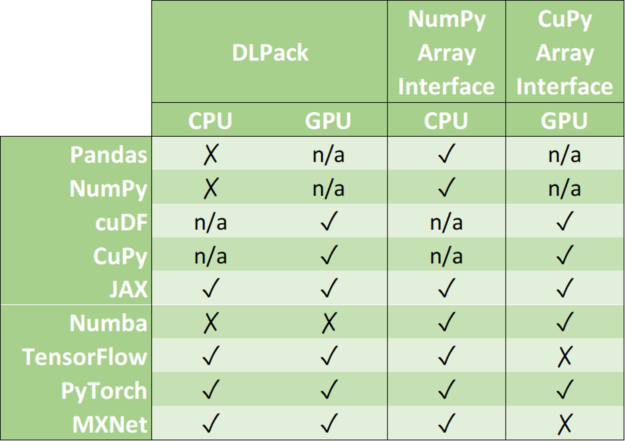
Zero-copy mechanisms avoid unnecessary data transfers, reducing your application execution time drastically. Data science frameworks have added support to one or more of the following data formats: DLPack, CUDA Array Interface, and NumPy Array Interface.
DLPack is an open in-memory tensor structure for sharing tensors among frameworks. CUDA Array Interface and Numpy Array Interface are the de facto standards to exchange GPU and CPU array-like objects.
Table 1: Data Formats Support Matrix.
Please, note that some libraries like cuDF and CuPy exclusively run on GPU devices. Although it is possible to convert a NumPy array into a cuDF or CuPy object, we have marked its support as n/a because it requests data movement between host memory (CPU) and device memory (GPU).
In the following, we address memory layouts of the associated data objects in various frameworks, the efficient conversion of data objects using zero-copy, as well as the usage of a joint memory pool when mixing frameworks.
Memory pools
Memory allocations are expensive. They often impose global barriers, which block the remaining operations until the allocation is accomplished. Hence, repeatedly allocating memory in tight for-loops such as during the training of neural networks is prohibitive from a performance point of view. Modern data science and deep learning frameworks address this with dedicated memory pools. It is either preallocating a huge chunk of memory at the beginning of the program (for example, TensorFlow) or incrementally growing the pool using a few infrequent allocations (for example, PyTorch). Then, the preallocated memory is reused in a smart way by asynchronously assigning and retracting subsets of this memory range to/from whomever requests it. As an example, the RAPIDS Memory Manager (RMM) is a memory pool originally written for the RAPIDS data science framework. RMM facilitates blazingly fast host and device memory allocations. Mark Harris quantified the impact of RMM in this post: “We centralized memory management in cuDF by replacing all calls to cudaMalloc and cudaFree with RMM allocations. This was a lot of work, but it paid off. RMM calls are on the order of 1,000 times faster than cudaMalloc and cudaFree. The result was a 10x speedup for the mortgage demo.”
Several library-specific memory pools might compete for the same video RAM when combining distinct data science libraries. A straightforward workaround would be to limit the capacity of each memory pool to a fixed partition of the available memory. A better solution would be to use the same memory pool for all frameworks. Note that this does not necessarily mean that all frameworks must agree on the same memory pool implementation being shipped in their vanilla release. It is sufficient that all vendors agree to use an External Allocator Interface (EAI) for requesting and freeing memory in their frameworks.
Further advantages of an EAI are straightforward logging functionality, memory leak checking, as well as rate or resource limiting capabilities. For instance, the RAPIDS Memory Manager leverages unified memory to transparently oversubscribe GPU memory. The former translates into significantly reducing the chances of facing an Out of Memory error when working with huge datasets that do not fit in GPU memory.
The good news is that you can use RMM with CuPy and Numba by simply importing RAPIDS cuDF before importing everything else.
import cudf  #


Alternatively, you can combine Numba and RMM without using RAPIDS cuDF.


import rmm
from numba import cuda
cuda.set_memory_manager(rmm.RMMNumbaManager)
Conclusion
In this post of our framework interoperability series, you have learned about distinct memory layouts and how the Apache Arrow format can significantly speed up data transfers across distinct data science and machine learning frameworks such as TensorFlow, PyTorch, MXNet, cuDF, CuPy, Numba, and JAX. We have also discussed how asynchronous memory allocation facilitated by memory pools is crucial to avoid overheads as big as 90% of the overall runtime of your pipeline.
In the second part of the series, you will learn how Remote Direct Memory Access (RDMA) can be exploited to further accelerate data loading and data transfers in a multiple GPU setting.
Autonomous trucking startup Embark is planning for universal autonomy of commercial semi-trucks, developing one AI platform that fits all. The company announced today that it will use NVIDIA DRIVE to develop its Embark Universal Interface (EUI), a manufacturer-agnostic platform that includes the compute and multimodal sensors necessary for autonomous trucks. This flexible approach, combined with Read article >
Computer graphics and AI are cornerstones of NVIDIA. Combined, they’re bringing creators closer to the goal of cinema-quality 3D imagery rendered in real time. At a series of graphics conferences this summer, NVIDIA Research is sharing groundbreaking work in real-time path tracing and content creation, much of it based on cutting-edge AI techniques. These projects Read article >


 Using machine learning and visual psychophysics, researchers are developing AI models capable of transcribing ancient manuscripts.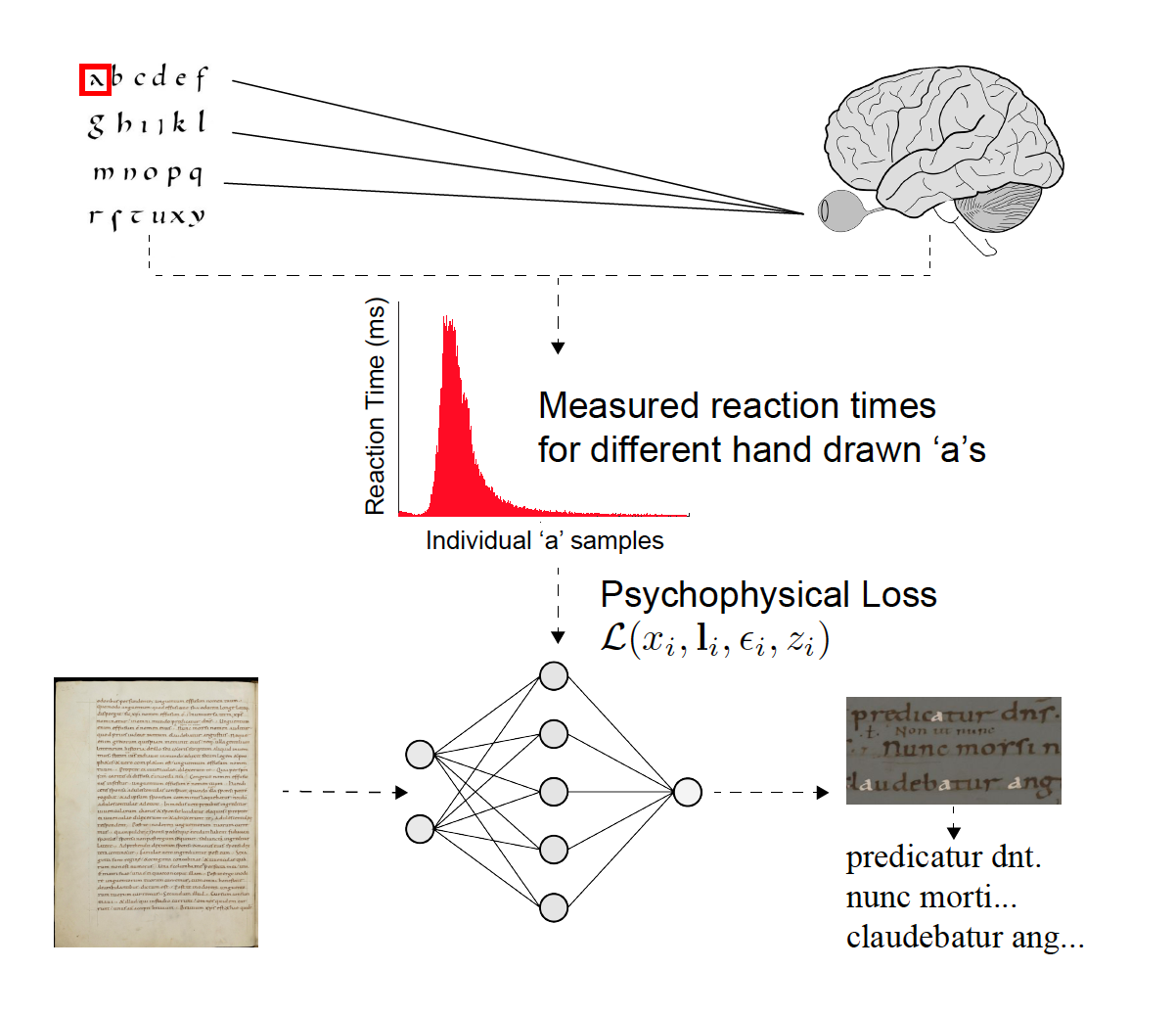
 This post discussing pros and cons of distinct memory layouts as well as memory pools for asynchronous memory allocation to enable zero-copy functionality.