 Determined AI’s application available in the NVIDIA NGC catalog, a GPU-optimized hub for AI applications, provides an open-source platform that enables deep learning engineers to focus on building models and not managing infrastructure.
As AI becomes universal, enterprise leaders are looking to empower their AI teams with fully integrated and automated development environments.
Determined AI’s application available in the NVIDIA NGC catalog, a GPU-optimized hub for AI applications, provides an open-source platform that enables deep learning engineers to focus on building models and not managing infrastructure.
Determined AI is a member of NVIDIA Inception AI and startup incubator.
Users can train models faster using state-of-the-art distributed training, without changing their model code. With built-in state-of-the-art hyperparameter tuning, deep learning engineers working on use-cases such Computer Vision or Natural Language Processing (NLP), can find high-quality models up to 100x faster than conventional tools.
Determined includes built-in experiment tracking, a lightweight model registry, and smart GPU scheduling, allowing deep learning engineers to get models from idea to production dramatically more quickly and at lower cost.
The product is packaged as user-managed software delivered via Helm charts for deployment to Kubernetes, or as a set of Docker containers for both on-premise or cloud based instances. Every GPU node runs an agent, and a central control node schedules workloads and coordinates work between the agents. Users submit deep learning workloads to the system and the automated system handles everything from job scheduling, resource provisioning to distributed training.
Jobs can be submitted by developers directly or programmatically via APIs, as well as via easy integrations with other ML workflow systems like Kubeflow Pipelines and Airflow. The system tracks metadata, model checkpoints, and metrics, and allows models to easily be exported to downstream serving systems like Seldon and TensorFlow Serving. Users can interact with the system’s web UI to monitor job or cluster status, and debug and interact with live or historical experiments.
To get started, download the Helm chart from the NGC catalog.
 The CMake package and build system for both libraries continue to improve with add_subdirectory support, installation rules, status messages, and other features that make these libraries easier to use from CMake projects.
  Data augmentation technique enables AI model to emulate artwork from a small dataset from the Metropolitan Museum of Art — and opens up new potential applications in fields like healthcare.
 Researchers, developers, and engineers from all over the world are gathering virtually this year for the 2020 Neural Information Processing Systems (NeurlPS). NVIDIA Research will present its research through spotlight and posters.
 Watch part 1 of our popular NVIDIA On-Demand session, Rendering Game With Millions of Ray Traced Lights, where NVIDIA’s Chris Wyman provides an overview on reservoir spatiotemporal importance resampling (ReSTIR).
 Now available to all NVIDIA Developers, NVIDIA On-Demand is a catalog of technical sessions, podcasts, past keynotes, demos, research posters and more from NVIDIA GPU Technology Conferences across the global, as well as leading industry events.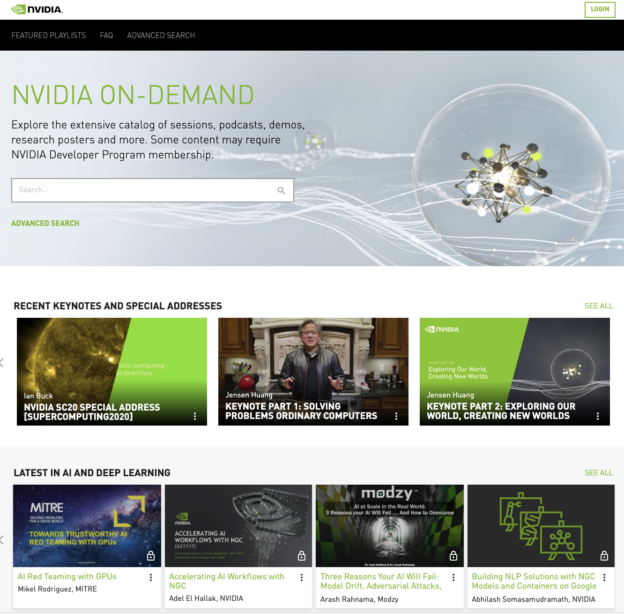
 Learn more about breakthrough NVIDIA technologies and dive into our expansive selection of graphics and simulation sessions.