when I’m using TensorFlow multi worker strategy does every node have to have every file or do I give certain files to each node?
submitted by /u/Mayfieldmobster
[visit reddit] [comments]
 DataBloom
when I’m using TensorFlow multi worker strategy does every node have to have every file or do I give certain files to each node?
submitted by /u/Mayfieldmobster
[visit reddit] [comments]
I’m at my wits end, every single tutorial for classification I find for Tensorflow 1.x is a goddamn MNIST tutorial, they always skip the basics, and I need the basics.
I have a test set with 6 numerical features and a label that is binary 1 or 0.
With Tensorflow 2.0 I can easily just use something like this
model = tf.keras.Sequential([ tf.keras.layers.Dense(21, activation="tanh"), tf.keras.layers.Dense(10, activation="sigmoid"), tf.keras.layers.Dense(1, activation="sigmoid") ]) model.compile( loss=tf.keras.losses.binary_crossentropy, optimizer=tf.keras.optimizers.Adam(0.001), metrics=['accuracy'] ) history = model.fit(X_train, y_train, epochs=25)
For the life of me I don’t know how to go about doing this in Tensorflow 1.x.
submitted by /u/Practicing1s
[visit reddit] [comments]
 At the forefront of AI innovation, NVIDIA continues to push the boundaries of technology in machine learning, self-driving cars, robotics, graphics, and more.
At the forefront of AI innovation, NVIDIA continues to push the boundaries of technology in machine learning, self-driving cars, robotics, graphics, and more. NVIDIA researchers will present 20 papers at the thirty-fifth annual conference on Neural Information Processing Systems (NeurIPS) from December 6 to December 14, 2021.
Here are some of the featured papers:
Alias-Free Generative Adversarial Networks (StyleGAN3)
Tero Karras, Miika Aittala, Samuli Laine, Erik Härkönen, Janne Hellsten, Jaakko Lehtinen, Timo Aila | Paper | GitHub | Blog
StyleGAN3, a model developed by NVIDIA Research, will be presented on Tuesday, December 7 from 12:40 AM – 12:55 AM PST, advances the state-of-the-art in generative adversarial networks used to synthesize realistic images. The breakthrough brings graphics principles in signal processing and image processing to GANs to avoid aliasing: a kind of image corruption often visible when images are rotated, scaled or translated.
EditGAN: High-Precision Semantic Image Editing
Huan Ling*, Karsten Kreis*, Daiqing Li, Seung Wook Kim, Antonio Torralba, Sanja Fidler | Paper | GitHub
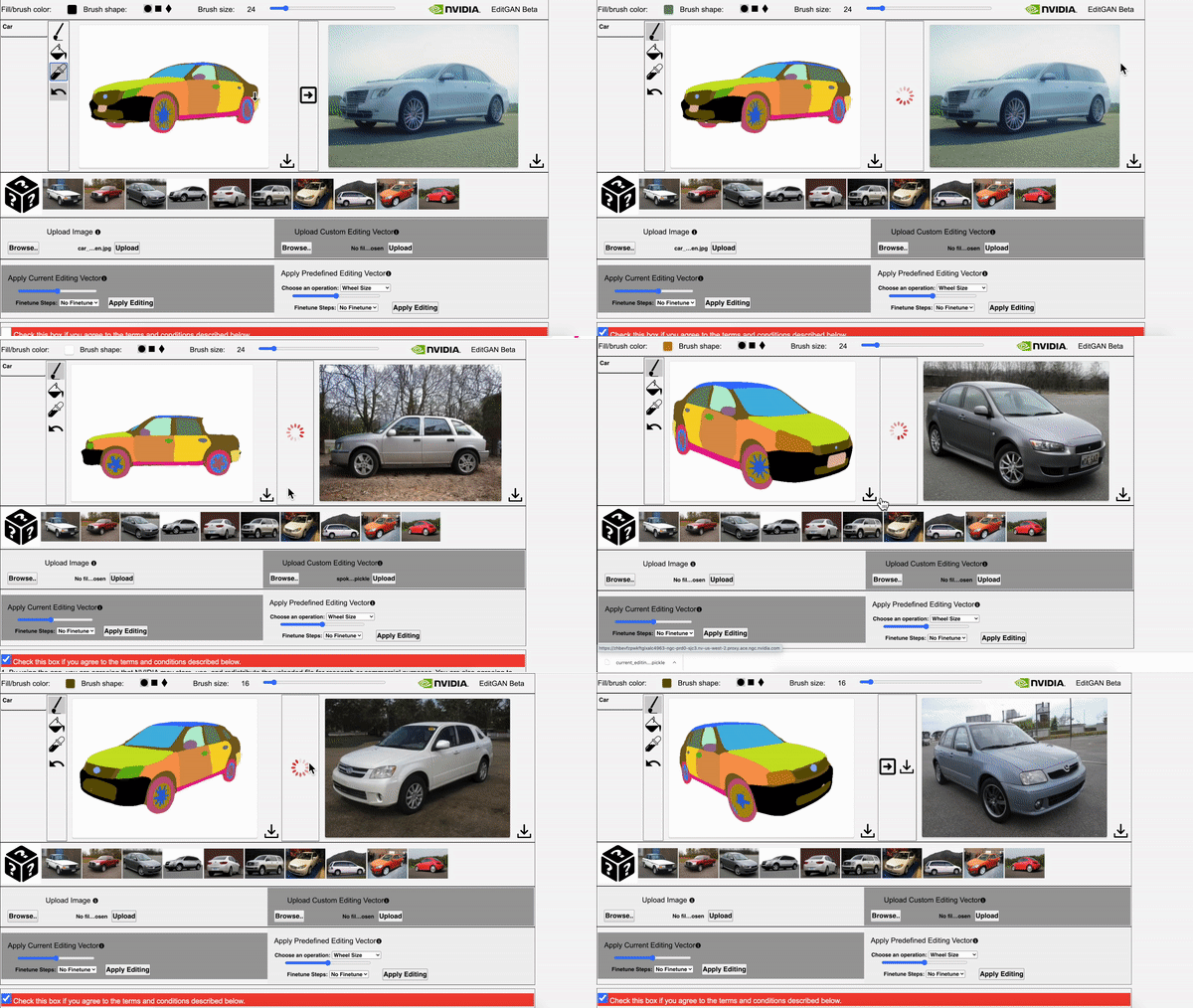
EditGAN, a novel method for high quality, high precision semantic image editing, allowing users to edit images by modifying their highly detailed part segmentation masks, e.g., drawing a new mask for the headlight of a car. EditGAN builds on a GAN framework that jointly models images and their semantic segmentations, requiring only a handful of labeled examples, making it a scalable tool for editing. The poster session will be held on Thursday, December 9 from 8:30 AM – 10:00 AM PST.
SegFormer: Simple and Efficient Design for Semantic Segmentation with Transformers
Enze Xie, Wenhai Wang, Zhiding Yu, Anima Anandkumar, Jose M. Alvarez, Ping Luo | Paper | GitHub
SegFormer, a simple, efficient yet powerful semantic segmentation framework which unifies Transformers with lightweight multilayer perception (MLP) decoders. SegFormer has two appealing features: 1) SegFormer comprises a novel hierarchically structured Transformer encoder which outputs multiscale features. It does not need positional encoding, thereby avoiding the interpolation of positional codes which leads to decreased performance when the testing resolution differs from training. 2) SegFormer avoids complex decoders. The poster will be presented on Tuesday, December 7 from 8:30 AM – 10:00 AM PST.
DIB-R++: Learning to Predict Lighting and Material with a Hybrid Differentiable Renderer
Wenzheng Chen, Joey Litalien, Jun Gao, Zian Wang, Clement Fuji Tsang, Sameh Khamis, Or Litany, Sanja Fidler | Paper
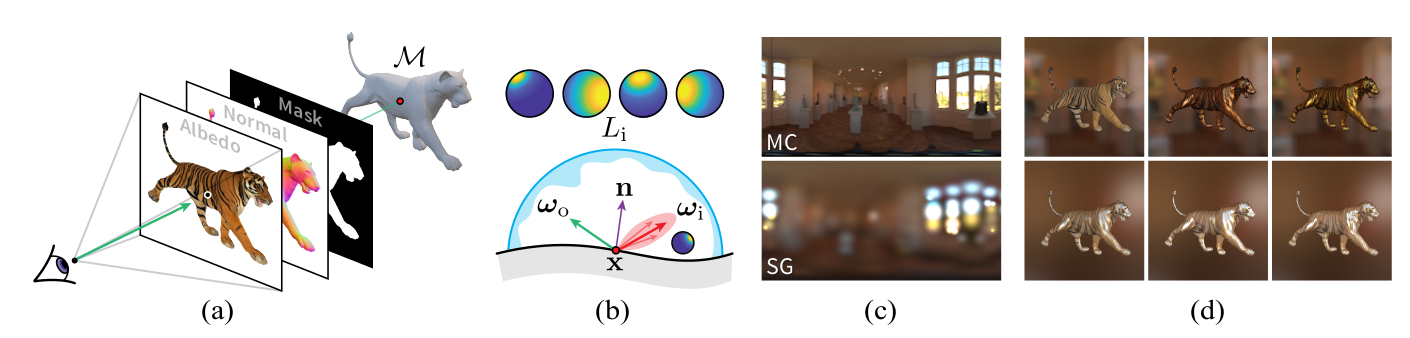
DIB-R++, a deferred, image-based renderer which supports these photorealistic effects by combining rasterization and ray-tracing, taking advantage of their respective strengths—speed and realism. The poster session is on Thursday, December 9 from 4:30 PM – 6:00 PM PST.
In addition to the papers at NeurIPS 2021, researchers and developers can accelerate 3D deep learning research with new Kaolin features:
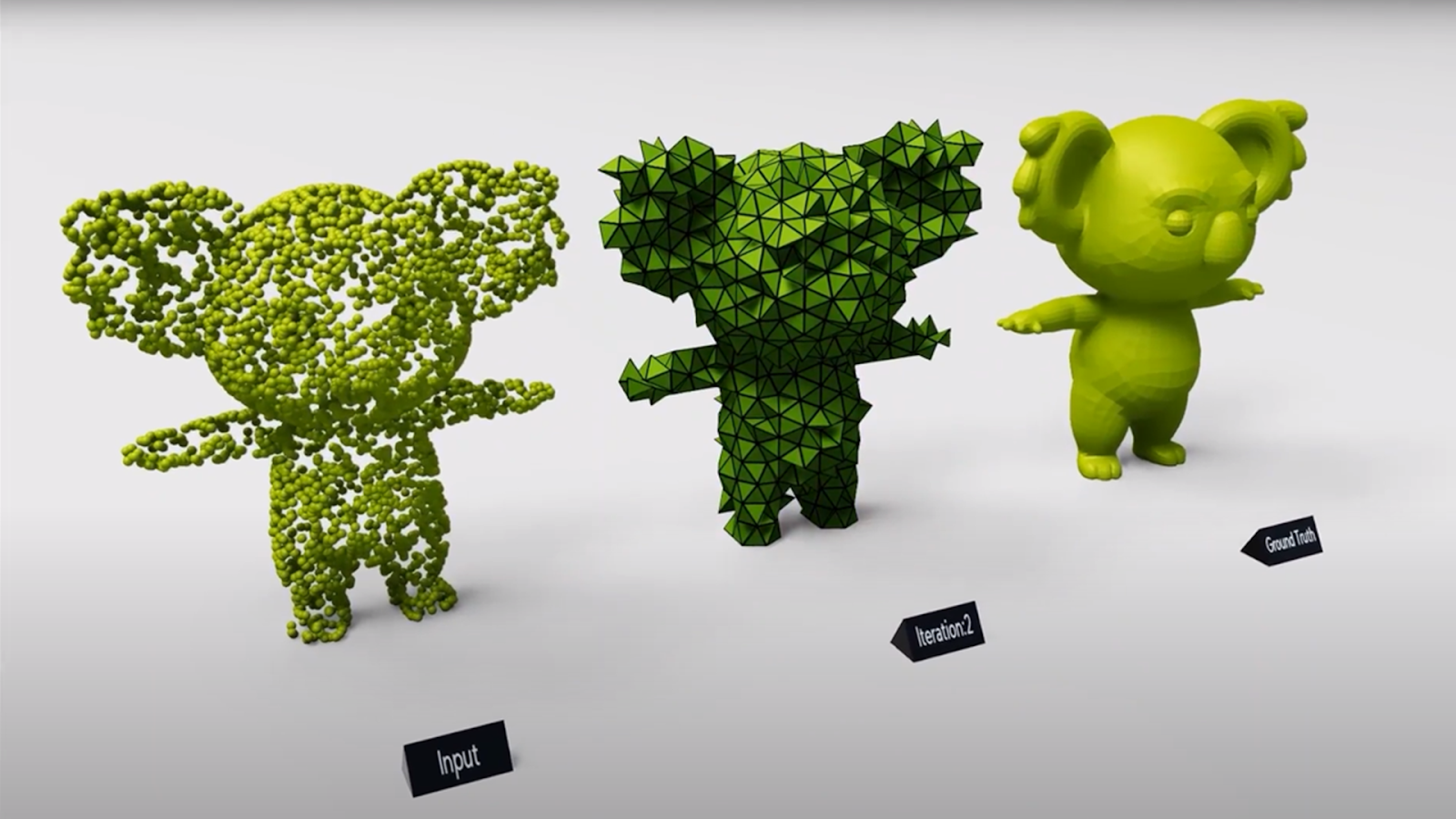
Kaolin is launching new features to accelerate 3D deep learning research. Updates to the NVIDIA Omniverse Kaolin app will bring robust visualization of massive point clouds. Updates to the Kaolin library will include support for tetrahedral meshes, rays management functionality, and a strong speedup to DIB-R. To learn more about Kaolin, watch the recent GTC session.
To view the complete list of NVIDIA Research accepted papers, workshop and tutorials, demos, and to explore job opportunities at NVIDIA, visit the NVIDIA at NeurIPS 2021 website.
hi, i tried to load model on cpu with tf.device while inference of 500 images , the cpu usage resches to 100% , inference time is 0.6sec and how do I minimize the inference time and also the utilization of cpu .
submitted by /u/nanitiru18
[visit reddit] [comments]
I am trying to increase the training speed of my model by using mixed precision and the nvidia gpu tensor cores. For this, I just use the keras mixed precision, but the speed increment is only of 10%. Then I found the nividia ngc container, which is optimized for their gpus, and with mixed precision I can increase the training speed a 60%, although with float32 the speed in lower than native. I would like to have at least the speed increase of ngc container natively, what do I need to do?
submitted by /u/diepala
[visit reddit] [comments]
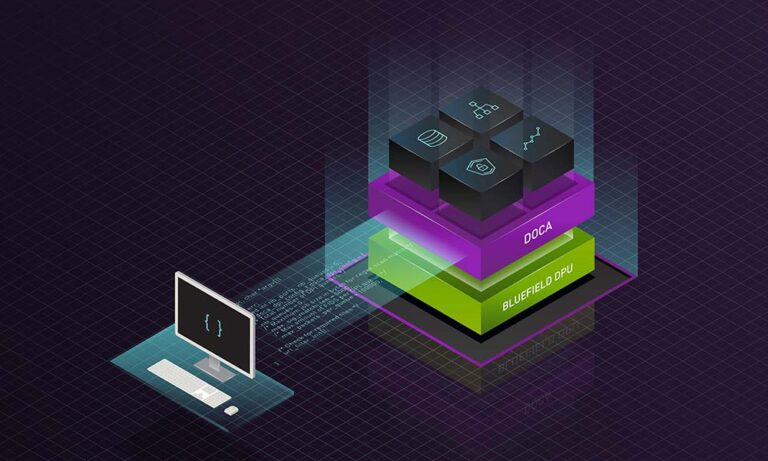 Dive deep into the new features and use cases available for networking, security, storage in the latest release of the DOCA software framework.
Today, NVIDIA released the NVIDIA DOCA 1.2 software framework for NVIDIA BlueField DPUs, the world’s most advanced data processing unit (DPU). Designed to enable the NVIDIA BlueField ecosystem and developer community, DOCA is the key to unlocking the potential of the DPU by offering services to offload, accelerate, and isolate infrastructure applications services from the CPU.
DOCA is a software framework that brings together APIs, drivers, libraries, sample code, documentation, services, and prepackaged containers to simplify and speed up application development and deployment on BlueField DPUs on every data center node. Together, DOCA and BlueField create an isolated and secure services domain for networking, security, storage, and infrastructure management that is ideal for enabling a zero-trust strategy.
The DOCA 1.2 release introduces several important features and use cases.
A modern approach to security based on zero trust principles is critical to securing today’s data centers, as resources inside the data center can no longer be trusted automatically. App Shield enables detection of attacks on critical services in a system. In many systems, those critical services are responsible for ensuring the integrity and privacy of the execution of many applications.
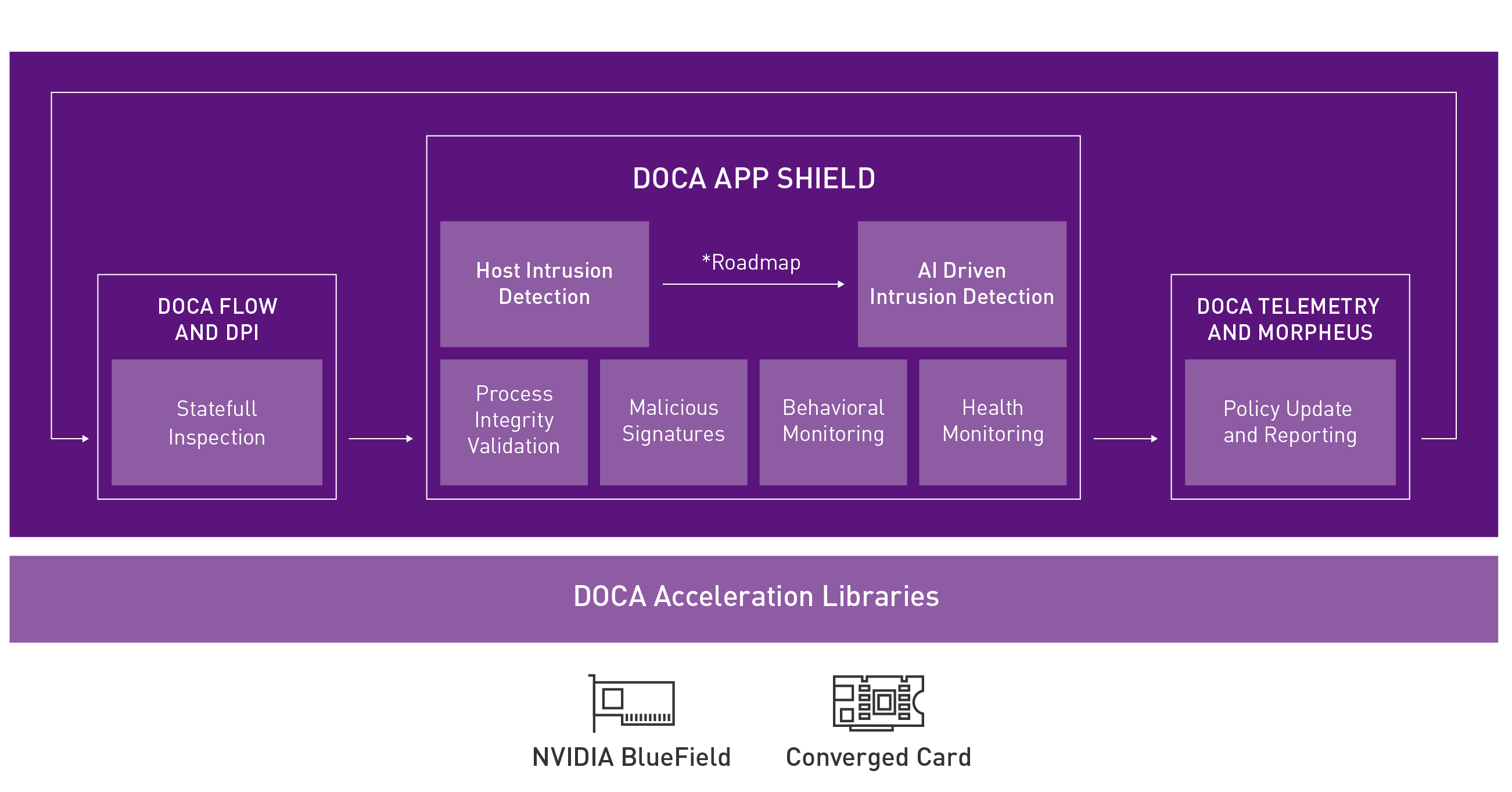
DOCA App Shield provides host monitoring enabling cybersecurity vendors to create accelerated intrusion detection system (IDS) solutions to identify an attack on any physical or virtual machine. It can feed data about application status to security information and event management (SIEM) or extended detection and response (XDR) tools and also enhances forensic investigations.
If a host is compromised, attackers normally exploit the security control mechanism breaches to move laterally across data center networks to other servers and devices. App Shield enables security teams to shield their application processes, continuously validate their integrity, and in turn detect malicious activity.
In the event that an attacker kills the machine security agent’s processes, App Shield can mitigate the attack by isolating the compromised host, preventing the malware from accessing confidential data or spreading to other resources. App Shield is an important advancement in the fight against cybercrime and an effective tool to enable a zero-trust security stance.
BlueField DPUs and the DOCA software framework provide an open foundation for partners and developers to build zero-trust solutions and address the security needs of the modern data center. Together, DOCA and BlueField create an isolated and secure services domain for networking, security, storage, and infrastructure management that is ideal for enabling a zero-trust strategy.
Precision timing is a critical capability to enable and accelerate distributed apps from edge to core. DOCA Firefly is a data center timing service that supports extremely precise time synchronization everywhere. With nanosecond-level clock synchronization, you can enable a new broad range of timing-critical and delay-sensitive applications.
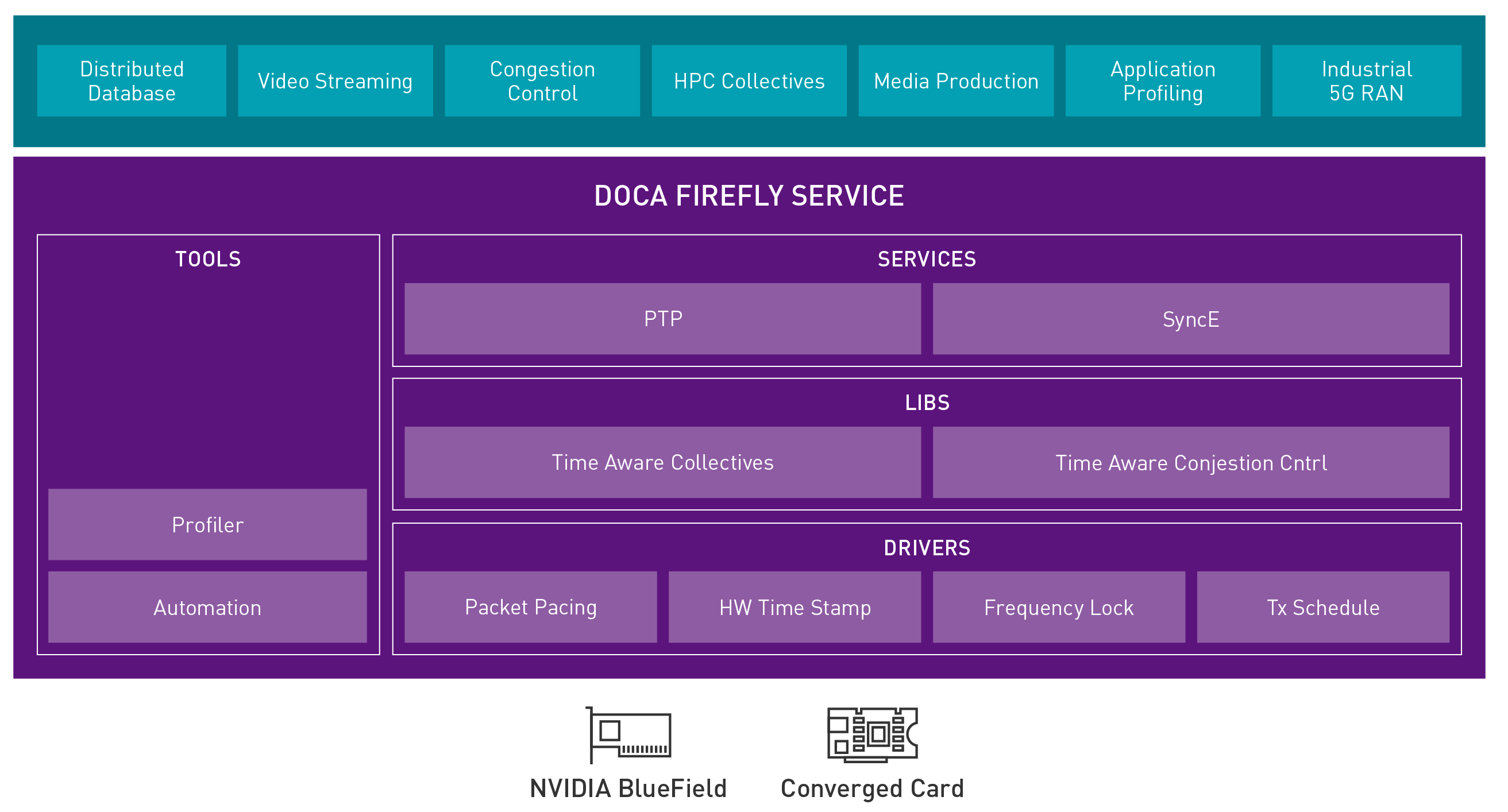
DOCA Firefly addresses a wide range of use cases, including the following:
It enables data consistency, accurate event ordering, and causality analysis, such as ensuring the correct sequencing of stock market transactions and fair bidding during digital auctions. The hardware engines in the BlueField application-specific integrated circuit (ASIC) are capable of time-stamping data packets at full wire speed with breakthrough nanosecond-level accuracy.
Improving the accuracy of data center timing by orders of magnitude offers many advantages.
With globally synchronized data centers, you can accelerate distributed applications and data analysis including AI, HPC, professional media production, telco virtual network functions, and precise event monitoring. All the servers in the data center—or across data centers—can be harmonized to provide something that is far bigger than any single compute node.
The benefits of improving data center timing accuracy include a reduction in the amount of compute power and network traffic needed to replicate and validate the data. For example, Firefly synchronization delivers a 3x database performance gain to distributed databases.
The BlueField DPU is a unique solution for network acceleration and policy enforcement within an endpoint host. At the same time, BlueField provides an administrative and software demarcation between the host operating system and functions running on the DPU.
With DOCA host-based networking (HBN), top-of-rack (TOR) network configuration can extend down to the DPU, enabling network administrators to own DPU configuration and management while application management can be handled separately by x86 host administrators. This creates an unparalleled opportunity to reimagine how you can build data center networks.
DOCA 1.2 provides a new driver for HBN called Netlink to DOCA (nl2doca) that accelerates and offloads traditional Linux Netlink messages. nl2doca is provided as an acceleration driver integrated as part of the HBN service container. You can now accelerate host networking for L2 and L3 that relies on DPDK, OVS, or now kernel routing with Netlink.
NVIDIA is adding support for the open-source Free Range Routing (FRR) project, running on the DPU and leveraging this new nl2doca driver. This support enables the DPU to operate exactly like a TOR switch plus additional benefits. FRR on the DPU enables EVPN networks to move directly into the host, providing layer 2 (VLAN) extension and layer 3 (VRF) tenant isolation.
HBN on the DPU can manage and monitor traffic between VMs or containers on the same node. It can also analyze and encrypt or decrypt then analyze traffic to and from the node, both tasks that no ToR switch can perform. You can build your own Amazon VPC-like solution in your private cloud for containerized, virtual machine, and bare metal workloads.
HBN with BlueField DPUs revolutionizes how you build data center networks. It offers the following benefits:
nl2doca driver provided by HBN enables any netlink capable application to offload and accelerate kernel based networking without the complexities of traditional DPDK libraries. Additional DOCA 1.2 SDK updates:
In addition, NVIDIA is introducing a Deep Learning Institute (DLI) course: Introduction to DOCA for the BlueField DPU. The main objective of this course is to provide students, including developers, researchers, and system administrators, with an introduction to DOCA and BlueField DPUs. This enables students to successfully work with DOCA to create accelerated applications and services powered by BlueField DPUs.
You can experience DOCA today with the DOCA software, which includes DOCA SDK and runtime accelerated libraries for networking, storage, and security. The libraries help you program your data center infrastructure running on the DPU.
The DOCA Early Access program is open now for applications. To receive news and updates about DOCA or to become an early access member/partner, register on the DOCA Early Access page.
For more information, see the following resources:
This week marks the beginning of the 35th annual Conference on Neural Information Processing Systems (NeurIPS 2021), the biggest machine learning conference of the year. NeurIPS 2021 will be held virtually and includes invited talks, demonstrations and presentations of some of the latest in machine learning research. This year, NeurIPS also announced a new Datasets and Benchmarks track, which will include publications, talks, posters, and discussions related to this research area.
Google will have a strong presence with more than 170 accepted papers, additionally contributing to and learning from the broader academic research community via talks, posters, workshops, and tutorials. You can learn more about our work being presented in the list below (Google affiliations highlighted in bold).
Organizing Committee
Communications Co-Chair: Emily Denton
Program Co-Chair: Yann Dauphin
Workshop Co-Chair: Sanmi Koyejo
Senior Area Chairs: Alekh Agarwal, Amir Globerson, Been Kim, Charles Sutton, Claudio Gentile, Corinna Cortes, Dale Schuurmans, David Duvenaud, Elad Hazan, Hugo Larochelle, Jean-Philippe Vert, Kevin Murphy, Marco Cuturi, Mehryar Mohri, Mohammad Ghavamzadeh, Samory Kpotufe, Sanjiv Kumar, Satyen Kale, Sergey Levine, Tara N. Sainath, Yishay Mansour
Area Chairs: Abhishek Kumar, Abhradeep Guha Thakurta, Alex Kulesza, Alexander A. Alemi, Alexander T. Toshev, Amin Karbasi, Amit Daniely, Ananda Theertha Suresh, Ankit Singh Rawat, Ashok Cutkosky, Badih Ghazi, Balaji Lakshminarayanan, Ben Poole, Bo Dai, Boqing Gong, Chelsea Finn, Chiyuan Zhang, Christian Szegedy, Cordelia Schmid, Craig Boutilier, Cyrus Rashtchian, D. Sculley, Daniel Keysers, David Ha, Denny Zhou, Dilip Krishnan, Dumitru Erhan, Dustin Tran, Ekin Dogus Cubuk, Fabian Pedregosa, George Tucker, Hanie Sedghi, Hanjun Dai, Heinrich Jiang, Hossein Mobahi, Izhak Shafran, Jaehoon Lee, Jascha Sohl-Dickstein, Jasper Snoek, Jeffrey Pennington, Jelani Nelson, Jieming Mao, Justin Gilmer, Karol Hausman, Karthik Sridharan, Kevin Swersky, Maithra Raghu, Mario Lucic, Mathieu Blondel, Matt Kusner, Matthew Johnson, Matthieu Geist, Ming-Hsuan Yang, Mohammad Mahdian, Mohammad Norouzi, Nal Kalchbrenner, Naman Agarwal, Nicholas Carlini, Nicolas Papernot, Olivier Bachem, Olivier Pietquin, Paul Duetting, Praneeth Netrapalli, Pranjal Awasthi, Prateek Jain, Quentin Berthet, Renato Paes Leme, Richard Nock, Rif A. Saurous, Rose Yu, Roy Frostig, Samuel Stern Schoenholz, Sashank J. Reddi, Sercan O. Arik, Sergei Vassilvitskii, Sergey Ioffe, Shay Moran, Silvio Lattanzi, Simon Kornblith, Srinadh Bhojanapalli, Thang Luong, Thomas Steinke, Tim Salimans, Tomas Pfister, Tomer Koren, Uri Stemmer, Vahab Mirrokni, Vikas Sindhwani, Vincent Dumoulin, Virginia Smith, Vladimir Braverman, W. Ronny Huang, Wen Sun, Yang Li, Yasin Abbasi-Yadkori, Yinlam Chow,Yujia Li, Yunhe Wang, Zoltán Szabó
NeurIPS Foundation Board 2021: Michael Mozer, Corinna Cortes, Hugo Larochelle, John C. Platt, Fernando Pereira
Test of Time Award
Online Learning for Latent Dirichlet Allocation
Matthew D. Hoffman†, David M. Blei, Francis Bach
Publications
Deep Reinforcement Learning at the Edge of the Statistical Precipice (see blog post)
Outstanding Paper Award Recipient
Rishabh Agarwal, Max Schwarzer, Pablo Samuel Castro, Aaron Courville, Marc G. Bellemare
A Separation Result Between Data-Oblivious and Data-Aware Poisoning Attacks
Samuel Deng, Sanjam Garg, Somesh Jha, Saeed Mahloujifar, Mohammad Mahmoody, Abhradeep Guha Thakurta
Adversarial Robustness of Streaming Algorithms Through Importance Sampling
Vladimir Braverman, Avinatan Hassidim, Yossi Matias, Mariano Schain, Sandeep Silwal, Samson Zhou
Aligning Silhouette Topology for Self-Adaptive 3D Human Pose Recovery
Mugallodi Rakesh, Jogendra Nath Kundu, Varun Jampani, R. Venkatesh Babu
Attention Bottlenecks for Multimodal Fusion
Arsha Nagrani, Shan Yang, Anurag Arnab, Aren Jansen, Cordelia Schmid, Chen Sun
Autonomous Reinforcement Learning via Subgoal Curricula
Archit Sharma, Abhishek Gupta, Sergey Levine, Karol Hausman, Chelsea Finn
Calibration and Consistency of Adversarial Surrogate Losses
Pranjal Awasthi, Natalie S. Frank, Anqi Mao, Mehryar Mohri, Yutao Zhong
Compressive Visual Representations
Kuang-Huei Lee, Anurag Arnab, Sergio Guadarrama, John Canny, Ian Fischer
Counterfactual Invariance to Spurious Correlations in Text Classification
Victor Veitch, Alexander D’Amour, Steve Yadlowsky, Jacob Eisenstein
Deep Learning Through the Lens of Example Difficulty
Robert J.N. Baldock, Hartmut Maennel, Behnam Neyshabur
Deep Neural Networks as Point Estimates for Deep Gaussian Processes
Vinent Dutordoir, James Hensman, Mark van der Wilk, Carl Henrik Ek, Zoubin Ghahramani, Nicolas Durrande
Delayed Gradient Averaging: Tolerate the Communication Latency for Federated Learning
Ligeng Zhu, Hongzhou Lin, Yao Lu, Yujun Lin, Song Han
Discrete-Valued Neural Communication
Dianbo Liu, Alex Lamb, Kenji Kawaguchi, Anirudh Goyal, Chen Sun, Michael Curtis Mozer, Yoshua Bengio
Do Vision Transformers See Like Convolutional Neural Networks?
Maithra Raghu, Thomas Unterthiner, Simon Kornblith, Chiyuan Zhang, Alexey Dosovitskiy
Dueling Bandits with Team Comparisons
Lee Cohen, Ulrike Schmidt-Kraepelin, Yishay Mansour
End-to-End Multi-Modal Video Temporal Grounding
Yi-Wen Chen, Yi-Hsuan Tsai, Ming-Hsuan Yang
Environment Generation for Zero-Shot Compositional Reinforcement Learning
Izzeddin Gur, Natasha Jaques, Yingjie Miao, Jongwook Choi, Manoj Tiwari, Honglak Lee, Aleksandra Faust
H-NeRF: Neural Radiance Fields for Rendering and Temporal Reconstruction of Humans in Motion
Hongyi Xu, Thiemo Alldieck, Cristian Sminchisescu
Improving Calibration Through the Relationship with Adversarial Robustness
Yao Qin, Xuezhl Wang, Alex Beutel, Ed Chi
Learning Generalized Gumbel-Max Causal Mechanisms
Guy Lorberbom, Daniel D. Johnson, Chris J. Maddison, Daniel Tarlow, Tamir Hazan
MICo: Improved Representations via Sampling-Based State Similarity for Markov Decision Processes
Pablo Samuel Castro, Tyler Kastner, Prakash Panangaden, Mark Rowland
Near-Optimal Lower Bounds For Convex Optimization For All Orders of Smoothness
Ankit Garg, Robin Kothari, Praneeth Netrapalli, Suhail Sherif
Neural Circuit Synthesis from Specification Patterns
Frederik Schmitt, Christopher Hahn, Markus N. Rabe, Bernd Finkbeiner
Non-Local Latent Relation Distillation for Self-Adaptive 3D Human Pose Estimation
Jogendra Nath Kundu, Siddharth Seth, Anirudh Jamkhandi, Pradyumna YM, Varun Jampani, Anirban Chakraborty, R. Venkatesh Babu
Object-Aware Contrastive Learning for Debiased Scene Representation
Sangwoo Mo, Hyunwoo Kang, Kihyuk Soh, Chun-Liang Li, Jinwoo Shin
On Density Estimation with Diffusion Models
Diederik P. Kingma, Tim Salimans, Ben Poole, Jonathan Ho
On Margin-Based Cluster Recovery with Oracle Queries
Marco Bressan, Nicolo Cesa-Bianchi, Silvio Lattanzi, Andrea Paudice
On Model Calibration for Long-Tailed Object Detection and Instance Segmentation
Tai-Yu Pan, Cheng Zhang, Yandong Li, Hexiang Hu, Dong Xuan, Soravit Changpinyo, Boqing Gong, Wei-Lun Chao
Parallelizing Thompson Sampling
Amin Karbasi, Vahab Mirrokni, Mohammad Shadravan
Reverse-Complement Equivariant Networks for DNA Sequences
Vincent Mallet, Jean-Philippe Vert
Revisiting ResNets: Improved Training and Scaling Strategies
Irwan Bello, William Fedus, Xianzhi Du, Ekin Dogus Cubuk, Aravind Srinivas, Tsung-Yi Lin, Jonathon Shlens, Barret Zoph
Revisiting the Calibration of Modern Neural Networks
Matthias Minderer, Josip Djolonga, Rob Romijnders, Frances Ann Hubis, Xiaohua Zhai, Neil Houlsby, Dustin Tran, Mario Lucic
Scaling Vision with Sparse Mixture of Experts
Carlos Riquelme, Joan Puigcerver, Basil Mustafa, Maxim Neumann, Rodolphe Jenatton, André Susano Pinto, Daniel Keysers, Neil Houlsby
SE(3)-Equivariant Prediction of Molecular Wavefunctions and Electronic Densities
Oliver Thorsten Unke, Mihail Bogojeski, Michael Gastegger, Mario Geiger, Tess Smidt, Klaus Robert Muller
Stateful ODE-Nets Using Basis Function Expansions
Alejandro Francisco Queiruga, N. Benjamin Erichson, Liam Hodgkinson, Michael W. Mahoney
Statistically and Computationally Efficient Linear Meta-Representation Learning
Kiran Koshy Thekumparampil, Prateek Jain, Praneeth Netrapalli, Sewoong Oh
Streaming Belief Propagation for Community Detection
Yuchen Wu, Jakab Tardos, Mohammad Hossein Bateni, André Linhares, Filipe Miguel Gonçalves de Almeida, Andrea Montanari, Ashkan Norouzi-Fard
Synthetic Design: An Optimization Approach to Experimental Design with Synthetic Controls
Nick Doudchenko, Khashayar Khosravi, Jean Pouget-Abadie, Sebastien Lahaie, Miles Lubin, Vahab Mirrokni, Jann Spiess, Guido Imbens
The Difficulty of Passive Learning in Deep Reinforcement Learning
George Ostrovski, Pablo Samuel Castro, Will Dabney
The Pareto Frontier of Model Selection for General Contextual Bandits
Teodor Marinov, Julian Zimmert
VATT: Transformers for Multimodal Self-Supervised Learning from Raw Video, Audio and Text
Hassan Akbari, Liangzhe Yuan, Rui Qian, Wei-Hong Chuang, Shih-Fu Chang, Yin Cui, Boqing Gong
Co-Adaptation of Algorithmic and Implementational Innovations in Inference-Based Deep Reinforcement Learning
Hiroki Furuta, Tadashi Kozuno, Tatsuya Matsushima, Yutaka Matsuo, Shixiang Gu
Conservative Data Sharing for Multi-Task Offline Reinforcement Learning
Tianhe Yu, Aviral Kumar, Yevgen Chebotar, Karol Hausman, Sergey Levine, Chelsea Finn
Does Knowledge Distillation Really Work?
Samuel Stanton, Pavel Izmailov, Polina Kirichenko, Alexander A. Alemi, Andrew Gordon Wilson
Exponential Graph is Provably Efficient for Decentralized Deep Training
Bicheng Ying, Kun Yuan, Yiming Chen, Hanbin Hu, Pan Pan, Wotao Yin
Faster Matchings via Learned Duals
Michael Dinitz, Sungjin Im, Thomas Lavastida, Benjamin Moseley, Sergei Vassilvitskii
Improved Transformer for High-Resolution GANs
Long Zhao, Zizhao Zhang, Ting Chen, Dimitris N. Metaxas, Han Zhang
Near-Optimal Offline and Streaming Algorithms for Learning Non-Linear Dynamical Systems
Prateek Jain, Suhas S. Kowshik, Dheeraj Mysore Nagaraj, Praneeth Netrapalli
Nearly Horizon-Free Offline Reinforcement Learning
Tongzheng Ren, Jialian Li, Bo Dai, Simon S. Du, Sujay Sanghavi
Overparameterization Improves Robustness to Covariate Shift in High Dimensions
Nilesh Tripuraneni, Ben Adlam, Jeffrey Pennington
Pay Attention to MLPs
Hanxiao Liu, Zihang Dai, David R. So, Quoc V. Le
PLUR: A Unifying, Graph-Based View of Program Learning, Understanding, and Repair
Zimin Chen*, Vincent Josua Hellendoorn*, Pascal Lamblin, Petros Maniatis, Pierre-Antoine Manzagol, Daniel Tarlow, Subhodeep Moitra
Prior-Independent Dynamic Auctions for a Value-Maximizing Buyer
Yuan Deng, Hanrui Zhang
Remember What You Want to Forget: Algorithms for Machine Unlearning
Ayush Sekhari, Jayadev Acharya, Gautam Kamath, Ananda Theertha Suresh
Reverse Engineering Learned Optimizers Reveals Known and Novel Mechanisms
Niru Maheswaranathan*, David Sussillo*, Luke Metz, Ruoxi Sun, Jascha Sohl-Dickstein
Revisiting 3D Object Detection From an Egocentric Perspective
Boyang Deng, Charles R. Qi, Mahyar Najibi, Thomas Funkhouser, Yin Zhou, Dragomir Anguelov
Robust Auction Design in the Auto-Bidding World
Santiago Balseiro, Yuan Deng, Jieming Mao, Vahab Mirrokni, Song Zuo
Shift-Robust GNNs: Overcoming the Limitations of Localized Graph Training Data
Qi Zhu, Natalia Ponomareva, Jiawei Han, Bryan Perozzi
Understanding How Encoder-Decoder Architectures Attend
Kyle Aitken, Vinay V. Ramasesh, Yuan Cao, Niru Maheswaranathan
Understanding the Effect of Stochasticity in Policy Optimization
Jincheng Mei, Bo Dai, Chenjun Xiao, Csaba Szepesvari, Dale Schuurmans
Accurately Solving Rod Dynamics with Graph Learning
Han Shao, Tassilo Kugelstadt, Torsten Hädrich, Wojtek Palubicki, Jan Bender, Sören Pirk, Dominik L. Michels
GradInit: Learning to Initialize Neural Networks for Stable and Efficient Training
Chen Zhu, Renkun Ni, Zheng Xu, Kezhi Kong, W. Ronny Huang, Tom Goldstein
Learnability of Linear Thresholds from Label Proportions
Rishi Saket
MLP-Mixer: An All-MLP Architecture for Vision
Ilya Tolstikhin, Neil Houlsby, Alexander Kolesnikov, Lucas Beyer, Xiaohua Zhai, Thomas Unterthiner, Jessica Yung, Andreas Steiner, Daniel Keysers, Jakob Uszkoreit, Mario Lucic, Alexey Dosovitskiy
Neural Additive Models: Interpretable Machine Learning with Neural Nets
Rishabh Agarwal, Levi Melnick, Nicholas Frosst, Xuezhou Zhang, Ben Lengerich, Rich Caruana, Geoffrey Hinton
Neural Production Systems
Anirudh Goyal, Aniket Didolkar, Nan Rosemary Ke, Charles Blundell, Philippe Beaudoin, Nicolas Heess, Michael Mozer, Yoshua Bengio
Physics-Aware Downsampling with Deep Learning for Scalable Flood Modeling
Niv Giladi, Zvika Ben-Haim, Sella Nevo, Yossi Matias, Daniel Soudry
Shape from Blur: Recovering Textured 3D Shape and Motion of Fast Moving Objects
Denys Rozumnyi, Martin R. Oswald, Vittorio Ferrari, Marc Pollefeys
What Matters for Adversarial Imitation Learning?
Manu Orsini, Anton Raichuk, Léonard Hussenot, Damien Vincent, Robert Dadashi, Sertan Girgin, Matthieu Geist, Olivier Bachem, Olivier Pietquin, Marcin Andrychowicz
A Convergence Analysis of Gradient Descent on Graph Neural Networks
Pranjal Awasthi, Abhimanyu Das, Sreenivas Gollapudi
A Geometric Analysis of Neural Collapse with Unconstrained Features
Zhihui Zhu, Tianyu Ding, Jinxin Zhou, Xiao Li, Chong You, Jeremias Sulam, Qing Qu
Agnostic Reinforcement Learning with Low-Rank MDPs and Rich Observations
Christoph Dann, Yishay Mansour, Mehryar Mohri, Ayush Sekhari, Karthik Sridharan
Controlled Text Generation as Continuous Optimization with Multiple Constraints
Sachin Kumar, Eric Malmi, Aliaksei Severyn, Yulia Tsvetkov
Coupled Gradient Estimators for Discrete Latent Variables
Zhe Dong, Andriy Mnih, George Tucker
Detecting Errors and Estimating Accuracy on Unlabeled Data with Self-Training Ensembles
Jiefeng Chen*, Frederick Liu, Besim Avci, Xi Wu, Yingyu Liang, Somesh Jha
Neural Active Learning with Performance Guarantees
Zhilei Wang, Pranjal Awasthi, Christoph Dann, Ayush Sekhari, Claudio Gentile
Optimal Sketching for Trace Estimation
Shuli Jiang, Hai Pham, David Woodruff, Qiuyi (Richard) Zhang
Representing Long-Range Context for Graph Neural Networks with Global Attention
Zhanghao Wu, Paras Jain, Matthew A. Wright, Azalia Mirhoseini, Joseph E. Gonzalez, Ion Stoica
Scaling Up Exact Neural Network Compression by ReLU Stability
Thiago Serra, Xin Yu, Abhinav Kumar, Srikumar Ramalingam
Soft Calibration Objectives for Neural Networks
Archit Karandikar, Nicholas Cain, Dustin Tran, Balaji Lakshminarayanan, Jonathon Shlens, Michael Curtis Mozer, Rebecca Roelofs
Sub-Linear Memory: How to Make Performers SLiM
Valerii Likhosherstov, Krzysztof Choromanski, Jared Davis, Xingyou Song, Adrian Weller
A New Theoretical Framework for Fast and Accurate Online Decision-Making
Nicolò Cesa-Bianchi, Tommaso Cesari, Yishay Mansour, Vianney Perchet
Bridging the Gap Between Practice and PAC-Bayes Theory in Few-Shot Meta-Learning
Nan Ding, Xi Chen, Tomer Levinboim, Sebastian Goodman, Radu Soricut
Differentially Private Multi-Armed Bandits in the Shuffle Model
Jay Tenenbaum, Haim Kaplan, Yishay Mansour, Uri Stemmer
Efficient and Local Parallel Random Walks
Michael Kapralov, Silvio Lattanzi, Navid Nouri, Jakab Tardos
Improving Anytime Prediction with Parallel Cascaded Networks and a Temporal-Difference Loss
Michael Louis Iuzzolino, Michael Curtis Mozer, Samy Bengio*
It Has Potential: Gradient-Driven Denoisers for Convergent Solutions to Inverse Problems
Regev Cohen, Yochai Blau, Daniel Freedman, Ehud Rivlin
Learning to Combine Per-Example Solutions for Neural Program Synthesis
Disha Shrivastava, Hugo Larochelle, Daniel Tarlow
LLC: Accurate, Multi-purpose Learnt Low-Dimensional Binary Codes
Aditya Kusupati, Matthew Wallingford, Vivek Ramanujan, Raghav Somani, Jae Sung Park, Krishna Pillutla, Prateek Jain, Sham Kakade, Ali Farhadi
There Is No Turning Back: A Self-Supervised Approach for Reversibility-Aware Reinforcement Learning (see blog post)
Nathan Grinsztajn, Johan Ferret, Olivier Pietquin, Philippe Preux, Matthieu Geist
A Near-Optimal Algorithm for Debiasing Trained Machine Learning Models
Ibrahim Alabdulmohsin, Mario Lucic
Adaptive Sampling for Minimax Fair Classification
Shubhanshu Shekhar, Greg Fields, Mohammad Ghavamzadeh, Tara Javidi
Asynchronous Stochastic Optimization Robust to Arbitrary Delays
Alon Cohen, Amit Daniely, Yoel Drori, Tomer Koren, Mariano Schain
Boosting with Multiple Sources
Corinna Cortes, Mehryar Mohri, Dmitry Storcheus, Ananda Theertha Suresh
Breaking the Centralized Barrier for Cross-Device Federated Learning
Sai Praneeth Karimireddy, Martin Jaggi, Satyen Kale, Mehryar Mohri, Sashank J. Reddi, Sebastian U. Stitch, Ananda Theertha Sureshi
Canonical Capsules: Self-Supervised Capsules in Canonical Pose
Weiwei Sun, Andrea Tagliasacchi, Boyang Deng, Sara Sabour, Soroosh Yazdani, Geoffrey Hinton, Kwang Moo Yi
Contextual Recommendations and Low-Regret Cutting-Plane Algorithms
Sreenivas Gollapudi, Guru Guruganesh, Kostas Kollias, Pasi Manurangsi, Renato Paes Leme, Jon Schneider
Decision Transformer: Reinforcement Learning via Sequence Modeling
Lili Chen, Kevin Lu, Aravind Rajeswaran, Kimin Lee|Aditya Grover, Michael Laskin, Pieter Abbeel, Aravind Srinivas, Igor Mordatch
Deep Learning on a Data Diet: Finding Important Examples Early in Training
Mansheej Paul, Surya Ganguli, Gintare Karolina Dziugaite
Deep Learning with Label Differential Privacy
Badih Ghazi, Noah Golowich*, Ravi Kumar, Pasin Manurangsi, Chiyuan Zhang
Efficient Training of Retrieval Models Using Negative Cache
Erik Lindgren, Sashank J. Reddi, Ruiqi Guo, Sanjiv Kumar
Exploring Cross-Video and Cross-Modality Signals for Weakly-Supervised Audio-Visual Video Parsing
Yan-Bo Lin, Hung-Yu Tseng, Hsin-Ying Lee, Yen-Yu Lin, Ming-Hsuan Yang
Federated Reconstruction: Partially Local Federated Learning
Karan Singhal, Hakim Sidahmed, Zachary Garrett, Shanshan Wu, Keith Rush, Sushant Prakash
Framing RNN as a Kernel Method: A Neural ODE Approach
Adeline Fermanian, Pierre Marion, Jean-Philippe Vert, Gérard Biau
Learning Semantic Representations to Verify Hardware Designs
Shobha Vasudevan, Wenjie Jiang, David Bieber, Rishabh Singh, Hamid Shojaei, C. Richard Ho, Charles Sutton
Learning with User-Level Privacy
Daniel Asher Nathan Levy*, Ziteng Sun*, Kareem Amin, Satyen Kale, Alex Kulesza, Mehryar Mohri, Ananda Theertha Suresh
Logarithmic Regret from Sublinear Hints
Aditya Bhaskara, Ashok Cutkosky, Ravi Kumar, Manish Purohit
Margin-Independent Online Multiclass Learning via Convex Geometry
Guru Guruganesh, Allen Liu, Jon Schneider, Joshua Ruizhi Wang
Multiclass Boosting and the Cost of Weak Learning
Nataly Brukhim, Elad Hazan, Shay Moran, Indraneel Mukherjee, Robert E. Schapire
Neural-PIL: Neural Pre-integrated Lighting for Reflectance Decomposition
Mark Boss, Varun Jampani, Raphael Braun, Ce Liu*, Jonathan T. Barron, Hendrik Lensch
Never Go Full Batch (in Stochastic Convex Optimization)
Idan Amir, Yair Carmon, Tomer Koren, Roi Livni
On Large-Cohort Training for Federated Learning
Zachary Charles, Zachary Garrett, Zhouyuan Huo, Sergei Shmulyian, Virginia Smith
On the Sample Complexity of Privately Learning Axis-Aligned Rectangles
Menachem Sadigurschi, Uri Stemmer
Online Control of Unknown Time-Varying Dynamical Systems
Edgar Minasyan, Paula Gradu, Max Simchowitz, Elad Hazan
Online Knapsack with Frequency Predictions
Sungjin Im, Ravi Kumar,Mahshid Montazer Qaem, Manish Purohit
Optimal Rates for Random Order Online Optimization
Uri Sherman, Tomer Koren, Yishay Mansour
Oracle-Efficient Regret Minimization in Factored MDPs with Unknown Structure
Aviv Rosenberg, Yishay Mansour
Practical Large-Scale Linear Programming Using Primal-Dual Hybrid Gradient
David Applegate, Mateo Díaz*, Oliver Hinder, Haihao Lu*, Miles Lubin, Brendan O’Donoghue, Warren Schudy
Private and Non-Private Uniformity Testing for Ranking Data
Robert Istvan Busa-Fekete, Dimitris Fotakis, Manolis Zampetakis
Privately Learning Subspaces
Vikrant Singhal, Thomas Steinke
Provable Representation Learning for Imitation with Contrastive Fourier Features
Ofir Nachum, Mengjiao Yang
Safe Reinforcement Learning with Natural Language Constraints
Tsung-Yen Yang, Michael Hu, Yinlam Chow, Peter J. Ramadge, Karthik Narasimhan
Searching for Efficient Transformers for Language Modeling
David R. So, Wojciech Mańke, Hanxiao Liu, Zihang Dai, Noam Shazeer, Quoc V. Le
SLOE: A Faster Method for Statistical Inference in High-Dimensional Logistic Regression
Steve Yadlowsky, Taedong Yun, Cory McLean, Alexander D’Amour
Streaming Linear System Identification with Reverse Experience Replay
Prateek Jain, Suhas S. Kowshik, Dheeraj Mysore Nagaraj, Praneeth Netrapalli
The Skellam Mechanism for Differentially Private Federated Learning
Naman Agarwal, Peter Kairouz, Ziyu Liu*
TokenLearner: Adaptive Space-Time Tokenization for Videos
Michael S. Ryoo, AJ Piergiovanni, Anurag Arnab, Mostafa Dehghani, Anelia Angelova
Towards Best-of-All-Worlds Online Learning with Feedback Graphs
Liad Erez, Tomer Koren
Training Over-Parameterized Models with Non-decomposable Objectives
Harikrishna Narasimhan, Aditya Krishna Menon
Twice Regularized MDPs and the Equivalence Between Robustness and Regularization
Esther Derman, Matthieu Geist, Shie Mannor
Unsupervised Learning of Compositional Energy Concepts
Yilun Du, Shuang Li, Yash Sharma, Joshua B. Tenenbaum, Igor Mordatch
User-Level Differentially Private Learning via Correlated Sampling
Badih Ghazi, Ravi Kumar, Pasin Manurangsi
ViSER: Video-Specific Surface Embeddings for Articulated 3D Shape Reconstruction
Gengshan Yang, Deqing Sun, Varun Jampani, Daniel Vlasic, Forrester Cole, Ce Liu*, Deva Ramanan
A Minimalist Approach to Offline Reinforcement Learning
Scott Fujimoto, Shixiang Gu
A Unified View of cGANs With and Without Classifiers
Si-An Chen, Chun-Liang Li, Hsuan-Tien Lin
CoAtNet: Marrying Convolution and Attention for All Data Sizes (see blog post)
Zihang Dai, Hanxiao Liu, Quoc V. Le, Mingxing Tan
Combiner: Full Attention Transformer with Sparse Computation Cost
Hongyu Ren*, Hanjun Dai, Zihang Dai, Mengjiao Yang, Jure Leskovec, Dale Schuurmans, Bo Dai
Contrastively Disentangled Sequential Variational Autoencoder
Junwen Bai, Weiran Wang, Carla P. Gomes
Controlling Neural Networks with Rule Representations
Sungyong Seo, Sercan O. Arik, Jinsung Yoon, Xiang Zhang, Kihyuk Sohn, Tomas Pfister
Dataset Distillation with Infinitely Wide Convolutional Networks
Timothy Nguyen*, Roman Novak, Lechao Xiao, Jaehoon Lee
Deep Synoptic Monte-Carlo Planning in Reconnaissance Blind Chess
Gregory Clark
Differentially Private Learning with Adaptive Clipping
Galen Andrew, Om Thakkar, Swaroop Ramaswamy, Hugh Brendan McMahan
Differentially Private Model Personalization
Prateek Jain, Keith Rush, Adam Smith, Shuang Song, Abhradeep Thakurta
Efficient Algorithms for Learning Depth-2 Neural Networks with General ReLU Activations
Pranjal Awasthi, Alex Tang, Aravindan Vijayaraghavan
Efficiently Identifying Task Groupings for Multi-Task Learning
Christopher Fifty, Ehsan Amid, Zhe Zhao, Tianhe Yu, Rohan Anil, Chelsea Finn
Generalized Shape Metrics on Neural Representations
Alex H. Williams, Erin Kunz, Simon Kornblith, Scott Linderman
High-Probability Bounds for Non-Convex Stochastic Optimization with Heavy Tails
Ashok Cutkosky, Harsh Mehta
Identity Testing for Mallows Model
Róbert Busa-Fekete, Dimitris Fotakis, Balázs Szörényi, Manolis Zampetakis
Learnable Fourier Features for Multi-dimensional Spatial Positional Encoding
Yang Li, Si Si, Gang Li, Cho-Jui Hsieh, Samy Bengio*
Learning to Select Exogenous Events for Marked Temporal Point Process
Ping Zhang, Rishabh K. Iyer, Ashish V. Tendulkar, Gaurav Aggarwal, Abir De
Meta-learning to Improve Pre-training
Aniruddh Raghu, Jonathan Peter Lorraine, Simon Kornblith, Matthew B.A. McDermott, David Duvenaud
Pointwise Bounds for Distribution Estimation Under Communication Constraints
Wei-Ning Chen, Peter Kairouz, Ayfer Özgür
REMIPS: Physically Consistent 3D Reconstruction of Multiple Interacting People Under Weak Supervision
Mihai Fieraru, Mihai Zanfir, Teodor Alexandru Szente, Eduard Gabriel Bazavan, Vlad Olaru, Cristian Sminchisescu
Replacing Rewards with Examples: Example-Based Policy Search via Recursive Classification
Benjamin Eysenbach, Sergey Levine, Ruslan Salakhutdinov
Revealing and Protecting Labels in Distributed Training
Trung Dang, Om Thakkar, Swaroop Ramaswamy, Rajiv Mathews, Peter Chin, Françoise Beaufays
Robust Predictable Control
Benjamin Eysenbach, Ruslan Salakhutdinov, Sergey Levine
Robust Visual Reasoning via Language Guided Neural Module Networks
Arjun Reddy Akula, Varun Jampani, Soravit Changpinyo, Song-Chun Zhu
Towards Understanding Retrosynthesis by Energy-Based Models
Ruoxi Sun, Hanjun Dai, Li Li, Steven Kearnes, Bo Dai
Exploring the Limits of Out-of-Distribution Detection
Stanislav Fort, Jie Ren, Balaji Lakshminarayanan
Minimax Regret for Stochastic Shortest Path
Alon Cohen, Yonathan Efroni, Yishay Mansour, Aviv Rosenberg
No Regrets for Learning the Prior in Bandits
Soumya Basu, Branislav Kveton, Manzil Zaheer, Csaba Szepesvari
Structured Denoising Diffusion Models in Discrete State-Spaces
Jacob Austin, Daniel D. Johnsonv, Jonathan Ho, Daniel Tarlow, Rianne van den Berg
The Sensory Neuron as a Transformer: Permutation-Invariant Neural Networks for Reinforcement Learning (see blog post)
Yujin Tang, David Ha
On the Existence of The Adversarial Bayes Classifier
Pranjal Awasthi, Natalie Frank, Mehyrar Mohri
Beyond Value-Function Gaps: Improved Instance-Dependent Regret Bounds for Episodic Reinforcement Learning
Christopher Dann, Teodor Vanislavov Marinov, Mehryar Mohri, Julian Zimmert
A Provably Efficient Model-Free Posterior Sampling Method for Episodic Reinforcement Learning
Christopher Dann, Mehryar Mohri, Tong Zhang, Julian Zimmert
Datasets & Benchmarks Accepted Papers
Reduced, Reused and Recycled: The Life of a Dataset in Machine Learning Research
Bernard Koch, Emily Denton, Alex Hanna, Jacob G. Foster
Datasets & Benchmarks Best Paper
Constructing a Visual Dataset to Study the Effects of Spatial Apartheid in South Africa
Raesetje Sefala, Timnit Gebru, Luzango Mfupe, Nyalleng Moorosi
AI and the Everything in the Whole Wide World Benchmark
Inioluwa Deborah Raji, Emily M. Bender, Amandalynne Paullada, Emily Denton, Alex Hannah
A Unified Few-Shot Classification Benchmark to Compare Transfer and Meta Learning Approaches
Vincent Dumoulin, Neil Houlsby, Utku Evci, Xiaohua Zhai, Ross Goroshin, Sylvain Gelly, Hugo Larochelle
The Neural MMO Platform for Massively Multi-agent Research
Joseph Suarez, Yilun Du, Clare Zhu, Igor Mordatch, Phillip Isola
Systematic Evaluation of Causal Discovery in Visual Model-Based Reinforcement Learning
Nan Rosemary Ke, Aniket Didolkar, Sarthak Mittal, Anirudh Goyal, Guillaume Lajole, Stefan Bauer, Danilo Rezende, Yoshua Bengio, Michael Mozer, Christopher Pal
STEP: Segmenting and Tracking Every Pixel
Mark Weber, Jun Xie, Maxwell Collins, Yukun Zhu, Paul Voigtlaender, Hartwig Adam, Bradley Green, Andreas Geiger, Bastian Leibe, Daneil Cremers, Aljosa Osep, Laura Leal-Taixe, Liang-Chieh Chen
Artsheets for Art Datasets
Ramya Srinivisan, Emily Denton, Jordan Famularo, Negar Rostamzadeh, Fernando Diaz, Beth Coleman
SynthBio: A Case in Human–AI Collaborative Curation of Text Datasets
Ann Yuan, Daphne Ippolito, Vitaly Niolaev, Chris Callison-Burch, Andy Coenen, Sebastian Gehrmann
Benchmarking Bayesian Deep Learning on Diabetic Retinopathy Detection Tasks
Neil Band, Tim G. J. Rudner, Qixuan Feng, Angelos Filos, Zachary Nado, Michael W. Dusenberry, Ghassen Jerfel, Dustin Tran, Yarin Gal
Brax – A Differentiable Physics Engine for Large Scale Rigid Body Simulation (see blog post)
C. Daniel Freeman, Erik Frey, Anton Raichuk, Sertan Girgin, Igor Mordatch, Olivier Bachem
MLPerf Tiny Benchmark
Colby Banbury, Vijay Janapa Reddi, Peter Torelli, Jeremy Holleman, Nat Jeffries, Csaba Kiraly, Pietro Montino, David Kanter, Sebastian Ahmed, Danilo Pau, Urmish Thakker, Antonio Torrini, Peter Warden, Jay Cordaro, Giuseppe Di Guglielmo, Javier Duarte, Stephen Gibellini, Videet Parekh, Honson Tran, Nhan Tran, Niu Wenxu, Xu Xuesong
Automatic Construction of Evaluation Suites for Natural Language Generation Datasets
Simon Mille, Kaustubh D. Dhole, Saad Mahamood, Laura Perez-Beltrachini, Varun Gangal, Mihir Kale, Emiel van Miltenburg, Sebastian Gehrmann
An Empirical Investigation of Representation Learning for Imitation
Xin Chen, Sam Toyer, Cody Wild, Scott Emmons, Ian Fischer, Kuang-Huei Lee, Neel Alex, Steven Wang, Ping Luo, Stuart Russell, Pieter Abbeel, Rohin Shah
Multilingual Spoken Words Corpus
Mark Mazumder, Sharad Chitlangia, Colby Banbury, Yiping Kang, Juan Manuel Ciro, Keith Achorn, Daniel Galvez, Mark Sabini, Peter Mattson, David Kanter, Greg Diamos, Pete Warden, Josh Meyer, Vijay Janapa Reddi
Workshops
4th Robot Learning Workshop: Self-Supervised and Lifelong Learning
Sponsor: Google
Organizers include Alex Bewley, Vincent Vanhoucke
Differentiable Programming Workshop
Sponsor: Google
Machine Learning for Creativity and Design
Sponsor: Google
Organizers include: Daphne Ippolito, David Ha
LatinX in AI (LXAI) Research @ NeurIPS 2021
Sponsor: Google
Sponsorship Level: Platinum
Workshop Chairs include: Andres Munoz Medina
Mentorship Roundtables include: Jonathan Huang, Pablo Samuel Castro
Algorithmic Fairness Through the Lens of Causality and Robustness
Organizers include: Jessica Schrouff, Awa Dieng
ImageNet: Past, Present, and Future
Organizers include: Lucas Beyer, Xiaohua Zhai
Speakers include: Emily Denton, Vittorio Ferrari, Alex Hanna, Alex Kolesnikov, Rebecca Roelofs
Optimal Transport and Machine Learning
Organizers include: Marco Cuturi
Safe and Robust Control of Uncertain Systems
Speakers include: Aleksandra Faust
CtrlGen: Controllable Generative Modeling in Language and Vision
Speakers include: Sebastian Gehrmann
Deep Reinforcement Learning
Organizers include: Chelsea Finn
Speakers include: Karol Hausam, Dale Schuurmans
Distribution Shifts: Connecting Methods and Applications (DistShift)
Speakers include: Chelsea Finn
ML For Systems
Organizers include: Anna Goldie, Martin Maas, Azade Nazi, Azalia Mihoseini, Milad Hashemi, Kevin Swersky
Learning in Presence of Strategic Behavior
Organizers include: Yishay Mansour
Bayesian Deep Learning
Organizers include: Zoubin Ghahramani, Kevin Murphy
Advances in Programming Languages and Neurosymbolic Systems (AIPLANS)
Organizers include: Disha Shrivastava, Vaibhav Tulsyan, Danny Tarlow
Ecological Theory of Reinforcement Learning: How Does Task Design Influence Agent Learning?
Organizers include: Shixiang Shane Gu, Pablo Samuel Castro, Marc G. Bellemare
The Symbiosis of Deep Learning and Differential Equations
Organizers include: Lily Hu
Out-of-Distribution Generalization and Adaptation in Natural and Artificial Intelligence
Speakers include: Chelsea Finn
Cooperative AI
Organizers include: Natasha Jaques
Offline Reinforcement Learning
Organizers include: Rishabh Agarwal, George Tucker
Speakers include: Minmin Chen
2nd Workshop on Self-Supervised Learning: Theory and Practice
Organizers include: Kristina Toutanova
Data Centric AI
Organizers include: Lora Aroyo
Math AI for Education (MATHAI4ED): Bridging the Gap Between Research and Smart Education
Organizers include: Yuhai (Tony) Wu
Tutorials
Beyond Fairness in Machine Learning
Organizers include: Emily Denton
Competitions
Evaluating Approximate Inference in Bayesian Deep Learning
Organizers include: Matthew D. Hoffman, Sharad Vikram
HEAR 2021 NeurIPS Challenge Holistic Evaluation of Audio Representations
Organizers include: Jesse Engel
Machine Learning for Combinatorial Optimization
Organizers include: Pawel Lichocki, Miles Lubin

 Researchers create a neural network that automatically detects tectonic fault deformation, crucial to understanding and possibly predicting earthquake behavior.
Researchers at Los Alamos National Laboratory in New Mexico are working toward earthquake detection with a new machine learning algorithm capable of global monitoring. The study uses Interferometric Synthetic Aperture Radar (InSAR) satellite data to detect slow-slip earthquakes. The work will help scientists gain a deeper understanding of the interplay between slow and fast earthquakes, which could be key to making future predictions of quake events.
“Applying machine learning to InSAR data gives us a new way to understand the physics behind tectonic faults and earthquakes,” Bertrand Rouet-Leduc, a geophysicist in Los Alamos’ Geophysics group said in a press release. “That’s crucial to understanding the full spectrum of earthquake behavior.”
Discovered a couple of decades ago, slow earthquakes remain a bit of a mystery. They occur at the boundary between plates and can last from days to months without detection due to their slow and quiet nature.
They typically happen in areas where faults are locked due to frictional resistance, and scientists believe they may precede major fast quakes. Japan’s 9.0 magnitude earthquake in 2011, which also caused a tsunami and the Fukushima nuclear disaster, followed two slow earthquakes along the Japan Trench.
Scientists can track earthquake behavior with InSAR satellite data. The radar waves have the benefit of penetrating clouds and also work effectively at night, making it possible to track ground deformation continuously. Comparing radar images over time, researchers can detect ground surface movement.
But these movements are small, and existing approaches limit ground deformation measurements to a few centimeters. Ongoing monitoring of global fault systems also creates massive data streams that are too much to interpret manually.
The researchers created deep learning models addressing both of these limitations. The team trained convolutional neural networks on several million time series of synthetic InSAR data to detect automatically and extract ground deformation.
Using cuDNN-accelerated TensorFlow deep learning framework distributed over multiple NVIDIA GPUs, the new methodology operates without prior knowledge of a fault’s location or slip behavior.
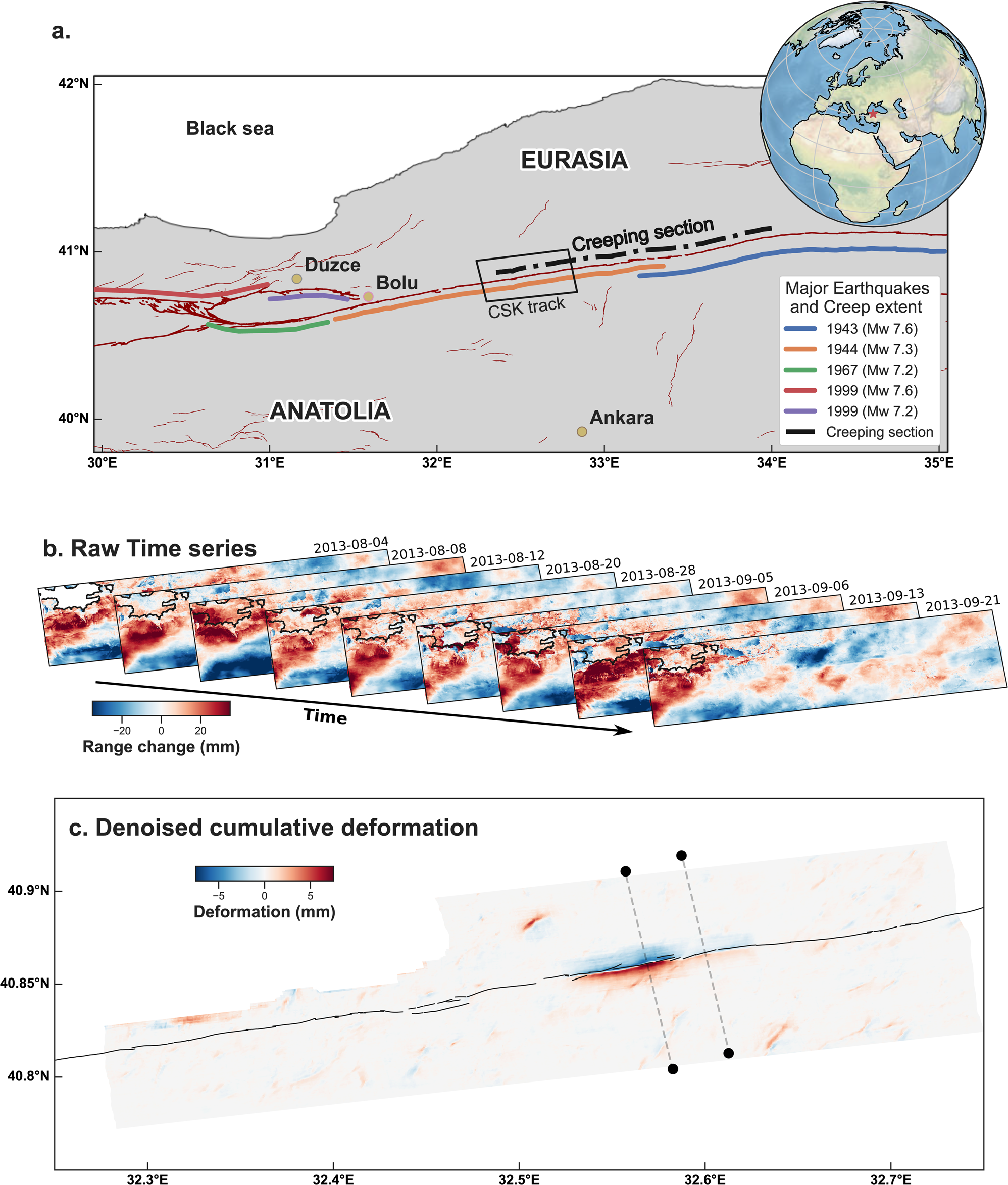
To test their approach, they applied the algorithm to a time series built from images of the North Anatolian fault in Turkey. As a major plate boundary fault, the area has ruptured several times in the past century.
With a finer temporal resolution, the algorithm identified previously undetected slippage events, showing that slow earthquakes happen much more often than expected. It also spotted movement as small as two millimeters, something experts would have overlooked due to the subtlety.
“The use of deep learning unlocks the detection on faults of deformation events an order of magnitude smaller than previously achieved manually. Observing many more slow slip events may, in turn, unveil their interaction with regular, dynamic earthquakes, including the potential nucleation of earthquakes with slow deformation,” Rouet-Leduc said.
The team is currently working on a follow-up study, testing a model on the San Andreas Fault that extends roughly 750 miles through California. According to Rouet-Leduc, the model will soon be available on GitHub.
Read the published research in Nature Communications. >>
Read the press release. >>
 Supply chain shortages are impacting many industries, with semiconductors feeling the crunch in particular. With networking digital twins, you don’t have to wait on the hardware. Get started with infrastructure simulation in NVIDIA Air to stage deployments, test out tools, and enable hardware-free training.
What do Ethernet switches, sports cars, household appliances, and toilet paper have in common? If you read this blog’s title and have lived through the past year and a half, you probably know the answer. These are all products whose availability has been impacted by the materials shortages due to the global pandemic.
In some instances, the supply issues are more of an inconvenience–waiting a few extra months to get that new Corvette won’t be the end of the world. For other products (think toilet paper or a replacement freezer), the supply crunch was and is a big deal.
It is easy to see the impact on consumers, but enterprises feel the pain of long lead times too. Consider Ethernet switches: Ethernet switches build the networking fabric that ties together the data center. Ethernet switch shortages mean more than “rack A is unable to talk to rack B.” They mean decreased aggregate throughput, and increased load on existing infrastructure, leading to more downtime and unplanned outages; that is, significant adverse impacts to business outcomes.
That all sounds bad, but there is no need to panic. NVIDIA can help you mitigate these challenges and transform your operations with a data center digital twin from NVIDIA Air.
So, what is a digital twin, and how is it related to the data center? A digital twin is a software-simulated replica of a real-world thing, system, or process. It constantly reacts and updates any changes to the status of its physical sibling and is always on. A data center digital twin applies the digital twin concept to data center infrastructure. To model the data center itself as a data center and not just a bunch of disparate pizza boxes, it is imperative that the data center digital twin fully simulates the network.
NVIDIA Air is unmatched in providing that capability. The modeling tool in Air enables you to create logical instances of every switch and cable, connecting to logical server instances. In addition to modeling the hardware, NVIDIA Air spins up fully functional virtual appliances with pre-built and fully functional network and server OS images. This is the key ingredient to the digital twin–with an appliance model, the simulation is application-granular.
NVIDIA Air enables data center digital twins, but how does that solve supply chain issues? Focusing on those benefits tied to hardware, in particular, it enables:
One caveat: data center digital twins will not expedite the date that the RTX 3090 comes back in stock at your favorite retailer, but they will help with the crunch around your networking procurement.
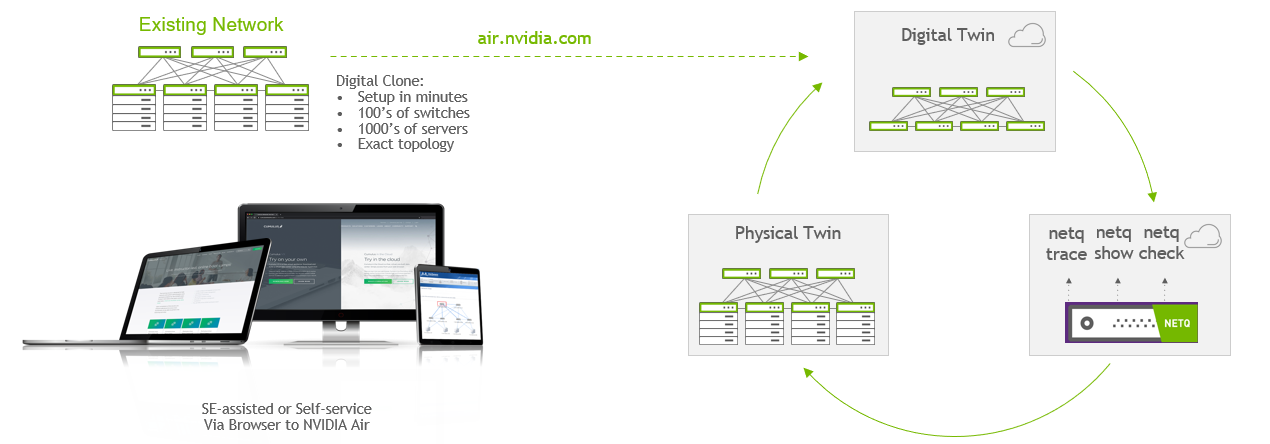
The best part – if you are curious to learn more, you can do so right now. NVIDIA Air brings the public cloud experience to on-premises networking, making it simple and quick to jump right in. Navigate to NVIDIA Air in your browser and get started immediately.
Hello! I’m a long time developer but new to AI-based image processing. The end goal is to process images from cameras and alert when deer (and eventually other wildlife) is detected.
The first step is finding a decent model that can (say) detect deer vs. birds vs. other animals, then running that somewhere. The default The CameraTraps model here allows detecting “animal” vs. “person” vs. “vehicle”:
https://github.com/microsoft/CameraTraps/blob/master/megadetector.md
Would I need to train it further to differentiate between types of animals, or am I missing something with the default model? Or a more general question, how can you see what a frozen model is set up to detect? (I just learned what a frozen model was yesterday)
Appreciate any pointers or if there’s another sub that would be more suited to getting this project setup, happy to post there instead 🙂
submitted by /u/brianhogg
[visit reddit] [comments]