What is the interest in trillion-parameter models? We know many of the use cases today and interest is growing due to the promise of an increased capacity for:…
What is the interest in trillion-parameter models? We know many of the use cases today and interest is growing due to the promise of an increased capacity for: The benefits are great, but training and deploying large models can be computationally expensive and resource-intensive. Computationally efficient, cost-effective, and energy-efficient systems, architected to deliver real-time…
Large language model development is about to reach supersonic speed thanks to a collaboration between NVIDIA and Anyscale. At its annual Ray Summit developers conference, Anyscale — the company behind the fast growing open-source unified compute framework for scalable computing — announced today that it is bringing NVIDIA AI to Ray open source and the Read article >
The broadcast industry is undergoing a transformation in how content is created, managed, distributed, and consumed. This transformation includes a shift from…
The broadcast industry is undergoing a transformation in how content is created, managed, distributed, and consumed. This transformation includes a shift from traditional linear workflows bound by fixed-function devices to flexible and hybrid, software-defined systems that enable the future of live streaming.
Developers can now apply to join the early access program for NVIDIA Holoscan for Media, a software-defined platform for developing and deploying media applications on-prem, in the cloud, and at the edge.
Using Holoscan for Media, broadcasters and solution providers can leverage the latest IT and provisioning technologies and a modern container-based approach to development, orchestration, and delivery.
Holoscan for Media is an IP-based solution built on industry standards and APIs including SMPTE ST 2110, AMWA NMOS, RIST, SRT, and NDI.
The platform integrates open-source and ubiquitous technologies, breaking from the proprietary and inflexible nature of SDI and FPGA-based systems. It also enables incorporation of the latest capabilities in production—such as generative AI—without additional infrastructure investments. With Holoscan for Media, countless NVIDIA application frameworks and SDKs are made accessible to the industry for development.
This framework provides several benefits to both broadcasters and solution providers, including:
Repurposability: Use a single platform for many applications.
Lower TCO: Benefit from the cyclical cost reductions.
Flexibility: The platform is cloud-native and independent of location. An application can be developed once and deployed everywhere.
Sustainability: Provisioning technologies that drive resource sharing means that overall less equipment is required. This means lower power and cooling costs and reduced impact from shipping to and from events. Ultimately, this leads to CO2 reductions.
IP-based platform architecture
NVIDIA Holoscan targets sensor data and media processing applications deployed at-scale across countless industries, in the cloud, on premises, and at the edge. Holoscan for Media tightens the focus on broadcast and live production workflows, with the first target being on-premises deployments.
Figure 1. Holoscan for Media platform architecture
The hardware basis of the platform is therefore NVIDIA-certified systems from our partners, using NVIDIA Ampere architecture or later GPUs and NVIDIA BlueField-2 or later DPUs. The first systems are x86, but the entire software stack is multi-architecture to enable a wide range of systems and use cases with lower power consumption. In production, a minimal Holoscan for Media cluster consists of three nodes, and scales from there.
The software stack begins with Kubernetes, the open-source container orchestration system for automating software deployment, scaling, and management. Partnering with the Red Hat OpenShift Container Platform brings enterprise-grade operation and support.
The inclusion of Kubernetes plug-ins, known as operators, which provide and manage the hardware and underlay services, frees software developers to focus on their unique functionality. The open-source OpenShift Node Tuning Operator, NVIDIA GPU Operator, and NVIDIA Network Operator provide system, GPU, and high-speed secondary networking, tuned for performance and made available to every application that needs them. The GPU Operator can be used to assign one or more entire GPUs to an application.
Support for MIG (Multi-Instance GPU) and vGPU (virtual GPU) enables GPUs to be securely shared between applications. The PTP Operator uses the PTP Hardware Clock on NVIDIA DPUs to provide precise timing from the secondary network to each application through a simple “get time” API. Other operators and plug-ins take care of IP address management (IPAM), DNS zone management, and more.
Holoscan for Media also includes services such as an NMOS Registry and an easy-to-use graph-builder-based NMOS Controller user interface. These can be installed to support development and deployment of applications that act as media nodes and simplify integration with broadcast facility networks.
Applications on the platform are packaged with Helm for simple, consistent deployment. A developer can indicate each container’s required capabilities and resources, including GPU, CPU, memory, and storage. This enables the platform to schedule and monitor applications to ensure each one is appropriately isolated, their requirements are met, and that best use is made of the available hardware.
Developers can build applications using the growing list of NVIDIA SDKs supported on the Holoscan for Media platform. Traditional real-time video encoding and decoding with the Video Codec SDK, GPU-accelerated computer vision by CV-CUDA library, and any parallel compute algorithm using the CUDA toolkit. On top of GPU-accelerated inference through TensorRT SDK or NVIDIA Triton Inference Server, new AI capabilities are offered by SDK and Cloud APIs like Maxine or NVIDIA Avatar Cloud Engine (ACE). Foundational SMPTE 2110 support and optimization of large media transfer is provided through NVIDIA Rivermax SDK. Developers can natively leverage Rivermax on the platform or through the DeepStream SDK, a complete streaming analytics toolkit based on GStreamer for AI-based media processing. Additionally, if developers have wider use cases beyond media, and want to consume and control other sensor types, NVIDIA provides the Holoscan SDK for creating real-time, AI-enabled sensor processing pipelines that meet latency requirements and scale from the data center to the edge.
Full source for a containerized reference application is available to Holoscan for Media developers. This uses NVIDIA DeepStream and can be configured as an NMOS-capable ST 2110 transmitter, receiver or transcoder gateway.
Altogether, this open platform architecture provides the building blocks for the Dynamic Media Facility, using the latest scalable IT and provisioning technologies and open standards to benefit both broadcasters and software vendors.
Get started with Holoscan for Media
Holoscan for Media is now available for early access. Note that you must be registered in the NVIDIA Developer Program to apply for the early access release. You must also be logged in using your organization’s email address. We cannot accept applications from accounts using Gmail, Yahoo, QQ, or other personal email accounts.
To participate, fill out the short application form and provide details about your use case.
GFN Thursday is downright demonic, as Devil May Cry 5 comes to GeForce NOW. Capcom’s action-packed third-person brawler leads 15 titles joining the GeForce NOW library this week, including Gears Tactics and The Crew Motorfest. It’s also the last week to take on the Ultimate KovaaK’s Challenge. Get on the leaderboard today for a chance Read article >
Generative AI-based models can not only learn and understand natural languages — they can learn the very language of nature itself, presenting new possibilities for scientific research. Anima Anandkumar, Bren Professor at Caltech and senior director of AI research at NVIDIA, was recently invited to speak at the President’s Council of Advisors on Science and Read article >
Crossing the chasm and reaching its iPhone moment, generative AI must scale to fulfill exponentially increasing demands. Reliability and uptime are critical for…
Crossing the chasm and reaching its iPhone moment, generative AI must scale to fulfill exponentially increasing demands. Reliability and uptime are critical for building generative AI at the enterprise level, especially when AI is core to conducting business operations. NVIDIA is investing its expertise into building a solution for those enterprises ready to take the leap.
Introducing NVIDIA AI Enterprise 4.0
The latest version of NVIDIA AI Enterprise accelerates development through multiple facets with production-ready support, manageability, security, and reliability for enterprises innovating with generative AI.
Quickly train, customize, and deploy LLMs at scale with NVIDIA NeMo
Generative AI models have billions of parameters and require an efficient data training pipeline. The complexity of training models, customization for domain-specific tasks, and deployment of models at scale require expertise and compute resources.
NVIDIA AI Enterprise 4.0 now includes NVIDIA NeMo, an end-to-end, cloud-native framework for data curation at scale, accelerated training and customization of large language models (LLMs), and optimized inference on user-preferred platforms. From cloud to desktop workstations, NVIDIA NeMo provides easy-to-use recipes and optimized performance with accelerated infrastructure, greatly reducing time to solution and increasing ROI.
Build generative AI applications faster with AI workflows
NVIDIA AI Enterprise 4.0 introduces two new AI workflows for building generative AI applications: AI chatbot with retrieval augmented generation and spear phishing detection.
The generative AI knowledge base chatbot workflow, leveraging Retrieval Augmented Generation, accelerates the development and deployment of generative AI chatbots tuned on your data. These chatbots accurately answer domain-specific questions, retrieving information from a company’s knowledge base and generating real-time responses in natural language. It uses pretrained LLMs, NeMo, NVIDIA Triton Inference Server, along with third-party tools including Langchain and vector database, for training and deploying the knowledge base question-answering system.
Defending against spear-phishing e-mails is a challenge. Spear phishing e-mails are indistinguishable from benign e-mails, with the only difference between the scam and legitimate e-mail being the intent of the sender. This is why traditional mechanisms for detecting spear phishing fall short.
Develop AI anywhere
Enterprise adoption of AI can require additional skilled AI developers and data scientists. Organizations will need a flexible high-performance infrastructure consisting of optimized hardware and software to maximize productivity and accelerate AI development. Together with NVIDIA RTX 6000 Ada Generation GPUs for workstations, NVIDIA AI Enterprise 4.0 provides AI developers a single platform for developing AI applications and deploying them in production.
Beyond the desktop, NVIDIA offers a complete infrastructure portfolio for AI workloads including NVIDIA H100, L40S, L4 GPUs, and accelerated networking with NVIDIA BlueField data processing units. With HPE Machine Learning Data Management, HPE Machine Learning Development Environment, Ubuntu KVM and Nutanix AHV virtualization support, organizations can use on-prem infrastructure to power AI workloads.
Manage AI workloads and infrastructure
NVIDIA Triton Management Service, an exclusive addition to NVIDIA AI Enterprise 4.0, automates the deployment of multiple Triton Inference Servers in Kubernetes with GPU resource-efficient model orchestration. It simplifies deployment by loading models from multiple sources and allocating compute resources. Triton Management Service is available for lab experience on NVIDIA LaunchPad.
NVIDIA AI Enterprise 4.0 also includes cluster management software, NVIDIA Base Command Manager Essentials, for streamlining cluster provisioning, workload management, infrastructure monitoring, and usage reporting. It facilitates the deployment of AI workload management with dynamic scaling and policy-based resource allocation, providing cluster integrity.
New AI software, tools, and pretrained foundation models
NVIDIA AI Enterprise 4.0 brings more frameworks and tools to advance AI development. NVIDIA Modulus is a framework for building, training, and fine-tuning physics-machine learning models with a simple Python interface.
Using Modulus, users can bolster engineering simulations with AI and build models for enterprise-scale digital twin applications across multiple physics domains, from CFD and Structural to Electromagnetics. The Deep Graph Library container is designed to implement and train Graph Neural Networks that can help scientists research the graph structure of molecules or financial services to detect fraud.
Lastly, three exclusive pretrained foundation models, part of NVIDIA TAO, speed time to production for industry applications such as vision AI, defect detection, and retail loss prevention.
NVIDIA AI Enterprise 4.0 is the most comprehensive upgrade to the platform to date. With enterprise-grade security, stability, manageability, and support, enterprises can expect reliable AI uptime and uninterrupted AI excellence.
Get started with NVIDIA AI Enterprise
Three ways to get accelerated with NVIDIA AI Enterprise:
Sign up for NVIDIA LaunchPad for short-term access to sets of hands-on labs.
Sign up for a free 90-day evaluation for existing on-prem or cloud infrastructure.
Organizations are integrating machine learning (ML) throughout their systems and products at an unprecedented rate. They are looking for solutions to help deal…
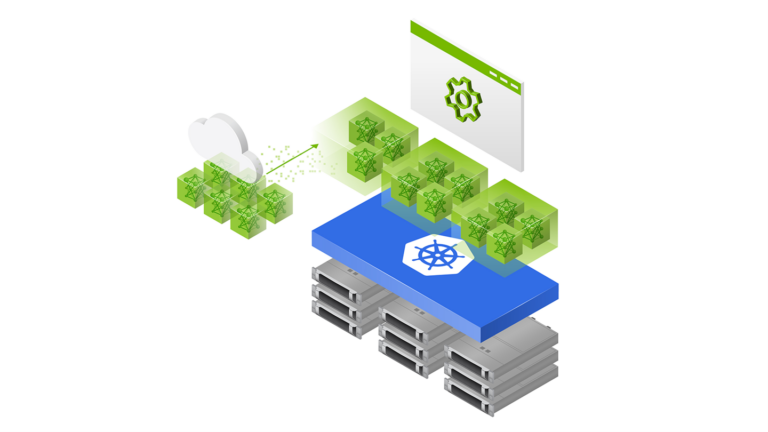
Organizations are integrating machine learning (ML) throughout their systems and products at an unprecedented rate. They are looking for solutions to help deal with the complexities of deploying models at production scale.
NVIDIA Triton Management Service (TMS), exclusively available with NVIDIA AI Enterprise, is a new product that helps do just that. Specifically, it helps manage and orchestrate a fleet of NVIDIA Triton Inference Servers in a Kubernetes cluster. TMS enables users to scale their NVIDIA Triton deployments to handle large and varied workloads efficiently. It also improves the developer experience of coordinating the resources and tools required.
This post explores some of the most common challenges developers and MLOps teams face when deploying models at scale, and how NVIDIA Triton Management Service addresses them.
Challenges in scaling AI model deployment
Model deployments of any scale come with their own sets of challenges. Developers need to consider how to balance a variety of frameworks, model types, and hardware while maximizing performance and interfacing with the other components of the environment.
NVIDIA Triton is a powerful solution built to handle these issues and extract the best throughput and performance from the machine it’s deployed on. But as organizations incorporate AI into more of their core workflows, the number and size of inference workloads can grow beyond what a single server can handle. The model deployments have to scale. A new scale of deployment brings with it a new set of challenges—challenges related to the cost and complexity of managing distributed inference workloads.
Cost of deployment
As you deploy more models and find more use cases for them, it can quickly become necessary to scale out deployments to make use of a cluster of resources. A simple approach is to keep scaling your cluster linearly as you add more models, keeping all of your models live and ready for inference at all times.
However, this is not an approach with infinite scale potential. Focusing on expanding the capacity of your serving cluster can result in unnecessary expenses when you have the option to improve utilization of currently available hardware. You will also have to deal with the logistical challenges of adding more resources on premises, or bumping up against quota limits in the cloud.
Other approaches to scaling might appear less expensive, but can lead to steep performance trade-offs. For example, you could wait to load the models into memory until the inference requests come in, leading to long waits and an extended time-to-first-inference. Or you could overcommit your compute resources, leading to performance penalties from context switching during execution and errors from running out of memory on the device.
With careful preplanning and colocation of workloads, you can avoid some of the worst of these issues. Still, that only exacerbates the second major issue of large-scale deployments.
Operational complexity
At a small scale and early in the development of a process that requires model orchestration, it can be viable to manually configure and deploy your models. But as your ML deployments scale, it becomes increasingly challenging to coordinate all of the necessary resources. You need to manage when to launch or scale servers, where to load particular models, how to route requests to the right place, and how to handle the model lifecycle in your environment.
Determining which models can be colocated adds another layer of complexity to these deployments. Large models might exceed the memory capacity of your GPU or CPU if loaded concurrently into the same device. Some frameworks (such as PyTorch and TensorFlow) hold on to any memory allocated to them even after the models are unloaded, leading to inefficient utilization when models from those frameworks are run alongside models from other frameworks.
In general, different models will have different requirements regarding resource allocation and server configuration, making it difficult to standardize on a single type of deployment.
Cost-efficient deployment and scaling of AI models
Triton Management Service addresses these challenges with three main strategies: simplifying Triton Inference Server deployment, maximizing resource usage, and monitoring/scaling Triton inference servers.
Simplifying deployment
TMS automates the deployment and management of Triton server instances on Kubernetes using a simplified gRPC API and command-line tool. With these interfaces, you don’t need to write out extensive code or config files for creating deployments, services, and Kubernetes resources. Instead, you can use the API or CLI to easily launch Triton servers and automatically load models onto these servers as needed.
TMS also employs a method of grouping to optimize GPU or CPU memory utilization. This prevents issues that arise when different frameworks like PyTorch and TensorFlow models run on the same server and fail to release unused GPU or CPU? memory to each other.
Maximizing resources
TMS loads models on-demand and unloads them using a lease system when they are not in use, making sure that models are not kept active in the cluster unnecessarily. To bring up a model, you can submit an API request with a specified timeline or a checking mechanism. The system will keep the model available if it’s being used; otherwise, it will be taken down.
TMS also automatically colocates models on the same device when sufficient capacity is available. To enable this, you need to prespecify the expected GPU memory use of your models during deployment. While there is no automated way to measure this yet, you can rely on Triton Model Analyzer and other benchmarking tools to determine memory requirements beforehand. Together, these features enable you to run more workloads on your existing clusters, saving on costs, and reducing the need to acquire more computational resources.
Monitoring and autoscaling
TMS keeps track of the health and capacity of various Triton servers for high availability reasons. Autoscaling is integrated into the system, enabling TMS to deploy Kubernetes Horizontal Pod Autoscalers automatically based on the model deployment configuration. You can specify metrics for autoscaling, indicating the conditions under which scaling should occur. Load balancing is also applied when autoscaling is implemented across multiple Triton instances.
How Triton Management Service works
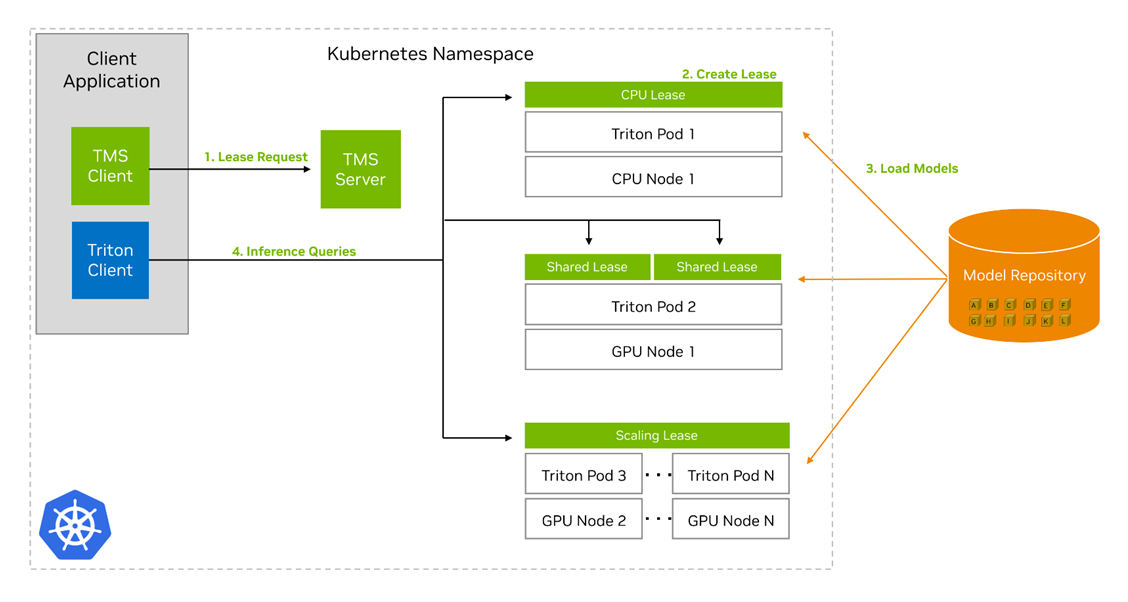
Figure 1. Overall orchestration flow for NVIDIA Triton Management Service
To install TMS, deploy a Helm chart with configurable values into a Kubernetes cluster. This Helm chart delpoys the TMS Server control plane into the cluster, along with a config map that holds many of the configuration settings for TMS. You can operate TMS through gRPC API calls to the TMS Server, or by using the provided tmsctl command-line tool.
The key concept in TMS is the lease. At its core, a lease is a grouping of models and some associated metadata that tells TMS how to treat those models, and what constraints exist for their deployment. Users can create, renew, and release leases. Creating a lease requires specifying a set of models from predefined repositories by a unique identifier, along with metadata including:
Compute resources required by the lease
Image/version of Triton to use for this lease
Minimum duration of the lease
Window size for detecting activity on the models in the lease
Metrics and thresholds for scaling the lease
Constraints on what models or leases with with the new lease can be collected
A unique name for the lease that can be used to addressed it
When the TMS Server receives the lease request, it performs the actions listed below to create the lease:
Check the model repositories to see if the models are present and accessible.
If models are present and accessible, check for existing Triton Inference Servers present in the cluster that meet the constraints of the new lease.
Otherwise, choose one of the existing Triton pods to add the lease to.
In either case, the Triton Sidecar in the Triton Pod will pull the models in your lease from the repository and load them into its paired Triton server.
TMS will also create several other Kubernetes resources to help with management and routing for the lease:
A deployment that will revive Triton pods if they crash.
A Kubernetes service based on the lease name that can be used to address the models in the lease.
A horizontal pod autoscaler to automatically create replicas of the Triton pods based on the metrics and thresholds defined in the lease.
Once the lease has been created, you can use the Triton Inference Server API or an existing Triton client to send inference requests to the server for execution. The Triton client does not need any modifications to work with Triton Inference Servers deployed by Triton Management Service.
Get started with NVIDIA Triton Management Service
To get started with NVIDIA Triton Management Service and learn more about its features and functionality, check out the AI Model Orchestration with Triton Management Service lab on LaunchPad. This lab provides free access to a GPU-enabled Kubernetes cluster and a step-by-step guide on installing Triton Management Service and using it to deploy a variety of AI workloads.
In an event at the White House today, NVIDIA announced support for voluntary commitments that the Biden Administration developed to ensure advanced AI systems are safe, secure and trustworthy. The news came the same day NVIDIA’s chief scientist, Bill Dally, testified before a U.S. Senate subcommittee seeking input on potential legislation covering generative AI. Separately, Read article >

 What is the interest in trillion-parameter models? We know many of the use cases today and interest is growing due to the promise of an increased capacity for:…
 The broadcast industry is undergoing a transformation in how content is created, managed, distributed, and consumed. This transformation includes a shift from…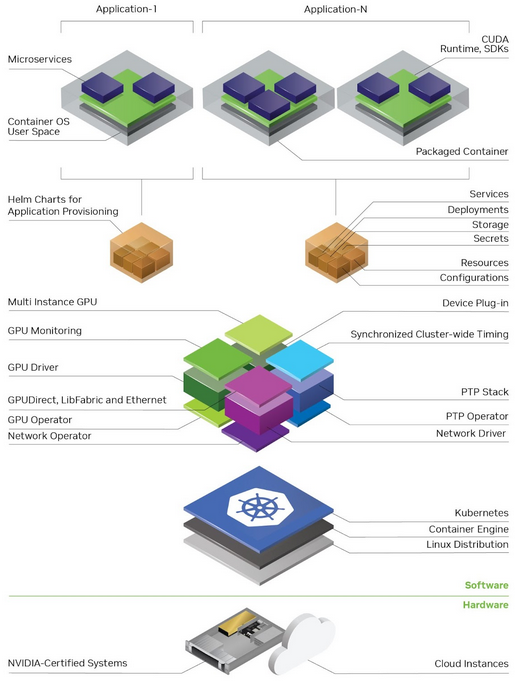
 Streamline and accelerate deployment by integrating ETL and ML training into a single Apache Spark script on Amazon EMR.
 Explore generative AI concepts and applications, along with challenges and opportunities in this self-paced course.
 Crossing the chasm and reaching its iPhone moment, generative AI must scale to fulfill exponentially increasing demands. Reliability and uptime are critical for…
 Organizations are integrating machine learning (ML) throughout their systems and products at an unprecedented rate. They are looking for solutions to help deal…