Categories
Misc

Creating Immersive Events with OpenUSD and Digital Twins

Moment Factory is a global multimedia entertainment studio that combines specializations in video, lighting, architecture, sound, software, and interactivity to…

Moment Factory is a global multimedia entertainment studio that combines specializations in video, lighting, architecture, sound, software, and interactivity to create immersive experiences for audiences around the world. 

From live performances and multimedia shows to interactive installations, Moment Factory is known for some of the most awe-inspiring and entertaining experiences that bring people together in the real world. These include dazzling visuals at Billie Eilish’s Happier Than Ever world tour, Lumina Night Walks at natural sites around the world, and digital placemaking at the AT&T Discovery District.

With a team of over 400 professionals and offices in Montreal, Tokyo, Paris, New York City, and Singapore, Moment Factory has become a global leader in the entertainment industry.

Billie Eilish on stage during her Happier Than Ever world tour
Figure 1. Billie Eilish engaged Moment Factory to oversee creative direction, stage design, and content creation for her Happier Than Ever world tour

Streamlining immersive experience development with OpenUSD

Bringing these experiences to life requires large teams of highly skilled experts with diverse specialties, all using unique tools. To achieve optimal efficiency in their highly complex production processes, Moment Factory looked to implement an interoperable open data format and development platform that could seamlessly integrate all aspects, from concept to operation.

Moment Factory chose Universal Scene Description, also known as OpenUSD, as the solution. OpenUSD is an extensible framework and ecosystem for describing, composing, simulating, and collaborating within 3D worlds. NVIDIA Omniverse is a software platform that enables teams to develop OpenUSD-based 3D workflows and applications. It provides the unified environment to visualize and collaborate on digital twins in real time with live connections to Moment Factory’s tools.

Using OpenUSD with Omniverse enables Moment Factory to unify data from their diverse digital content creation (DCC) tools to form a digital twin of a real-world environment. Every member of the team can interact with this digital twin and iterate on their aspect of the project without affecting other elements

For example, a scenographer can work on a base set and unique scene pieces using Vectorworks, 3D design software. At the same time in the same scene, an AV (audio visual) and lighting designer can take care of lighting and projectors with Moment Factory’s proprietary live entertainment operating system and virtual projection mapping software, X-Agora.

Simultaneously, artists and designers can render and create eye-catching visuals in the scene using tools like Epic Games Unreal Engine, Blender, and Adobe Photoshop—without affecting layers of the project still in progress.

“USD is unique in that it can be fragmented into smaller pieces that enable people to work on their own unique parts of a project while staying connected,” said Arnaud Grosjean, solution architect and project lead for Moment Factory’s Innovation Team. “Its flexibility and interoperability allows us to create powerful, custom 3D pipelines.”
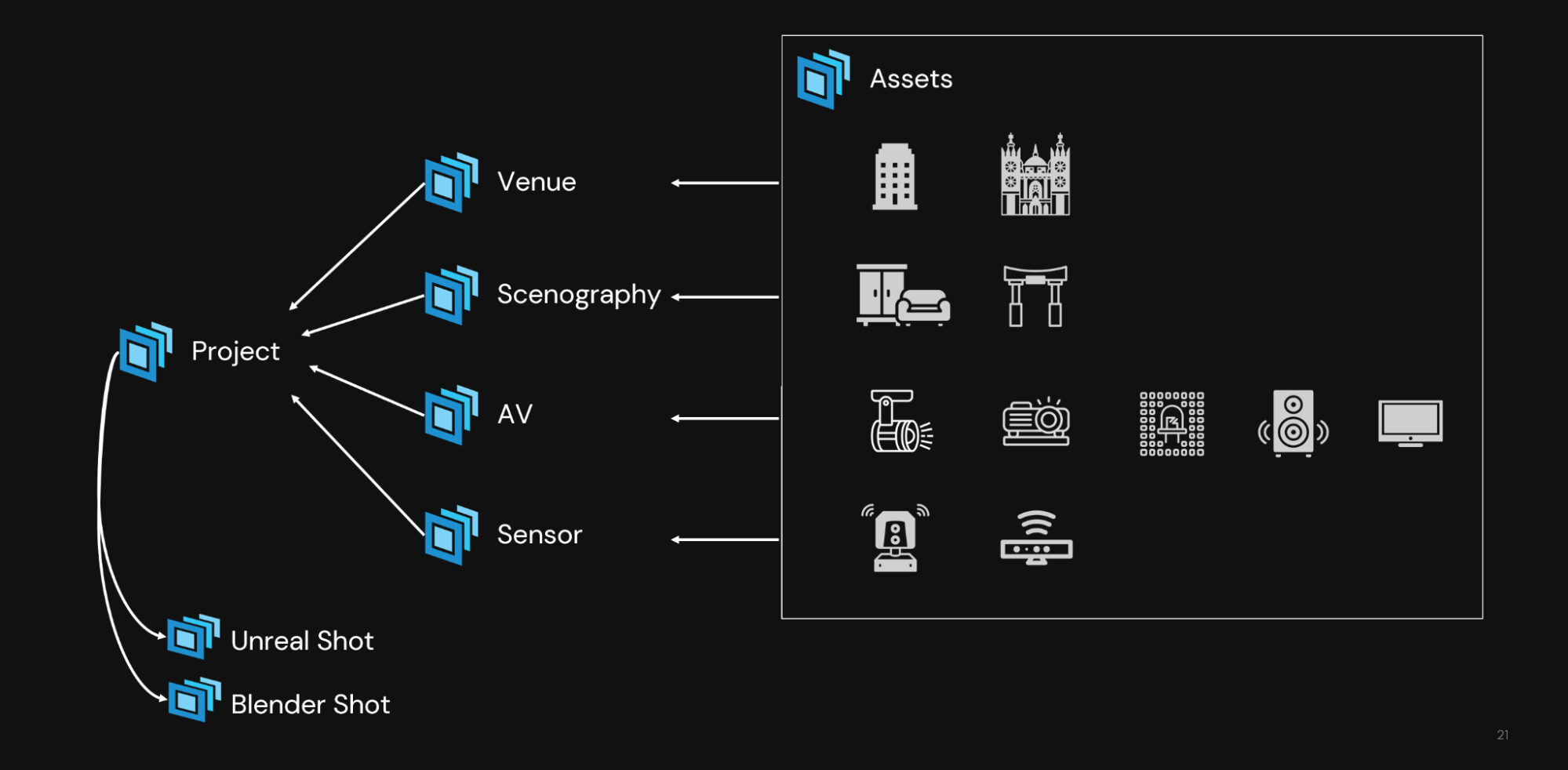
Diagram of USD scenes composition, including nondestructive layers such as venue, scenography, AV, and sensor data from diverse data sources.
Figure 2. USD scenes are composed of nondestructive layers such as venue, scenography, AV, and sensor data from diverse data sources

Digital twins simulate real-world experiences 

To simulate immersive events before deploying them in the real world, Moment Factory is developing digital twins of their installations in NVIDIA Omniverse. Omniverse, a computing platform that enables teams to develop OpenUSD-based 3D workflows and applications, provides the unified environment to visualize and collaborate on digital twins in real time with live connections to DCC tools.

The first digital twin they’ve created is that of Blackbox, which serves as an experimentation and prototyping space where they can preview fragments of immersive experiences before real-world deployment. It is a critical space for nearly every phase of the project lifecycle, from conception and design to integration and operation. 

To build the digital twin of the Blackbox, Moment Factory used USD Composer, a fully customizable foundation application built on NVIDIA Omniverse.
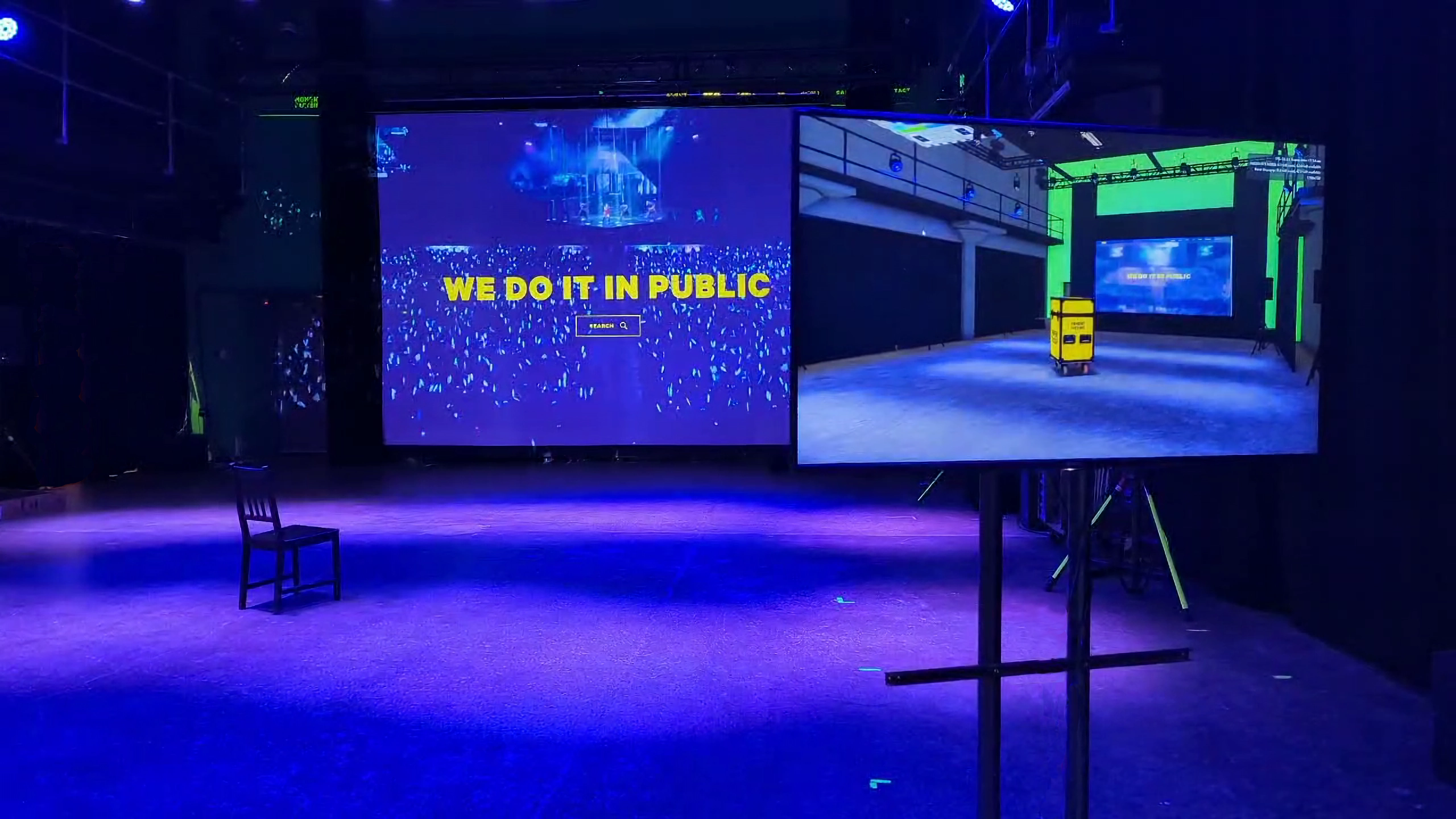
Moment Factory digital twin
Figure 3. Live video projection and lighting in the Blackbox is reflected in real time in the digital twin of the Blackbox, shown in the screen on the right

The virtual replica of the installation enables the team to run innumerable iterations on the project to test for various factors. They can also better sell concepts for immersive experiences to prospective customers, who can see the show before live production in a virtual environment.

One of the key challenges in the process for building large-scale immersive experiences is reaching a consensus among various stakeholders and managing changes. 

“Everyone has their own idea of how a scene should be structured, so we needed a way to align everyone contributing to the project in a unified, dynamic environment” explained Grosjean. “With the digital twin, potential ideas can be tested and simulated with stakeholders across every core expertise.”

As CAD drafters, AV designers, interactive designers, and others contribute to the digital twin of the Blackbox, artists and 2D/3D designers can render and experiment with beauty shots of the immersive experience in action.

To see the digital twin of the Blackbox in action, join the Omniverse Livestream with Moment Factory on Wednesday, September 13.

Developing Omniverse Connectors and extensions

Moment Factory is continuously building and testing extensions for Omniverse to bring new functionalities and possibilities into their digital twins.

They developed an Omniverse Connector for X-Agora, their proprietary multi-display software that allows you to design, plan and operate shows. The software now has a working implementation of a Nucleus connection, USD import/export, and an early live mode implementation.

Video projection is a key element of immersive events. The team will often experiment with mapping and projecting visual content onto architectural surfaces, scenic elements, and sometimes even moving objects, transforming static spaces into dynamic and captivating environments.

NDI, which stands for Network Design Interface, is a popular IP video protocol developed by NewTek that allows for efficient live video production and streaming across interconnected devices and systems. In their immersive experiences, Moment Factory typically connects a media system to physical projectors using video cables. With NDI, they can replicate this connection within a virtual venue, effectively simulating the entire experience digitally. 

To enable seamless connectivity between the Omniverse RTX Renderer and their creative content, Moment Factory developed an NDI extension for Omniverse. The extension supports more than just video projection and allows the team to simulate LED walls, screens, and pixel fields to mirror their real-world setup in the digital twin.

The extension, which was developed with Omniverse Kit, also enables users to use video feeds as dynamic textures. Developers at Moment Factory used the kit-cv-video-example and kit-dynamic texture-example to develop the extension.

Anyone can access and use Moment Factory’s Omniverse-NDI-extension on GitHub, and install it on the Omniverse Launcher or launch with:

$ ./link_app.bat --app create
$ ./app/omni.create.bat --/rtx/ecoMode/enabled=false --ext-folder exts --enable mf.ov.ndi

Extensions in Omniverse serve as reusable components or tools that developers can build to accelerate and add new functionalities for 3D workflows. They can be built for simple tasks like randomizing objects or used to enable more complex workflows like visual scripting.

The team also developed an extension for converting MPDCI, a VESA standard describing multiprojector rigs, to USD called the Omniverse-MPCDI-converter. They are currently testing extensions for MVR (My Virtual Rig) and GDTF (General Device Type Format) Converters to import lighting fixtures and rigs into their digital twins. 

Even more compelling is a lidar UDP simulator extension, which is being developed to enable sensor simulation in Omniverse and connect synthetic data to lidar-compatible software.

You can use Moment Factory’s NDI and MPDCI extensions today in your workflows. Stay tuned for new extensions coming soon.

To build extensions like Moment Factory, get started with all the Omniverse Developer Resources you’ll need, like  documentation, tutorials, USD resources, GitHub samples, and more.

Get started with NVIDIA Omniverse by downloading the standard license free, or learn how Omniverse Enterprise can connect your team

Developers can check out these Omniverse resources to begin building on the platform. 

Stay up to date on the platform by subscribing to the newsletter and following NVIDIA Omniverse on Instagram, LinkedIn, Medium, Threads, and Twitter.

For more, check out our forums, Discord server, Twitch, and YouTube channels.
Categories
Misc

Leading MLPerf Inference v3.1 Results with NVIDIA GH200 Grace Hopper Superchip Debut

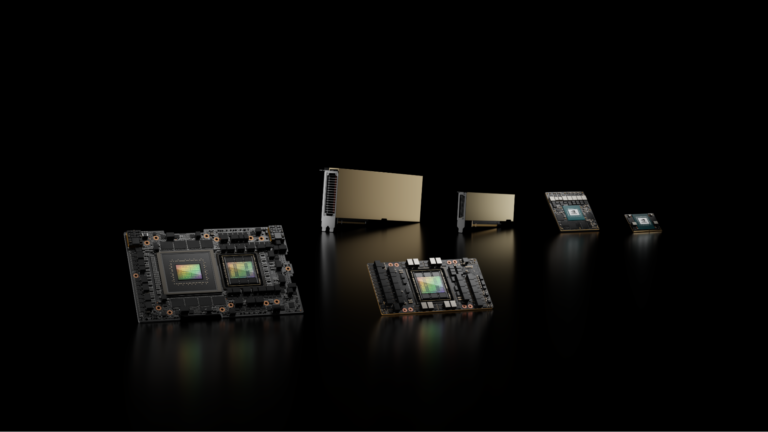
NVIDIA Jetson Orin modules.AI is transforming computing, and inference is how the capabilities of AI are deployed in the world’s applications. Intelligent chatbots, image and video…NVIDIA Jetson Orin modules.
AI is transforming computing, and inference is how the capabilities of AI are deployed in the world’s applications. Intelligent chatbots, image and video synthesis from simple text prompts, personalized content recommendations, and medical imaging are just a few examples of AI-powered applications.

Inference workloads are both computationally demanding and diverse, requiring that platforms be able to process many predictions on never-seen-before data quickly as well as run inference on a breadth of AI models. Organizations looking to deploy AI need a way to evaluate the performance of infrastructure objectively across a breadth of workloads, environments, and deployment scenarios. This is true for both AI training and inference.

MLPerf Inference v3.1, developed by the MLCommons consortium, is the latest edition of an industry-standard AI inference benchmark suite. It complements MLPerf Training and MLPerf HPC. MLPerf Inference v3.1 measures inference performance across a variety of important workloads, including image classification, object detection, natural language processing, speech recognition, and recommender systems, across common data center and edge deployment scenarios.

MLPerf Inference v3.1 includes two important updates to better reflect modern AI use cases:

  • The addition of a large language model (LLM) test based on GPT-J–an open source, 6B-parameter LLM–to represent text summarization, a form of generative AI.
  • An updated DLRM test with a new model architecture and a substantially larger dataset that mirrors the DLRM update introduced in MLPerf Training v3.0. The update better reflects the scale and complexity of modern recommender systems.

Powered by the full NVIDIA AI Inference software stack, including the latest TensorRT 9.0, NVIDIA made submissions in MLPerf Inference v3.1 using a wide array of products. These included the debut submission of the NVIDIA GH200 Grace Hopper Superchip, which extended the great per-accelerator performance delivered by the NVIDIA H100 Tensor Core GPU. NVIDIA also submitted the NVIDIA L4 Tensor Core GPU for mainstream servers, as well as both the NVIDIA Jetson AGX Orin and Jetson Orin NX platforms for edge AI and robotics.  

The rest of this post provides highlights of the NVIDIA submissions as well as a peek into how these exceptional results were achieved.

Grace Hopper Superchip extends NVIDIA Hopper inference performance

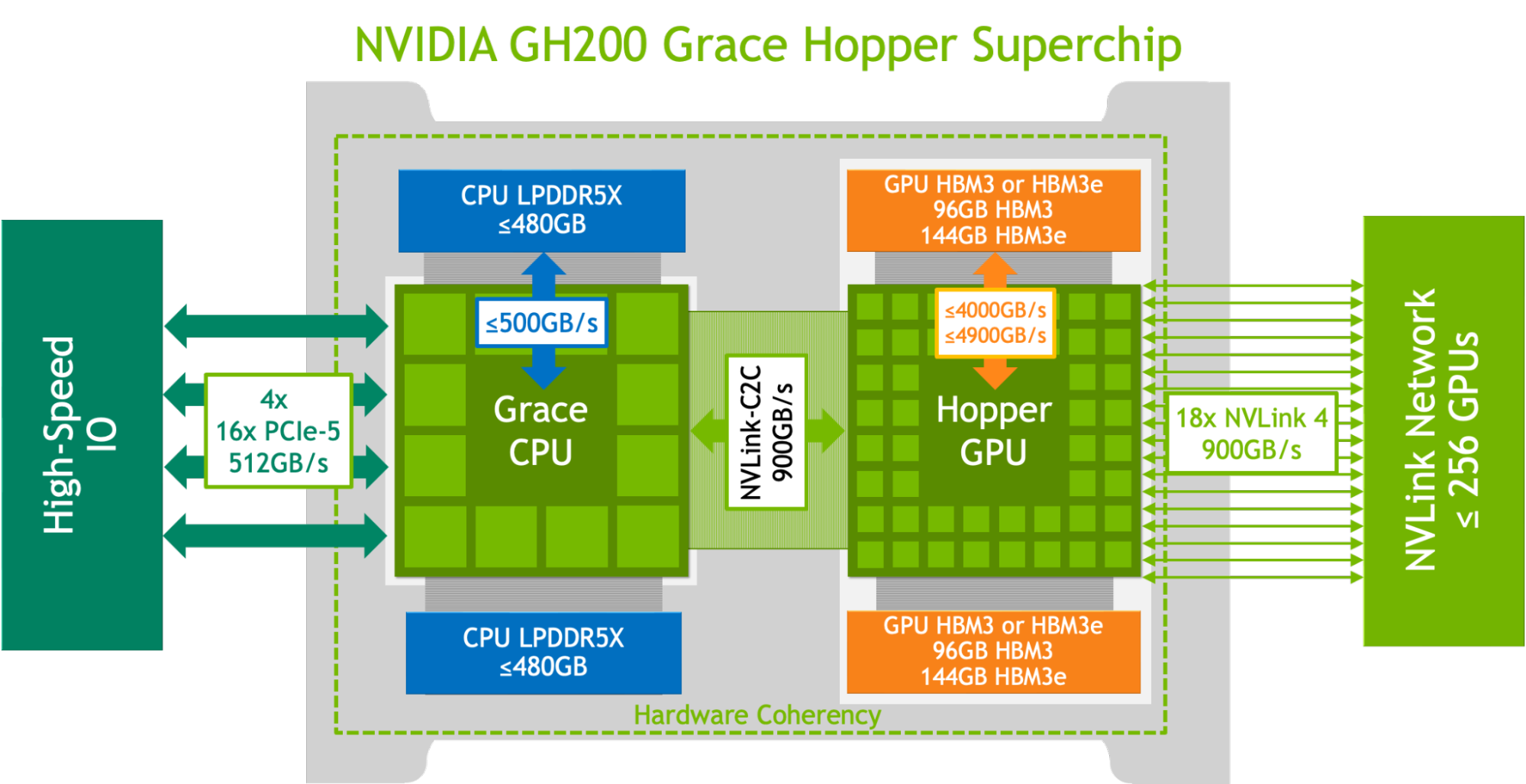
The NVIDIA GH200 Grace Hopper Superchip combines the NVIDIA Hopper GPU and the NVIDIA Grace CPU through the coherent NVLink-C2C at 900 GB/s to create a single superchip. That’s 7x higher than PCIe Gen5 at 5x lower power. It also incorporates up to 576 GB of fast access memory through the combination of 96 GB of HBM3 GPU memory and up to 480 GB of low-power, high-bandwidth LPDDR5X memory.

The GH200 Grace Hopper Superchip has integrated power management features that enable the GH200 to take advantage of the energy efficiency of the Grace CPU to balance efficiency and performance. For more information, see NVIDIA Grace Hopper Superchip Architecture In-Depth and the NVIDIA Grace Hopper Superchip Architecture whitepaper.

Diagram shows the GH200 with 96 GB HBM3 was used for MLPerf Inference v3.1 submission.
Figure 1. Logical overview of the NVIDIA GH200 Grace Hopper Superchip

The NVIDIA GH200 Grace Hopper Superchip is designed for the versatility required to deliver leading performance across compute and memory-intensive workloads. It also delivers substantially higher performance on the most demanding frontier workloads, such as large transformer-based models with hundreds of billions or trillions of parameters, recommender systems with multi-terabyte embedding tables, and vector databases.

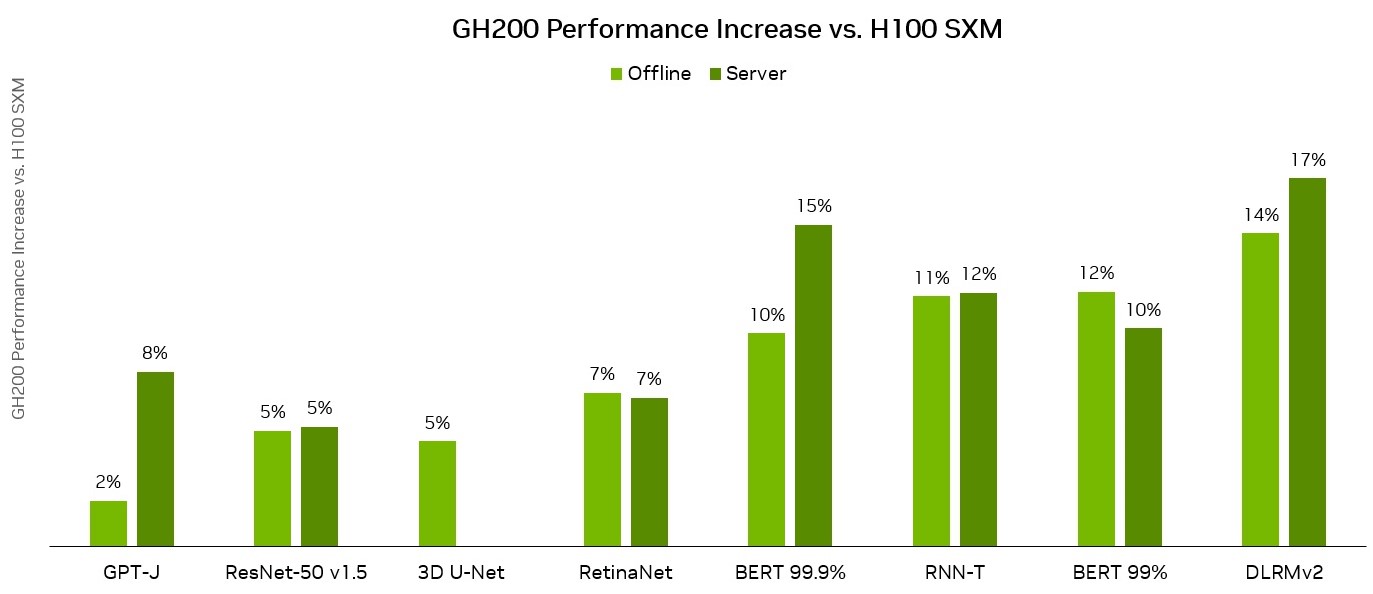
In addition to being built for the most intensive AI workloads, the GH200 Grace Hopper Superchip also shines on the popular, mainstream workloads tested by MLPerf Inference. It ran every test, demonstrating its seamless support for the full NVIDIA software stack. It extended the exceptional performance achieved by NVIDIA’s single H100 SXM submission on every workload.

Bar chart shows that NVIDIA Grace Hopper delivered up to 17% better performance than H100 SXM with the help of larger memory capacity, wider memory bandwidth, and sustaining higher GPU clock frequency.
Figure 2. NVIDIA Grace Hopper MLPerf Inference data center performance results compared to DGX H100 SXM

MLPerf Inference: Datacenter v3.1, Closed. Submission IDs: NVIDIA 3.1-0107(1xH100 SXM), 3.1-0110(1xGH200 Grace Hopper Superchip)
The MLPerf name and logo are trademarks of MLCommons Association in the United States and other countries. All rights reserved. Unauthorized use strictly prohibited. For more information, see www.mlcommons.org.

The GH200 Grace Hopper Superchip incorporates 96 GB of HBM3 and provides up to four TB/s of HBM3 memory bandwidth, compared to 80 GB and 3.35 TB/s for H100 SXM, respectively. This larger memory capacity, as well as greater memory bandwidth, enabled the use of larger batch sizes for workloads on the NVIDIA GH200 Grace Hopper Superchip compared to the NVIDIA H100 SXM. For example, both RetinaNet and DLRMv2 ran with up to double the batch sizes in the Server scenario and 50% greater batch sizes in the Offline scenario.

The GH200 Grace Hopper Superchip’s high-bandwidth NVLink-C2C link between the NVIDIA Hopper GPU and the Grace CPU enables fast communication between the CPU and GPU, which can help boost performance.

For example, in the MLPerf DLRMv2 workload, transferring a batch of tensors over PCIe takes approximately 22% of the batch inference time on H100 SXM. The GH200 Grace Hopper Superchip, however, performed the same transfer using just 3% of the inference time as a result of NVLink-C2C.

Thanks to higher memory bandwidth and larger memory capacity, the Grace Hopper Superchip delivered up to 17% higher per-chip performance advantage compared to the H100 GPU on MLPerf Inference v3.1 workloads. These results showcase the performance and versatility of both the GH200 Grace Hopper Superchip and the NVIDIA software stack.

Optimizing GPT-J 6B for LLM inference

To represent LLM inference workloads, MLPerf Inference v3.1 introduces a new test based on the GPT-J 6B model: an LLM with 6B parameters. The task tested by the new benchmark is text summarization using the CNN/DailyMail dataset.

The NVIDIA platform delivered strong results on the GPT-J workload, with GH200 Grace Hopper Superchip delivered the highest per-accelerator performance on both the Offline and Server scenarios on a per-accelerator basis. The NVIDIA L4 GPU also delivered strong performance, outpacing the best CPU-only result up to 6x in a 1-slot PCIe card with a thermal design power (TDP) of just 72 Watts.

To achieve these results, NVIDIA software for LLM inference intelligently applies both FP8 and FP16 precisions to increase performance while also meeting target accuracy requirements.

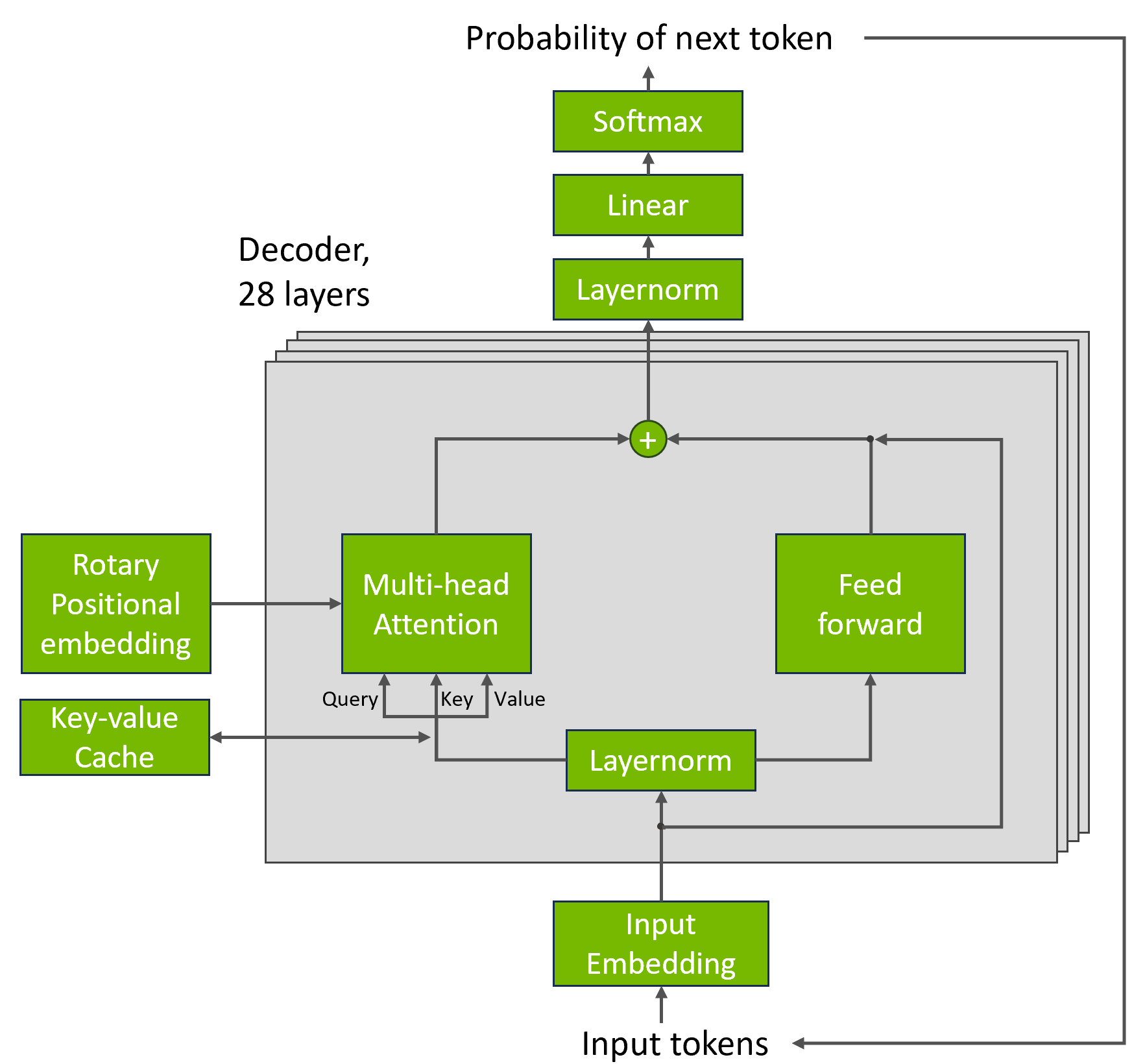
A key challenge for performing GPT-J inference is the high memory consumption of the key-value (KV) cache in the transformer block. By storing the KV cache in the FP8 data format, the NVIDIA submission significantly increased the batch size used. This boosted GPU memory utilization and enabled better use of the immense compute performance of NVIDIA GPUs.

Diagram shows the architecture of the GPT-J model, including input, output, and internal mechanism.
Figure 3. GPT-J architecture

Enabling DLRM-DCNv2 submissions

MLPerf Inference v3.1 introduced an update to the DLRMv1 model used in prior versions of the benchmark. This DLRMv2 model replaces the interactions layer with a three-layer DCNv2 cross network. DLRMv2 also uses multi-hot categorical inputs rather than one-hot, which are synthetically generated from the Criteo Terabyte Click Logs Dataset.

One of the challenges of recommender inference arises from fitting the embedding tables on the system. By converting the model to FP16 precision, including the embedding table, we could both improve performance and halve the memory footprint of the embedding table, reducing it to 49 GB. This enables the entire embedding table to fit within a single H100 GPU. 

To enable our submission on the L4 GPU, which has 24 GB of memory, NVIDIA software intelligently splits the embedding table between GPU and host memory using row-frequency data obtained by analyzing the training dataset. Using this data, NVIDIA software can minimize memory transfers between the host CPU and GPU  by storing the most frequently used embedding table rows on the GPU.

The NVIDIA platform demonstrated exceptional results on DLRMv2, with GH200 showing up to a 17% increase compared to the great performance delivered by H100 SXM. 

Maximizing parallelism on NVIDIA Jetson Orin with Programmable Vision Accelerator

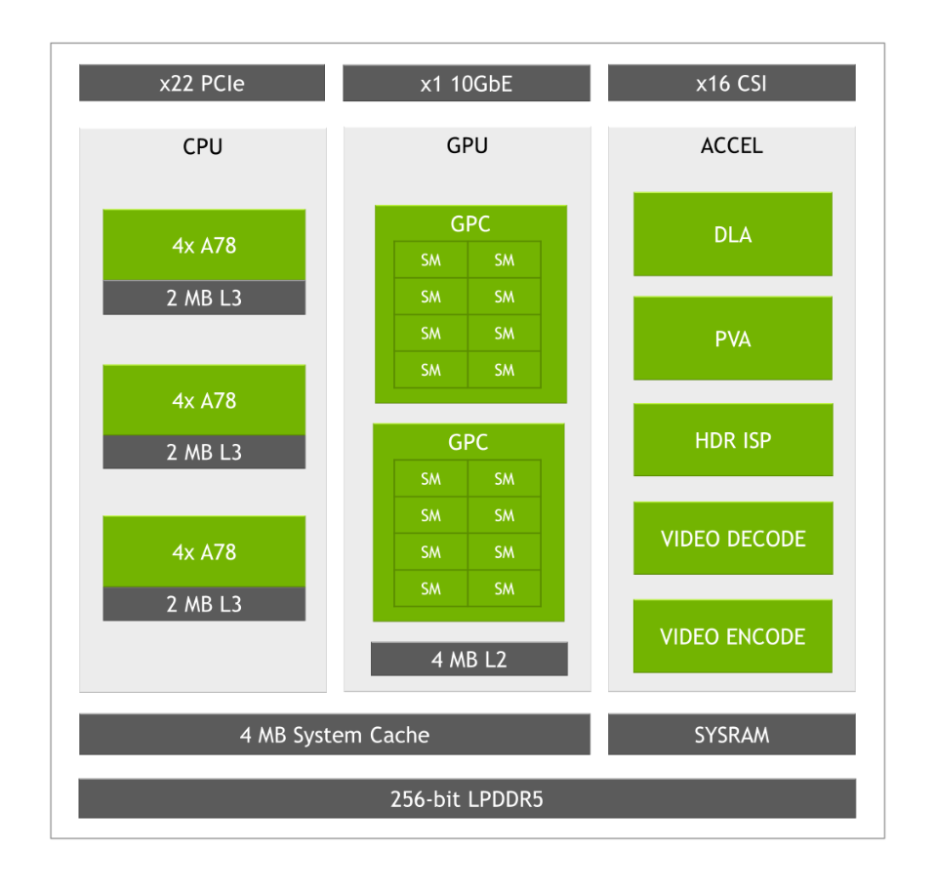
The Jetson AGX Orin series and Jetson Orin NX series are embedded modules for edge AI and robotics, based on the NVIDIA Orin system-on-chip (SoC). To deliver exceptional AI performance and efficiency across a range of use cases, Jetson Orin incorporates many compute engines:

These accelerators can be used to offload the GPU and enable additional AI inference performance on the Jetson Orin modules.

NVDLA is a fixed-function accelerator optimized for deep learning operations and is designed to do full hardware acceleration of convolutional neural network inferencing. 

Diagram of the NVIDIA Orin SoC shows the individual blocks, including CPU, GPU, dedicated accelerators, cache, and memory interface.
Figure 4. NVIDIA Orin system-on-chip

For the first time in MLPerf Inference v3.1, we demonstrate the concurrent use of the PVA alongside GPU and DLA for inference. The second-generation PVA provides dedicated hardware for various computer vision kernels such as filtering, warping, and fast Fourier transforms (FFT). It also supports advanced programmed kernels, which can serve as the backend runtime of TensorRT custom plug-ins.

With the 23.08 Jetson CUDA-X AI Developer Preview, we’ve included a sample PVA SDK. This package provides runtime support for a non-maximum suppression (NMS) layer. It demonstrates that the PVA can serve as a highly capable accelerator, complementing the powerful Jetson Orin GPU.

NVIDIA has developed a TensorRT custom NMS PVA plug-in as a reference for Jetson Orin users and it was included as part of the NVIDIA MLPerf Inference v3.1 submission.

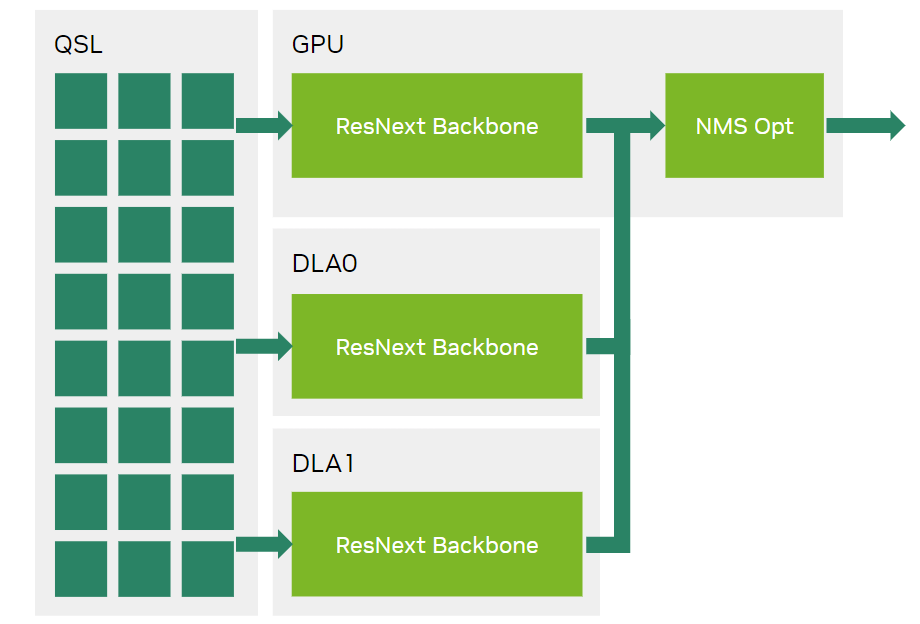
In the NVIDIA MLPerf Inference v3.0 RetinaNet submission on NVIDIA Orin platforms, the GPU handled all outputs from the ResNext + FPN backbone from the GPU as well as from the two DLAs.

Diagram shows how inference queries are sent to the GPU and DLAs, and then the GPU handles the outputs from the DLAs.
Figure 5. GPU responsible for GPU and DLA outputs in MLPerf Inference v3.0

Figure 5 shows how, in MLPerf Inference v3.0 submissions, the GPU was responsible for outputs from the ResNext+FPN backbone from both the GPU and the DLAs.

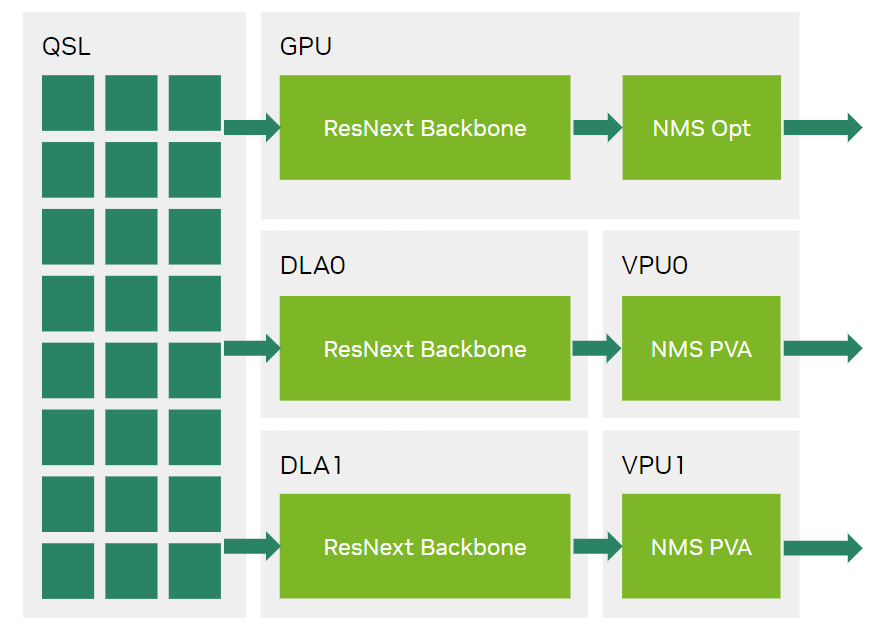
By using the NMS PVA plug-in, the NMS operator is now offloaded from GPU to PVA, enabling three fully parallel inference flows on Jetson Orin AGX and Jetson Orin NX. The output from the ResNext and the FPN backbone running on the two DLAs is now consumed by the two PVAs running the NMS PVA plug-in inside the end-to-end RetinaNet TensorRT engine.

Diagram shows how inference queries are sent to the GPU and DLAs, the PVAs consume the outputs from the DLAs, and then the GPU and two PVAs create output.
Figure 6. Fully parallel computations in MLPerf Inference v3.1

In Figure 6, the NVIDIA MLPerf Inference v3.1 submission enables computations to run fully in parallel through optimized use of Jetson Orin PVAs.

This careful use of PVA along with GPU and DLA boosts performance by 30% on both the Jetson AGX Orin 64GB and the Jetson Orin NX 16GB modules. When this use of PVA is coupled with a newly optimized NMS Opt GPU plug-in, Jetson AGX Orin delivers 61% higher performance and 38% better power efficiency on the RetinaNet workload. The Jetson Orin NX 16GB showed an even larger gain, with an 84% performance boost on the same test.

Algorithmic optimizations further improve BERT performance

In MLPerf Inference v3.1, NVIDIA made a submission on the BERT Large workload using the L4 GPU in the open division using techniques developed by the OmniML team. OmniML is a startup acquired by NVIDIA in early 2023 that brought expertise in machine learning algorithmic model optimization for use cases spanning cloud platforms to edge devices.

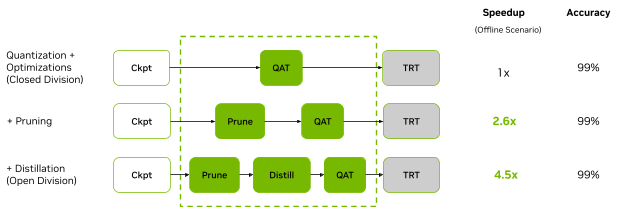
The open division submission on BERT applied structured pruning with distillation techniques to improve the performance by up to 4.7x while maintaining 99% accuracy. This submission demonstrates the potential of algorithmic optimizations for enhancing significantly the already exceptional performance of the NVIDIA platform.

NVIDIA deployed a proprietary, automatic, structured pruning tool that uses a gradient-based sensitivity analysis to prune the model to the given target FLOPs and fine-tune it with distillation to recover most of the accuracy. The number of transformer layers, attention heads, and linear layer dimensions were pruned in all the transformer layers in the model while the embedding dimension was kept unchanged.

Compared to the original MLPerf Inference BERT INT8 model, our pruned model reduced the number of parameters by 4x and the number of FLOPs by 5.6x. This model has a varying number of heads and linear layer dimensions in each layer. The resulting TensorRT engine built from the pruned model is 3.4x smaller, 177 MB compared to 607 MB.

The fine-tuned model is quantized to INT8 precision using the same technique employed in the NVIDIA closed division submission. The submission also employed distillation during quantization-aware training (QAT) to achieve an accuracy that is 99% or higher.

Scenario Closed Division Open Division Speedup
Offline samples/sec 1029 4609 4.5x
Server samples/sec 899 4265 4.7x
Single Stream p90 Latency (ms) 2.58 0.82 3.1x
Table 1. BERT Large performance metrics for both closed division and open division

To understand better how each of the model optimizations affects performance, NVIDIA performed a stacking analysis and applied different model optimization methods individually (Figure 8).

Diagram stacks quantization performance on optimization and pruning (Closed Division) and then on distillation (Open Division). The accuracy baseline is the FP32 model (not listed).
Figure 7. Stacking performance analysis

Figure 7 shows that, through model pruning and distillation, the NVIDIA open division submission on the BERT workload using L4 provides a 4.5x speedup compared to the same GPU running the closed division workload in the offline scenario.

Each model optimization method applied can be easily integrated with each other. Together, they yielded a substantial performance improvement compared to the baseline model.

NVIDIA accelerated computing boosts performance for inference and AI training workloads

In its MLPerf debut, the GH200 Grace Hopper Superchip turned in exceptional performance on all workloads and scenarios in the closed division of the data center category, boosting performance by up to 17% on the NVIDIA single-chip H100 SXM submission. The NVIDIA software stack fully supports the GH200 Grace Hopper Superchip today. 

For mainstream servers, the L4 GPU showed delivery of a large performance leap over CPU-only offerings in a compact, low-power, PCIe add-in card.

For edge AI and robotics applications, the Jetson AGX Orin and Jetson Orin NX modules achieved great performance. Software optimizations helped to further unlock the potential of the powerful NVIDIA Orin SoC that powers those modules. It boosted performance on RetinaNet, a popular AI network for object detection, by up to 84%.

In this round, NVIDIA also submitted results in the open division, providing a first look at the potential for model optimizations to speed inference performance dramatically while still achieving excellent accuracy.

The latest MLPerf Inference v3.1 benchmarks show that the NVIDIA accelerated computing platform continues to deliver leadership performance and versatility. There’s innovation at every layer of the technology stack, from cloud to edge, at the speed of light.

Categories
Misc

Webinar: Boost Your AI Development with ClearML and NVIDIA TAO

Event promo card.On Sept. 19, learn how NVIDIA TAO integrates with the ClearML platform to deploy and maintain machine learning models in production environments.Event promo card.
On Sept. 19, learn how NVIDIA TAO integrates with the ClearML platform to deploy and maintain machine learning models in production environments.

Categories
Misc

NVIDIA Partners with India Giants to Advance AI in World’s Most Populous Nation

The world’s largest democracy is poised to transform itself and the world, embracing AI on an enormous scale. Speaking with the press Friday in Bengaluru, in the context of announcements from two of India’s largest conglomerates, Reliance Industries Limited and Tata Group, NVIDIA founder and CEO Jensen Huang detailed plans to bring AI technology and Read article >

Categories
Misc

NVIDIA TensorRT-LLM Supercharges Large Language Model Inference on NVIDIA H100 GPUs

Large language models offer incredible new capabilities, expanding the frontier of what is possible with AI. But their large size and unique execution…
Large language models offer incredible new capabilities, expanding the frontier of what is possible with AI. But their large size and unique execution characteristics can make them difficult to use in cost-effective ways. 

NVIDIA has been working closely with leading companies, including Meta, Anyscale, Cohere, Deci, Grammarly, Mistral AI, MosaicML, now a part of Databricks, OctoML, Tabnine and Together AI, to accelerate and optimize LLM inference. 

Those innovations have been integrated into the open-source NVIDIA TensorRT-LLM software, set for release in the coming weeks. TensorRT-LLM consists of the TensorRT deep learning compiler and includes optimized kernels, pre- and post-processing steps, and multi-GPU/multi-node communication primitives for groundbreaking performance on NVIDIA GPUs. It enables developers to experiment with new LLMs, offering peak performance and quick customization capabilities, without requiring deep knowledge of C++ or NVIDIA CUDA.

TensorRT-LLM improves ease of use and extensibility through an open-source modular Python API for defining, optimizing, and executing new architectures and enhancements as LLMs evolve, and can be customized easily.  

For example, MosaicML has added specific features that it needs on top of TensorRT-LLM seamlessly and integrated them into their inference serving. Naveen Rao, vice president of engineering at Databricks notes that “it has been an absolute breeze.”

“TensorRT-LLM is easy to use, feature-packed with streaming of tokens, in-flight batching, paged-attention, quantization, and more, and is efficient,” Rao said. “It delivers state-of-the-art performance for LLM serving using NVIDIA GPUs and allows us to pass on the cost savings to our customers.”

Performance comparison

Summarizing articles is just one of the many applications of LLMs. The following benchmarks show performance improvements brought by TensorRT-LLM on the latest NVIDIA Hopper architecture. 

The following figures reflect article summarization using an NVIDIA A100 and NVIDIA H100 with CNN/Daily Mail, a well-known dataset for evaluating summarization performance.  

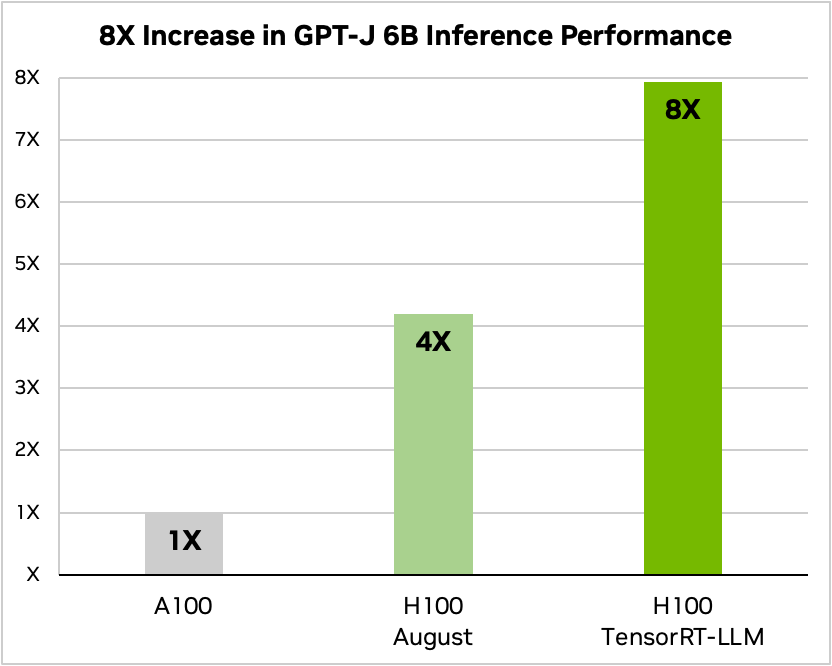
In Figure 1, H100 alone is 4x faster than A100. Adding TensorRT-LLM and its benefits, including in-flight batching, result in an 8X total increase to deliver the highest throughput. 

GPT-J performance comparison between A100 and H100 with and without TensorRT-LLM.
Figure 1. GPT-J-6B  A100 compared to H100 with and without TensorRT-LLM

Text summarization, variable I/O length, CNN / DailyMail dataset | A100 FP16 PyTorch eager mode | H100 FP8 | H100 FP8, in-flight batching, TensorRT-LLM

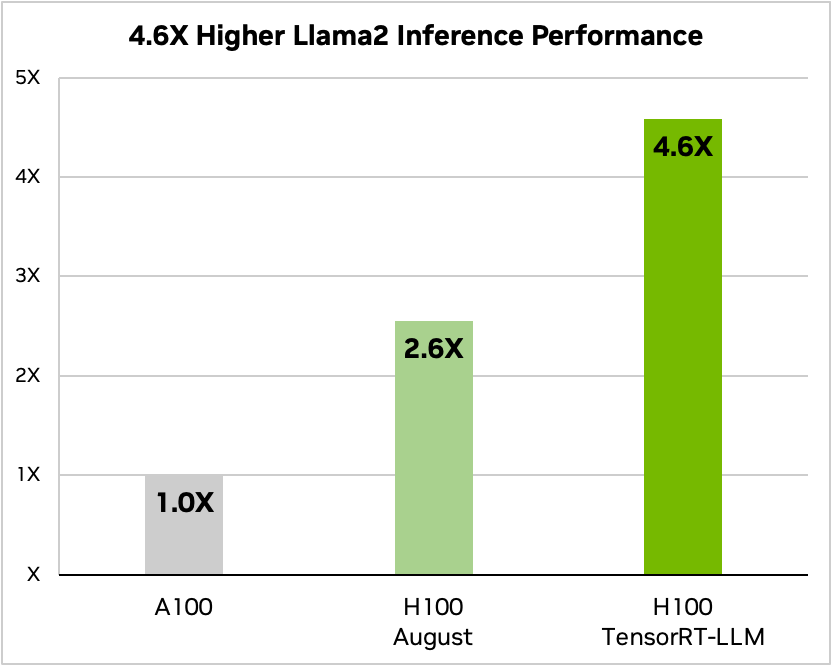
On Llama 2—a popular language model released recently by Meta and used widely by organizations looking to incorporate generative AI—TensorRT-LLM can accelerate inference performance by 4.6x compared to A100 GPUs.

Llama 2 70B performance comparison between A100 and H100 with and without TensorRT-LLM.
Figure 2. Llama 2 70B, A100 compared to H100 with and without TensorRT-LLM

Text summarization, variable I/O length, CNN / DailyMail dataset | A100 FP16 PyTorch eager mode| H100 FP8 | H100 FP8, in-flight batching, TensorRT-LLM

LLM ecosystem explosion

The ecosystem is innovating rapidly, developing new and diverse model architectures. Larger models unleash new capabilities and use cases. Some of the largest, most advanced language models, like Meta’s 70-billion-parameter Llama 2, require multiple GPUs working in concert to deliver responses in real time. Previously, developers looking to achieve the best performance for LLM inference had to rewrite and manually split the AI model into fragments and coordinate execution across GPUs.

TensorRT-LLM uses tensor parallelism, a type of model parallelism in which individual weight matrices are split across devices. This enables efficient inference at scale–with each model running in parallel across multiple GPUs connected through NVLink and across multiple servers–without developer intervention or model changes.

As new models and model architectures are introduced, developers can optimize their models with the latest NVIDIA AI kernels available open source in TensorRT-LLM. The supported kernel fusions include cutting-edge implementations of FlashAttention and masked multi-head attention for the context and generation phases of GPT model execution, along with many others.

Additionally, TensorRT-LLM includes fully optimized, ready-to-run versions of many LLMs widely used in production today. This includes Meta Llama 2, OpenAI GPT-2 and GPT-3, Falcon, Mosaic MPT, BLOOM, and a dozen others, all of which can be implemented with the simple-to-use TensorRT-LLM Python API.

These capabilities help developers create customized LLMs faster and more accurately to meet the needs of virtually any industry.

In-flight batching

Today’s large language models are extremely versatile. A single model can be used simultaneously for a variety of tasks that look very different from one another. From a simple question-and-answer response in a chatbot to the summarization of a document or the generation of a long chunk of code, workloads are highly dynamic, with outputs varying in size by several orders of magnitude. 

This versatility can make it difficult to batch requests and execute them in parallel effectively—a common optimization for serving neural networks—which could result in some requests finishing much earlier than others.

To manage these dynamic loads, TensorRT-LLM includes an optimized scheduling technique called in-flight batching. This takes advantage of the fact that the overall text generation process for an LLM can be broken down into multiple iterations of execution on the model. 

With in-flight batching, rather than waiting for the whole batch to finish before moving on to the next set of requests, the TensorRT-LLM runtime immediately evicts finished sequences from the batch. It then begins executing new requests while other requests are still in flight. In-flight batching and the additional kernel-level optimizations enable improved GPU usage and minimally double the throughput on a benchmark of real-world LLM requests on H100 Tensor Core GPUs, helping to minimize TCO.

H100 Transformer Engine with FP8

LLMs contain billions of model weights and activations, typically trained and represented with 16-bit floating point (FP16 or BF16) values where each value occupies 16 bits of memory. At inference time, however, most models can be effectively represented at lower precision, like 8-bit or even 4-bit integers (INT8 or INT4), using modern quantization techniques. 

Quantization is the process of reducing the precision of a model’s weights and activations without sacrificing accuracy. Using lower precision means that each parameter is smaller, and the model takes up less space in GPU memory. This enables inference on larger models with the same hardware while spending less time on memory operations during execution. 

NVIDIA H100 GPUs with TensorRT-LLM give users the ability to convert their model weights into a new FP8 format easily and compile their models to take advantage of optimized FP8 kernels automatically. This is made possible through Hopper Transformer Engine technology and done without having to change any model code. 

The FP8 data format introduced by the H100 enables developers to quantize their models and radically reduce ‌memory consumption without degrading model accuracy. FP8 quantization retains higher accuracy compared to other data formats like INT8 or INT4 while achieving the fastest performance and offering the simplest implementation.  

Summary

LLMs are advancing rapidly. Diverse model architectures are being developed daily and contribute to a growing ecosystem. In turn, larger models unleash new capabilities and use cases, driving adoption across all industries.

LLM inference is reshaping the data center. Higher performance with increased accuracy yields better TCO for enterprises. Model innovations enable better customer experiences, translating into higher revenue and earnings.

When planning inference deployment projects, there are still many other considerations to achieve peak performance using state-of-the-art LLMs. Optimization rarely happens automatically. Users must consider fine-tuning factors such as parallelism, end-to-end pipelines, and advanced scheduling techniques. And they require a computing platform that can handle mixed precision without diminishing accuracy.

TensorRT-LLM comprises TensorRT’s Deep Learning Compiler, optimized kernels, pre- and post-processing, and multi-GPU/multi-node communication in a simple, open-source Python API for defining, optimizing, and executing LLMs for inference in production. 

Get started with TensorRT-LLM

NVIDIA TensorRT-LLM is now available in early access and soon will be integrated into the NVIDIA NeMo framework—part of NVIDIA AI Enterprise, an enterprise-grade AI software platform with security, stability, manageability, and support. Developers and researchers will be able to access TensorRT-LLM through the NeMo framework on NGC or through the source repository on GitHub. 

Note that you must be registered in the NVIDIA Developer Program to apply for the early access release. You must also be logged in using your organization’s email address. We cannot accept applications from accounts using Gmail, Yahoo, QQ, or other personal email accounts.

To participate, fill out the short application form and provide details about your use case.

Categories
Misc

Workshop: Fundamentals of Deep Learning

An illustration of computer monitors showing data science models.Learn key techniques and tools required to train a deep learning model in this virtual hands-on workshop.An illustration of computer monitors showing data science models.
Learn key techniques and tools required to train a deep learning model in this virtual hands-on workshop.

Categories
Misc

Tata Partners With NVIDIA to Build Large-Scale AI Infrastructure

NVIDIA today announced an extensive collaboration with Tata Group to deliver AI computing infrastructure and platforms for developing AI solutions. The collaboration will bring state-of-the-art AI capabilities within reach to thousands of organizations, businesses and AI researchers, and hundreds of startups in India.

Categories
Misc

Reliance and NVIDIA Partner to Advance AI in India, for India

In a major step to support India’s industrial sector, NVIDIA and Reliance Industries today announced a collaboration to develop India’s own foundation large language model trained on the nation’s diverse languages and tailored for generative AI applications to serve the world’s most populous nation.

Categories
Misc

How Industries Are Meeting Consumer Expectations With Speech AI

Thanks to rapid technological advances, consumers have become accustomed to an unprecedented level of convenience and efficiency. Smartphones make it easier than ever to search for a product and have it delivered right to the front door. Video chat technology lets friends and family on different continents connect with ease. With voice command tools, AI Read article >

Categories
Misc

NVIDIA CUDA Toolkit Symbol Server

Decorative image of two boxes with libcuda.sym labels.NVIDIA has already made available a GPU driver binary symbols server for Windows. Now, NVIDIA is making available a repository of CUDA Toolkit symbols for…Decorative image of two boxes with libcuda.sym labels.

NVIDIA has already made available a GPU driver binary symbols server for Windows. Now, NVIDIA is making available a repository of CUDA Toolkit symbols for Linux.

What are we providing?

NVIDIA is introducing CUDA Toolkit symbols for Linux for an application development enhancement. During application development, you can now download obfuscated symbols for NVIDIA libraries that are being debugged or profiled in your application. This is shipping initially for the CUDA Driver (libcuda.so) and the CUDA Runtime (libcudart.so), with more libraries to be added.

For instance, when an issue appears to relate to a CUDA API, it may not always be possible to provide NVIDIA with a reproducing example, core dump, or unsymbolized stack traces with all library load information. Providing a symbolized call stack can help speed up the debug process.

We are only hosting symbol files, so debug data will not be distributed. The symbol files contain obfuscated symbol names.

Quickstart guide

There are two recommended ways to use the obfuscated symbols for each library:

  • By unstripping the library
  • By deploying the .sym file as a symbol file for the library
# Determine the symbol file to fetch and obtain it
$ readelf -n /usr/local/cuda/lib64/libcudart.so

# ... Build ID: 70f26eb93e24216ffc0e93ccd8da31612d277030
# Browse to https://cudatoolkit-symbols.nvidia.com/libcudart.so/70f26eb93e24216ffc0e93ccd8da31612d277030/index.html to determine filename to download
$ wget https://cudatoolkit-symbols.nvidia.com/libcudart.so/70f26eb93e24216ffc0e93ccd8da31612d277030/libcudart.so.12.2.128.sym

# Then with appropriate permissions, either unstrip,
$ eu-unstrip /usr/local/cuda-12.2/targets/x86_64-linux/lib/libcudart.so.12.2.128 libcudart.so.12.2.128.sym –o /usr/local/cuda-12.2/targets/x86_64-linux/lib/libcudart.so.12.2.128

# Or, with appropriate permissions, deploy as symbol file
# By splitting the Build ID into first two characters as directory, then remaining with ".debug" extension
$ cp libcudart.so.12.2.128.sym /usr/lib/debug/.build-id/70/f26eb93e24216ffc0e93ccd8da31612d277030.debug

Example: Symbolizing

Here is a simplified example to show the uses of symbolizing. The sample application test_shared has a data corruption that leads to an invalid handle being passed to the CUDA Runtime API cudaStreamDestroy. With a default install of CUDA Toolkit and no obfuscated symbols, the output in gdb might look like the following:

Thread 1 "test_shared" received signal SIGSEGV, Segmentation fault.
0x00007ffff65f9468 in ?? () from /lib/x86_64-linux-gnu/libcuda.so.1
(gdb) bt
#0  0x00007ffff65f9468 in ?? () from /lib/x86_64-linux-gnu/libcuda.so.1
#1  0x00007ffff6657e1f in ?? () from /lib/x86_64-linux-gnu/libcuda.so.1
#2  0x00007ffff6013845 in ?? () from /usr/local/cuda/lib64/libcudart.so.12
#3  0x00007ffff604e698 in cudaStreamDestroy () from /usr/local/cuda/lib64/libcudart.so.12
#4  0x00005555555554e3 in main ()

After applying the obfuscated symbols in one of the ways described earlier, it would give a stack trace like the following example:

Thread 1 "test_shared" received signal SIGSEGV, Segmentation fault.
0x00007ffff65f9468 in libcuda_8e2eae48ba8eb68460582f76460557784d48a71a () from /lib/x86_64-linux-gnu/libcuda.so.1
(gdb) bt
#0  0x00007ffff65f9468 in libcuda_8e2eae48ba8eb68460582f76460557784d48a71a () from /lib/x86_64-linux-gnu/libcuda.so.1
#1  0x00007ffff6657e1f in libcuda_10c0735c5053f532d0a8bdb0959e754c2e7a4e3d () from /lib/x86_64-linux-gnu/libcuda.so.1
#2  0x00007ffff6013845 in libcudart_43d9a0d553511aed66b6c644856e24b360d81d0c () from /usr/local/cuda/lib64/libcudart.so.12
#3  0x00007ffff604e698 in cudaStreamDestroy () from /usr/local/cuda/lib64/libcudart.so.12
#4  0x00005555555554e3 in main ()

The symbolized call stack can then be documented as part of the bug description provided to NVIDIA for analysis.

Conclusion

When you have to profile and debug applications using CUDA and want to share a call stack with NVIDIA for analysis, use the CUDA symbol server. Profiling and debugging will be faster and easier.

For questions or issues, dive into the forum at Developer Tools.