
From smart factories to next-generation railway systems, developers and enterprises across the world are racing to fuel industrial digitalization opportunities at every scale. Key to this is the open-source Universal Scene Description (USD) framework, or OpenUSD, along with metaverse applications powered by AI. OpenUSD, originally developed by Pixar for large-scale feature film pipelines for animation Read article >
Category: Misc
 Autonomous vehicle (AV) development requires massive amounts of sensor data for perception development. Developers typically get this data from two…
Autonomous vehicle (AV) development requires massive amounts of sensor data for perception development.
Developers typically get this data from two sources—replay streams of real-world drives or simulation. However, real-world datasets offer limited flexibility, as the data is fixed to only the objects, events, and view angles captured by the physical sensors. It is also difficult to simulate the detail and imperfection of real-world conditions—such as sensor noise or occlusions—at scale.
Neural fields have gained significant traction in recent years. These AI tools capture real-world content and simulate it from novel viewpoints with high levels of realism, achieving the fidelity and diversity required for AV simulation.
At NVIDIA GTC 2022, we showed how we use neural reconstruction to build a 3D scene from recorded camera sensor data in simulation, which can then be rendered from novel views. A paper we published for ICCV 2023—which runs Oct. 2 to Oct.6—details how we applied a similar approach to address these challenges in synthesizing lidar data.
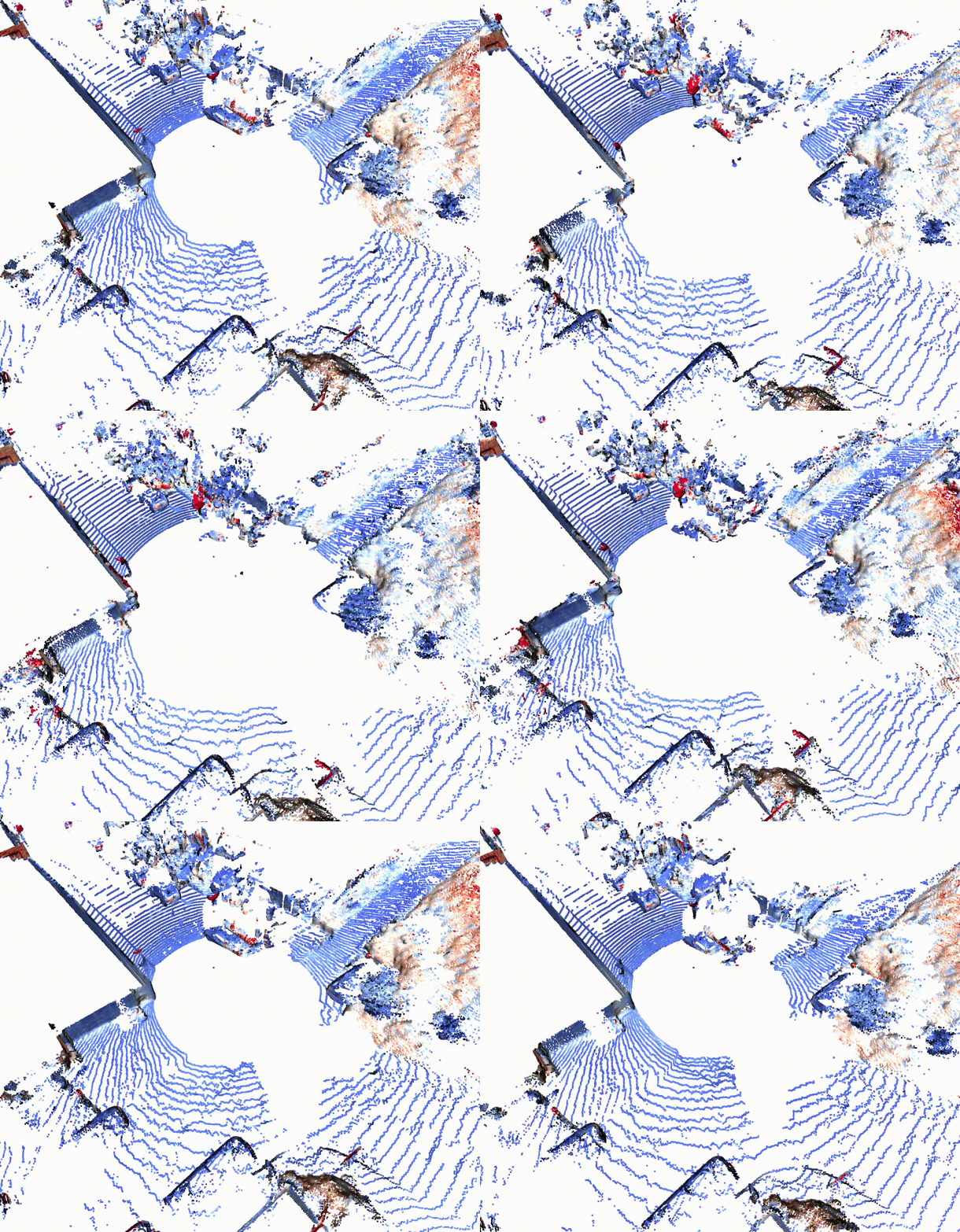
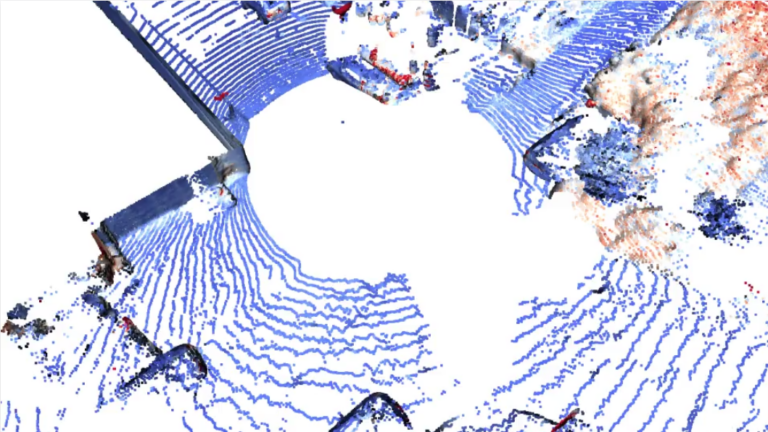
The method, called neural lidar fields, optimizes a neural radiance field (NeRF)-like representation from lidar measurements that enables synthesizing realistic lidar scans from entirely new viewpoints. It combines neural rendering with a physically based lidar model to accurately reproduce sensor behaviors—such as beam divergence, secondary returns, and ray dropping.
With neural lidar fields, we can achieve improved realism of novel views, narrowing the domain gap with real lidar data recordings. In doing so, we can improve the scalability of lidar sensor simulation and accelerate AV development.
By applying neural rendering techniques such as neural lidar fields in NVIDIA Omniverse, AV developers can bypass the time– and cost-intensive process of rebuilding real-world scenes by hand. They can bring physical sensors into a scalable and repeatable simulation.
Novel view synthesis
While replaying recorded data is a key component of testing and validation, it is critical to also simulate new scenarios for the AV system to experience.
These scenarios make it possible to test situations where the vehicle deviates from the original trajectory. It will view the world from novel views. This benefit also extends to testing a sensor suite on a different vehicle type, where the rig may be positioned differently (for example, switching from a sedan to an SUV).
With the ability to modify sensor properties such as beam divergence and ray pattern, we can also use a different lidar type in simulation than the sensor that originally recorded the data.
However, previous explicit approaches to simulating novel views have proven cumbersome and often inaccurate. First, surface representation—such as surfels or a triangular mesh—must be extracted from scanned lidar point clouds. Then, lidar measurements are simulated from a novel viewpoint by casting rays and intersecting them with the surface model.
These methods—known as explicit reconstruction—introduce noticeable errors in the rendering as well as assuming a perfect lidar model with no divergence of beams.
Neural lidar fields method
Rather than rely on an error-prone reconstruction pipeline, the neural lidar fields method takes a NeRF-style approach. It is based on neural scene representation and sensor modeling, which is directly optimized to render sensor measurements. This results in a more realistic output.
Specifically, we used an improved, lidar-specific volume rendering procedure, which creates range and intensity measurements from the 3D scene. Then, we added beam divergence for improved realism. We took into account that lidar works as an active sensor—rather than a passive one like a camera. This, along with characteristics such as beam divergence, enabled us to reproduce sensor properties, including dropped rays and multiple returns.
To test the accuracy of the neural lidar fields, we ran the scenes in a lidar simulator, comparing results with a variety of viewpoints taken at different distances from the original scan.
These scans were then compared with real data from the Waymo Open dataset, using metrics such as real-world intensities, ray drop, and secondary returns to evaluate fidelity. We also used real data to validate the accuracy of the neural lidar fields’ view synthesis in challenging scenes.
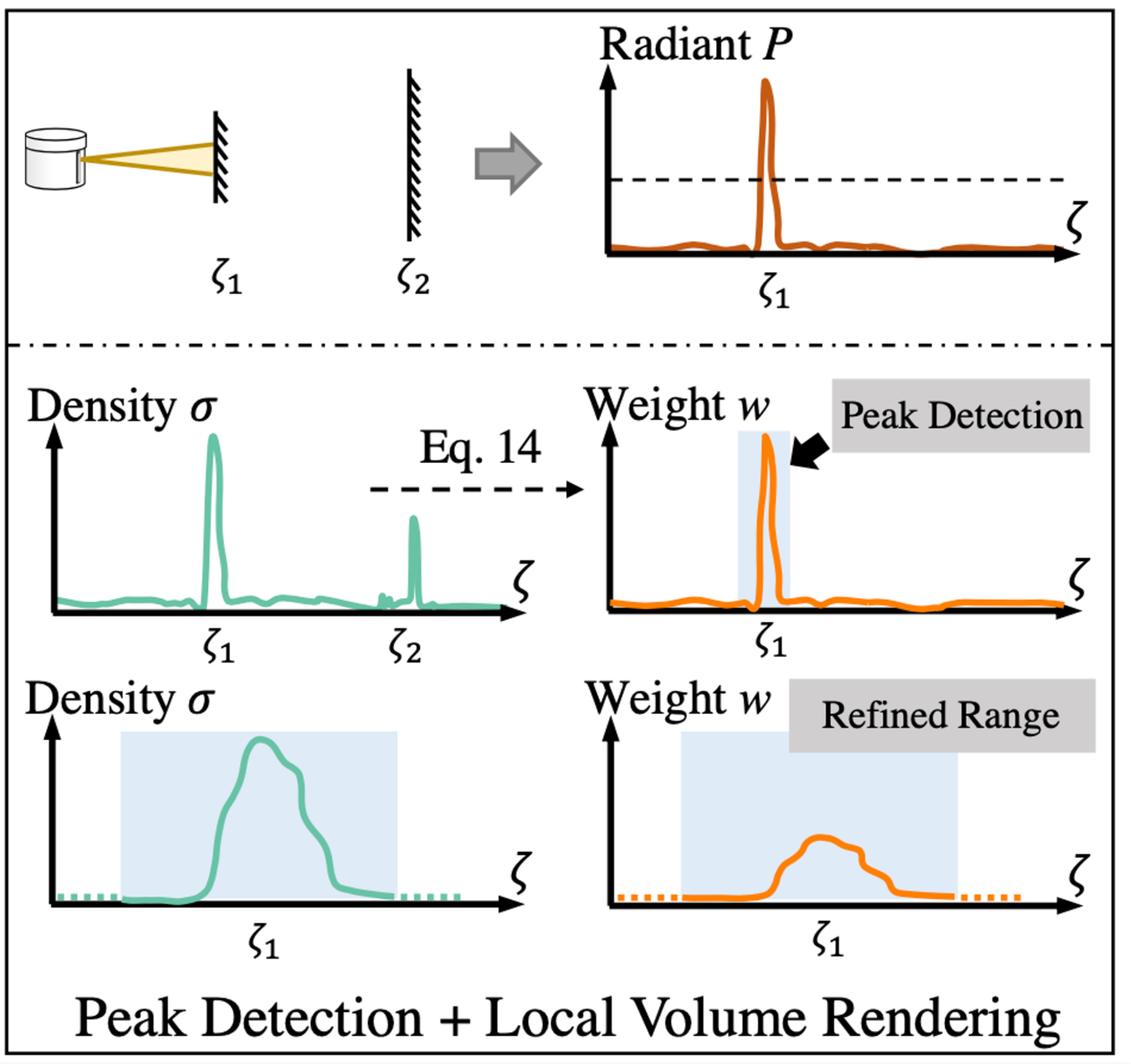
In Figure 2, the neural lidar fields accurately reproduce the waveform properties. The top row shows that the first surface fully scatters the lidar energy. The other rows shows that neural lidar fields estimate range through peak detection on the computed weights followed by volume rendering-based range refinement.
Results
Using these evaluation methods, we compared neural lidar field-synthesized lidar views with traditional reconstruction processes.
By accounting for real-world lidar characteristics, neural lidar field views reduced range errors and improved performance compared with explicit reconstruction. We also found the implicit method synthesized challenging scenes with high accuracy.
After we established performance, we then validated the neural lidar field-generated scans using two low-level perception tasks: point cloud registration and semantic segmentation.
We applied the same model to both real-world lidar scans and various synthesized scans to evaluate how well the scans maintained accuracy. We found that neural lidar fields outperformed the baseline methods on datasets with complex geometry and high noise levels.
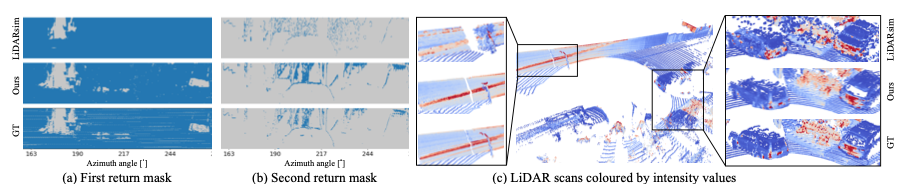
For semantic segmentation, we applied the same pretrained model to both real and synthetic lidar scans. Neural lidar fields achieved the highest recall for vehicles, which are especially difficult to render due to sensor noise such as dual returns and ray drops.
While neural lidar fields are still an active research method, it is a critical tool for scalable AV simulation. Next, we plan to focus on generalizing the networks across scenes and handling dynamic environments. Eventually, developers on Omniverse and the NVIDIA DRIVE Sim AV simulator will be able to tap into these AI-powered approaches for accelerated and physically based simulation.
For more information about neural lidar fields and our development and evaluation methods, see the Neural LiDAR Fields for Novel View Synthesis paper.
Acknowledgments
We would like to thank our collaborators at ETH Zurich, Shengyu Huang and Konrad Schindler, as well as Zan Gojcic, Zian Wang, Francis Williams, Yoni Kasten, Sanja Fidler, and Or Litany from the NVIDIA Research team.
 Machine learning-based weather prediction has emerged as a promising complement to traditional numerical weather prediction (NWP) models. Models such as NVIDIA…
Machine learning-based weather prediction has emerged as a promising complement to traditional numerical weather prediction (NWP) models. Models such as NVIDIA FourCastNet have demonstrated that the computational time for generating weather forecasts can be reduced from hours to mere seconds, a significant improvement to current NWP-based workflows.
Traditional methods are formulated from first principles and typically require a timestep restriction to guarantee the accuracy of the underlying numerical method. ML-based approaches do not come with such restrictions, and their uniform memory access patterns are ideally suited for GPUs.
However, these methods are purely data-driven, and you may rightfully ask:
- How can we trust these models?
- How well do they generalize?
- How can we further increase their skill, trustworthiness, and explainability, if they are not formulated from first principles?
In this post, we discuss spherical Fourier neural operators (SFNOs), physical systems on the sphere, the importance of symmetries, and how SFNOs are implemented using the spherical harmonic transform (SHT). For more information about the math, see the ICML paper, Spherical Fourier Neural Operators: Learning Stable Dynamics on the Sphere.
The importance of symmetries
A potential approach to creating principled and trustworthy models involves formulating them in a manner akin to the formulation of physical laws.
Physical laws are typically formulated from symmetry considerations:
- We do not expect physics to depend on the frame of reference.
- We further expect underlying physical laws to remain unchanged if the frame of reference is altered.
In the context of physical systems on the sphere, changes in the frame of reference are accomplished through rotations. Thus, we strive to establish a formulation that remains equivariant under rotations.
Current ML-based weather prediction models treat the state of the atmosphere as a discrete series of vectors representing physical quantities of interest at various spatial locations over time. Any of these vectors are updated by a learned function, which maps the current state to the next state in the sequence.
In plain terms, we ask a neural network to consecutively predict the weather in the next time step when showing it the weather of today. This is comparable to the integration of a physical system using traditional methods, with the caveat of having learned the dynamics in a purely data-driven manner, as opposed to deriving them from physical laws. This approach enables significantly larger time steps as opposed to traditional methods.
The task at hand can thus be understood as learning image-to-image mappings between finite-dimensional vector spaces.
While a broad variety of neural network topologies such as U-Nets are applicable to this task, such approaches ignore the functional nature of the problem. Both input and output are functions and their evolution is governed by partial differential equations.
Traditional ML approaches such as U-Nets ignore this, as they learn a map at a fixed resolution. Neural operators generalize neural networks to solve this problem. Rather than learning maps between finite-dimensional spaces, they learn an operator that can directly map one function to another.
As such, Fourier neural operators (FNOs) provide a powerful framework for learning maps between function spaces and approximating the solution operator of PDEs, which maps one state to the next.
However, classical FNOs are defined in Cartesian space, whose associated symmetries differ from those of the sphere. In practice, ignoring the geometry and pretending that Earth is a periodic rectangle leads to artifacts, which accumulate on long rollouts, due to the autoregressive nature of the model. Such artifacts typically occur around the poles and lead to a breakdown of the model (Figure 2).
You may now wonder, what would an FNO on a sphere look like?
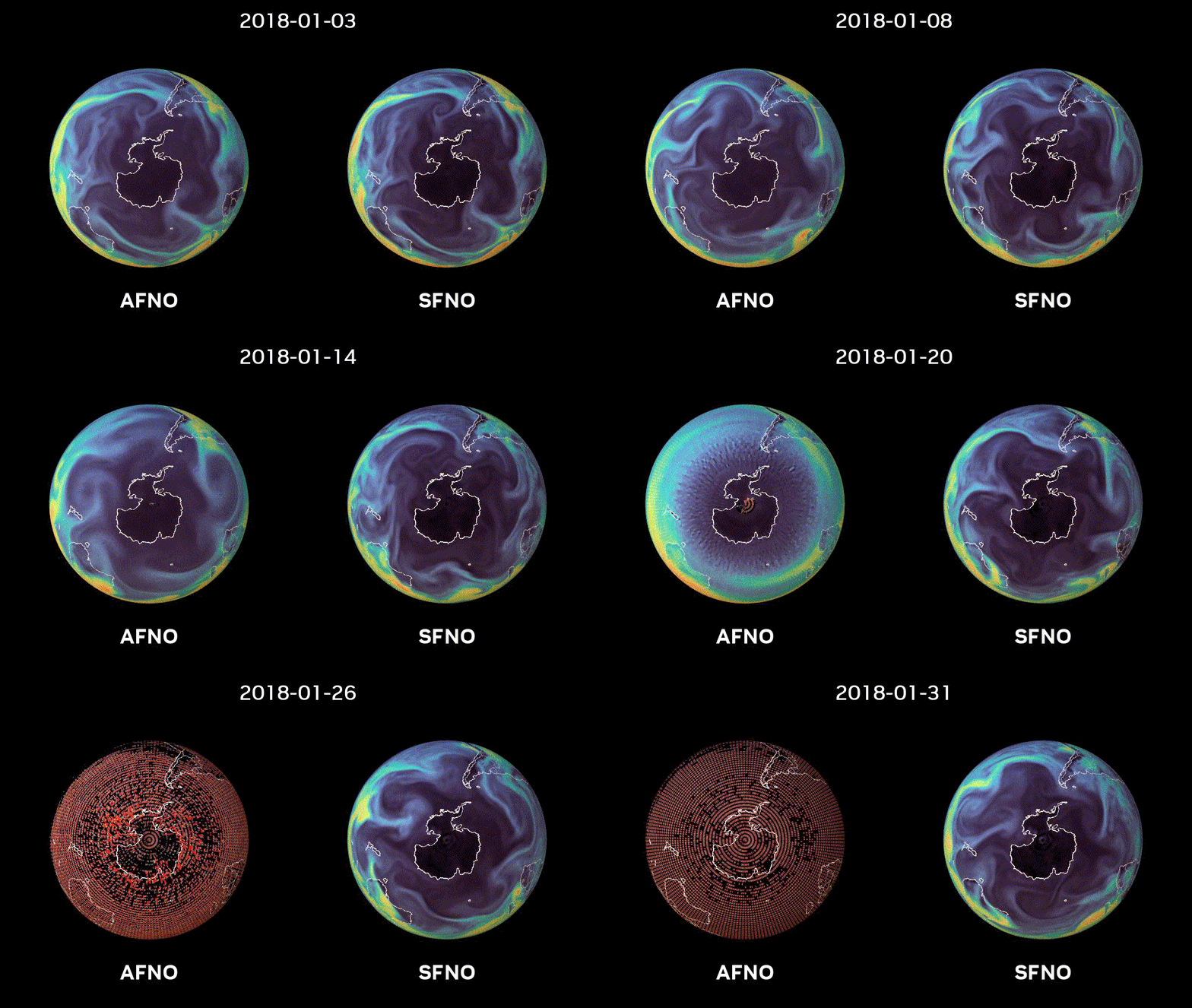
Figure 2 shows temperature predictions using adaptive Fourier neural operators (AFNO) as compared to spherical Fourier neural operators (SFNO). Respecting the spherical geometry and associated symmetries avoids artifacts and enables a stable rollout.
Spherical Fourier neural operators
To respect the spherical geometry of Earth, we implemented spherical Fourier neural operators (SFNOs), a Fourier neural operator that is directly formulated in spherical coordinates. To achieve this, we made use of a convolution theorem formulated on the sphere.
Global convolutions are the central building blocks of FNOs. Their computation through FFTs is enabled by the convolution theorem: a powerful mathematical tool that connects convolutions to the Fourier transform.
Similarly, a convolution theorem on the sphere connects spherical convolutions to the generalization of the Fourier transform on the sphere: the spherical harmonic transform (SHT).
Implementing differentiable spherical harmonic transforms
To enable the implementation of SFNOs, we required a differentiable SHT. To this end, we implemented torch-harmonics, a PyTorch library for differentiable SHTs. The library natively supports the computation of SHTs on single and multiple GPUs as well as CPUs, to enable scalable model parallelism. torch-harmonics can be installed easily by running the following command:
pip install torch-harmonics
torch-harmonics seamlessly integrates with PyTorch. The differentiable SHT can be easily integrated into any existing ML architecture as a module. To compute the SHT of a random function, run the following code example:
import torch
import torch_harmonics as th

device = torch.device('cuda' if torch.cuda.is_available() else 'cpu')

# parameters
nlat = 512
nlon = 2*nlat
batch_size = 32
signal = torch.randn(batch_size, nlat, nlon)

# create SHT instance
sht = th.RealSHT(nlat, nlon).to(device).float()

# execute transform
coeffs = sht(signal)
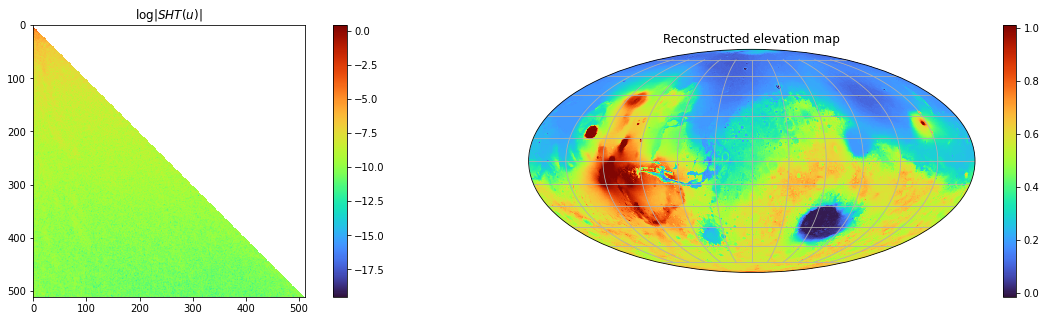
To get started with torch-harmonics, we recommend the getting-started notebook, which guides you through the computation of the spherical harmonic coefficients of Mars’ elevation map (Figure 3). The example showcases the computation of the coefficients using both the SHT and the differentiability of the ISHT.
Implications for ML-based weather forecasting
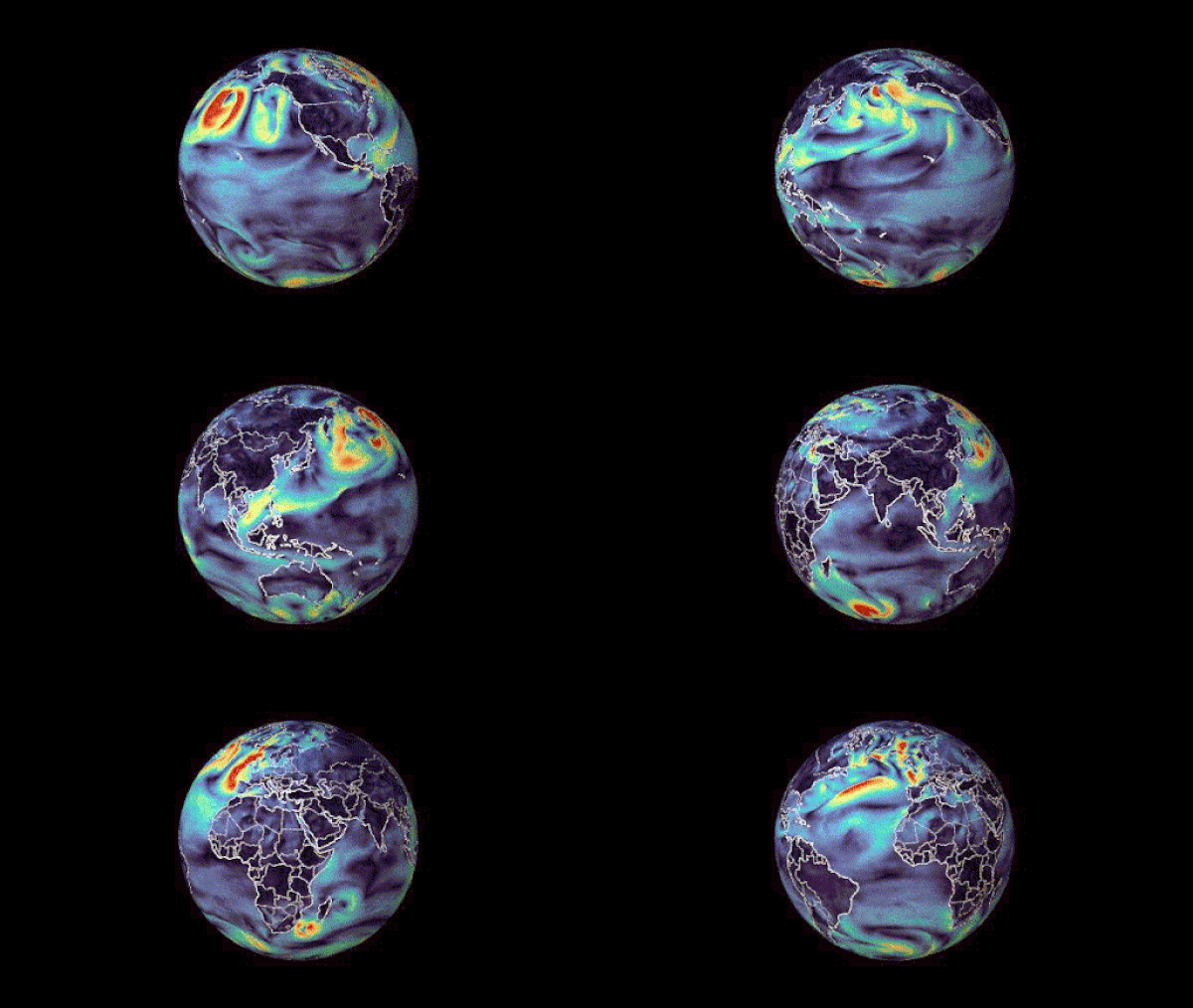
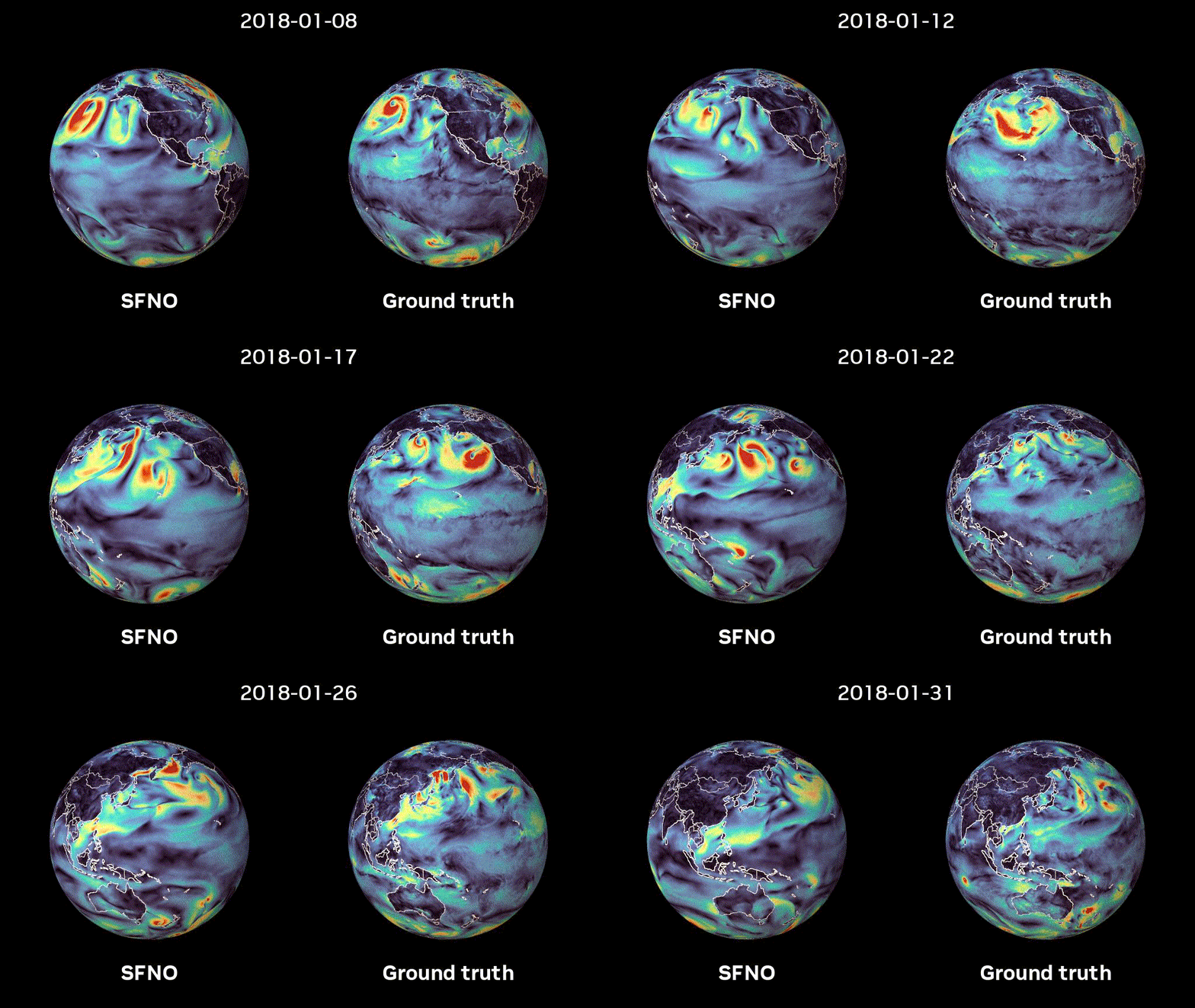
We trained SFNOs on the ERA5 dataset, provided by the European Centre for Medium-range Weather Forecasts (ECMWF). This dataset represents our best understanding of the state of Earth’s atmosphere over the past 44 years. Figure 2 shows that SFNO shows no signs of artifacts over the poles and rollouts remain remarkably stable, over thousands of autoregressive steps, for up to a year (Figure 1).
These results pave the way for the deployment of ML-based weather prediction methods. They offer a glimpse of how ML-based methods may hold the key to bridging the gap between weather forecasting and climate prediction, in the holy grail of sub-seasonal-to-seasonal forecasting.
A single rollout of SFNOs for a year, which involves 1460 autoregressive steps, is computed in 13 minutes on a single NVIDIA RTX A6000. That is over a thousand times faster than traditional numerical weather prediction methods.
Such substantially faster forecasting tools open the door to the computation of thousands of possible scenarios in the same time that it took to do a single one using traditional NWP, enabling higher confidence predictions of the risk of rare but high-impact extreme weather events.
More about SFNOs and the NVIDIA Earth-2 initiative
To see how SFNOs were used to generate thousands of ensemble members and predict the 2018 Algerian heat wave, watch the following video:
For more information about SFNOs, see the following resources:
- Our ICML poster
- Spherical Fourier Neural Operators: Learning Stable Dynamics on the Sphere whitepaper
- torch-harmonics GitHub repo
- Implementation of SFNO
- Getting started with torch-harmonics
- Training SFNO on the spherical shallow water equations
- neuraloperator GitHub repo
- Training SFNO on shallow water equations in neuraloperator
- Implementation of SFNO in Modulus
For more information about the NVIDIA Earth-2 initiative, see the following resources:
AI is improving ways to power the world by tapping the sun and the wind, along with cutting-edge technologies. The latest episode in the I AM AI video series showcases how artificial intelligence can help optimize solar and wind farms, simulate climate and weather, enhance power grid reliability and resilience, advance carbon capture and power Read article >
Get ready for Gunfire Games and Gearbox Publishing’s highly anticipated Remnant II, available for members to stream on GeForce NOW at launch. It leads eight new games coming to the cloud gaming platform. Ultimate and Priority members, make sure to grab the Guild Wars 2 rewards, available now through Thursday, Aug. 31. Visit the GeForce Read article >
ServiceNow (NYSE: NOW), NVIDIA (NASDAQ: NVDA), and Accenture (NYSE: ACN) today announced the launch of AI Lighthouse, a first-of-its-kind program designed to fast-track the development and adoption of enterprise generative AI capabilities.
Categories
NVIDIA H100 GPUs Now Available on AWS Cloud
AWS users can now access the leading performance demonstrated in industry benchmarks of AI training and inference. The cloud giant officially switched on a new Amazon EC2 P5 instance powered by NVIDIA H100 Tensor Core GPUs. The service lets users scale generative AI, high performance computing (HPC) and other applications with a click from a Read article >
The world increasingly runs on code. Accelerating the work of those who create that code will boost their productivity — and that’s just what AI startup Codeium, a member of NVIDIA’s Inception program for startups, aims to do. On the latest episode of NVIDIA’s AI Podcast, host Noah Kravitz interviewed Codeium founder and CEO Varun Read article >
Categories
Ask Me Anything: NVIDIA CUDA Toolkit 12
 On July 26, connect with CUDA product team experts on the latest NVIDIA CUDA Toolkit 12.
On July 26, connect with CUDA product team experts on the latest NVIDIA CUDA Toolkit 12.
 Vision Transformers (ViTs) are taking computer vision by storm, offering incredible accuracy, robust solutions for challenging real-world scenarios, and…
Vision Transformers (ViTs) are taking computer vision by storm, offering incredible accuracy, robust solutions for challenging real-world scenarios, and improved generalizability. The algorithms are playing a pivotal role in boosting computer vision applications and NVIDIA is making it easy to integrate ViTs into your applications using NVIDIA TAO Toolkit and NVIDIA L4 GPUs.
How ViTs are different
ViTs are machine learning models that apply transformer architectures, originally designed for natural language processing, to visual data. They have several advantages over their CNN-based counterparts and the ability to perform parallelized processing of large-scale inputs. While CNNs use local operations that lack a global understanding of an image, ViTs provide long-range dependencies and global context. They do this effectively by processing images in a parallel and self-attention-based manner, enabling interactions between all image patches.
Figure 1 shows see the processing of an image in a ViT model, where the input image is divided into smaller fixed-size patches, which are flattened and transformed into sequences of tokens. These tokens, along with positional encodings, are then fed into a transformer encoder, which consists of multiple layers of self-attention and feed-forward neural networks.
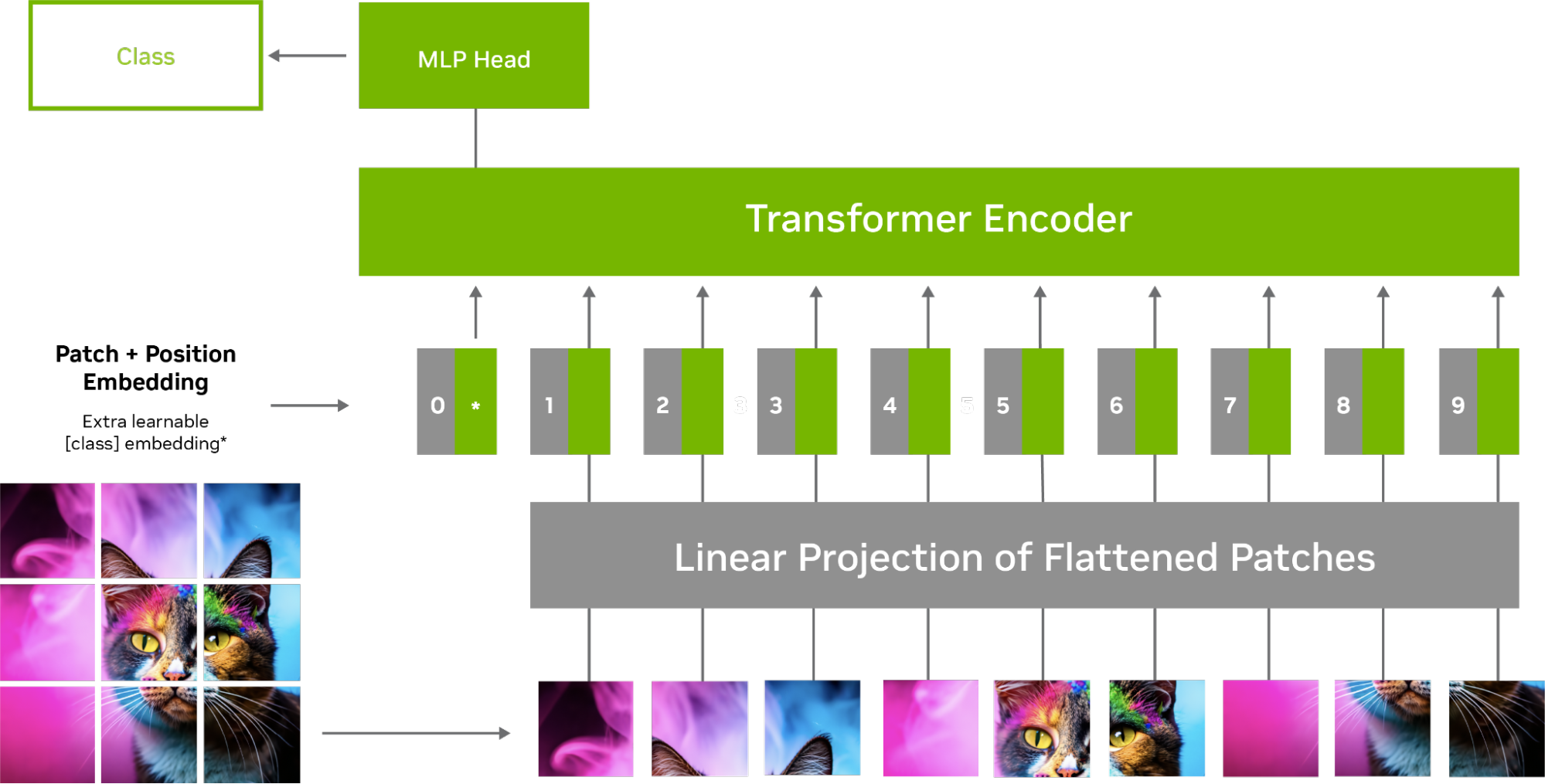
With the self-attention mechanism, each token or patch of an image interacts with other tokens to decide which tokens are important. This helps the model capture relationships and dependencies between tokens and learns which ones are considered important over others.
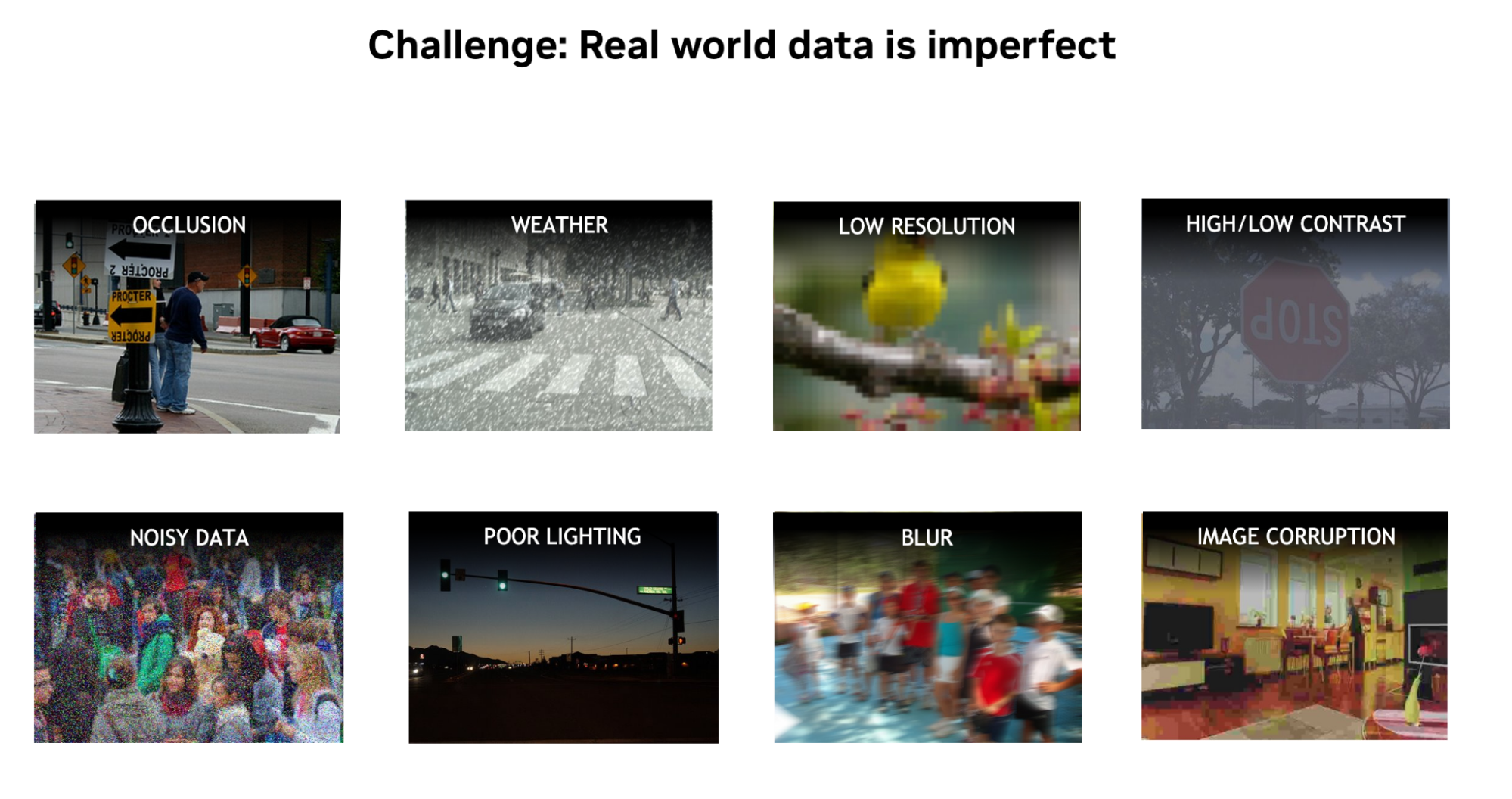
For example, with an image of a bird, the model pays more attention to important features, such as the eyes, beak, and feathers rather than the background. This translates into increased training efficiency, enhanced robustness against image corruption and noise, and superior generalization on unseen objects.
Why ViTs are critical for computer vision applications
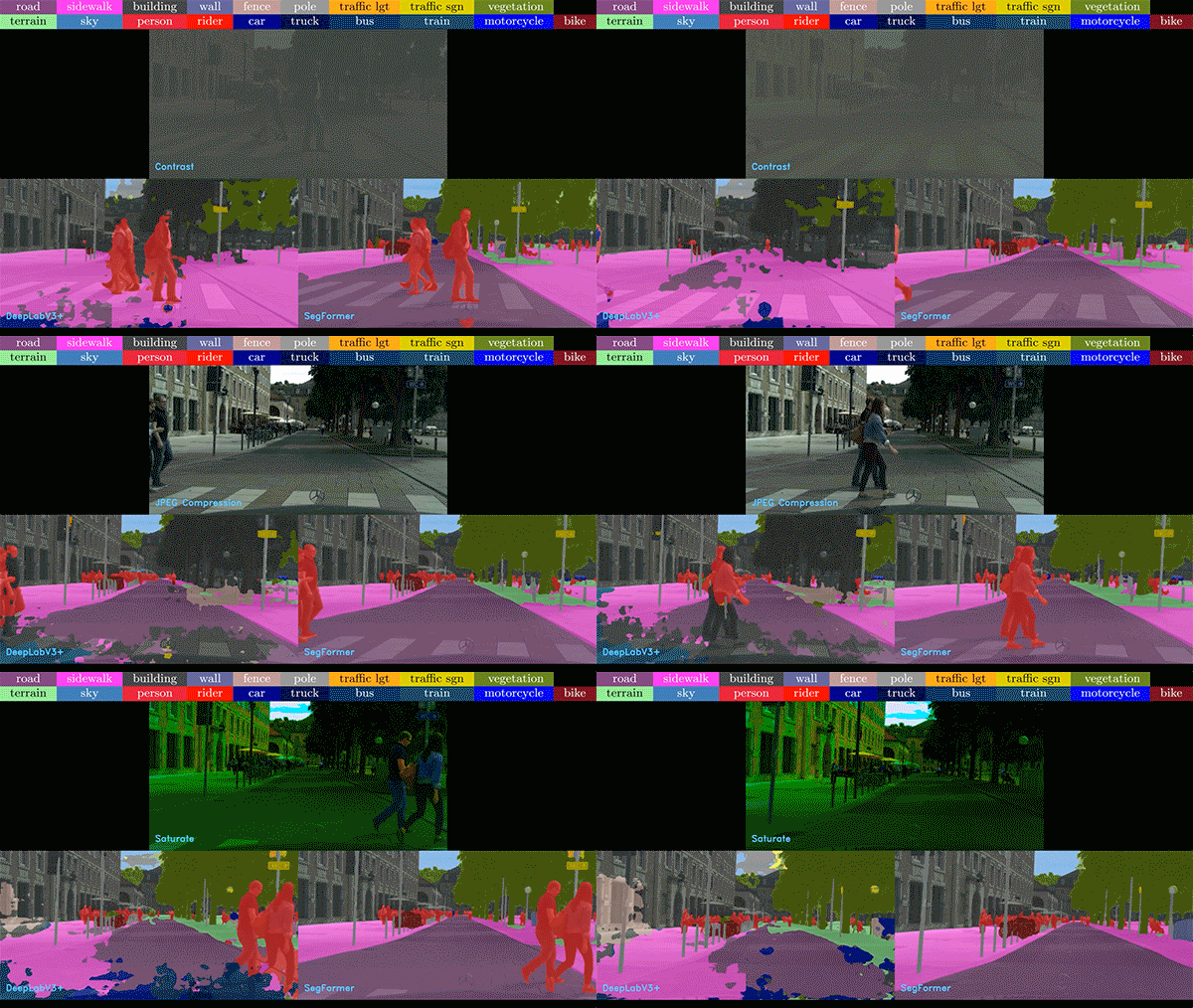
Real-world environments have diverse and complex visual patterns. The scalability and adaptability of ViTs enable them to handle a wide variety of tasks without the need for task-specific architecture adjustments, unlike CNNs.
In the following video, we compare noisy videos running both on a CNN-based model and ViT-based model. In every case, ViTs outperform CNN-based models.
Integrating ViTs with TAO Toolkit 5.0
TAO, a low-code AI toolkit to build and accelerate vision AI models, now makes it easy to build and integrate ViTs into your applications and AI workflow. Users can quickly get started with a simple interface and config files to train ViTs, without requiring in-depth knowledge of model architectures.
The TAO Toolkit 5.0 features several advanced ViTs for popular computer vision tasks including the following.
Fully Attentional Network (FAN)
As a transformer-based family of backbones from NVIDIA Research, FAN achieves SOTA robustness against various corruptions as highlighted in Table 1. This family of backbones can easily generalize to new domains, fighting noise and blur. Table 1 shows the accuracy of all FAN models on the ImageNet-1K dataset for both clean and corrupted versions.
| Model | # of Params | Accuracy (Clean/Corrupted) |
| FAN-Tiny-Hybrid | 7.4M | 80.1/57.4 |
| FAN-Small-Hybrid | 26.3M | 83.5/64.7 |
| FAN-Base-Hybrid | 50.4M | 83.9/66.4 |
| FAN-Large-Hybrid | 76.8M | 84.3/68.3 |
Global Context Vision Transformer (GC-ViT)
GC-ViT is a novel architecture from NVIDIA Research that achieves very high accuracy and compute efficiency. It addresses the lack of inductive bias in vision transformers. It also achieves better results on ImageNet with a smaller number of parameters through the use of local self-attention, which combined with global self-attention can give much better local and global spatial interactions.
| Model | # of Params | Accuracy |
| GC-ViT-xxTiny | 12M | 79.9 |
| GC-ViT-xTiny | 20M | 82.0 |
| GC-ViT-Tiny | 28M | 83.5 |
| GC-ViT-Small | 51M | 84.3 |
| GC-ViT-Base | 90M | 85.0 |
| GC-ViT-Large | 201M | 85.7 |
Detection transformer with improved denoising anchor (DINO)
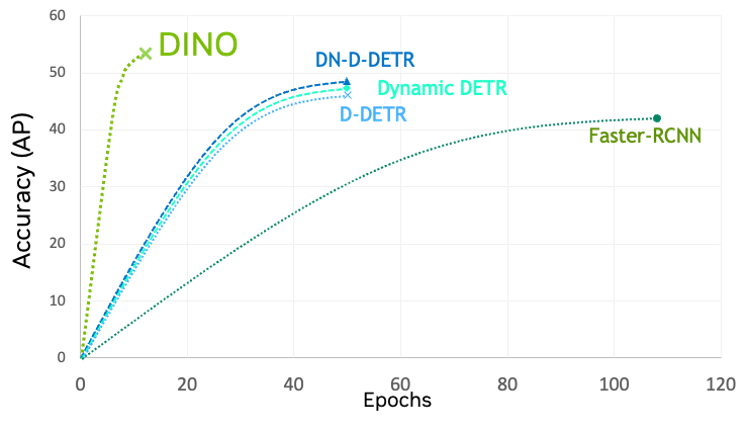
DINO is the newest generation of detection transformers (DETR) with faster training convergence compared to other ViTs and CNNs. DINO in the TAO Toolkit is flexible and can be combined with various backbones from traditional CNNs, such as ResNets, and transformer-based backbones like FAN and GC-ViT.
Segformer
Segformer is a lightweight and robust transformer-based semantic segmentation. The decoder is made of lightweight multi-head perception layers. It avoids using positional encoding (mostly used by transformers), which makes the inference efficient at different resolutions.
Powering efficient transformers with NVIDIA L4 GPUs
NVIDIA L4 GPUs are built for the next wave of vision AI workloads. They’re powered by the NVIDIA Ada Lovelace architecture, which is designed to accelerate transformative AI technologies.
L4 GPUs are suitable for running ViT workloads with their high compute capability of FP8 485 TFLOPs with sparsity. FP8 reduces memory pressure when compared to larger precisions and dramatically accelerates AI throughput.
The versatility and energy-efficient L4 with single-slot, low-profile form factor makes it ideal for vision AI deployments, including edge locations.
Watch this Metropolis Developer Meetup on-demand to learn more about ViTs, NVIDIA TAO Toolkit 5.0, and L4 GPUs.