Categories
Misc

Implementing High Performance Matrix Multiplication Using CUTLASS v2.8

High performance CUTLASS template abstractions support matrix multiply operations (GEMM), Convolution AI, and improved Strided-DGrad.

NVIDIA continues to enhance CUTLASS to provide extensive support for mixed-precision computations, providing specialized data-movement, and multiply-accumulate abstractions. Today, NVIDIA is announcing the availability of CUTLASS version 2.8.

Download the free CUTLASS v2.8 software.

What’s new

  • Emulated single-precision GEMM and Convolution (up to 48TFLOPs)
  • Grouped GEMM concept
  • Improved Strided-DGrad

See the CUTLASS Release Notes for more information.

About CUTLASS

CUTLASS is a collection of CUDA C++ template abstractions for implementing high-performance matrix-multiplication (GEMM) at all levels, and scales within CUDA. It incorporates strategies for hierarchical decomposition and data movement similar to those used to implement cuBLAS.

CUTLASS decomposes these “moving parts” into reusable and modular software components abstracted by C++ template classes. These thread-wide, warp-wide, block-wide, and device-wide primitives can be specialized and tuned via custom tiling sizes, data types, and other algorithmic policy. The resulting flexibility simplifies their use as building blocks within custom kernels and applications.

To support a wide variety of applications, CUTLASS provides extensive support for mixed-precision computations, providing specialized data-movement, and multiply-accumulate abstractions for:

  • Half-precision floating point (FP16), BFloat16 (BF16), and Tensor Float 32 (TF32) data types.
  • Single-precision floating point (FP32) data type.
  • Double-precision floating point (FP64) data type.
  • Integer data types (4b and 8b).
  • Binary data types (1b).

Furthermore, CUTLASS demonstrates warp-synchronous matrix multiply operations targeting the programmable, high-throughput Tensor Cores implemented on NVIDIA Volta, Turing, and Ampere architectures.

CUTLASS implements high-performance convolution (implicit GEMM). Implicit GEMM is the formulation of a convolution operation as a GEMM. This allows CUTLASS to build convolutions by reusing highly optimized warp-wide GEMM components and below.

Learn more

Recent Developer Blog posts

Categories
Misc

Pretrained vision transformers in Tensorflow.

Have you been looking for pretrained vision transformer models in TensorFlow? Have you been frustrated that pretrained models are available only in PyTorch? And JAX…

Let me introduce TensorFlow Image Models (tfimm), a TF port of the PyTorch timm library, which in version v0.1.1 provides 37 pretrained vision transformers of the ViT and DeiT varieties.

The list of available models will grow in upcoming releases.

submitted by /u/drbottich
[visit reddit] [comments]

Categories
Misc

Using TensorFlow with Anaconda [help]

I’ve been trying to set up my tensorflow env and am having difficulty. For my project i need tensorflow, scikit-learn matplotlib, pandas and numpy.

When I go the conda forge route, and try to run my .py file, i get different errors for each iteration of the env that i have.

Some highlighting tensorflow-estimator; i’ve tried using different versions of this module, and tried different version of python and different versions of tensorflow.

Each environment yields a different error. So instead of trying to iterate through each version, i wanted to see if anyone had any clues to what I may be doing wrong.

Or

If you use Anaconda w/ tensorflow and the other packages i’ve mentioned, if you can give me a breakdown of your env/version numbers for corresponding packages, that would be great!

Thanks in advance!

Error I am getting when using env. that strictly installs through packages through anaconda navigator (I have tried pip, I have tried conda terminal etc)

ImportError: cannot import name ‘MomentumParameters’ from ‘tensorflow.python.tpu.tpu_embedding’ (C:Usersmeanaconda3envstf_envlibsite-packagestensorflowpythontputpu_embedding.py)

submitted by /u/Pos1tivity
[visit reddit] [comments]

Categories
Misc

Reach New Frontiers of Immersive Production with NVIDIA CloudXR and HTC VIVE Focus 3

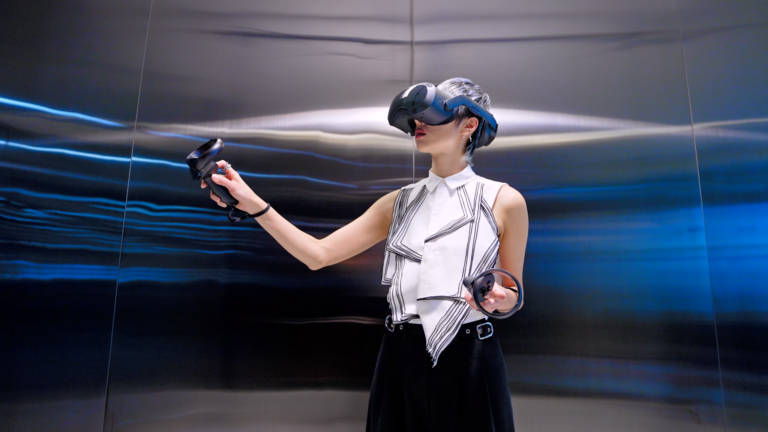
Woman wearing the HTC VIVE Focus 3 headset.HTC released a CloudXR client to support their VIVE Focus 3, which provides a “best of both worlds” solution to the difficult tradeoffs VR developers face.Woman wearing the HTC VIVE Focus 3 headset.
Whether building immersive theatrical experiences or virtual training solutions, XR development continues to push the limits of both content and device performance. Often, this means having to compromise on either fidelity or mobility. But with the NVIDIA CloudXR streaming solution, this is no longer the case.

This month at NVIDIA GTC, HTC announced the release of an NVIDIA CloudXR client to support their VIVE Focus 3, available now on GitHub. This provides a “best of both worlds” solution to the difficult tradeoffs VR developers typically face.

“High fidelity, cloud-based VR streaming represents the next big evolution in the XR industry, and we’re excited to continue working closely with the teams at NVIDIA to keep pushing the industry forwards,” said Shen Ye, senior director and global head of products at HTC.

The VIVE Focus 3 is the first commercially available VR headset with a custom NVIDIA CloudXR client. With seamless remote rendering powered by NVIDIA CloudXR, creative studios like Agile Lens can design extremely high fidelity immersive experiences, which would otherwise be impossible to run on a mobile chipset.

Alex Coulombe, cofounder and creative director at Agile Lens, has wanted to bring the intimacy and power of theater to the masses using technologies like VR. His latest venture, Heavenue, is a platform that integrates NVIDIA CloudXR to deliver high fidelity immersive live performances to VR headsets from the cloud.

Heavenue’s first partner is the Actors Theatre of Louisville, which is producing an immersive rendition of the classic A Christmas Carol this December. This will be the first simultaneous live stage and virtual theater performance of its kind.

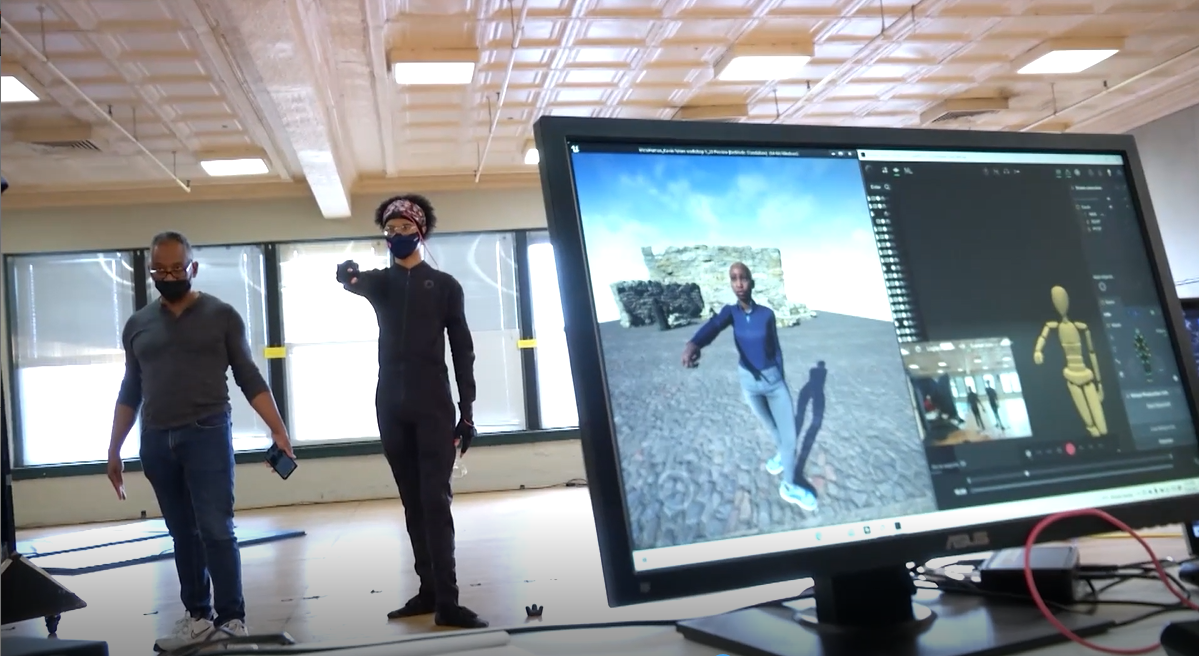
Image of actors using VR equipment to create avatars shown on a computer screen.
Figure 1. Actors Theater of Louisville combined live motion capture with virtual avatars using Heavenue for their production of A Christmas Carol.

The producers combined motion capture from live performers with facial and voice tracking from actors, overlaid onto a virtual avatar using Unreal Engine 4 to complete the experience. This is all hosted by CoreWeave, which offers powerful servers with a broad range of NVIDIA GPUs. It includes North America’s largest deployment of A40s, in the cloud and streamed to end users on standalone VR headsets such as the VIVE Focus 3, with the NVIDIA CloudXR. The result is a rich and immersive experience where users can freely move around the theater environment without tether restriction.

“NVIDIA CloudXR is like a bridge to the future,” Coulombe said. “This has never been possible before. It’s only now, with the advent of technologies like these that we can start to build a platform that democratizes the experience of an incredibly immersive, compelling, vivid, high fidelity live performance.”

With NVIDIA CloudXR, virtual productions and location-based experiences (LBE) are able to use the VIVE Focus 3 to deliver a more immersive experience. This shifts computing to centralized computers and removes the need to spend time navigating around cords. Having a centralized computing environment makes debugging and troubleshooting easy, creating a more user-friendly system and experience. All of this comes without impacting quality or graphical fidelity, taking full advantage of a 5K resolution and 120-degree field of view.

This application extends to any use case where mobility and high fidelity are required, such as in enterprise training, product and building design, or manufacturing floor planning.

HTC VIVE has open-sourced their CloudXR sample client for the VIVE Focus 3 on GitHub. Developers can extend the sample client source code to add bespoke features and customized user interface. Those less familiar with Android development, or just wanting to try it out, can download the prebuilt APK and install this directly into their headset to get started.

Learn more about NVIDIA CloudXR and download the HTC VIVE Focus 3 sample client today.

Categories
Misc

NVIDIA Merlin Extends Open Source Interoperability for Recommender Workflows with Latest Update

NVIDIA Merlin recommender workflow.Check out NVIDIA Merlin’s latest updates including Transformers4Rec and SparseOperations Kit.NVIDIA Merlin recommender workflow.

Data scientists and machine learning engineers use many methods, techniques, and tools to prep, build, train, deploy, and optimize their machine learning models. While technical leads cite the importance of leveraging open source software for recommender team workflows, the majority of popular machine learning methods, libraries, and frameworks are not designed to support and accelerate recommender workflows. 

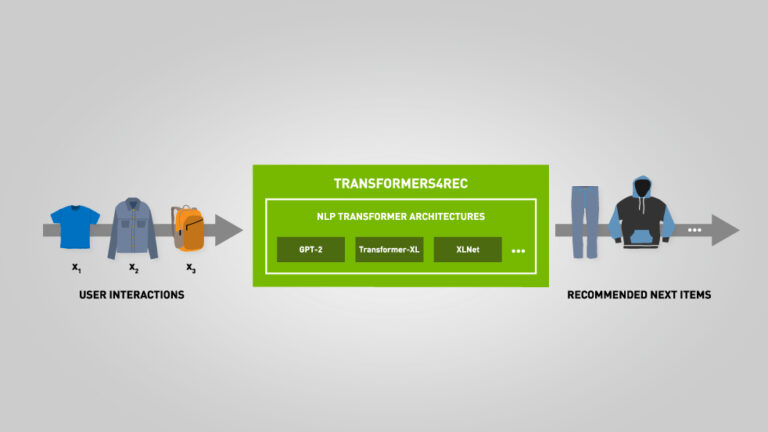
NVIDIA Merlin is designed to streamline recommender workflows. The latest update includes Transformers4Rec, a new library that wraps HuggingFace Transformer Architectures to build pipelines for session-based recommendations. It also adds SparseOperationsKit (SOK), a new Python package that supports sparse training and inference with Deep Learning (DL). 

This latest release reaffirms the commitment of NVIDIA to help machine learning engineers and data scientists develop and optimize their recommender systems—with open source canonical building blocks. 

Merlin Transformers4Rec, designed for recommenders and solving cold-start problems

Recommender methods popularized in mainstream media often rely upon long-term user profiles or lifetime user behavior. Yet, ecommerce and media companies acquiring new ongoing active users must provide relevant recommendations to first-time and early-visit users. Relevant recommendations enable increased user engagement, retention, and conversion to subscription services. 

Utilizing session-based recommenders with Transformers4Rec, data scientists and machine learning engineers are able to solve the cold-start problem by leveraging contextual and recent user interactions to predict a user’s next action and provide relevant recommendations. The NVIDIA Merlin team designed Transformers4Rec to be used as a standalone solution or within an ensemble of recommendation models.

SparseOperationsKit, sparse training, and inference with deep learning 

Recommender teams that work with massive datasets benefit from using deep learning (DL) recommenders. Merlin HugeCTR is a DL training framework designed for recommender systems and the latest update includes SOK, a new open source Python package that supports sparse training and inference. 

It is also compatible with DL frameworks including TensorFlow. SOK provides embedding model parallelism functionality to use GPUs, including scaling from a single GPU to multiple GPUs. Most common DL frameworks do not support model-parallelism, which makes it challenging to use all available GPUs in a cluster. Yet, SOK being compatible with DL frameworks, including TensorFlow, helps fill that void. 

Download and try NVIDIA Merlin 

The latest update to NVIDIA Merlin, including Transformers4Rec and SOK, strengthens streamlining and accelerating recommender workflows with open-source interoperability and performance enhancements. 

For more information about the latest release download NVIDIA Merlin today.

Categories
Misc

‘Paint Me a Picture’: NVIDIA Research Shows GauGAN AI Art Demo Now Responds to Words

A picture worth a thousand words now takes just three or four words to create, thanks to GauGAN2, the latest version of NVIDIA Research’s wildly popular AI painting demo. The deep learning model behind GauGAN allows anyone to channel their imagination into photorealistic masterpieces — and it’s easier than ever. Simply type a phrase like Read article >

The post ‘Paint Me a Picture’: NVIDIA Research Shows GauGAN AI Art Demo Now Responds to Words appeared first on The Official NVIDIA Blog.

Categories
Misc

find the maximum number in each feature map inside a tensor

Hi everybody,

Please, is there a way to find the maximum pixel value in each feature map inside a tensor?

for example, suppose we have this shape (None,48,48,32) of a tensor x. which consist of 32 feature maps of 48×48 size. How can i find the maximum pixel value in the fifth feature map?

Thanks.

submitted by /u/Ali_Q_Saeed
[visit reddit] [comments]

Categories
Misc

BERT FineTuning training time

Hello

I am trying to fine-tune a Bert model using the well-known Movie Review dataset on M1 Chip.

The ETA for an epoch is estimated at 10 hours to refine all 66M of parameters.

In order to reduce the ETA, I thought to set the first two layers as `trainable=False`, so the trainable parameters now are 2K.

Even if I dropped the trainable parameters, nothing is changed, ETA is still 10h.

Do you think it is normal or there is something wrong on my side?

Thanks

submitted by /u/i_cook_bits
[visit reddit] [comments]

Categories
Misc

An Elevated Experience: Xpeng G9 Takes EV Innovation Higher with NVIDIA DRIVE Orin

You don’t need a private plane to be at the forefront of personal travel. Electric automaker Xpeng took the wraps off the G9 SUV this week at the international Auto Guangzhou show in China. The intelligent, software-defined vehicle is built on the high-performance compute of NVIDIA DRIVE Orin and delivers AI capabilities that are continuously Read article >

The post An Elevated Experience: Xpeng G9 Takes EV Innovation Higher with NVIDIA DRIVE Orin appeared first on The Official NVIDIA Blog.

Categories
Misc

In Pursuit of Smart City Vision, Startup Two-i Keeps an AI on Worker Safety

When Julien Trombini and Guillaume Cazenave founded video-analytics startup Two-i four years ago, they had an ambitious goal: improving the quality of urban life by one day being able to monitor a city’s roads, garbage collection and other public services. Along the way, the pair found a wholly different niche. Today, the company’s technology — Read article >

The post In Pursuit of Smart City Vision, Startup Two-i Keeps an AI on Worker Safety appeared first on The Official NVIDIA Blog.