|
submitted by /u/-JuliusSeizure |
 DataBloom
Hello, I’ve just started learning and messing around with neural networks. I’m not sure if this is a problem, or this is how neural networks work, but I’ve noticed, that whenever I try to predict a binary classification outcome with my model, the predictions vary completely based on the size of the data i pass it.
For example, if I try to predict a single outcome with one row of data, I get something like 0.4. Then if I add another row of data and predict again, the first prediction of row 1 becomes 0.9, even though the data in row 1 did not change, I only added an additional row of data for an additional prediction.
My training data consists of 1266 entries with 54 features. I’ve tried reducing the batch_size to 1, different optimizers, number of layers, number of neurons and the result is mostly the same. Is this normal behavior?
submitted by /u/CandyPoper
[visit reddit] [comments]
Idea generation, not hardware or software, needs to be the bottleneck to the advancement of AI, Bryan Catanzaro, vice president of applied deep learning research at NVIDIA, said this week at the AI Hardware Summit. “We want the inventors, the researchers and the engineers that are coming up with future AI to be limited only Read article >
The post Pushing Forward the Frontiers of Natural Language Processing appeared first on The Official NVIDIA Blog.
I have an object detection model (Faster R-CNN sved as a frozen graph) that was trained over two years ago. It requires TF GPU 1.14 and the TF Object Detection API. It’s a bit of a hassle to setup that environment and was wondering if there was a more streamlined way to use that model with the latest version of TF/Keras?
submitted by /u/bc_uk
[visit reddit] [comments]
This feels like a profoundly stupid question, and maybe that’s why I’m not finding any answers to it… am new to machine learning.
I’m used to doing development inside VMs, but as I want to benefit from the GPU that’s not really an option here, right? I was thinking maybe I could do it in a Docker container instead (am on Windows) but not sure that’s viable, either. Would either a VM or Docker work for Windows and doing ML? Thanks.
submitted by /u/asking4afriend40631
[visit reddit] [comments]
Want to play awesome PC games for free without having to buy an expensive gaming rig? This GFN Thursday takes a look at the 90+ free-to-play PC games — including this week’s Fortnite Season 8 release and the Epic Games Store free game of the week, Speed Brawl, free to claim Sept. 16-23 — all Read article >
The post GeForce NOW Members Are Free to Play a Massive Library of Most-Played Games, Included With Membership appeared first on The Official NVIDIA Blog.
I am trying to build a sentiment classification (hate speech) for German language using NLP + Deep Learning. Any code tutorial? I found lots of research papers but few code implementations.
submitted by /u/grid_world
[visit reddit] [comments]
I am on tf_nightly-2.7.0 and used tensorflow’s “make_csv_dataset” to make dataset from a TSV file, but it seems the Tensorflow PrefetchDataset doesn’t have shape information. I could have used Pandas dataframe but would like to try Tensorflow’s dataset. Here are codes without the import:
!wget https://cdn.freecodecamp.org/project-data/sms/train-data.tsv train_file_path = "train-data.tsv" train_data = tf.data.experimental.make_csv_dataset(train_file_path, header=False, field_delim='t', column_names=['label', 'text'], batch_size=5, label_name='label', num_epochs=1, ignore_errors=True) examples, labels = next(iter(train_data)) # Just the first batch. print("FEATURES: n", examples, "n") print("LABELS: n", labels) encoder = keras.layers.TextVectorization(max_tokens=None, output_mode='int', output_sequence_length=160) encoder.adapt(train_data)
Here is how the dataset looks in the print output:
FEATURES: OrderedDict([('text', <tf.Tensor: shape=(5,), dtype=string, numpy= array([b'rt-king pro video club>> need help? info@ringtoneking.co.uk or call 08701237397 you must be 16+ club credits redeemable at www.ringtoneking.co.uk! enjoy!', b'good afternoon sunshine! how dawns that day ? are we refreshed and happy to be alive? do we breathe in the air and smile ? i think of you, my love ... as always', b'they have a thread on the wishlist section of the forums where ppl post nitro requests. start from the last page and collect from the bottom up.', b'no current and food here. i am alone also', b'die... i accidentally deleted e msg i suppose 2 put in e sim archive. haiz... i so sad...'], dtype=object)>)]) LABELS: tf.Tensor([b'spam' b'ham' b'ham' b'ham' b'ham'], shape=(5,), dtype=string)
Here is the error on line encoder.adapt(train_data) :
AttributeError: 'NoneType' object has no attribute 'ndims
The desired outcome would be no error message after manipulating the Tensorflow dataset.
Thank you for the help in advance!
submitted by /u/na_haran
[visit reddit] [comments]
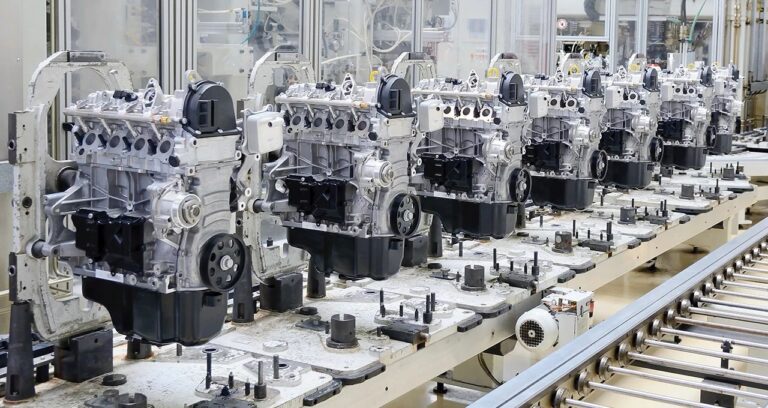 Read how the power of AI and edge computing is critical to driving operational efficiencies and productivity gains.
Automation and monitoring of industrial assets, systems, processes, and environments are increasingly important across manufacturing industries, including transportation, electronics, mining, and textiles. In order to implement safer and more productive practices, companies are automating their manufacturing processes with IoT sensors. IoT sensors generate vast amounts of data that, when combined with the power of AI, produce valuable insights that manufacturers can use to improve operational efficiency.
Edge computing allows sensor-enabled devices to collect and process data locally to deliver insights on the factory floor without having to communicate with the cloud. Edge AI enables any device or computer to process data and make AI-led decisions in real time, with minimal latency. This convenience gives rise to new use cases where fast, real-time insights are required, like when scanning for product defects on assembly lines, identifying workplace hazards, flagging machines that require maintenance, and more.
By bringing AI processing tasks closer to the source, edge computing provides many advantages to manufacturers, including:
Manufacturers globally have started to use AI at the edge to transform their manufacturing processes. The following use cases explore how edge computing is promoting enhanced efficiency and productivity in manufacturing.
Edge computing will continue to transform the manufacturing industry by bringing about AI-driven operational efficiencies and productivity gains. Download this free e-book to learn how edge computing is helping build smarter and safer spaces around the world.
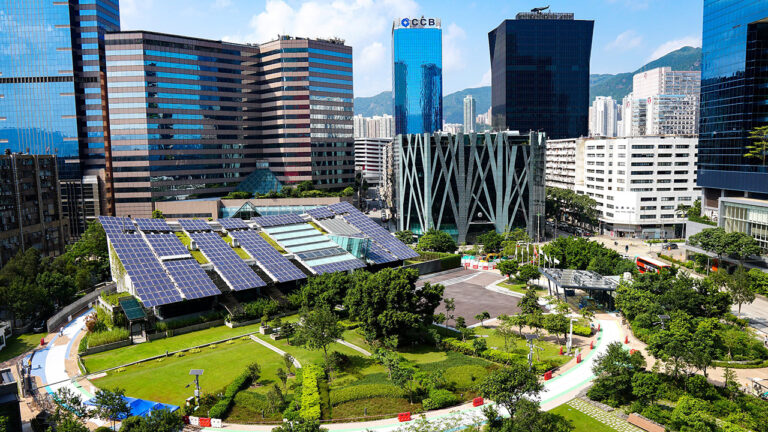 A new study creates a deep convolutional neural network using global satellite imagery to detect sustainable roofscapes—a promising strategy for climate mitigation.
A new AI-mapping tool is helping scientists assess how cities across the globe are using rooftops to combat climate change. Named Roofpedia, the research creates an open-source and scalable map of sustainable rooftops—a promising strategy for climate mitigation. Identifying areas with solar or green installations could help guide urban development, while also boosting community health, prosperity, and the environment.
“By collecting such data, Roofpedia allows us to gauge how cities might further utilize their rooftops to mitigate carbon emissions and how much untapped potential their roofscapes have,” coauthor Filip Biljecki, an assistant professor at the National University of Singapore and principal investigator for the Urban Analytics Lab, said in a press release.
By 2050, an estimated 68% of the world’s population will be living in urban areas. Strategies focused on the well-being of people and the planet remain central to creating healthy and thriving communities in the future. Studies have shown the benefits of sustainable rooftops—most commonly roofs with solar or green space— are plentiful and wide-ranging. Beyond creating an efficient and relatively clean source of energy, they also reduce carbon emissions, add to food production, aid stormwater management, improve air quality, create wildlife habitat, reduce traffic noise, and promote biodiversity.
Accounting for current installations could help planners and developers benchmark spaces, identify new potential areas, gauge the effectiveness of current incentives such as subsidies, and track the progress of environmentally friendly businesses.
Despite the advantages, most research focuses on estimating the potential of these roofscapes, rather than their distribution globally. A lack of data also limits the understanding of current totals, distribution, and global growth.
The team sought out to fill this data gap with the creation of Roofpedia, an open registry of sustainable roofscapes around the world.
The tool was created using high-resolution satellite imagery from Mapbox, with images from 17 diverse cities across Europe, North America, Australia, and Asia. Sampling a range of urban contexts and image conditions, the team hand-labeled some of the satellite images and trained a convolutional neural network to identify and tag roofs with solar, green space, or both.
According to study co-author Abraham Wu, Roofpedia was developed on PyTorch using NVIDIA Docker and an NVIDIA RTX 2060 GPU.
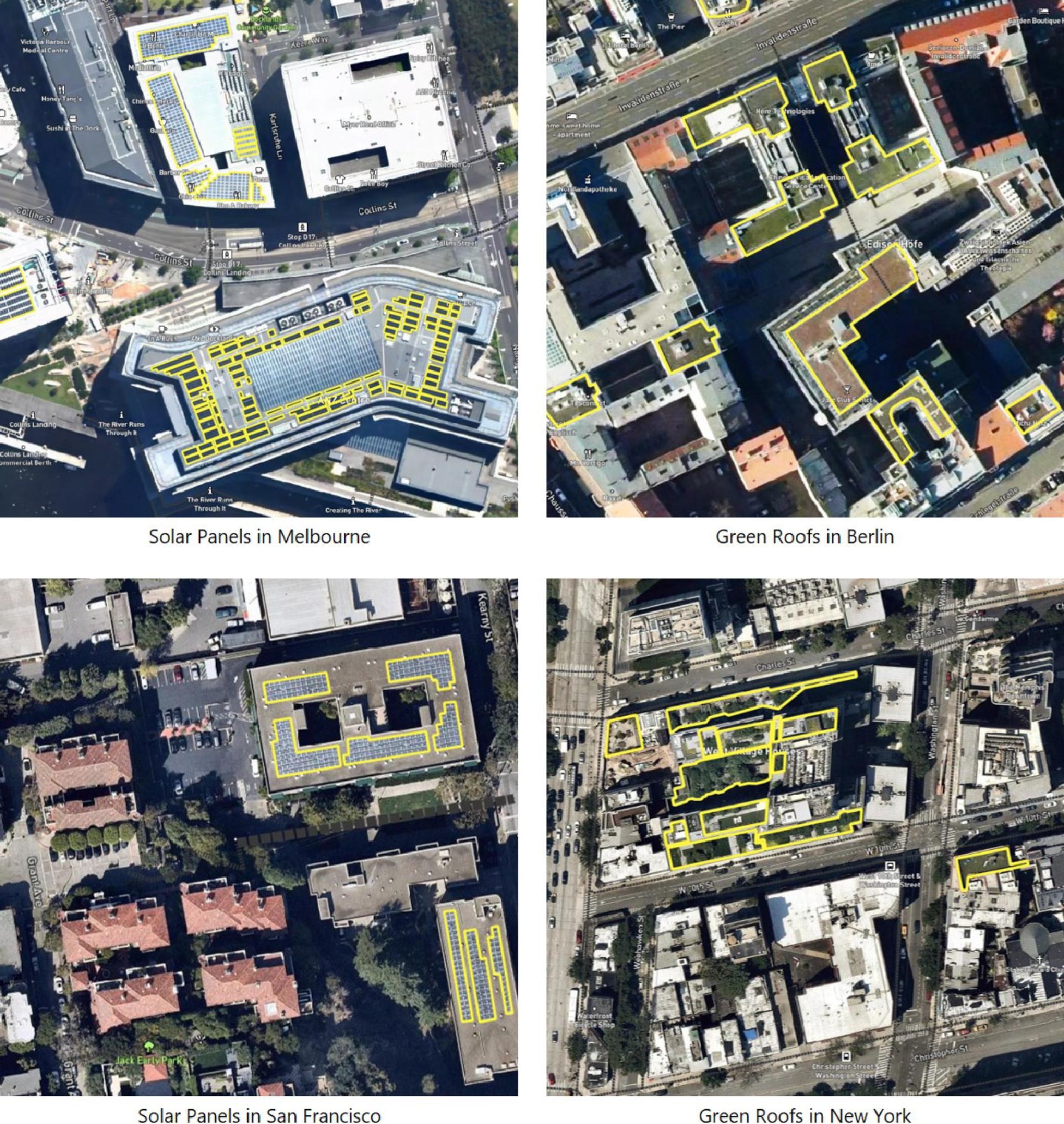
As data is added to the Roofpedia Registry and Index, the tool maps the distribution of solar and green rooftops and calculates the rank of a city. Scores and ranks are calculated by comparing solar and green roofs against the total number of buildings and area of buildings in a city, along with an overall combined score.
Currently, Las Vegas leads the solar ranking with a score of 86, while Zurich scores high in both solar (81) and green (100), for a combined score of 91.
There are over a million buildings in the current data set and the researchers note that more cities are being added as aerial or satellite imagery becomes available. Final results are rendered on Mapbox, with both the dataset and code available on GitHub.
“We are making this sustainable roofscape inventory available publicly, aiding researchers, practitioners, local governments, and the public to understand the current status of the roofscape in the context of sustainable urban development and achieving carbon neutrality,” the researchers write in the study.
Read the full article in Landscape and Urban Planning >>
Read more >>