Categories
Misc

RAPIDS Accelerator for Apache Spark v21.06 Release

Introduction RAPIDS Accelerator for Apache Spark v21.06 is here! You may notice right away that we’ve had a huge leap in version number since we announced our last release. Don’t worry, you haven’t missed anything. RAPIDS Accelerator is built on cuDF, part of the RAPIDS ecosystem. RAPIDS transitioned to calendar versioning (CalVer) in the last … Continued

Introduction

RAPIDS Accelerator for Apache Spark v21.06 is here! You may notice right away that we’ve had a huge leap in version number since we announced our last release. Don’t worry, you haven’t missed anything. RAPIDS Accelerator is built on cuDF, part of the RAPIDS ecosystem. RAPIDS transitioned to calendar versioning (CalVer) in the last release, and, from now on, our releases will follow the same convention.

We like CalVer because it is simple, and this new release is all about making your data science work simple as well. Of course, we’ve made changes to accommodate new versions of Apache Spark, but we’ve also simplified installation. We’ve added a profiling tool so it’s easier to identify the best workloads to run on the GPU.

There is a host of new functions to make life working with data easier. And we’ve expanded our community: if you are a Cloudera or an Azure user, GPU acceleration is more straightforward than ever. Let’s get into the details.

Updates

We added support for Apache Spark version 3.1.2 and Databricks 8.2ML GPU runtime.

To simplify the installation of the plug-in, we now have a single RAPIDS cuDF jar that works with all versions of NVIDIA CUDA 11.x. The jar was tested with CUDA 11.0 and 11.2 and relies on CUDA enhanced compatibility to work with any version of CUDA 11.

Profling and qualification tool

The RAPIDS Accelerator for Apache Spark now has an early release of the tool to analyze Spark logs to find jobs that are a good fit for GPU acceleration, as well as, profile jobs running with the plug-in. If applied to a single application, the tool looks at CPU event logs. In the case of multiple applications, the tool filters out individual application event logs and then provides information about the percentage of the runtime spent in SQL/Dataframe operations. It also calculates a breakdown of runtime spent on IO compared to Computation compared to Shuffle for these operations.

The profiling tool gives users information to help them debug their jobs. Key information it provides is Spark version, Spark properties (including those provided by the plug-in). Hadoop properties, lists of failed jobs and failed executors, query duration comparisons for all the queries in the input event logs, and the data format and storage type used.

As the tool is still in the early stages, we are excited to hear back from users on how we can improve the tool and their experience.

New functionality

This new release has additional functionality for arrays and structs. We can now sort on struct keys, have structs with map values, and cache structs. We can support concatenation of array columns, creation of 2D arrays, partition on arrays, and more. We’ve also expanded windowing lead/lag to support arrays. And range windows now support non-timestamp order by expressions. One of the important scaling capabilities is enabling large joins (for example, joins with large skew) to spill out of GPU memory and complete successfully. In addition, GPUDIRECT Storage has been integrated into the plug-in to enable Direct Memory Access (DMA) between storage and GPUs with increased bandwidth and lower latency to reduce I/O overhead for spilling and improve performance. For a detailed list of new features, please refer to the 21.06.0 changelog on the GitHub site.

Growing community

NVIDIA and Cloudera have continued to expand their partnership. Cloudera Data Platform (CDP) integration with RAPIDS Accelerator will be generally available on CDP PVC Base 7.1.6 release from July 15. With this integration, on-prem (private cloud) customers can accelerate their ETL workloads with NVIDIA-Certified systems and Cloudera Data Platform. See the press release from Cloudera here and check out our joint webinar here.

We’re also excited to let you know that NVIDIA and Microsoft have teamed to bring RAPIDS Accelerator to Azure Synapse. Support for Accelerator is now built-in, and customers can use NVIDIA GPUs for Apache Spark applications with no-code change and with an experience identical to a CPU cluster.

Coming soon

RAPIDS Accelerator for Apache Spark is a year old and growing fast. Our next release will expand read/write support for Parquet and ORC data formats, add operator support for Struct, Map, and List data types, increase stability and deliver an initial implementation of Out of Core Group by operations. Look forward to our next release in August, and in the meantime, follow all our developments on GitHub and blogs.

Categories
Misc

NVIDIA and Mozilla Release Common Voice Dataset, Surpassing 13,000 Hours for the First Time

As part of NVIDIA’s collaboration with Mozilla Common Voice, the models trained on this and other public datasets are made available for free via an open-source toolkit called NVIDIA NeMo.
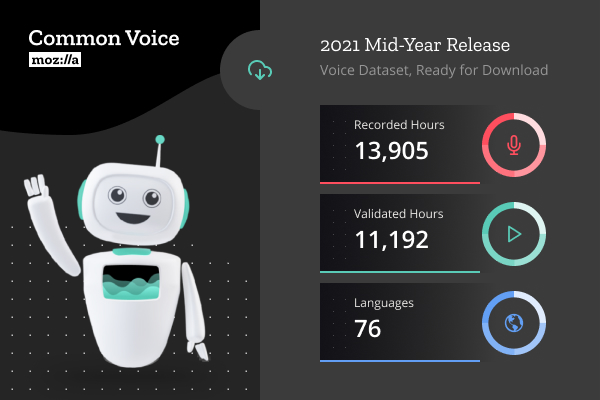
NVIDIA and Mozilla are proud to announce the latest release of the Common Voice dataset, with over 13,000 hours of crowd-sourced speech data, and adding another 16 languages to the corpus. 

Common Voice is the world’s largest open data voice dataset and designed to democratize voice technology. It is used by researchers, academics, and developers around the world.  Contributors mobilize their own communities to donate speech data to the MCV public database, which anyone can then use to train voice-enabled technology.  As part of NVIDIA’s collaboration with Mozilla Common Voice, the models trained on this and other public datasets are made available for free via an open-source toolkit called NVIDIA NeMo

Newly released Mozilla Common Voice dataset.

Highlights of this release include:

  • Common Voice dataset release is now 13,905 hours, an increase of 4,622 hours from the previous release.
  • Introduces 16 new languages to the Common Voice dataset: Basaa, Slovak, Northern Kurdish, Bulgarian, Kazakh, Bashkir, Galician, Uyghur, Armenian, Belarusian, Urdu, Guarani, Serbian, Uzbek, Azerbaijani, Hausa.
  • The top five languages by total hours are English (2,630 hours), Kinyarwanda (2,260), German (1,040), Catalan (920), and Esperanto (840). 
  • Languages that have increased the most by percentage are Thai (almost 20x growth, from 12 hours to 250 hours), Luganda (9x growth, from 8 hours to 80 hours), Esperanto (more than 7x growth, from 100 hours to 840 hours), and Tamil (more than 8x growth, from 24 hours to 220 hours).
  • The dataset now features over 182,000 unique voices, a 25% growth in contributor community in just six months.

Pretrained Models:

NVIDIA has released multilingual speech recognition models in NGC for free as part of the partnership mission to democratize voice technology. NeMo is an open-source toolkit for researchers developing state-of-the-art conversational AI models. Researchers can further fine-tune these models on multilingual datasets. See an example in this notebook that fine tunes an English speech recognition model on the MCV Japanese dataset. 

Contribute Your Voice, and Validate Samples: 

The dataset relies on the amazing effort and contribution from many communities across the world. Take the time to feed back into the dataset by recording your voice and validating samples from other contributors: https://commonvoice.mozilla.org/speak

You can download the latest MCV dataset from https://commonvoice.mozilla.org/datasets, including the repo for full stats https://github.com/common-voice/cv-dataset/, and NVIDIA NeMo from NGC Catalog and GitHub.

Dataset ‘Ask Me Anything’:
August 4, 2021 from 3:00 – 4:00 p.m. UTC / 2:00 – 3:00 p.m. EDT / 11:00 a.m. – 12:00 p.m. PDT:

In celebration of the dataset release, on August 4th Mozilla is hosting an AMA discussion with Lead Engineer Jenny Zhang. Jenny will be available to answer your questions live, to join and ask a question please use the following AMA discourse topic.   

Read more > >

Categories
Misc

What output nodes should I use?

For context, I’m working with Mozilla’s DeepSpeech (version 0.1.0) to transcribe audios into text. I have a checkpoint folder with these files: model.data-00000, model.index, and model.meta

I need to convert the data file to a .pb file (protobuf). I’ve tried all the links in stack overflow, but nothing seems to be working. I’m guessing that maybe I’m getting my output nodes wrong, so is there a way to know what output nodes are relevant? I have over a 100 in the data file and if I convert all of that to .pb, it’ll be 1.5 GB in size. And if I try to transcribe with such a large frozen model, DeepSpeech gives me a “core dumped” error. So is there a way to know what output nodes are relevant?

I’m not sure if my question makes sense as my brain is scrambled from sitting with this for days now.

Please help anyone! And thank you!

submitted by /u/Due-Grade-756
[visit reddit] [comments]

Categories
Misc

Selecting the colour of the bounding boxes of tensorflow object detection API

Hello guys,

So I am doing a project where I have to identify an object and then identify its colour and the bounding box must be of the same colour as of the detected object. Please help if you guys have any ideas.

submitted by /u/BeerThePain
[visit reddit] [comments]

Categories
Misc

Edge Computing in Ethiopia – A Quest for an AI Solution

This is a guest submitted post by Natnael Kebede, Co-founder and Chief NERD at New Era Research and Development Center It was one year ago in a random conversation that a friend told me about a piece of hardware in excitement. At that point I never imagined how that conversation would have the potential to … Continued
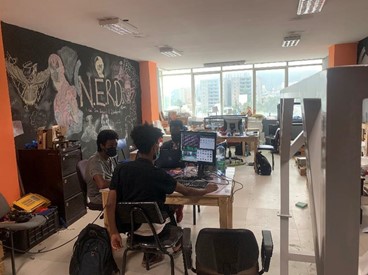
This is a guest submitted post by Natnael Kebede, Co-founder and Chief NERD at New Era Research and Development Center

It was one year ago in a random conversation that a friend told me about a piece of hardware in excitement. At that point I never imagined how that conversation would have the potential to impact my life. My name is Natnael Kebede, the Co-founder and Chief NERD at New Era Research and Development (NERD) Center in Ethiopia. NERD is a center that provides a hacker space, educational content, and research for Ethiopian youth to create a better Ethiopia Africa and World

That piece of hardware was the Jetson Nano. I went over to my house and started researching about the Jetson Nano that night. From that point onward, I could not stop following up and researching about the NVIDIA edge computing concept. This is a story about how a single conversation helped me build a career and a community around an idea.

The conversation we had with my friend was about edge computing disrupting the new AI-development environment. For a country like Ethiopia, AI is usually considered a luxury than a necessity. This is due to the perception of universities, investors, startups and the government have about AI. All of them think about expensive high-performance computers and lack of experienced professionals in the field. Very soon, I realized how the edge computing solution could be a peaceful weapon to change the attitude towards AI in Ethiopia. Me and my partner decided to buy the Jetson Nano and put our name on the map.

The learning process was much easier and efficient when we started experimenting with the Jetson hands-on. It was coincidentally by that time we were invited to the first Ethiopian AI Summit to showcase any project related to AI. We decided to go for building an edge solution. Our research team side of the problem was to build a system that reads a streamed video, and use the Jetson to identify any desired inference at the edge. The application could range from counting cars in a connected traffic junctions and detecting license plates, to an agricultural solution where any flying or ground vehicle feeding a video of a farm to detect plantation health issues/counting fruits. We started off with the traffic management system. We organized a team of three engineering interns and myself to build a prototype in less than eight weeks.

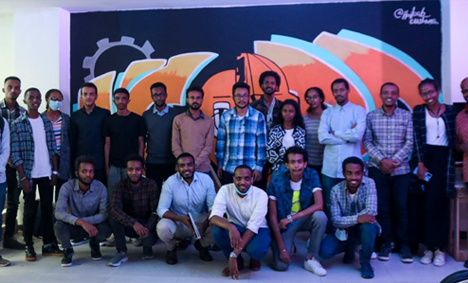
The NERD team behind the traffic management system.

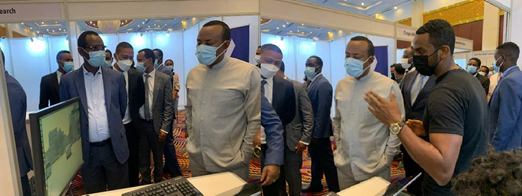
We got the whole thing figured out after going through a lot of reading. Finding answers was not the easiest thing as it was rare to find publications on the Nano. Meanwhile, a friend gave our contact to one of the NVIDIA Emerging Chapters Program leads, and we had a conversation about the program. It was the best timing. Although we wish we had known about the program earlier to access the DLI (NVIDIA Deep Learning Institute) courses, we kept going with a hope that the program will enable future projects with hands-on experience and technical training. The project was finally presented at the Summit and we had the chance to pitch the idea of edge computing to the Prime Minster of Ethiopia His Excellency Dr. Abiy Ahmed. We received promising feedback from him in regards to taking the project forward into implementation on the years to come.

Presenting the smart traffic light control system to Prime Minister Dr. Abiy Ahmed at the Ethiopian AI Summit

After the Summit we knew we needed more talent to recruit and inspire. We launched a short-term training on the Jetson Nano. It took our team eight weeks to build the traffic management system. We made sure the training takes the same duration of time for the students to build a final project at the end. We value open-sourcing the project. The output from these trainings are projects to be open-source so we can build our community bigger. Since we have limited resources, we only provided 25 students in three groups. Currently, we registered 13 students and the first batch is currently taking trainings. We are using the free DLI courses we were granted as part of the Emerging Chapters Program as guideline to our curriculum. We will soon provide them with free course vouchers after filtering consistent training participants.

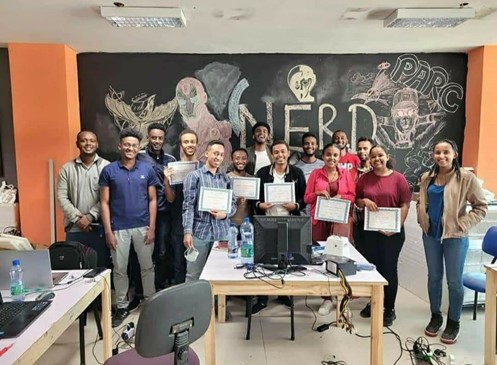
First group of Mechatronics at the Jetson Nano training

Our goal is to create a community of enthusiasts, hobbyist, engineers and developers passionate about edge computing solutions in Agriculture and Smart City projects. We do this by consistently engaging with the tech community in Addis Ababa, Ethiopia. We organized an open seminar last week where we showcased our projects and also talked about edge computing. We were able to inspire more students for our program. Our team members are all enjoying the free DLI courses and we will be coming up with something much larger very soon. I want to personally thank the NVIDIA Emerging Chapters Program for all the support and resources. On behalf of our team, we are grateful to be part of the program. Very soon we would love to present our work for other partners!

The AI-based traffic control system is now on GitHub.

To learn more about NERD and to stay up-to-date, follow us on Instagram @nerds_center.

Categories
Misc

Why the prediction in converted Tensorflow model in Javascript keeps returning the same broken result but it performed great in Python (the origin) ?

I made the transfer learning model in Tensorflow python with the pretrained model Mobilenet V2, it performed so great in python even when I predicted. After that, I save the model to keras h5 format and convert it to tensorflow.js model. Then I create a static page that implements the tensorflow.js model and run it with Web Server for Chrome in Chrome browser. The prediction result I got is really confusing as the result was always the same one, no matter that I changed the image to be predicted. Any inputs, suggestion and solutions on this problem are highly appreciated. Thanks in advance!

Full Description and Code I had made so far on this issue : https://stackoverflow.com/questions/68574893/my-converted-tensorflow-transfer-learning-model-always-returns-same-results-in-t

submitted by /u/TechnologyOk9486
[visit reddit] [comments]

Categories
Misc

How to use max_steps in train with boosted trees?

How to use max_steps in train with boosted trees?

I am a little bit confused about the the usage of steps in train with boosted trees. I get the meaning of step when I use it with a incremental model like neural net, but I don’t get when to use it with n_trees of the boosted trees. I guess that 1 step means that I train the whole n_trees one time. Am I correct?

https://preview.redd.it/z8rb5zwud5e71.png?width=1486&format=png&auto=webp&s=a81de0fc536387db29385cb8e2fca6cc507db8a2

submitted by /u/Tokukawa
[visit reddit] [comments]

Categories
Misc

Setting the Virtual Stage: ‘Deathtrap Dungeon’ Gets Interactive Thanks to NVIDIA RTX

Deathtrap Dungeon: The Golden Room is a gripping choose-your-own-adventure story, but it’s no page-turner. Based on the best-selling book of the same name, it’s an interactive film in which viewers become the player on their quest to find The Golden Room while facing down dungeon masters and avoiding traps. NVIDIA RTX technology powers the real-time Read article >

The post Setting the Virtual Stage: ‘Deathtrap Dungeon’ Gets Interactive Thanks to NVIDIA RTX appeared first on The Official NVIDIA Blog.

Categories
Misc

NVIDIA Showcases the Latest in Graphics, AI, and Virtual Collaboration at SIGGRAPH

Developers, researchers, graphics professionals, and others from around the world will get a sneak peek at the latest innovations in computer graphics at the SIGGRAPH 2021 virtual conference, taking place August 9-13.
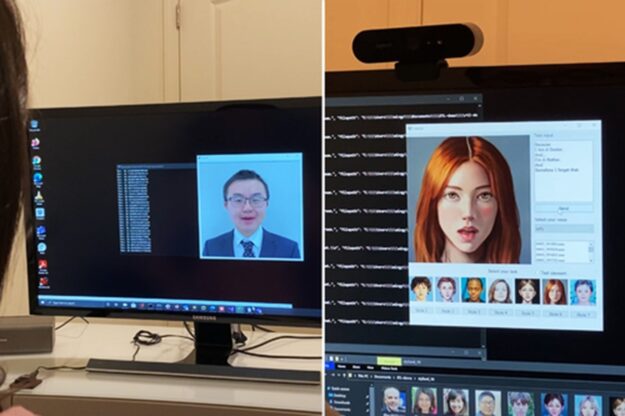
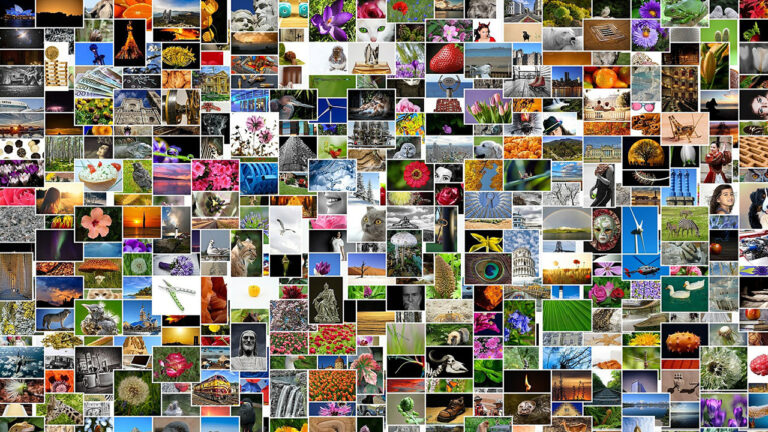
Developers, researchers, graphics professionals, and others from around the world will get a sneak peek at the latest innovations in computer graphics at the SIGGRAPH 2021 virtual conference, taking place August 9-13.

NVIDIA will be presenting the breakthroughs that NVIDIA RTX technology delivers, from real-time ray tracing to AI-enhanced workflows.

Watch the NVIDIA special address on Tuesday, August 10 at 8:00 a.m. PDT, where we will showcase the latest tools and solutions that are driving graphics, AI, and the emergence of shared worlds.

And on Wednesday, August 11, catch the global premiere of “Connecting in the Metaverse: The Making of the GTC Keynote” at 11:00 a.m. PDT. The new documentary highlights the creative minds and groundbreaking technologies behind the NVIDIA GTC 2021 keynote. See how a small team of artists used NVIDIA Omniverse to blur the line between real and rendered.

Explore the Latest from NVIDIA Research

At SIGGRAPH, the NVIDIA Research team will be presenting the following papers:

Don’t miss our Real-Time Live! demo on August 10 at 4:30 p.m. PDT to see how NVIDIA Research creates AI-driven digital avatars.

Dive into Technical Training with NVIDIA Deep Learning Institute

Here’s a preview of some DLI sessions you don’t want to miss:

Omniverse 101: Getting Started with Universal Scene Description for Collaborative 3D Workflows

This free self-paced training provides an introduction to USD. Go through a series of hands-on exercises consisting of training videos accompanied by live scripted examples, and learn about concepts like layer composition, references and variants.

Fundamentals of Ray Tracing Development using NVIDIA Nsight Graphics and NVIDIA Nsight Systems

With NVIDIA RTX and real-time ray-tracing APIs like DXR and Vulkan Ray Tracing, see how it’s now easier than ever to create stunning visuals at interactive frame rates. This instructor-led workshop will show audiences how to utilize NVIDIA Nsight graphics and NVIDIA Nsight Systems to profile and optimize 3D applications that are using ray tracing. Space is limited.

Graphics and Omniverse Teaching Kit

Designed for college and university educators looking to bring graphics and NVIDIA Omniverse into the classroom, this teaching kit includes downloadable teaching materials and online courses that provide the foundation for understanding and building hands-on expertise in graphics and Omniverse.

Discover the Latest Tools and Solutions in Our Virtual Demos

We’ll be showcasing how NVIDIA technology is transforming workflows in some of our exciting demos, including:

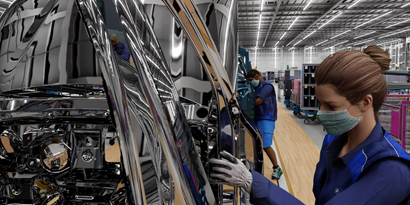
  • Factory of the Future: Explore the next era of manufacturing with this demo, which showcases BMW Group’s factory of the future – designed, simulated, operated, and maintained entirely in NVIDIA Omniverse.
  • Multiple Artists, One Server: See how teams can accelerate visual effects production with the NVIDIA EGX Platform, which enables multiple artists to work together on a powerful, secure server from anywhere.
  • 3D Photogrammetry on an RTX Mobile Workstation: Watch how NVIDIA RTX-powered mobile workstations help drive the process of 3D scanning using photogrammetry, whether in a studio or in a remote location.
  • Interactive volumes with NanoVDB in Blender Cycles: Learn how NanoVDB makes volume rendering more GPU memory efficient, meaning larger and more complex scenes can be interactively adjusted and rendered with NVIDIA RTX-accelerated ray tracing and AI denoising.

Enter for a Chance to Win Some Gems

Attendees can win a limited-edition hard copy of Ray Tracing Gems II, the follow up to 2019’s Ray Tracing Gems.

Ray Tracing Gems II brings the community of rendering experts back together to share their knowledge. The book covers everything in ray tracing and rendering, from basic concepts geared toward beginners to full ray tracing deployment in shipping AAA games.

Learn more about the sweepstakes and enter for a chance to win.

Join NVIDIA at SIGGRAPH and learn more about the latest tools and technologies driving real-time graphics, AI-enhanced workflows, and virtual collaboration.

Categories
Misc

Accelerating Billion Vector Similarity Searches with GPUs

A collection of images.Relying on the capabilities of GPUs, a team from Facebook AI Research has developed a faster, more efficient way for AI to run similarity searches. The study, published in IEEE Transactions on Big Data, creates a deep learning algorithm capable of handling and comparing high-dimensional data from media that is notably faster, while just as … ContinuedA collection of images.
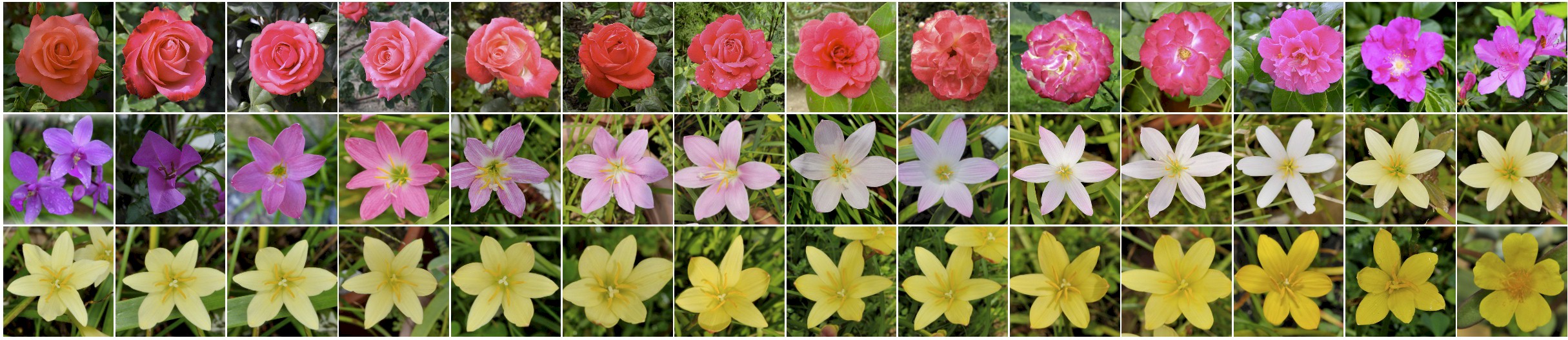
Relying on the capabilities of GPUs, a team from Facebook AI Research has developed a faster, more efficient way for AI to run similarity searches. The study, published in IEEE Transactions on Big Data, creates a deep learning algorithm capable of handling and comparing high-dimensional data from media that is notably faster, while just as accurate as previous techniques. 

In a world with an ever-growing supply of data, the work promises to ease both the compute power and time needed for processing large libraries.

“The most straightforward technique for searching and indexing [high-dimensional data] is by brute-force comparison, whereby you need to check [each image] against every other image in the database. This is impractical for collections containing billions of vectors,” Jeff Johnson, study colead and a research engineer at Facebook, said in a press release.

Containing millions of pixels and data points, every image and video creates billions of vectors. This large amount of data is valuable for analyzing, detecting, indexing, and comparing vectors. It is also problematic for calculating similarities of large libraries with traditional CPU algorithms that rely on several supercomputer components, slowing down overall computing time.

Using only four GPUs with CUDA, the researchers designed an algorithm for GPUs to both host and analyze library image data points. The method also compresses the data, making it easier, and thus faster to analyze.  

An example of how the algorithm computes the smoothest path between images where only the first and the last image are given. Credit: Facebook/Johnson et al

The new algorithm processed over 95 million high-dimensional images in 35 minutes. A graph of a billion vectors took less than 12 hours to compute. According to a comparison test in the study, handling the same database with a cluster of 128 CPU servers took 108.7 hours-about 8.5x longer.

“By keeping computations purely on a GPU, we can take advantage of the much faster memory available on the accelerator, instead of dealing with the slower memories of CPU servers and even slower machine-to-machine network interconnects within a traditional supercomputer cluster,” said Johnson. 

The researchers state the methods are already being applied to a wide variety of tasks, including a language processing search for translations. Known as the Facebook AI Similarity Search library, the approach is open source for implementation, testing, and comparison.


Read more >>>
Read the full article in IEEE Transactions on Big Data >>>