Categories
Misc

NVIDIA Research: Learning and Rendering Dynamic Global Illumination with One Tiny Neural Network in Real-Time

Today, NVIDIA is releasing a SIGGRAPH 2021 technical paper, “Real-time Neural Radiance Caching for Path Tracing” that introduces another leap forward in real-time global illumination: Neural Radiance Caching. Global illumination, that is, illumination due to light bouncing around in a scene, is essential for rich, realistic visuals. This is a challenging task, even in cinematic … Continued

Today, NVIDIA is releasing a SIGGRAPH 2021 technical paper, “Real-time Neural Radiance Caching for Path Tracing” that introduces another leap forward in real-time global illumination: Neural Radiance Caching.

Global illumination, that is, illumination due to light bouncing around in a scene, is essential for rich, realistic visuals. This is a challenging task, even in cinematic rendering, because it is difficult to find all the paths of light that contribute meaningfully to an image. Solving this problem through brute force requires hundreds, sometimes thousands of paths per pixel, but this is far too expensive for real-time rendering.
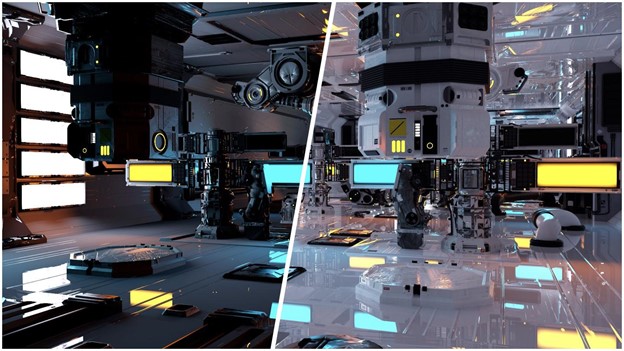
Direct illumination alone (left) lacks indirect reflections. Global illumination (right) adds indirect reflections, resulting in refined image detail and realism. The images were rendered offline.

Before NVIDIA RTX introduced real-time ray tracing to games, global illumination in games was largely static. Since then, technologies such as RTXGI bring dynamic global illumination to life. They overcome the limited realism of pre-computing “baked” lighting in dynamic worlds and simplify an otherwise tedious lighting design process.

Neural Radiance Caching combines RTX’s neural network acceleration hardware (NVIDIA TensorCores) and ray tracing hardware (NVIDIA RTCores) to create a system capable of fully-dynamic global illumination that works with all kinds of materials, be they diffuse, glossy, or volumetric. It handles fine-scale textures such as albedo, roughness, or bump maps, and scales to large, outdoor environments neither requiring auxiliary data structures nor scene parameterizations.

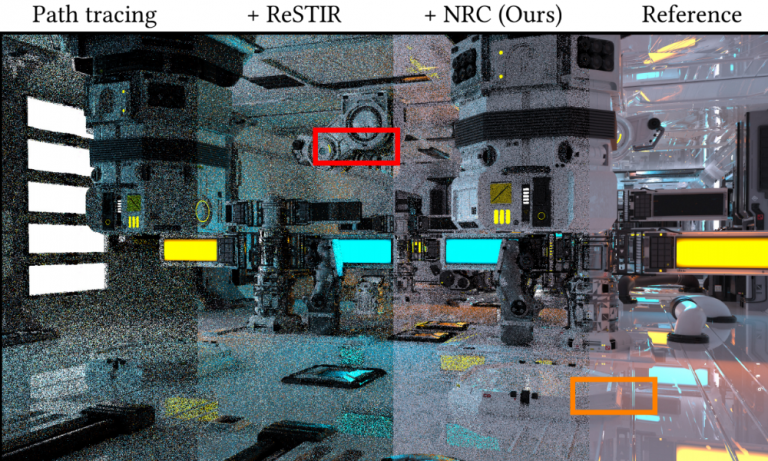
Combined with NVIDIA’s state-of-the-art direct lighting algorithm, ReSTIR, Neural Radiance Caching can improve rendering efficiency of global illumination by up to a factor of 100—two orders of magnitude.
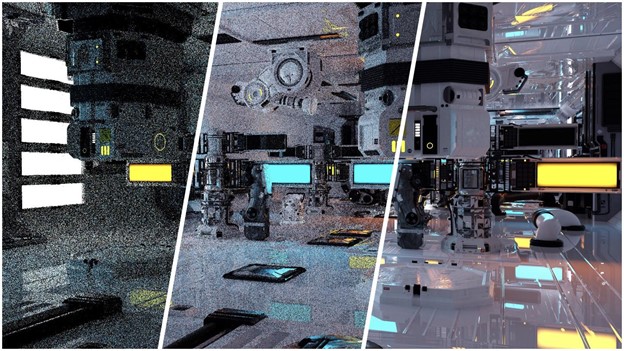
NVIDIA’s combination of ReSTIR and Neural Radiance Caching (middle) exhibits less noise than path tracing (left). The right image shows an offline rendered ground truth.

NVIDIA’s combination of ReSTIR and Neural Radiance Caching (middle) exhibits less noise than path tracing (left). The right image shows an offline rendered ground truth.

At the heart of the technology is a single tiny neural network that runs up to 9x faster than TensorFlow v2.5.0. Its speed makes it possible to train the network live during gameplay in order to keep up with arbitrary dynamic content. On an NVIDIA RTX 3090 graphics card, Neural Radiance Caching can provide over 1 billion global illumination queries per second.
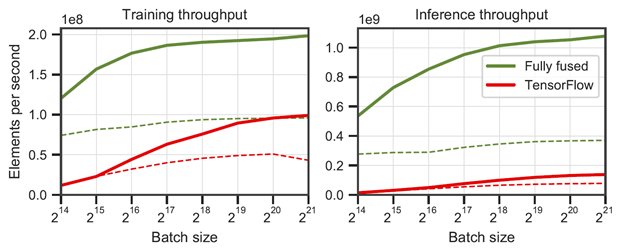
NVIDIA’s fully fused neural networks outperforming TensorFlow v2.5.0 for a 64 neuron wide (solid line) and 128 neuron wide (dashed line) multi-layer perceptrons on an NVIDIA RTX 3090.

NVIDIA’s fully fused neural networks outperforming TensorFlow v2.5.0 for a 64 neuron wide (solid line) and 128 neuron wide (dashed line) multi-layer perceptrons on an NVIDIA RTX 3090.

Training is often considered an offline process with only inference occurring at runtime. In contrast, Neural Radiance Caching performs both training and inference at runtime, showing that real-time training of neural networks is practical.

This paper paves the way for using dynamic neural networks in various other areas of computer graphics and possibly other real-time fields, such as wireless communication and reinforcement learning.

“Our work represents a paradigm shift from complex, memory-intensive auxiliary data structures to generic, compute-intensive neural representations” says Thomas Müller, one of the paper’s authors. “Computation is significantly cheaper than memory transfers, which is why real-time trained neural networks make sense despite their massive number of operations.”

We are excited about future applications enabled by tiny real-time-trained neural networks and look forward to further research of real-time machine learning in computer graphics and beyond. To help researchers and developers adopt the technology, NVIDIA releases the CUDA source code of their tiny neural networks.

Learn more: Check out the project website.
Categories
Misc

ICYMI: NVIDIA Jetson for Robot Operating System

In this month’s technical digest we’re highlighting this powerful capability and offer a collection of resources to help ROS users familiarize with the power of Jetson, ISAAC SDK, ISAAC Sim and a success story from NVIDIA Inception Member, Aerobotics.
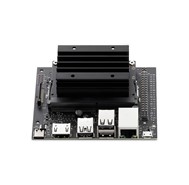
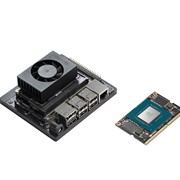
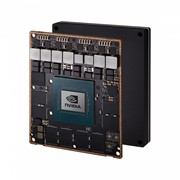
While you are likely already familiar with Jetson as the NVIDIA AI platform for edge AI, you might be surprised to learn that the power of Jetson isn’t limited to solutions built entirely on Jetson platforms. Jetpack on Jetson and Isaac SDK, our robotics platform, adds AI capabilities to existing autonomous machines and bridges dependencies for diverse hardware and software solutions.

In this month’s technical digest, we’re highlighting this powerful capability and offering a collection of resources to help Robotic Operating System (ROS) users get familiar with the power of Jetson, Isaac SDK, Isaac Sim, and a success story on a startup in the NVIDIA Inception program.

Jetson and ROS tutorials

Accelerating AI Modules for ROS and ROS 2 on NVIDIA Jetson Platform
A showcase of support for ROS and ROS 2 on NVIDIA Jetson developer kits.
Read now >

Building Robotics Applications Using ROS and NVIDIA Isaac SDK
Learn how to use a ROS application stack with NVIDIA Isaac and ISAAC Sim.
Read now >  

Implementing Robotics Applications with ROS 2 and AI on the NVIDIA Jetson Platform
Learn how to perform classification, object detection and pose estimation with ROS 2 on Jetson.
Read now >

Top 5 Jetson resources

Meet Jetson, the platform for AI at the edge
NVIDIA Jetson is used by professional developers to create breakthrough AI products across all industries, and by students and enthusiasts for hands-on AI learning and making amazing projects.
Meet Jetson >

Getting started with Jetson Developer Kits
Jetson developer kits are used by professionals to develop and test software for products based on Jetson modules, and by students and enthusiasts for projects and learning. Each developer kit includes a non-production specification Jetson module attached to a reference carrier board with standard hardware interfaces for flexible development and rapid prototyping.
Learn more >

Free 8-hour class on getting started with AI on Jetson Nano
In this course, you’ll use Jupyter iPython notebooks on your own Jetson Nano to build a deep learning classification project with computer vision models. Upon completion, you receive a certificate.
Start learning hands-on today >

Jetson and Embedded Systems developer forums
The Jetson and Embedded Systems community is active, vibrant, and continually monitored by the Jetson Product and Engineering teams.
Meet the community >

Jetson community projects
Explore and learn from Jetson projects created by us and our community.
Explore community projects >

Recommended hardware

Jetson Nano 2GB
Most affordable
At 457 GFLOPs for $59, this developer kit is the ultimate starter AI computer.
Learn more >
Jetson Xavier NX
Great for multiple use cases
Run modern neural networks and advanced AI applications within the footprint of a credit card.
Learn more >
Partner solutions
Production-ready now
Our ecosystem partners can support subsystem designs all the way up to fully realized autonomous machines with their associated requirements.
Learn more >

Inception spotlight

Bilberry: Using Jetson for Computer Vision for Crop Surveying
In 2016, the former dormmates at École Nationale Supérieure d’Arts et Métiers in Paris, founded Bilberry. The startup developed a solution to recognize weeds powered by the NVIDIA Jetson edge AI platform for precision application of herbicides at corn and wheat farms, offering as much as a 92% reduction in herbicide usage.
Learn more >

Do you have a startup? Join NVIDIA Inception’s global network of over 7,500 AI and data science startups.

Categories
Misc

Tesla Unveils Top AV Training Supercomputer Powered by NVIDIA A100 GPUs

Tackling one of the largest computing challenges of this lifetime requires larger than life computing. At CVPR this week, Andrej Karpathy, senior director of AI at Tesla, unveiled the in-house supercomputer the automaker is using to train deep neural networks for Autopilot and self-driving capabilities. The cluster uses 720 nodes of 8x NVIDIA A100 Tensor Read article >

The post Tesla Unveils Top AV Training Supercomputer Powered by NVIDIA A100 GPUs appeared first on The Official NVIDIA Blog.

Categories
Misc

NVIDIA Fleet Command Scales Edge AI Services for Enterprises

SaaS Platform Helps Leading Device Makers, Factories, Warehouses and Retailers Deploy AI Products and ServicesSANTA CLARA, Calif., June 22, 2021 (GLOBE NEWSWIRE) — NVIDIA today announced …

Categories
Misc

NVIDIA Announces Instant AI Infrastructure for Enterprises

Built with Enterprise IT Partners and Deployed First at Equinix, NVIDIA AI LaunchPad Includes End-to-End NVIDIA Hardware and Software Stack to Accelerate AI from Hybrid Cloud to EdgeSANTA …

Categories
Misc

Can someone help me fix this error?

Traceback (most recent call last):

File “c:UsersLandenOneDriveDesktopSign Language DetectorRealTimeObjectDetectionTensorflowscriptsgenerate_tfrecord.py”, line 62, in <module> label_map_dict = label_map_util.get_label_map_dict(label_map) File

“C:UsersLandenAppDataLocalProgramsPythonPython39libsite-packagesobject_detectionutilslabel_map_util.py”, line 164, in get_label_map_dict label_map = load_labelmap(label_map_path) File

“C:UsersLandenAppDataLocalProgramsPythonPython39libsite-packagesobject_detectionutilslabel_map_util.py”, line 133, in load_labelmap label_map_string = fid.read() File “C:UsersLandenAppDataLocalProgramsPythonPython39libsite-packagestensorflowpythonlibiofile_io.py”, line 117, in read self._preread_check() File

“C:UsersLandenAppDataLocalProgramsPythonPython39libsite-packagestensorflowpythonlibiofile_io.py”, line 79, in _preread_check self._read_buf = _pywrap_file_io.BufferedInputStream( TypeError: __init__(): incompatible constructor arguments.

The following argument types are supported:

  1. tensorflow.python.lib.io._pywrap_file_io.BufferedInputStream(filename: str, buffer_size: int, token: tensorflow.python.lib.io._pywrap_file_io.TransactionToken = None)

    Invoked with: item { name: “Hello” id: 1 } item { name: “ILoveYou” id: 2 } item { name: “No” id: 3 } item { name: “Thanks” id: 4 } item { name: “Yes” id: 5 } , 524288

submitted by /u/Spud783
[visit reddit] [comments]

Categories
Misc

Federated Learning with Homomorphic Encryption

In NVIDIA Clara Train 4.0, we added homomorphic encryption (HE) tools for federated learning (FL). HE enables you to compute data while the data is still encrypted. In Clara Train 3.1, all clients used certified SSL channels to communicate their local model updates with the server. The SSL certificates are needed to establish trusted communication … Continued
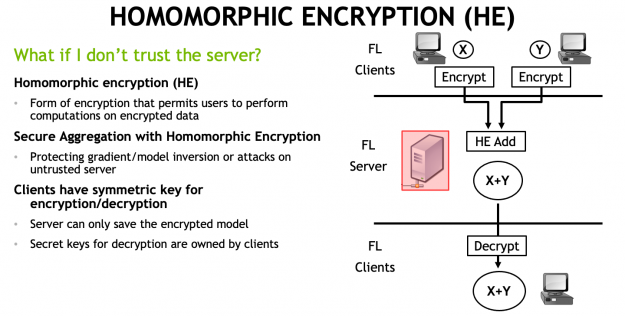
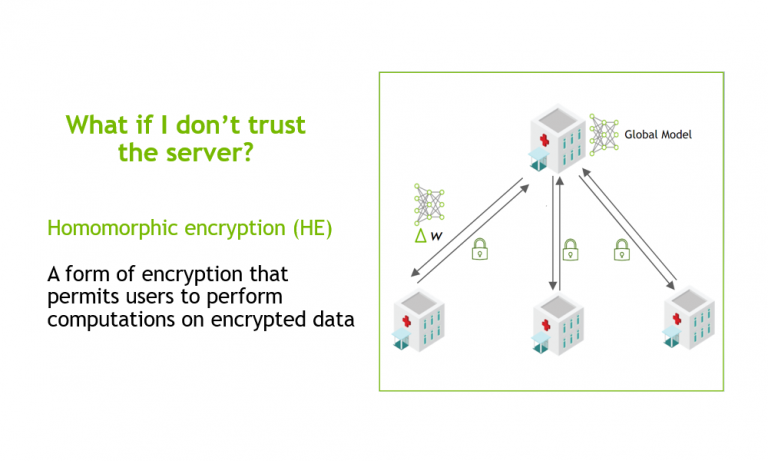
In NVIDIA Clara Train 4.0, we added homomorphic encryption (HE) tools for federated learning (FL). HE enables you to compute data while the data is still encrypted.

In Clara Train 3.1, all clients used certified SSL channels to communicate their local model updates with the server. The SSL certificates are needed to establish trusted communication channels and are provided through a third party that runs the provisioning tool and securely distributes them to the hospitals. This secures the communication to the server, but the server can still see the raw model (unencrypted) updates to do aggregation.

With Clara Train 4.0, the communication channels are still established using SSL certificates and the provisioning tool. However, each client optionally also receives additional keys to homomorphically encrypt their model updates before sending them to the server. The server doesn’t own a key and only sees the encrypted model updates.

With HE, the server can aggregate these encrypted weights and then send the updated model back to the client. The clients can decrypt the model weights because they have the keys and can then continue with the next round of training (Figure 1).

Diagram shows HE in action. Two clients send encrypted values to the FL server to be added together. The result is then sent back to the client and decrypted.
Figure 1. Why homomorphic encryption?

HE ensures that each client’s changes to the global model stays hidden by preventing the server from reverse-engineering the submitted weights and discovering any training data. This added security comes at a computational cost on the server. However, it can play an important role in healthcare in making sure that patient data stays secure at each hospital while still benefiting from using federated learning with other institutions.

HE implementation in Clara Train 4.0

We implemented secure aggregation during FL with HE using the TenSEAL library by OpenMined, a convenient Python wrapper around Microsoft SEAL. Both libraries are available as open-source and provide an implementation of Homomorphic encryption for arithmetic of approximate numbers, also known as the CKKS scheme, which was proposed as a solution for encrypted machine learning.

Our default uses the following HE setting, specified in Clara Train’s provisioning tool for FL:

# homomorphic encryption
he:
  lib: tenseal
  config:
    poly_modulus_degree: 8192
    coeff_mod_bit_sizes: [60, 40, 40]
    scale_bits: 40
    scheme: CKKS 

These settings are recommended and should work for most tasks but could be further optimized depending on your specific model architecture and machine learning problem. For more information about different settings, see this tutorial on the CKKS scheme and benchmarking.

HE benchmarking in FL

To compare the impact of HE to the overall training time and performance, we ran the following experiments. We chose SegResNet (a U-Net like architecture used to win the BraTS 2018 challenge) trained on the CT spleen segmentation task from the Medical Segmentation Decathlon.

Each federated learning run was trained for 100 rounds with each client training for 10 local epochs on their local data on an NVIDIA V100 (server and clients are running on localhost). In each run, half of the clients each used half of the training data (16/16) and half of the validation data (5/4), respectively. We recorded the total training time and best average validation dice score of the global model. We show the relative increase added by HE in Table 1.

There is a moderate increase in total training time of about 20% when encrypting the full model. This increase in training time is due to the added encryption and decryption steps and aggregation in homomorphically encrypted space. Our implementation enables you to reduce that extra time by only encrypting a subset of the model parameters, for example, all convolutional layers (“conv”). You could also encrypt just three of the key layers, such as the input, middle, and output layers.

The added training time is also due to increased message sizes needed to send the encrypted model gradient updates, requiring longer upload times. For SegResNet, we observe an increase from 19 MB to 283 MB using the HE setting mentioned earlier (~15x increase).

Setting Message size (MB) Nr. clients Training time Best global Dice Best epoch Re. Increase in training time
Raw 19 2 4:57:26 0.951 931
Raw 19 4 5:11:20 0.956 931
Raw 19 8 5:18:00 0.943 901
HE full 283 2 5:57:05 0.949 931 20.1%
HE full 283 4 6:00:05 0.946 811 15.7%
HE full 283 8 6:21:56 0.963 971 20.1%
HE conv layers 272 2 5:54:39 0.952 891 19.2%
HE conv layers 272 4 6:06:13 0.954 951 17.6%
HE conv layers 272 8 6:28:16 0.948 891 22.1%
HE three layers 43 2 5:12:10 0.957 811 5.0%
HE three layers 43 4 5:15:01 0.939 841 1.2%
HE three layers 43 8 5:19:02 0.949 971 0.3%
Table 1. Relative increase in training time by running FL with secure aggregation using HE.

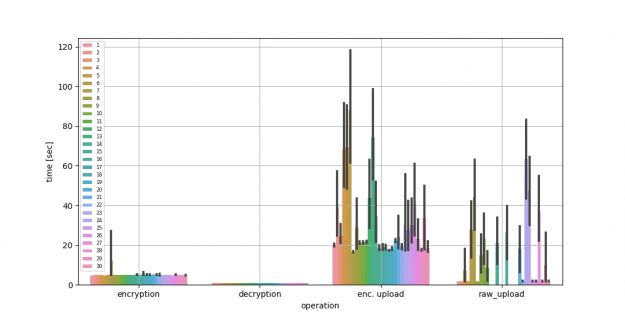
Next, we compare the performance of FL using up to 30 clients with the server running on AWS. For reference, we used an m5a.2xlarge with eight vCPUs, 32-GB memory, and up to 2,880 Gbps network bandwidth. We show the average encryption, decryption, and upload time, comparing raw compared to encrypted model gradients being uploaded in Figure 2 and Table 2. You can see the longer upload times due to the larger message sizes needed by HE.

A graph showing the average encryption, decryption, and upload time comparing raw compared to encrypted model gradients being uploaded.
Figure 2. Running federated learning with 30 clients and the server on AWS
Time in seconds Mean Std. Dev.
Encryption time 5.01 1.18
Decryption time 0.95 0.04
Enc. upload time 38 71.170
Raw upload time 21.57 74.23
Table 2. Federated learning using homomorphic encrypted compared to raw model updates.

Try it out

If you’re interested in learning more about how to set up FL with homomorphic encryption using Clara Train, we have a great Jupyter notebook on GitHub that walks you through the setup.

HE can reduce model inversion or data leakage risks if there is a malicious or compromised server. However, your final models might still contain or memorize privacy-relevant information. That’s where differential privacy methods can be a useful addition to HE. Clara Train SDK implements the sparse vector technique (SVT) and partial model sharing that can help preserve privacy. For more information, see Privacy-preserving Federated Brain Tumour Segmentation. Keep in mind that there is a tradeoff between model performance and privacy protection.

Categories
Misc

AMD Graphics

I am trying to run a CNN model on a computer with an AMD Raedon 5500. I ran the previous models on computers with Nvidia cards and they worked but for some reason tensorflow cannot see the GPU. It says the list of physical devices is empty. I know that the GPU is in PCI slot 3 and not 1, would that be an issue?

submitted by /u/NameError-undefined
[visit reddit] [comments]

Categories
Misc

Newb needs best Machine Learning approach for Number Sequence

I have a sequence of 20 numbers, 1 – 20 and all numbers must be put in to sequence once. I have a formula which generates a score for each sequence input. What would be the best Machine Learning approach to find the sequence with the lowest score. It is very noisy and has many minimums.

Thanks for your help.

James

submitted by /u/JackFeet
[visit reddit] [comments]

Categories
Misc

NVIDIA Isaac Sim on Omniverse Now Available in Open Beta

The new Isaac simulation engine not only creates better photorealistic environments, but also streamlines synthetic data generation and domain randomization to build ground-truth datasets to train robots in applications from logistics and warehouses to factories of the future.
The new Isaac simulation engine not only creates better photorealistic environments, but also streamlines synthetic data generation and domain randomization to build ground-truth datasets to train robots in applications from logistics and warehouses to factories of the future.
NVIDIA Omniverse is the underlying foundation for NVIDIA’s simulators, including the Isaac platform — which now includes several new features. Discover the next level in simulation capabilities for robots with NVIDIA Isaac Sim open beta, available now. 

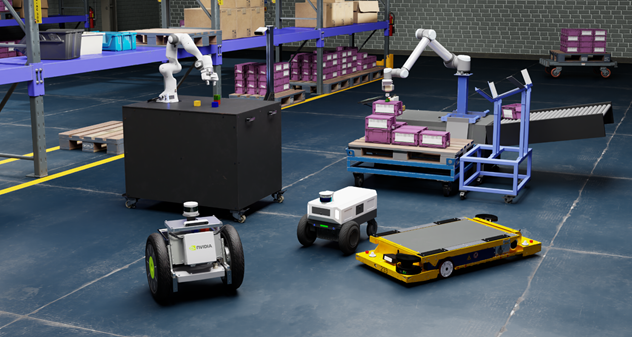
Built on the Omniverse platform, Isaac Sim is a robotics simulation application and synthetic data generation tool. It allows roboticists to train and test their robots more efficiently by providing a realistic simulation of the robot interacting with compelling environments that can expand coverage beyond what is possible in the real world.

This release of Isaac Sim also adds improved multi-camera support and sensor capabilities, and a PTC OnShape CAD importer to make it easier to bring in 3D assets. These new features will expand the breadth of robots and environments that can be successfully modeled and deployed in every aspect: from design and development of the physical robot, then training the robot, to deploying in a “digital twin” in which the robot is simulated and tested in an accurate and photorealistic virtual environment.

Summary of Key New Features

  • Multi-Camera Support
  • Fisheye Camera with Synthetic Data
  • ROS2 Support
  • PTC OnShape Importer
  • Improved Sensor Support
    • Ultrasonic Sensor
    • Force Sensor
    • Custom Lidar Patterns
  • Downloadable from NVIDIA Omniverse Launcher
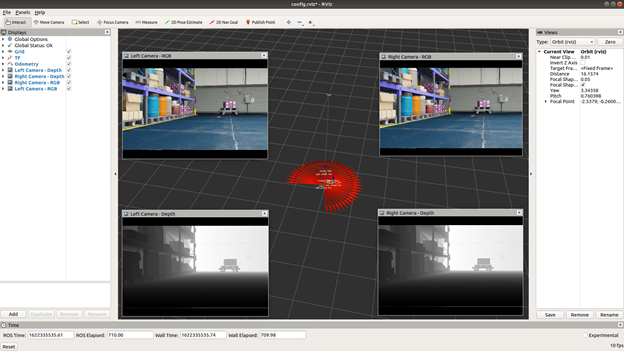
Isaac Sim sending multi-camera sensor data to Rviz (ROS Visualization Tool)
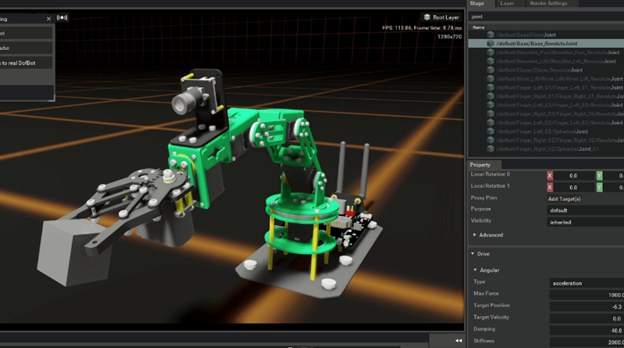
Controlling the Dofbot Manipulation Robot in Isaac Sim

Isaac Sim Enables More Robotics Simulation

Developers have long seen the benefits of having a powerful simulation environment for testing and training robots. But all too often, the simulators have had shortcomings which limited their adoption. Isaac Sim addresses these drawbacks with the benefits described below.

Realistic Simulation 

In order to deliver realistic robotics simulations, Isaac Sim leverages the Omniverse platform’s powerful technologies including advanced GPU-enabled physics simulation with PhysX 5, photorealism with real-time ray and path tracing, and Material Definition Language (MDL) support for physically-based rendering.

Modular, Breadth of Applications

Isaac Sim is built to address many of the most common robotics use cases including manipulation, autonomous navigation, and synthetic data generation for training data. Its modular design allows users to easily customize and extend the toolset to accommodate many applications and and environments.

Seamless Connectivity and Interoperability

Isaac Sim benefits from Omniverse Nucleus and Omniverse Connectors, enabling collaborative building, sharing, and importing of environments and robot models in Universal Scene Description (USD). Easily connect the robot’s brain to a virtual world through Isaac SDK and ROS/ROS2 interface, fully-featured Python scripting, plugins for importing robot and environment models.

Synthetic Data Generation in Isaac Sim Bootstraps Machine Learning

Synthetic Data Generation is an important tool that is increasingly used to train the perception models found in today’s robots. Getting real-world, properly labeled data is a time consuming and costly endeavor. But in the case of robotics, some of the required training data could be too difficult or dangerous to collect in the real world. This is especially true of robots that must operate in close proximity to humans.

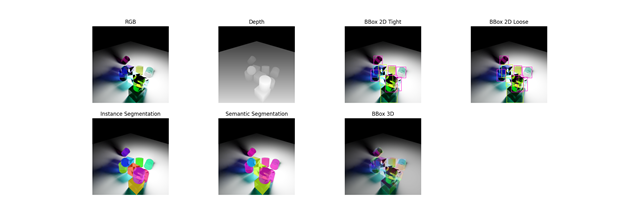
Isaac Sim has built-in support for a variety of sensor types that are important in training perception models. These sensors include RGB, depth, bounding boxes, and segmentation.

Ground Truth Synthetic Data with Glass Objects

In the open beta, we have the ability to output synthetic data in the KITTI format. This data can then be used directly with the NVIDIA Transfer Learning Toolkit to enhance model performance with use case-specific data.

Domain Randomization

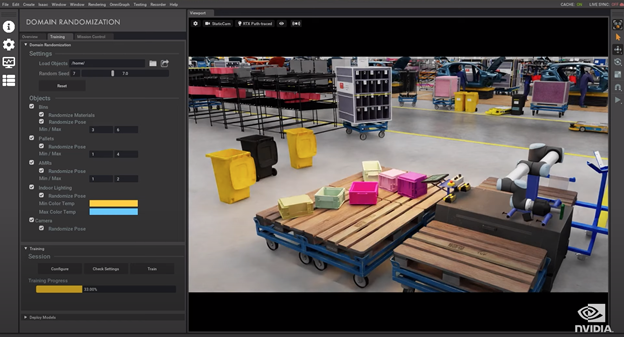
Domain Randomization varies the parameters that define a simulated scene, such as the lighting, color and texture of materials in the scene. One of the main objectives of domain randomization is to enhance the training of machine learning (ML) models by exposing the neural network to a wide variety of domain parameters in simulation. This will help the model to generalize well when it encounters real world scenarios. In effect, this technique helps teach models what to ignore.

Domain Randomization of a Factory Scene

Isaac Sim supports the randomization of many different attributes that help define a given scene. With these capabilities, the ML engineers can ensure that the synthetic dataset contains sufficient diversity to drive robust model performance.

Randomizable Parameters

Color Movement
Scale Light
Texture Material
Mesh Visibility
Rotation

In Isaac Sim open beta, we have enhanced the domain randomization capabilities by allowing the user  to define a region for randomization. Developers can now draw a box around the region in the scene that is to be randomized and the rest of the scene will remain static. 

More Information on Isaac Sim

Check out the latest Isaac Sim GTC 2021 session, Sim-to-Real.

Also, learn more about importing your own robot with the following tutorial.

Learn more about using Isasac Sim to train your Jetbot by exploring these developer blogs:.

Getting Started 

Join the thousands of developers who have worked with Isaac Sim across the robotics community via our early access program. Get started with the next step in robotics simulation by downloading Isaac Sim.