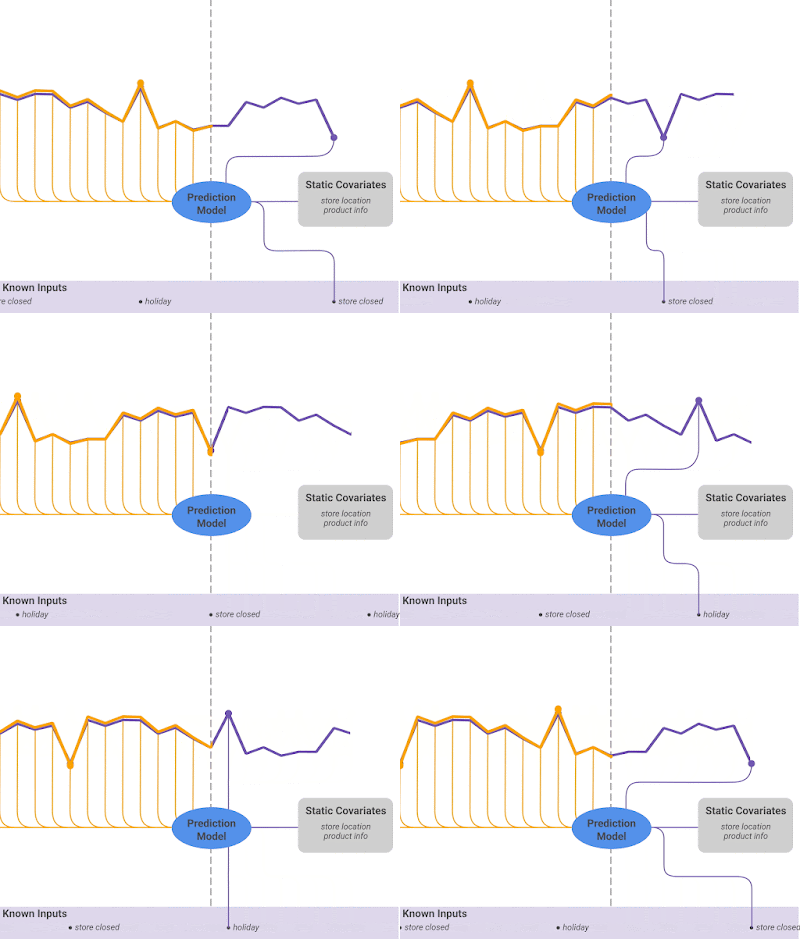
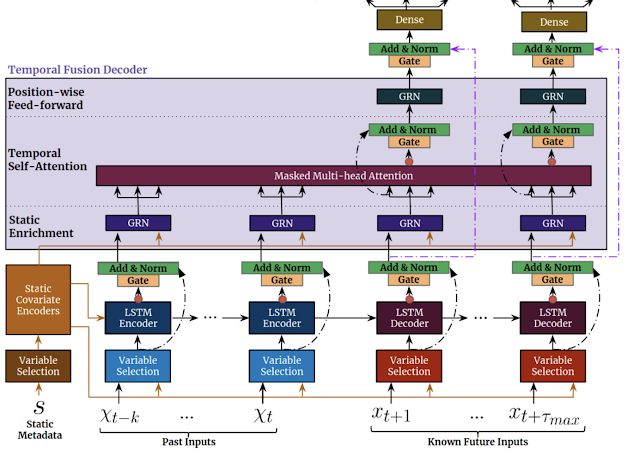
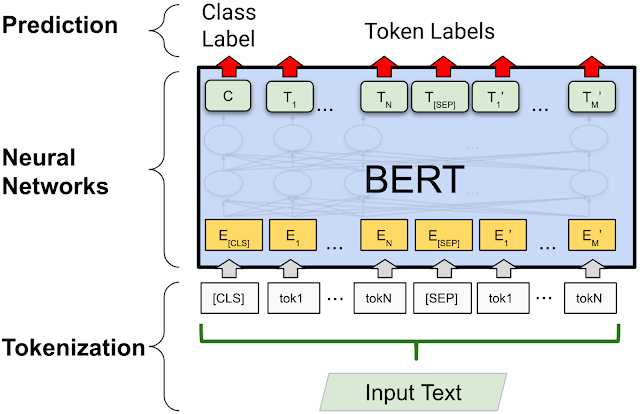
For keras, the last two releases have brought important new functionality, in terms of both low-level infrastructure and workflow enhancements. This post focuses on an outstanding example of the latter category: a new family of layers designed to help with pre-processing, data-augmentation, and feature-engineering tasks.
Category: Offsites
Stuff I find valuable at key websites
Scaling neural networks, whether it be the amount of training data used, the model size or the computation being utilized, has been critical for improving model quality in many real-world machine learning applications, such as computer vision, language understanding and neural machine translation. This, in turn, has motivated recent studies to scrutinize the factors that play a critical role in the success of scaling a neural model. Although increasing model capacity can be a sound approach to improve model quality, doing so presents a number of systems and software engineering challenges that must be overcome. For instance, in order to train large models that exceed the memory capacity of an accelerator, it becomes necessary to partition the weights and the computation of the model across multiple accelerators. This process of parallelization increases the network communication overhead and can result in device under-utilization. Moreover, a given algorithm for parallelization, which typically requires a significant amount of engineering effort, may not work with different model architectures.
To address these scaling challenges, we present “GSPMD: General and Scalable Parallelization for ML Computation Graphs”, in which we describe an open-source automatic parallelization system based on the XLA compiler. GSPMD is capable of scaling most deep learning network architectures and has already been applied to many deep learning models, such as GShard-M4, LaMDA, BigSSL, ViT, and MetNet-2, leading to state-of-the-art-results across several domains. GSPMD has also been integrated into multiple ML frameworks, including TensorFlow and JAX, which use XLA as a shared compiler.
Overview
GSPMD separates the task of programming an ML model from the challenge of parallelization. It allows model developers to write programs as if they were run on a single device with very high memory and computation capacity — the user simply needs to add a few lines of annotation code to a subset of critical tensors in the model code to indicate how to partition the tensors. For example, to train a large model-parallel Transformer, one may only need to annotate fewer than 10 tensors (less than 1% of all tensors in the entire computation graph), one line of additional code per tensor. Then GSPMD runs a compiler pass that determines the entire graph’s parallelization plan, and transforms it into a mathematically equivalent, parallelized computation that can be executed on each device. This allows users to focus on model building instead of parallelization implementation, and enables easy porting of existing single-device programs to run at a much larger scale.
The separation of model programming and parallelism also allows developers to minimize code duplication. With GSPMD, developers may employ different parallelism algorithms for different use cases without the need to reimplement the model. For example, the model code that powered the GShard-M4 and LaMDA models can apply a variety of parallelization strategies appropriate for different models and cluster sizes with the same model implementation. Similarly, by applying GSPMD, the BigSSL large speech models can share the same implementation with previous smaller models.
Generality and Flexibility
Because different model architectures may be better suited to different parallelization strategies, GSPMD is designed to support a large variety of parallelism algorithms appropriate for different use cases. For example, with smaller models that fit within the memory of a single accelerator, data parallelism is preferred, in which devices train the same model using different input data. In contrast, models that are larger than a single accelerator’s memory capacity are better suited for a pipelining algorithm (like that employed by GPipe) that partitions the model into multiple, sequential stages, or operator-level parallelism (e.g., Mesh-TensorFlow), in which individual computation operators in the model are split into smaller, parallel operators.
GSPMD supports all the above parallelization algorithms with a uniform abstraction and implementation. Moreover, GSPMD supports nested patterns of parallelism. For example, it can be used to partition models into individual pipeline stages, each of which can be further partitioned using operator-level parallelism.
GSPMD also facilitates innovation on parallelism algorithms by allowing performance experts to focus on algorithms that best utilize the hardware, instead of the implementation that involves lots of cross-device communications. For example, for large Transformer models, we found a novel operator-level parallelism algorithm that partitions multiple dimensions of tensors on a 2D mesh of devices. It reduces peak accelerator memory usage linearly with the number of training devices, while maintaining a high utilization of accelerator compute due to its balanced data distribution over multiple dimensions.
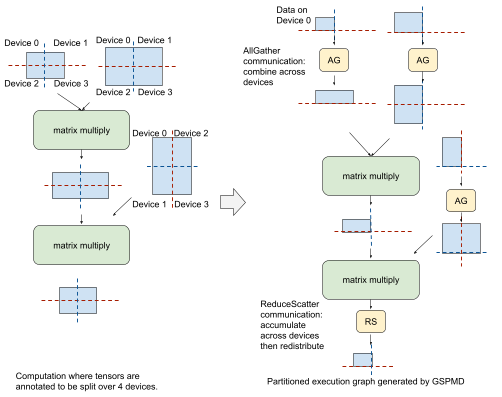
To illustrate this, consider a simplified feedforward layer in a Transformer model that has been annotated in the above way. To execute the first matrix multiply on fully partitioned input data, GSPMD applies an MPI-style AllGather communication operator to partially merge with partitioned data from another device. It then executes the matrix multiply locally and produces a partitioned result. Before the second matrix multiply, GSPMD adds another AllGather on the right-hand side input, and executes the matrix multiply locally, yielding intermediate results that will then need to be combined and partitioned. For this, GSPMD adds an MPI-style ReduceScatter communication operator that accumulates and partitions these intermediate results. While the tensors generated with the AllGather operator at each stage are larger than the original partition size, they are short-lived and the corresponding memory buffers will be freed after use, which does not affect peak memory usage in training.
A Transformer Example with Nested Parallelism
As a shared, robust mechanism for different parallelism modes, GSPMD allows users to conveniently switch between modes in different parts of a model. This is particularly valuable for models that may have different components with distinct performance characteristics, for example, multimodal models that handle both images and audio. Consider a model with the Transformer encoder-decoder architecture, which has an embedding layer, an encoder stack with Mixture-of-Expert layers, a decoder stack with dense feedforward layers, and a final softmax layer. In GSPMD, a complex combination of several parallelism modes that treats each layer separately can be achieved with simple configurations.
In the figure below, we show a partitioning strategy over 16 devices organized as a logical 4×4 mesh. Blue represents partitioning along the first mesh dimension X, and yellow represents partitioning along the second mesh dimension Y. X and Y are repurposed for different model components to achieve different parallelism modes. For example, the X dimension is used for data parallelism in the embedding and softmax layers, but used for pipeline parallelism in the encoder and decoder. The Y dimension is also used in different ways to partition the vocabulary, batch or model expert dimensions.
Computation Efficiency
GSPMD provides industry-leading performance in large model training. Parallel models require extra communication to coordinate multiple devices to do the computation. So parallel model efficiency can be estimated by examining the fraction of time spent on communication overhead — the higher percentage utilization and the less time spent on communication, the better. In the recent MLPerf set of performance benchmarks, a BERT-like encoder-only model with ~500 billion parameters to which we applied GSPMD for parallelization over 2048 TPU-V4 chips yielded highly competitive results (see table below), utilizing up to 63% of the peak FLOPS that the TPU-V4s offer. We also provide efficiency benchmarks for some representative large models in the table below. These example model configs are open sourced in the Lingvo framework along with instructions to run them on Google Cloud. More benchmark results can be found in the experiment section of our paper.
| Model Family | Parameter Count | % of model activated* | No. of Experts** | No. of Layers | No. of TPU | FLOPS utilization |
| Dense Decoder (LaMDA) | 137B | 100% | 1 | 64 | 1024 TPUv3 | 56.5% |
| Dense Encoder (MLPerf-Bert) | 480B | 100% | 1 | 64 | 2048 TPUv4 | 63% |
| Sparsely Activated Encoder-Decoder (GShard-M4) | 577B | 0.25% | 2048 | 32 | 1024 TPUv3 | 46.8% |
| Sparsely Activated Decoder | 1.2T | 8% | 64 | 64 | 1024 TPUv3 | 53.8% |
| *The fraction of the model activated during inference, which is a measure of model sparsity. **Number of experts included in the Mixture of Experts layer. A value of 1 corresponds to a standard Transformer, without a Mixture of Experts layer. |
Conclusion
The ongoing development and success of many useful machine learning applications, such as NLP, speech recognition, machine translation, and autonomous driving, depend on achieving the highest accuracy possible. As this often requires building larger and even more complex models, we are pleased to share the GSPMD paper and the corresponding open-source library to the broader research community, and we hope it is useful for efficient training of large-scale deep neural networks.
Acknowledgements
We wish to thank Claire Cui, Zhifeng Chen, Yonghui Wu, Naveen Kumar, Macduff Hughes, Zoubin Ghahramani and Jeff Dean for their support and invaluable input. Special thanks to our collaborators Dmitry Lepikhin, HyoukJoong Lee, Dehao Chen, Orhan Firat, Maxim Krikun, Blake Hechtman, Rahul Joshi, Andy Li, Tao Wang, Marcello Maggioni, David Majnemer, Noam Shazeer, Ankur Bapna, Sneha Kudugunta, Quoc Le, Mia Chen, Shibo Wang, Jinliang Wei, Ruoming Pang, Zongwei Zhou, David So, Yanqi Zhou, Ben Lee, Jonathan Shen, James Qin, Yu Zhang, Wei Han, Anmol Gulati, Laurent El Shafey, Andrew Dai, Kun Zhang, Nan Du, James Bradbury, Matthew Johnson, Anselm Levskaya, Skye Wanderman-Milne, and Qiao Zhang for helpful discussions and inspirations.
Transformer models consistently obtain state-of-the-art results in computer vision tasks, including object detection and video classification. In contrast to standard convolutional approaches that process images pixel-by-pixel, the Vision Transformers (ViT) treat an image as a sequence of patch tokens (i.e., a smaller part, or “patch”, of an image made up of multiple pixels). This means that at every layer, a ViT model recombines and processes patch tokens based on relations between each pair of tokens, using multi-head self-attention. In doing so, ViT models have the capability to construct a global representation of the entire image.
At the input-level, the tokens are formed by uniformly splitting the image into multiple segments, e.g., splitting an image that is 512 by 512 pixels into patches that are 16 by 16 pixels. At the intermediate levels, the outputs from the previous layer become the tokens for the next layer. In the case of videos, video ‘tubelets’ such as 16x16x2 video segments (16×16 images over 2 frames) become tokens. The quality and quantity of the visual tokens decide the overall quality of the Vision Transformer.
The main challenge in many Vision Transformer architectures is that they often require too many tokens to obtain reasonable results. Even with 16×16 patch tokenization, for instance, a single 512×512 image corresponds to 1024 tokens. For videos with multiple frames, that results in tens of thousands of tokens needing to be processed at every layer. Considering that the Transformer computation increases quadratically with the number of tokens, this can often make Transformers intractable for larger images and longer videos. This leads to the question: is it really necessary to process that many tokens at every layer?
In “TokenLearner: What Can 8 Learned Tokens Do for Images and Videos?”, an earlier version of which is presented at NeurIPS 2021, we show that adaptively generating a smaller number of tokens, rather than always relying on tokens formed by uniform splitting, enables Vision Transformers to run much faster and perform better. TokenLearner is a learnable module that takes an image-like tensor (i.e., input) and generates a small set of tokens. This module could be placed at various different locations within the model of interest, significantly reducing the number of tokens to be handled in all subsequent layers. The experiments demonstrate that having TokenLearner saves memory and computation by half or more without damaging classification performance, and because of its ability to adapt to inputs, it even increases the accuracy.
The TokenLearner
We implement TokenLearner using a straightforward spatial attention approach. In order to generate each learned token, we compute a spatial attention map highlighting regions-of-importance (using convolutional layers or MLPs). Such a spatial attention map is then applied to the input to weight each region differently (and discard unnecessary regions), and the result is spatially pooled to generate the final learned tokens. This is repeated multiple times in parallel, resulting in a few (~10) tokens out of the original input. This can also be viewed as performing a soft-selection of the pixels based on the weight values, followed by global average pooling. Note that the functions to compute the attention maps are governed by different sets of learnable parameters, and are trained in an end-to-end fashion. This allows the attention functions to be optimized in capturing different spatial information in the input. The figure below illustrates the process.
As a result, instead of processing fixed, uniformly tokenized inputs, TokenLearner enables models to process a smaller number of tokens that are relevant to the specific recognition task. That is, (1) we enable adaptive tokenization so that the tokens can be dynamically selected conditioned on the input, and (2) this effectively reduces the total number of tokens, greatly reducing the computation performed by the network. These dynamically and adaptively generated tokens can be used in standard transformer architectures such as ViT for images and ViViT for videos.
Where to Place TokenLearner
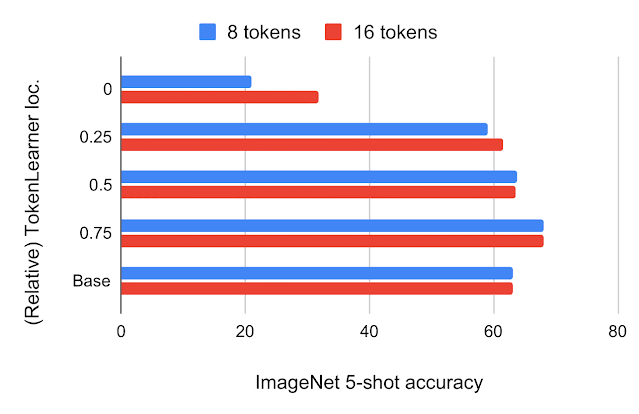
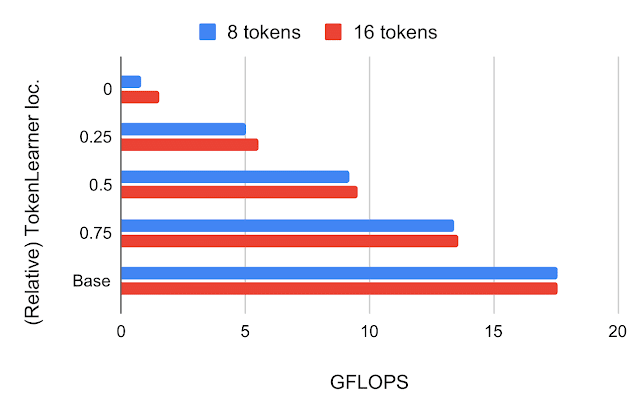
After building the TokenLearner module, we had to determine where to place it. We first tried placing it at different locations within the standard ViT architecture with 224×224 images. The number of tokens TokenLearner generated was 8 and 16, much less than 196 or 576 tokens the standard ViTs use. The below figure shows ImageNet few-shot classification accuracies and FLOPS of the models with TokenLearner inserted at various relative locations within ViT B/16, which is the base model with 12 attention layers operating on 16×16 patch tokens.
| Top: ImageNet 5-shot transfer accuracy with JFT 300M pre-training, with respect to the relative TokenLearner locations within ViT B/16. Location 0 means TokenLearner is placed before any Transformer layer. Base is the original ViT B/16. Bottom: Computation, measured in terms of billions of floating point operations (GFLOPS), per relative TokenLearner location. |
We found that inserting TokenLearner after the initial quarter of the network (at 1/4) achieves almost identical accuracies as the baseline, while reducing the computation to less than a third of the baseline. In addition, placing TokenLearner at the later layer (after 3/4 of the network) achieves even better performance compared to not using TokenLearner while performing faster, thanks to its adaptiveness. Due to the large difference between the number of tokens before and after TokenLearner (e.g., 196 before and 8 after), the relative computation of the transformers after the TokenLearner module becomes almost negligible.
Comparing Against ViTs
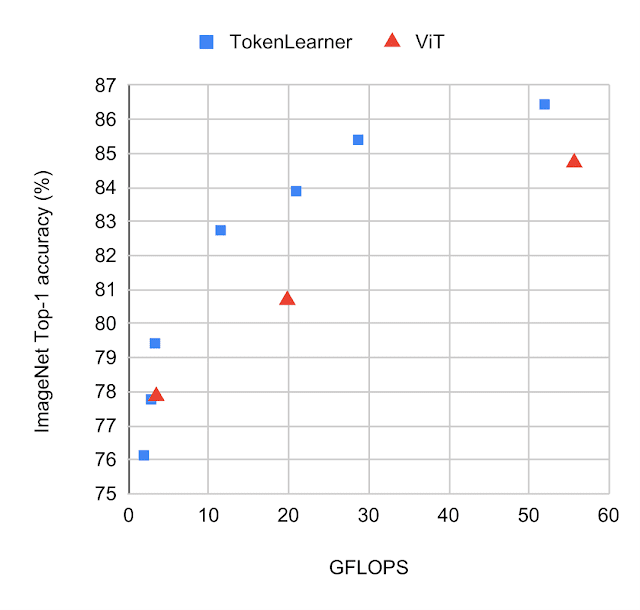
We compared the standard ViT models with TokenLearner against those without it while following the same setting on ImageNet few-shot transfer. TokenLearner was placed in the middle of each ViT model at various locations such as at 1/2 and at 3/4. The below figure shows the performance/computation trade-off of the models with and without TokenLearner.
We also inserted TokenLearner within larger ViT models, and compared them against the giant ViT G/14 model. Here, we applied TokenLearner to ViT L/10 and L/8, which are the ViT models with 24 attention layers taking 10×10 (or 8×8) patches as initial tokens. The below figure shows that despite using many fewer parameters and less computation, TokenLearner performs comparably to the giant G/14 model with 48 layers.
| Left: Classification accuracy of large-scale TokenLearner models compared to ViT G/14 on ImageNet datasets. Right: Comparison of the number of parameters and FLOPS. |
High-Performing Video Models
Video understanding is one of the key challenges in computer vision, so we evaluated TokenLearner on multiple video classification datasets. This was done by adding TokenLearner into Video Vision Transformers (ViViT), which can be thought of as a spatio-temporal version of ViT. TokenLearner learned 8 (or 16) tokens per timestep.
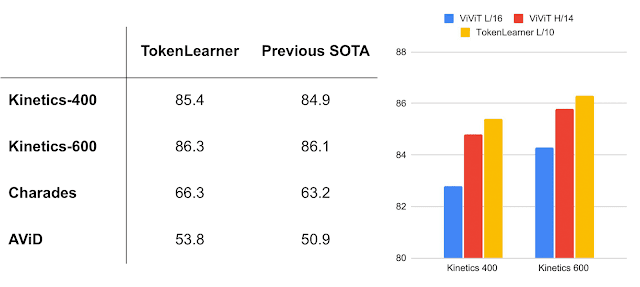
When combined with ViViT, TokenLearner obtains state-of-the-art (SOTA) performance on multiple popular video benchmarks, including Kinetics-400, Kinetics-600, Charades, and AViD, outperforming the previous Transformer models on Kinetics-400 and Kinetics-600 as well as previous CNN models on Charades and AViD.
| Models with TokenLearner outperform state-of-the-art on popular video benchmarks (captured from Nov. 2021). Left: popular video classification tasks. Right: comparison to ViViT models. |
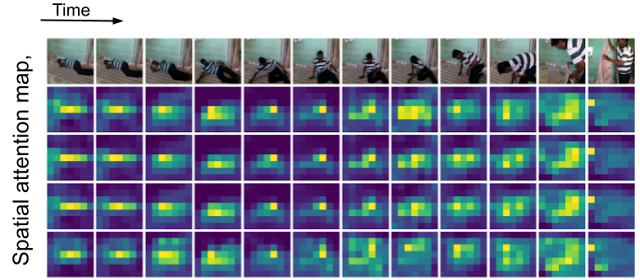
| Visualization of the spatial attention maps in TokenLearner, over time. As the person is moving in the scene, TokenLearner pays attention to different spatial locations to tokenize. |
Conclusion
While Vision Transformers serve as powerful models for computer vision, a large number of tokens and their associated computation amount have been a bottleneck for their application to larger images and longer videos. In this project, we illustrate that retaining such a large number of tokens and fully processing them over the entire set of layers is not necessary. Further, we demonstrate that by learning a module that extracts tokens adaptively based on the input image allows attaining even better performance while saving compute. The proposed TokenLearner was particularly effective in video representation learning tasks, which we confirmed with multiple public datasets. A preprint of our work as well as code are publicly available.
Acknowledgement
We thank our co-authors: AJ Piergiovanni, Mostafa Dehghani, and Anelia Angelova. We also thank the Robotics at Google team members for the motivating discussions.
Google at NeurIPS 2021
This week marks the beginning of the 35th annual Conference on Neural Information Processing Systems (NeurIPS 2021), the biggest machine learning conference of the year. NeurIPS 2021 will be held virtually and includes invited talks, demonstrations and presentations of some of the latest in machine learning research. This year, NeurIPS also announced a new Datasets and Benchmarks track, which will include publications, talks, posters, and discussions related to this research area.
Google will have a strong presence with more than 170 accepted papers, additionally contributing to and learning from the broader academic research community via talks, posters, workshops, and tutorials. You can learn more about our work being presented in the list below (Google affiliations highlighted in bold).
Organizing Committee
Communications Co-Chair: Emily Denton
Program Co-Chair: Yann Dauphin
Workshop Co-Chair: Sanmi Koyejo
Senior Area Chairs: Alekh Agarwal, Amir Globerson, Been Kim, Charles Sutton, Claudio Gentile, Corinna Cortes, Dale Schuurmans, David Duvenaud, Elad Hazan, Hugo Larochelle, Jean-Philippe Vert, Kevin Murphy, Marco Cuturi, Mehryar Mohri, Mohammad Ghavamzadeh, Samory Kpotufe, Sanjiv Kumar, Satyen Kale, Sergey Levine, Tara N. Sainath, Yishay Mansour
Area Chairs: Abhishek Kumar, Abhradeep Guha Thakurta, Alex Kulesza, Alexander A. Alemi, Alexander T. Toshev, Amin Karbasi, Amit Daniely, Ananda Theertha Suresh, Ankit Singh Rawat, Ashok Cutkosky, Badih Ghazi, Balaji Lakshminarayanan, Ben Poole, Bo Dai, Boqing Gong, Chelsea Finn, Chiyuan Zhang, Christian Szegedy, Cordelia Schmid, Craig Boutilier, Cyrus Rashtchian, D. Sculley, Daniel Keysers, David Ha, Denny Zhou, Dilip Krishnan, Dumitru Erhan, Dustin Tran, Ekin Dogus Cubuk, Fabian Pedregosa, George Tucker, Hanie Sedghi, Hanjun Dai, Heinrich Jiang, Hossein Mobahi, Izhak Shafran, Jaehoon Lee, Jascha Sohl-Dickstein, Jasper Snoek, Jeffrey Pennington, Jelani Nelson, Jieming Mao, Justin Gilmer, Karol Hausman, Karthik Sridharan, Kevin Swersky, Maithra Raghu, Mario Lucic, Mathieu Blondel, Matt Kusner, Matthew Johnson, Matthieu Geist, Ming-Hsuan Yang, Mohammad Mahdian, Mohammad Norouzi, Nal Kalchbrenner, Naman Agarwal, Nicholas Carlini, Nicolas Papernot, Olivier Bachem, Olivier Pietquin, Paul Duetting, Praneeth Netrapalli, Pranjal Awasthi, Prateek Jain, Quentin Berthet, Renato Paes Leme, Richard Nock, Rif A. Saurous, Rose Yu, Roy Frostig, Samuel Stern Schoenholz, Sashank J. Reddi, Sercan O. Arik, Sergei Vassilvitskii, Sergey Ioffe, Shay Moran, Silvio Lattanzi, Simon Kornblith, Srinadh Bhojanapalli, Thang Luong, Thomas Steinke, Tim Salimans, Tomas Pfister, Tomer Koren, Uri Stemmer, Vahab Mirrokni, Vikas Sindhwani, Vincent Dumoulin, Virginia Smith, Vladimir Braverman, W. Ronny Huang, Wen Sun, Yang Li, Yasin Abbasi-Yadkori, Yinlam Chow,Yujia Li, Yunhe Wang, Zoltán Szabó
NeurIPS Foundation Board 2021: Michael Mozer, Corinna Cortes, Hugo Larochelle, John C. Platt, Fernando Pereira
Test of Time Award
Online Learning for Latent Dirichlet Allocation
Matthew D. Hoffman†, David M. Blei, Francis Bach
Publications
Deep Reinforcement Learning at the Edge of the Statistical Precipice (see blog post)
Outstanding Paper Award Recipient
Rishabh Agarwal, Max Schwarzer, Pablo Samuel Castro, Aaron Courville, Marc G. Bellemare
A Separation Result Between Data-Oblivious and Data-Aware Poisoning Attacks
Samuel Deng, Sanjam Garg, Somesh Jha, Saeed Mahloujifar, Mohammad Mahmoody, Abhradeep Guha Thakurta
Adversarial Robustness of Streaming Algorithms Through Importance Sampling
Vladimir Braverman, Avinatan Hassidim, Yossi Matias, Mariano Schain, Sandeep Silwal, Samson Zhou
Aligning Silhouette Topology for Self-Adaptive 3D Human Pose Recovery
Mugallodi Rakesh, Jogendra Nath Kundu, Varun Jampani, R. Venkatesh Babu
Attention Bottlenecks for Multimodal Fusion
Arsha Nagrani, Shan Yang, Anurag Arnab, Aren Jansen, Cordelia Schmid, Chen Sun
Autonomous Reinforcement Learning via Subgoal Curricula
Archit Sharma, Abhishek Gupta, Sergey Levine, Karol Hausman, Chelsea Finn
Calibration and Consistency of Adversarial Surrogate Losses
Pranjal Awasthi, Natalie S. Frank, Anqi Mao, Mehryar Mohri, Yutao Zhong
Compressive Visual Representations
Kuang-Huei Lee, Anurag Arnab, Sergio Guadarrama, John Canny, Ian Fischer
Counterfactual Invariance to Spurious Correlations in Text Classification
Victor Veitch, Alexander D’Amour, Steve Yadlowsky, Jacob Eisenstein
Deep Learning Through the Lens of Example Difficulty
Robert J.N. Baldock, Hartmut Maennel, Behnam Neyshabur
Deep Neural Networks as Point Estimates for Deep Gaussian Processes
Vinent Dutordoir, James Hensman, Mark van der Wilk, Carl Henrik Ek, Zoubin Ghahramani, Nicolas Durrande
Delayed Gradient Averaging: Tolerate the Communication Latency for Federated Learning
Ligeng Zhu, Hongzhou Lin, Yao Lu, Yujun Lin, Song Han
Discrete-Valued Neural Communication
Dianbo Liu, Alex Lamb, Kenji Kawaguchi, Anirudh Goyal, Chen Sun, Michael Curtis Mozer, Yoshua Bengio
Do Vision Transformers See Like Convolutional Neural Networks?
Maithra Raghu, Thomas Unterthiner, Simon Kornblith, Chiyuan Zhang, Alexey Dosovitskiy
Dueling Bandits with Team Comparisons
Lee Cohen, Ulrike Schmidt-Kraepelin, Yishay Mansour
End-to-End Multi-Modal Video Temporal Grounding
Yi-Wen Chen, Yi-Hsuan Tsai, Ming-Hsuan Yang
Environment Generation for Zero-Shot Compositional Reinforcement Learning
Izzeddin Gur, Natasha Jaques, Yingjie Miao, Jongwook Choi, Manoj Tiwari, Honglak Lee, Aleksandra Faust
H-NeRF: Neural Radiance Fields for Rendering and Temporal Reconstruction of Humans in Motion
Hongyi Xu, Thiemo Alldieck, Cristian Sminchisescu
Improving Calibration Through the Relationship with Adversarial Robustness
Yao Qin, Xuezhl Wang, Alex Beutel, Ed Chi
Learning Generalized Gumbel-Max Causal Mechanisms
Guy Lorberbom, Daniel D. Johnson, Chris J. Maddison, Daniel Tarlow, Tamir Hazan
MICo: Improved Representations via Sampling-Based State Similarity for Markov Decision Processes
Pablo Samuel Castro, Tyler Kastner, Prakash Panangaden, Mark Rowland
Near-Optimal Lower Bounds For Convex Optimization For All Orders of Smoothness
Ankit Garg, Robin Kothari, Praneeth Netrapalli, Suhail Sherif
Neural Circuit Synthesis from Specification Patterns
Frederik Schmitt, Christopher Hahn, Markus N. Rabe, Bernd Finkbeiner
Non-Local Latent Relation Distillation for Self-Adaptive 3D Human Pose Estimation
Jogendra Nath Kundu, Siddharth Seth, Anirudh Jamkhandi, Pradyumna YM, Varun Jampani, Anirban Chakraborty, R. Venkatesh Babu
Object-Aware Contrastive Learning for Debiased Scene Representation
Sangwoo Mo, Hyunwoo Kang, Kihyuk Soh, Chun-Liang Li, Jinwoo Shin
On Density Estimation with Diffusion Models
Diederik P. Kingma, Tim Salimans, Ben Poole, Jonathan Ho
On Margin-Based Cluster Recovery with Oracle Queries
Marco Bressan, Nicolo Cesa-Bianchi, Silvio Lattanzi, Andrea Paudice
On Model Calibration for Long-Tailed Object Detection and Instance Segmentation
Tai-Yu Pan, Cheng Zhang, Yandong Li, Hexiang Hu, Dong Xuan, Soravit Changpinyo, Boqing Gong, Wei-Lun Chao
Parallelizing Thompson Sampling
Amin Karbasi, Vahab Mirrokni, Mohammad Shadravan
Reverse-Complement Equivariant Networks for DNA Sequences
Vincent Mallet, Jean-Philippe Vert
Revisiting ResNets: Improved Training and Scaling Strategies
Irwan Bello, William Fedus, Xianzhi Du, Ekin Dogus Cubuk, Aravind Srinivas, Tsung-Yi Lin, Jonathon Shlens, Barret Zoph
Revisiting the Calibration of Modern Neural Networks
Matthias Minderer, Josip Djolonga, Rob Romijnders, Frances Ann Hubis, Xiaohua Zhai, Neil Houlsby, Dustin Tran, Mario Lucic
Scaling Vision with Sparse Mixture of Experts
Carlos Riquelme, Joan Puigcerver, Basil Mustafa, Maxim Neumann, Rodolphe Jenatton, André Susano Pinto, Daniel Keysers, Neil Houlsby
SE(3)-Equivariant Prediction of Molecular Wavefunctions and Electronic Densities
Oliver Thorsten Unke, Mihail Bogojeski, Michael Gastegger, Mario Geiger, Tess Smidt, Klaus Robert Muller
Stateful ODE-Nets Using Basis Function Expansions
Alejandro Francisco Queiruga, N. Benjamin Erichson, Liam Hodgkinson, Michael W. Mahoney
Statistically and Computationally Efficient Linear Meta-Representation Learning
Kiran Koshy Thekumparampil, Prateek Jain, Praneeth Netrapalli, Sewoong Oh
Streaming Belief Propagation for Community Detection
Yuchen Wu, Jakab Tardos, Mohammad Hossein Bateni, André Linhares, Filipe Miguel Gonçalves de Almeida, Andrea Montanari, Ashkan Norouzi-Fard
Synthetic Design: An Optimization Approach to Experimental Design with Synthetic Controls
Nick Doudchenko, Khashayar Khosravi, Jean Pouget-Abadie, Sebastien Lahaie, Miles Lubin, Vahab Mirrokni, Jann Spiess, Guido Imbens
The Difficulty of Passive Learning in Deep Reinforcement Learning
George Ostrovski, Pablo Samuel Castro, Will Dabney
The Pareto Frontier of Model Selection for General Contextual Bandits
Teodor Marinov, Julian Zimmert
VATT: Transformers for Multimodal Self-Supervised Learning from Raw Video, Audio and Text
Hassan Akbari, Liangzhe Yuan, Rui Qian, Wei-Hong Chuang, Shih-Fu Chang, Yin Cui, Boqing Gong
Co-Adaptation of Algorithmic and Implementational Innovations in Inference-Based Deep Reinforcement Learning
Hiroki Furuta, Tadashi Kozuno, Tatsuya Matsushima, Yutaka Matsuo, Shixiang Gu
Conservative Data Sharing for Multi-Task Offline Reinforcement Learning
Tianhe Yu, Aviral Kumar, Yevgen Chebotar, Karol Hausman, Sergey Levine, Chelsea Finn
Does Knowledge Distillation Really Work?
Samuel Stanton, Pavel Izmailov, Polina Kirichenko, Alexander A. Alemi, Andrew Gordon Wilson
Exponential Graph is Provably Efficient for Decentralized Deep Training
Bicheng Ying, Kun Yuan, Yiming Chen, Hanbin Hu, Pan Pan, Wotao Yin
Faster Matchings via Learned Duals
Michael Dinitz, Sungjin Im, Thomas Lavastida, Benjamin Moseley, Sergei Vassilvitskii
Improved Transformer for High-Resolution GANs
Long Zhao, Zizhao Zhang, Ting Chen, Dimitris N. Metaxas, Han Zhang
Near-Optimal Offline and Streaming Algorithms for Learning Non-Linear Dynamical Systems
Prateek Jain, Suhas S. Kowshik, Dheeraj Mysore Nagaraj, Praneeth Netrapalli
Nearly Horizon-Free Offline Reinforcement Learning
Tongzheng Ren, Jialian Li, Bo Dai, Simon S. Du, Sujay Sanghavi
Overparameterization Improves Robustness to Covariate Shift in High Dimensions
Nilesh Tripuraneni, Ben Adlam, Jeffrey Pennington
Pay Attention to MLPs
Hanxiao Liu, Zihang Dai, David R. So, Quoc V. Le
PLUR: A Unifying, Graph-Based View of Program Learning, Understanding, and Repair
Zimin Chen*, Vincent Josua Hellendoorn*, Pascal Lamblin, Petros Maniatis, Pierre-Antoine Manzagol, Daniel Tarlow, Subhodeep Moitra
Prior-Independent Dynamic Auctions for a Value-Maximizing Buyer
Yuan Deng, Hanrui Zhang
Remember What You Want to Forget: Algorithms for Machine Unlearning
Ayush Sekhari, Jayadev Acharya, Gautam Kamath, Ananda Theertha Suresh
Reverse Engineering Learned Optimizers Reveals Known and Novel Mechanisms
Niru Maheswaranathan*, David Sussillo*, Luke Metz, Ruoxi Sun, Jascha Sohl-Dickstein
Revisiting 3D Object Detection From an Egocentric Perspective
Boyang Deng, Charles R. Qi, Mahyar Najibi, Thomas Funkhouser, Yin Zhou, Dragomir Anguelov
Robust Auction Design in the Auto-Bidding World
Santiago Balseiro, Yuan Deng, Jieming Mao, Vahab Mirrokni, Song Zuo
Shift-Robust GNNs: Overcoming the Limitations of Localized Graph Training Data
Qi Zhu, Natalia Ponomareva, Jiawei Han, Bryan Perozzi
Understanding How Encoder-Decoder Architectures Attend
Kyle Aitken, Vinay V. Ramasesh, Yuan Cao, Niru Maheswaranathan
Understanding the Effect of Stochasticity in Policy Optimization
Jincheng Mei, Bo Dai, Chenjun Xiao, Csaba Szepesvari, Dale Schuurmans
Accurately Solving Rod Dynamics with Graph Learning
Han Shao, Tassilo Kugelstadt, Torsten Hädrich, Wojtek Palubicki, Jan Bender, Sören Pirk, Dominik L. Michels
GradInit: Learning to Initialize Neural Networks for Stable and Efficient Training
Chen Zhu, Renkun Ni, Zheng Xu, Kezhi Kong, W. Ronny Huang, Tom Goldstein
Learnability of Linear Thresholds from Label Proportions
Rishi Saket
MLP-Mixer: An All-MLP Architecture for Vision
Ilya Tolstikhin, Neil Houlsby, Alexander Kolesnikov, Lucas Beyer, Xiaohua Zhai, Thomas Unterthiner, Jessica Yung, Andreas Steiner, Daniel Keysers, Jakob Uszkoreit, Mario Lucic, Alexey Dosovitskiy
Neural Additive Models: Interpretable Machine Learning with Neural Nets
Rishabh Agarwal, Levi Melnick, Nicholas Frosst, Xuezhou Zhang, Ben Lengerich, Rich Caruana, Geoffrey Hinton
Neural Production Systems
Anirudh Goyal, Aniket Didolkar, Nan Rosemary Ke, Charles Blundell, Philippe Beaudoin, Nicolas Heess, Michael Mozer, Yoshua Bengio
Physics-Aware Downsampling with Deep Learning for Scalable Flood Modeling
Niv Giladi, Zvika Ben-Haim, Sella Nevo, Yossi Matias, Daniel Soudry
Shape from Blur: Recovering Textured 3D Shape and Motion of Fast Moving Objects
Denys Rozumnyi, Martin R. Oswald, Vittorio Ferrari, Marc Pollefeys
What Matters for Adversarial Imitation Learning?
Manu Orsini, Anton Raichuk, Léonard Hussenot, Damien Vincent, Robert Dadashi, Sertan Girgin, Matthieu Geist, Olivier Bachem, Olivier Pietquin, Marcin Andrychowicz
A Convergence Analysis of Gradient Descent on Graph Neural Networks
Pranjal Awasthi, Abhimanyu Das, Sreenivas Gollapudi
A Geometric Analysis of Neural Collapse with Unconstrained Features
Zhihui Zhu, Tianyu Ding, Jinxin Zhou, Xiao Li, Chong You, Jeremias Sulam, Qing Qu
Agnostic Reinforcement Learning with Low-Rank MDPs and Rich Observations
Christoph Dann, Yishay Mansour, Mehryar Mohri, Ayush Sekhari, Karthik Sridharan
Controlled Text Generation as Continuous Optimization with Multiple Constraints
Sachin Kumar, Eric Malmi, Aliaksei Severyn, Yulia Tsvetkov
Coupled Gradient Estimators for Discrete Latent Variables
Zhe Dong, Andriy Mnih, George Tucker
Detecting Errors and Estimating Accuracy on Unlabeled Data with Self-Training Ensembles
Jiefeng Chen*, Frederick Liu, Besim Avci, Xi Wu, Yingyu Liang, Somesh Jha
Neural Active Learning with Performance Guarantees
Zhilei Wang, Pranjal Awasthi, Christoph Dann, Ayush Sekhari, Claudio Gentile
Optimal Sketching for Trace Estimation
Shuli Jiang, Hai Pham, David Woodruff, Qiuyi (Richard) Zhang
Representing Long-Range Context for Graph Neural Networks with Global Attention
Zhanghao Wu, Paras Jain, Matthew A. Wright, Azalia Mirhoseini, Joseph E. Gonzalez, Ion Stoica
Scaling Up Exact Neural Network Compression by ReLU Stability
Thiago Serra, Xin Yu, Abhinav Kumar, Srikumar Ramalingam
Soft Calibration Objectives for Neural Networks
Archit Karandikar, Nicholas Cain, Dustin Tran, Balaji Lakshminarayanan, Jonathon Shlens, Michael Curtis Mozer, Rebecca Roelofs
Sub-Linear Memory: How to Make Performers SLiM
Valerii Likhosherstov, Krzysztof Choromanski, Jared Davis, Xingyou Song, Adrian Weller
A New Theoretical Framework for Fast and Accurate Online Decision-Making
Nicolò Cesa-Bianchi, Tommaso Cesari, Yishay Mansour, Vianney Perchet
Bridging the Gap Between Practice and PAC-Bayes Theory in Few-Shot Meta-Learning
Nan Ding, Xi Chen, Tomer Levinboim, Sebastian Goodman, Radu Soricut
Differentially Private Multi-Armed Bandits in the Shuffle Model
Jay Tenenbaum, Haim Kaplan, Yishay Mansour, Uri Stemmer
Efficient and Local Parallel Random Walks
Michael Kapralov, Silvio Lattanzi, Navid Nouri, Jakab Tardos
Improving Anytime Prediction with Parallel Cascaded Networks and a Temporal-Difference Loss
Michael Louis Iuzzolino, Michael Curtis Mozer, Samy Bengio*
It Has Potential: Gradient-Driven Denoisers for Convergent Solutions to Inverse Problems
Regev Cohen, Yochai Blau, Daniel Freedman, Ehud Rivlin
Learning to Combine Per-Example Solutions for Neural Program Synthesis
Disha Shrivastava, Hugo Larochelle, Daniel Tarlow
LLC: Accurate, Multi-purpose Learnt Low-Dimensional Binary Codes
Aditya Kusupati, Matthew Wallingford, Vivek Ramanujan, Raghav Somani, Jae Sung Park, Krishna Pillutla, Prateek Jain, Sham Kakade, Ali Farhadi
There Is No Turning Back: A Self-Supervised Approach for Reversibility-Aware Reinforcement Learning (see blog post)
Nathan Grinsztajn, Johan Ferret, Olivier Pietquin, Philippe Preux, Matthieu Geist
A Near-Optimal Algorithm for Debiasing Trained Machine Learning Models
Ibrahim Alabdulmohsin, Mario Lucic
Adaptive Sampling for Minimax Fair Classification
Shubhanshu Shekhar, Greg Fields, Mohammad Ghavamzadeh, Tara Javidi
Asynchronous Stochastic Optimization Robust to Arbitrary Delays
Alon Cohen, Amit Daniely, Yoel Drori, Tomer Koren, Mariano Schain
Boosting with Multiple Sources
Corinna Cortes, Mehryar Mohri, Dmitry Storcheus, Ananda Theertha Suresh
Breaking the Centralized Barrier for Cross-Device Federated Learning
Sai Praneeth Karimireddy, Martin Jaggi, Satyen Kale, Mehryar Mohri, Sashank J. Reddi, Sebastian U. Stitch, Ananda Theertha Sureshi
Canonical Capsules: Self-Supervised Capsules in Canonical Pose
Weiwei Sun, Andrea Tagliasacchi, Boyang Deng, Sara Sabour, Soroosh Yazdani, Geoffrey Hinton, Kwang Moo Yi
Contextual Recommendations and Low-Regret Cutting-Plane Algorithms
Sreenivas Gollapudi, Guru Guruganesh, Kostas Kollias, Pasi Manurangsi, Renato Paes Leme, Jon Schneider
Decision Transformer: Reinforcement Learning via Sequence Modeling
Lili Chen, Kevin Lu, Aravind Rajeswaran, Kimin Lee|Aditya Grover, Michael Laskin, Pieter Abbeel, Aravind Srinivas, Igor Mordatch
Deep Learning on a Data Diet: Finding Important Examples Early in Training
Mansheej Paul, Surya Ganguli, Gintare Karolina Dziugaite
Deep Learning with Label Differential Privacy
Badih Ghazi, Noah Golowich*, Ravi Kumar, Pasin Manurangsi, Chiyuan Zhang
Efficient Training of Retrieval Models Using Negative Cache
Erik Lindgren, Sashank J. Reddi, Ruiqi Guo, Sanjiv Kumar
Exploring Cross-Video and Cross-Modality Signals for Weakly-Supervised Audio-Visual Video Parsing
Yan-Bo Lin, Hung-Yu Tseng, Hsin-Ying Lee, Yen-Yu Lin, Ming-Hsuan Yang
Federated Reconstruction: Partially Local Federated Learning
Karan Singhal, Hakim Sidahmed, Zachary Garrett, Shanshan Wu, Keith Rush, Sushant Prakash
Framing RNN as a Kernel Method: A Neural ODE Approach
Adeline Fermanian, Pierre Marion, Jean-Philippe Vert, Gérard Biau
Learning Semantic Representations to Verify Hardware Designs
Shobha Vasudevan, Wenjie Jiang, David Bieber, Rishabh Singh, Hamid Shojaei, C. Richard Ho, Charles Sutton
Learning with User-Level Privacy
Daniel Asher Nathan Levy*, Ziteng Sun*, Kareem Amin, Satyen Kale, Alex Kulesza, Mehryar Mohri, Ananda Theertha Suresh
Logarithmic Regret from Sublinear Hints
Aditya Bhaskara, Ashok Cutkosky, Ravi Kumar, Manish Purohit
Margin-Independent Online Multiclass Learning via Convex Geometry
Guru Guruganesh, Allen Liu, Jon Schneider, Joshua Ruizhi Wang
Multiclass Boosting and the Cost of Weak Learning
Nataly Brukhim, Elad Hazan, Shay Moran, Indraneel Mukherjee, Robert E. Schapire
Neural-PIL: Neural Pre-integrated Lighting for Reflectance Decomposition
Mark Boss, Varun Jampani, Raphael Braun, Ce Liu*, Jonathan T. Barron, Hendrik Lensch
Never Go Full Batch (in Stochastic Convex Optimization)
Idan Amir, Yair Carmon, Tomer Koren, Roi Livni
On Large-Cohort Training for Federated Learning
Zachary Charles, Zachary Garrett, Zhouyuan Huo, Sergei Shmulyian, Virginia Smith
On the Sample Complexity of Privately Learning Axis-Aligned Rectangles
Menachem Sadigurschi, Uri Stemmer
Online Control of Unknown Time-Varying Dynamical Systems
Edgar Minasyan, Paula Gradu, Max Simchowitz, Elad Hazan
Online Knapsack with Frequency Predictions
Sungjin Im, Ravi Kumar,Mahshid Montazer Qaem, Manish Purohit
Optimal Rates for Random Order Online Optimization
Uri Sherman, Tomer Koren, Yishay Mansour
Oracle-Efficient Regret Minimization in Factored MDPs with Unknown Structure
Aviv Rosenberg, Yishay Mansour
Practical Large-Scale Linear Programming Using Primal-Dual Hybrid Gradient
David Applegate, Mateo Díaz*, Oliver Hinder, Haihao Lu*, Miles Lubin, Brendan O’Donoghue, Warren Schudy
Private and Non-Private Uniformity Testing for Ranking Data
Robert Istvan Busa-Fekete, Dimitris Fotakis, Manolis Zampetakis
Privately Learning Subspaces
Vikrant Singhal, Thomas Steinke
Provable Representation Learning for Imitation with Contrastive Fourier Features
Ofir Nachum, Mengjiao Yang
Safe Reinforcement Learning with Natural Language Constraints
Tsung-Yen Yang, Michael Hu, Yinlam Chow, Peter J. Ramadge, Karthik Narasimhan
Searching for Efficient Transformers for Language Modeling
David R. So, Wojciech Mańke, Hanxiao Liu, Zihang Dai, Noam Shazeer, Quoc V. Le
SLOE: A Faster Method for Statistical Inference in High-Dimensional Logistic Regression
Steve Yadlowsky, Taedong Yun, Cory McLean, Alexander D’Amour
Streaming Linear System Identification with Reverse Experience Replay
Prateek Jain, Suhas S. Kowshik, Dheeraj Mysore Nagaraj, Praneeth Netrapalli
The Skellam Mechanism for Differentially Private Federated Learning
Naman Agarwal, Peter Kairouz, Ziyu Liu*
TokenLearner: Adaptive Space-Time Tokenization for Videos
Michael S. Ryoo, AJ Piergiovanni, Anurag Arnab, Mostafa Dehghani, Anelia Angelova
Towards Best-of-All-Worlds Online Learning with Feedback Graphs
Liad Erez, Tomer Koren
Training Over-Parameterized Models with Non-decomposable Objectives
Harikrishna Narasimhan, Aditya Krishna Menon
Twice Regularized MDPs and the Equivalence Between Robustness and Regularization
Esther Derman, Matthieu Geist, Shie Mannor
Unsupervised Learning of Compositional Energy Concepts
Yilun Du, Shuang Li, Yash Sharma, Joshua B. Tenenbaum, Igor Mordatch
User-Level Differentially Private Learning via Correlated Sampling
Badih Ghazi, Ravi Kumar, Pasin Manurangsi
ViSER: Video-Specific Surface Embeddings for Articulated 3D Shape Reconstruction
Gengshan Yang, Deqing Sun, Varun Jampani, Daniel Vlasic, Forrester Cole, Ce Liu*, Deva Ramanan
A Minimalist Approach to Offline Reinforcement Learning
Scott Fujimoto, Shixiang Gu
A Unified View of cGANs With and Without Classifiers
Si-An Chen, Chun-Liang Li, Hsuan-Tien Lin
CoAtNet: Marrying Convolution and Attention for All Data Sizes (see blog post)
Zihang Dai, Hanxiao Liu, Quoc V. Le, Mingxing Tan
Combiner: Full Attention Transformer with Sparse Computation Cost
Hongyu Ren*, Hanjun Dai, Zihang Dai, Mengjiao Yang, Jure Leskovec, Dale Schuurmans, Bo Dai
Contrastively Disentangled Sequential Variational Autoencoder
Junwen Bai, Weiran Wang, Carla P. Gomes
Controlling Neural Networks with Rule Representations
Sungyong Seo, Sercan O. Arik, Jinsung Yoon, Xiang Zhang, Kihyuk Sohn, Tomas Pfister
Dataset Distillation with Infinitely Wide Convolutional Networks
Timothy Nguyen*, Roman Novak, Lechao Xiao, Jaehoon Lee
Deep Synoptic Monte-Carlo Planning in Reconnaissance Blind Chess
Gregory Clark
Differentially Private Learning with Adaptive Clipping
Galen Andrew, Om Thakkar, Swaroop Ramaswamy, Hugh Brendan McMahan
Differentially Private Model Personalization
Prateek Jain, Keith Rush, Adam Smith, Shuang Song, Abhradeep Thakurta
Efficient Algorithms for Learning Depth-2 Neural Networks with General ReLU Activations
Pranjal Awasthi, Alex Tang, Aravindan Vijayaraghavan
Efficiently Identifying Task Groupings for Multi-Task Learning
Christopher Fifty, Ehsan Amid, Zhe Zhao, Tianhe Yu, Rohan Anil, Chelsea Finn
Generalized Shape Metrics on Neural Representations
Alex H. Williams, Erin Kunz, Simon Kornblith, Scott Linderman
High-Probability Bounds for Non-Convex Stochastic Optimization with Heavy Tails
Ashok Cutkosky, Harsh Mehta
Identity Testing for Mallows Model
Róbert Busa-Fekete, Dimitris Fotakis, Balázs Szörényi, Manolis Zampetakis
Learnable Fourier Features for Multi-dimensional Spatial Positional Encoding
Yang Li, Si Si, Gang Li, Cho-Jui Hsieh, Samy Bengio*
Learning to Select Exogenous Events for Marked Temporal Point Process
Ping Zhang, Rishabh K. Iyer, Ashish V. Tendulkar, Gaurav Aggarwal, Abir De
Meta-learning to Improve Pre-training
Aniruddh Raghu, Jonathan Peter Lorraine, Simon Kornblith, Matthew B.A. McDermott, David Duvenaud
Pointwise Bounds for Distribution Estimation Under Communication Constraints
Wei-Ning Chen, Peter Kairouz, Ayfer Özgür
REMIPS: Physically Consistent 3D Reconstruction of Multiple Interacting People Under Weak Supervision
Mihai Fieraru, Mihai Zanfir, Teodor Alexandru Szente, Eduard Gabriel Bazavan, Vlad Olaru, Cristian Sminchisescu
Replacing Rewards with Examples: Example-Based Policy Search via Recursive Classification
Benjamin Eysenbach, Sergey Levine, Ruslan Salakhutdinov
Revealing and Protecting Labels in Distributed Training
Trung Dang, Om Thakkar, Swaroop Ramaswamy, Rajiv Mathews, Peter Chin, Françoise Beaufays
Robust Predictable Control
Benjamin Eysenbach, Ruslan Salakhutdinov, Sergey Levine
Robust Visual Reasoning via Language Guided Neural Module Networks
Arjun Reddy Akula, Varun Jampani, Soravit Changpinyo, Song-Chun Zhu
Towards Understanding Retrosynthesis by Energy-Based Models
Ruoxi Sun, Hanjun Dai, Li Li, Steven Kearnes, Bo Dai
Exploring the Limits of Out-of-Distribution Detection
Stanislav Fort, Jie Ren, Balaji Lakshminarayanan
Minimax Regret for Stochastic Shortest Path
Alon Cohen, Yonathan Efroni, Yishay Mansour, Aviv Rosenberg
No Regrets for Learning the Prior in Bandits
Soumya Basu, Branislav Kveton, Manzil Zaheer, Csaba Szepesvari
Structured Denoising Diffusion Models in Discrete State-Spaces
Jacob Austin, Daniel D. Johnsonv, Jonathan Ho, Daniel Tarlow, Rianne van den Berg
The Sensory Neuron as a Transformer: Permutation-Invariant Neural Networks for Reinforcement Learning (see blog post)
Yujin Tang, David Ha
On the Existence of The Adversarial Bayes Classifier
Pranjal Awasthi, Natalie Frank, Mehyrar Mohri
Beyond Value-Function Gaps: Improved Instance-Dependent Regret Bounds for Episodic Reinforcement Learning
Christopher Dann, Teodor Vanislavov Marinov, Mehryar Mohri, Julian Zimmert
A Provably Efficient Model-Free Posterior Sampling Method for Episodic Reinforcement Learning
Christopher Dann, Mehryar Mohri, Tong Zhang, Julian Zimmert
Datasets & Benchmarks Accepted Papers
Reduced, Reused and Recycled: The Life of a Dataset in Machine Learning Research
Bernard Koch, Emily Denton, Alex Hanna, Jacob G. Foster
Datasets & Benchmarks Best Paper
Constructing a Visual Dataset to Study the Effects of Spatial Apartheid in South Africa
Raesetje Sefala, Timnit Gebru, Luzango Mfupe, Nyalleng Moorosi
AI and the Everything in the Whole Wide World Benchmark
Inioluwa Deborah Raji, Emily M. Bender, Amandalynne Paullada, Emily Denton, Alex Hannah
A Unified Few-Shot Classification Benchmark to Compare Transfer and Meta Learning Approaches
Vincent Dumoulin, Neil Houlsby, Utku Evci, Xiaohua Zhai, Ross Goroshin, Sylvain Gelly, Hugo Larochelle
The Neural MMO Platform for Massively Multi-agent Research
Joseph Suarez, Yilun Du, Clare Zhu, Igor Mordatch, Phillip Isola
Systematic Evaluation of Causal Discovery in Visual Model-Based Reinforcement Learning
Nan Rosemary Ke, Aniket Didolkar, Sarthak Mittal, Anirudh Goyal, Guillaume Lajole, Stefan Bauer, Danilo Rezende, Yoshua Bengio, Michael Mozer, Christopher Pal
STEP: Segmenting and Tracking Every Pixel
Mark Weber, Jun Xie, Maxwell Collins, Yukun Zhu, Paul Voigtlaender, Hartwig Adam, Bradley Green, Andreas Geiger, Bastian Leibe, Daneil Cremers, Aljosa Osep, Laura Leal-Taixe, Liang-Chieh Chen
Artsheets for Art Datasets
Ramya Srinivisan, Emily Denton, Jordan Famularo, Negar Rostamzadeh, Fernando Diaz, Beth Coleman
SynthBio: A Case in Human–AI Collaborative Curation of Text Datasets
Ann Yuan, Daphne Ippolito, Vitaly Niolaev, Chris Callison-Burch, Andy Coenen, Sebastian Gehrmann
Benchmarking Bayesian Deep Learning on Diabetic Retinopathy Detection Tasks
Neil Band, Tim G. J. Rudner, Qixuan Feng, Angelos Filos, Zachary Nado, Michael W. Dusenberry, Ghassen Jerfel, Dustin Tran, Yarin Gal
Brax – A Differentiable Physics Engine for Large Scale Rigid Body Simulation (see blog post)
C. Daniel Freeman, Erik Frey, Anton Raichuk, Sertan Girgin, Igor Mordatch, Olivier Bachem
MLPerf Tiny Benchmark
Colby Banbury, Vijay Janapa Reddi, Peter Torelli, Jeremy Holleman, Nat Jeffries, Csaba Kiraly, Pietro Montino, David Kanter, Sebastian Ahmed, Danilo Pau, Urmish Thakker, Antonio Torrini, Peter Warden, Jay Cordaro, Giuseppe Di Guglielmo, Javier Duarte, Stephen Gibellini, Videet Parekh, Honson Tran, Nhan Tran, Niu Wenxu, Xu Xuesong
Automatic Construction of Evaluation Suites for Natural Language Generation Datasets
Simon Mille, Kaustubh D. Dhole, Saad Mahamood, Laura Perez-Beltrachini, Varun Gangal, Mihir Kale, Emiel van Miltenburg, Sebastian Gehrmann
An Empirical Investigation of Representation Learning for Imitation
Xin Chen, Sam Toyer, Cody Wild, Scott Emmons, Ian Fischer, Kuang-Huei Lee, Neel Alex, Steven Wang, Ping Luo, Stuart Russell, Pieter Abbeel, Rohin Shah
Multilingual Spoken Words Corpus
Mark Mazumder, Sharad Chitlangia, Colby Banbury, Yiping Kang, Juan Manuel Ciro, Keith Achorn, Daniel Galvez, Mark Sabini, Peter Mattson, David Kanter, Greg Diamos, Pete Warden, Josh Meyer, Vijay Janapa Reddi
Workshops
4th Robot Learning Workshop: Self-Supervised and Lifelong Learning
Sponsor: Google
Organizers include Alex Bewley, Vincent Vanhoucke
Differentiable Programming Workshop
Sponsor: Google
Machine Learning for Creativity and Design
Sponsor: Google
Organizers include: Daphne Ippolito, David Ha
LatinX in AI (LXAI) Research @ NeurIPS 2021
Sponsor: Google
Sponsorship Level: Platinum
Workshop Chairs include: Andres Munoz Medina
Mentorship Roundtables include: Jonathan Huang, Pablo Samuel Castro
Algorithmic Fairness Through the Lens of Causality and Robustness
Organizers include: Jessica Schrouff, Awa Dieng
ImageNet: Past, Present, and Future
Organizers include: Lucas Beyer, Xiaohua Zhai
Speakers include: Emily Denton, Vittorio Ferrari, Alex Hanna, Alex Kolesnikov, Rebecca Roelofs
Optimal Transport and Machine Learning
Organizers include: Marco Cuturi
Safe and Robust Control of Uncertain Systems
Speakers include: Aleksandra Faust
CtrlGen: Controllable Generative Modeling in Language and Vision
Speakers include: Sebastian Gehrmann
Deep Reinforcement Learning
Organizers include: Chelsea Finn
Speakers include: Karol Hausam, Dale Schuurmans
Distribution Shifts: Connecting Methods and Applications (DistShift)
Speakers include: Chelsea Finn
ML For Systems
Organizers include: Anna Goldie, Martin Maas, Azade Nazi, Azalia Mihoseini, Milad Hashemi, Kevin Swersky
Learning in Presence of Strategic Behavior
Organizers include: Yishay Mansour
Bayesian Deep Learning
Organizers include: Zoubin Ghahramani, Kevin Murphy
Advances in Programming Languages and Neurosymbolic Systems (AIPLANS)
Organizers include: Disha Shrivastava, Vaibhav Tulsyan, Danny Tarlow
Ecological Theory of Reinforcement Learning: How Does Task Design Influence Agent Learning?
Organizers include: Shixiang Shane Gu, Pablo Samuel Castro, Marc G. Bellemare
The Symbiosis of Deep Learning and Differential Equations
Organizers include: Lily Hu
Out-of-Distribution Generalization and Adaptation in Natural and Artificial Intelligence
Speakers include: Chelsea Finn
Cooperative AI
Organizers include: Natasha Jaques
Offline Reinforcement Learning
Organizers include: Rishabh Agarwal, George Tucker
Speakers include: Minmin Chen
2nd Workshop on Self-Supervised Learning: Theory and Practice
Organizers include: Kristina Toutanova
Data Centric AI
Organizers include: Lora Aroyo
Math AI for Education (MATHAI4ED): Bridging the Gap Between Research and Smart Education
Organizers include: Yuhai (Tony) Wu
Tutorials
Beyond Fairness in Machine Learning
Organizers include: Emily Denton
Competitions
Evaluating Approximate Inference in Bayesian Deep Learning
Organizers include: Matthew D. Hoffman, Sharad Vikram
HEAR 2021 NeurIPS Challenge Holistic Evaluation of Audio Representations
Organizers include: Jesse Engel
Machine Learning for Combinatorial Optimization
Organizers include: Pawel Lichocki, Miles Lubin
*Work done while at Google. ↩
†Currently at Google. ↩
In recent years, pre-trained language models, such as BERT and GPT-3, have seen widespread use in natural language processing (NLP). By training on large volumes of text, language models acquire broad knowledge about the world, achieving strong performance on various NLP benchmarks. These models, however, are often opaque in that it may not be clear why they perform so well, which limits further hypothesis-driven improvement of the models. Hence, a new line of scientific inquiry has arisen: what linguistic knowledge is contained in these models?
While there are many types of linguistic knowledge that one may want to investigate, a topic that provides a strong basis for analysis is the subject–verb agreement grammar rule in English, which requires that the grammatical number of a verb agree with that of the subject. For example, the sentence “The dogs run.” is grammatical because “dogs” and “run” are both plural, but “The dogs runs.” is ungrammatical because “runs” is a singular verb.
One framework for assessing the linguistic knowledge of a language model is targeted syntactic evaluation (TSE), in which minimally different pairs of sentences, one grammatical and one ungrammatical, are shown to a model, and the model must determine which one is grammatical. TSE can be used to test knowledge of the English subject–verb agreement rule by having the model judge between two versions of the same sentence: one where a particular verb is written in its singular form, and the other in which the verb is written in its plural form.
With the above context, in “Frequency Effects on Syntactic Rule-Learning in Transformers”, published at EMNLP 2021, we investigated how a BERT model’s ability to correctly apply the English subject–verb agreement rule is affected by the number of times the words are seen by the model during pre-training. To test specific conditions, we pre-trained BERT models from scratch using carefully controlled datasets. We found that BERT achieves good performance on subject–verb pairs that do not appear together in the pre-training data, which indicates that it does learn to apply subject–verb agreement. However, the model tends to predict the incorrect form when it is much more frequent than the correct form, indicating that BERT does not treat grammatical agreement as a rule that must be followed. These results help us to better understand the strengths and limitations of pre-trained language models.
Prior Work
Previous work used TSE to measure English subject–verb agreement ability in a BERT model. In this setup, BERT performs a fill-in-the-blank task (e.g., “the dog _ across the park”) by assigning probabilities to both the singular and plural forms of a given verb (e.g., “runs” and “run”). If the model has correctly learned to apply the subject–verb agreement rule, then it should consistently assign higher probabilities to the verb forms that make the sentences grammatically correct.
This previous work evaluated BERT using both natural sentences (drawn from Wikipedia) and nonce sentences, which are artificially constructed to be grammatically valid but semantically nonsensical, such as Noam Chomsky’s famous example “colorless green ideas sleep furiously”. Nonce sentences are useful when testing syntactic abilities because the model cannot just fall back on superficial corpus statistics: for example, while “dogs run” is much more common than “dogs runs”, “dogs publish” and “dogs publishes” will both be very rare, so a model is not likely to have simply memorized the fact that one of them is more likely than the other.
BERT achieves an accuracy of more than 80% on nonce sentences (far better than the random-chance baseline of 50%), which was taken as evidence that the model had learned to apply the subject–verb agreement rule. In our paper, we went beyond this previous work by pre-training BERT models under specific data conditions, allowing us to dig deeper into these results to see how certain patterns in the pre-training data affect performance.
Unseen Subject–Verb Pairs
We first looked at how well the model performs on subject–verb pairs that were seen during pre-training, versus examples in which the subject and verb were never seen together in the same sentence:
BERT’s error rate increases slightly for unseen subject–verb (SV) pairs, for both natural and nonce evaluation sentences, but it is still much better than naïve heuristics, such as picking the verb form that occurred more often in the pre-training data or picking the verb form that occurred more frequently with the subject noun. This tells us that BERT is not just reflecting back the things that it sees during pre-training: making decisions based on more than just raw frequencies and generalizing to novel subject–verb pairs are indications that the model has learned to apply some underlying rule concerning subject–verb agreement.
Frequency of Verbs
Next, we went beyond just seen versus unseen, and examined how the frequency of a word affects BERT’s ability to use it correctly with the subject–verb agreement rule. For this study, we chose a set of 60 verbs, and then created several versions of the pre-training data, each engineered to contain the 60 verbs at a specific frequency, ensuring that the singular and plural forms appeared the same number of times. We then trained BERT models from these different datasets and evaluated them on the subject–verb agreement task:
| BERT’s ability to follow the subject–verb agreement rule depends on the frequency of verbs in the training set. |
These results indicate that although BERT is able to model the subject–verb agreement rule, it needs to see a verb about 100 times before it can reliably use it with the rule.
Relative Frequency Between Verb Forms
Finally, we wanted to understand how the relative frequencies of the singular and plural forms of a verb affect BERT’s predictions. For example, if one form of the verb (e.g., “combat”) appeared in the pre-training data much more frequently than the other verb form (e.g., “combats”), then BERT might be more likely to assign a high probability to the more frequent form, even when it is grammatically incorrect. To evaluate this, we again used the same 60 verbs, but this time we created manipulated versions of the pre-training data where the frequency ratio between verb forms varied from 1:1 to 100:1. The figure below shows BERT’s performance for these varying levels of frequency imbalance:
| As the frequency ratio between verb forms in training data becomes more imbalanced, BERT’s ability to use those verbs grammatically decreases. |
These results show that BERT achieves good accuracy at predicting the correct verb form when the two forms are seen the same number of times during pre-training, but the results become worse as the imbalance between the frequencies increases. This implies that even though BERT has learned how to apply subject–verb agreement, it does not necessarily use it as a “rule”, instead preferring to predict high-frequency words regardless of whether they violate the subject–verb agreement constraint.
Conclusions
Using TSE to evaluate the performance of BERT reveals its linguistic abilities on syntactic tasks. Moreover, studying its syntactic ability in relation to how often words appear in the training dataset reveals the ways that BERT handles competing priorities — it knows that subjects and verbs should agree and that high frequency words are more likely, but doesn’t understand that agreement is a rule that must be followed and that the frequency is only a preference. We hope this work provides new insight into how language models reflect properties of the datasets on which they are trained.
Acknowledgements
It was a privilege to collaborate with Tal Linzen and Ellie Pavlick on this project.
Most reinforcement learning (RL) and sequential decision making algorithms require an agent to generate training data through large amounts of interactions with their environment to achieve optimal performance. This is highly inefficient, especially when generating those interactions is difficult, such as collecting data with a real robot or by interacting with a human expert. This issue can be mitigated by reusing external sources of knowledge, for example, the RL Unplugged Atari dataset, which includes data of a synthetic agent playing Atari games.
However, there are very few of these datasets and a variety of tasks and ways of generating data in sequential decision making (e.g., expert data or noisy demonstrations, human or synthetic interactions, etc.), making it unrealistic and not even desirable for the whole community to work on a small number of representative datasets because these will never be representative enough. Moreover, some of these datasets are released in a form that only works with certain algorithms, which prevents researchers from reusing this data. For example, rather than including the sequence of interactions with the environment, some datasets provide a set of random interactions, making it impossible to reconstruct the temporal relation between them, while others are released in slightly different formats, which can introduce subtle bugs that are very difficult to identify.
In this context, we introduce Reinforcement Learning Datasets (RLDS), and release a suite of tools for recording, replaying, manipulating, annotating and sharing data for sequential decision making, including offline RL, learning from demonstrations, or imitation learning. RLDS makes it easy to share datasets without any loss of information (e.g., keeping the sequence of interactions instead of randomizing them) and to be agnostic to the underlying original format, enabling users to quickly test new algorithms on a wider range of tasks. Additionally, RLDS provides tools for collecting data generated by either synthetic agents (EnvLogger) or humans (RLDS Creator), as well as for inspecting and manipulating the collected data. Ultimately, integration with TensorFlow Datasets (TFDS) facilitates the sharing of RL datasets with the research community.
Dataset Structure
Algorithms in RL, offline RL, or imitation learning may consume data in very different formats, and, if the format of the dataset is unclear, it’s easy to introduce bugs caused by misinterpretations of the underlying data. RLDS makes the data format explicit by defining the contents and the meaning of each of the fields of the dataset, and provides tools to re-align and transform this data to fit the format required by any algorithm implementation. In order to define the data format, RLDS takes advantage of the inherently standard structure of RL datasets — i.e., sequences (episodes) of interactions (steps) between agents and environments, where agents can be, for example, rule-based/automation controllers, formal planners, humans, animals, or a combination of these. Each of these steps contains the current observation, the action applied to the current observation, the reward obtained as a result of applying action, and the discount obtained together with reward. Steps also include additional information to indicate whether the step is the first or last of the episode, or if the observation corresponds to a terminal state. Each step and episode may also contain custom metadata that can be used to store environment-related or model-related data.
Producing the Data
Researchers produce datasets by recording the interactions with an environment made by any kind of agent. To maintain its usefulness, raw data is ideally stored in a lossless format by recording all the information that is produced, keeping the temporal relation between the data items (e.g., ordering of steps and episodes), and without making any assumption on how the dataset is going to be used in the future. For this, we release EnvLogger, a software library to log agent-environment interactions in an open format.
EnvLogger is an environment wrapper that records agent–environment interactions and saves them in long-term storage. Although EnvLogger is seamlessly integrated in the RLDS ecosystem, we designed it to be usable as a stand-alone library for greater modularity.
As in most machine learning settings, collecting human data for RL is a time consuming and labor intensive process. The common approach to address this is to use crowd-sourcing, which requires user-friendly access to environments that may be difficult to scale to large numbers of participants. Within the RLDS ecosystem, we release a web-based tool called RLDS Creator, which provides a universal interface to any human-controllable environment through a browser. Users can interact with the environments, e.g., play the Atari games online, and the interactions are recorded and stored such that they can be loaded back later using RLDS for analysis or to train agents.
Sharing the Data
Datasets are often onerous to produce, and sharing with the wider research community not only enables reproducibility of former experiments, but also accelerates research as it makes it easier to run and validate new algorithms on a range of scenarios. For that purpose, RLDS is integrated with TensorFlow Datasets (TFDS), an existing library for sharing datasets within the machine learning community. Once a dataset is part of TFDS, it is indexed in the global TFDS catalog, making it accessible to any researcher by using tfds.load(name_of_dataset), which loads the data either in Tensorflow or in Numpy formats.
TFDS is independent of the underlying format of the original dataset, so any existing dataset with RLDS-compatible format can be used with RLDS, even if it was not originally generated with EnvLogger or RLDS Creator. Also, with TFDS, users keep ownership and full control over their data and all datasets include a citation to credit the dataset authors.
Consuming the Data
Researchers can use the datasets in order to analyze, visualize or train a variety of machine learning algorithms, which, as noted above, may consume data in different formats than how it has been stored. For example, some algorithms, like R2D2 or R2D3, consume full episodes; others, like Behavioral Cloning or ValueDice, consume batches of randomized steps. To enable this, RLDS provides a library of transformations for RL scenarios. These transformations have been optimized, taking into account the nested structure of the RL datasets, and they include auto-batching to accelerate some of these operations. Using those optimized transformations, RLDS users have full flexibility to easily implement some high level functionalities, and the pipelines developed are reusable across RLDS datasets. Example transformations include statistics across the full dataset for selected step fields (or sub-fields) or flexible batching respecting episode boundaries. You can explore the existing transformations in this tutorial and see more complex real examples in this Colab.
Available Datasets
At the moment, the following datasets (compatible with RLDS) are in TFDS:
- a subset of D4RL with tasks from Mujoco and Adroit
- the RLUnplugged DMLab, Atari, and Real World RL datasets
- three Robosuite datasets generated with the RLDS tools
Our team is committed to quickly expanding this list in the near future and external contributions of new datasets to RLDS and TFDS are welcomed.
Conclusion
The RLDS ecosystem not only improves reproducibility of research in RL and sequential decision making problems, but also enables new research by making it easier to share and reuse data. We hope the capabilities offered by RLDS will initiate a trend of releasing structured RL datasets, holding all the information and covering a wider range of agents and tasks.
Acknowledgements
Besides the authors of this post, this work has been done by Google Research teams in Paris and Zurich in Collaboration with Deepmind. In particular by Sertan Girgin, Damien Vincent, Hanna Yakubovich, Daniel Kenji Toyama, Anita Gergely, Piotr Stanczyk, Raphaël Marinier, Jeremiah Harmsen, Olivier Pietquin and Nikola Momchev. We also want to thank the collaboration of other engineers and researchers who provided feedback and contributed to the project. In particular, George Tucker, Sergio Gomez, Jerry Li, Caglar Gulcehre, Pierre Ruyssen, Etienne Pot, Anton Raichuk, Gabriel Dulac-Arnold, Nino Vieillard, Matthieu Geist, Alexandra Faust, Eugene Brevdo, Tom Granger, Zhitao Gong, Toby Boyd and Tom Small.
For many concepts, there is no direct one-to-one translation from one language to another, and even when there is, such translations often carry different associations and connotations that are easily lost for a non-native speaker. In such cases, however, the meaning may be more obvious when grounded in visual examples. Take, for instance, the word “wedding”. In English, one often associates a bride in a white dress and a groom in a tuxedo, but when translated into Hindi (शादी), a more appropriate association may be a bride wearing vibrant colors and a groom wearing a sherwani. What each person associates with the word may vary considerably, but if they are shown an image of the intended concept, the meaning becomes more clear.
| The word “wedding” in English and Hindi conveys different mental images. Images are taken from wikipedia, credited to Psoni2402 (left) and David McCandless (right) with CC BY-SA 4.0 license. |
With current advances in neural machine translation and image recognition, it is possible to reduce this sort of ambiguity in translation by presenting a text paired with a supporting image. Prior research has made much progress in learning image–text joint representations for high-resource languages, such as English. These representation models strive to encode the image and text into vectors in a shared embedding space, such that the image and the text describing it are close to each other in that space. For example, ALIGN and CLIP have shown that training a dual-encoder model (i.e., one trained with two separate encoders) on image–text pairs using a contrastive learning loss works remarkably well when provided with ample training data.
Unfortunately, such image–text pair data does not exist at the same scale for the majority of languages. In fact, more than 90% of this type of web data belongs to the top-10 highly-resourced languages, such as English and Chinese, with much less data for under-resourced languages. To overcome this issue, one could either try to manually collect image–text pair data for under-resourced languages, which would be prohibitively difficult due to the scale of the undertaking, or one could seek to leverage pre-existing datasets (e.g., translation pairs) that could inform the necessary learned representations for multiple languages.
In “MURAL: Multimodal, Multitask Representations Across Languages”, presented at Findings of EMNLP 2021, we describe a representation model for image–text matching that uses multitask learning applied to image–text pairs in combination with translation pairs covering 100+ languages. This technology could allow users to express words that may not have a direct translation into a target language using images instead. For example, the word “valiha”, refers to a type of tube zither played by the Malagasy people, which lacks a direct translation into most languages, but could be easily described using images. Empirically, MURAL shows consistent improvements over state-of-the-art models, other benchmarks, and competitive baselines across the board. Moreover, MURAL does remarkably well for the majority of the under-resourced languages on which it was tested. Additionally, we discover interesting linguistic correlations learned by MURAL representations.
MURAL Architecture
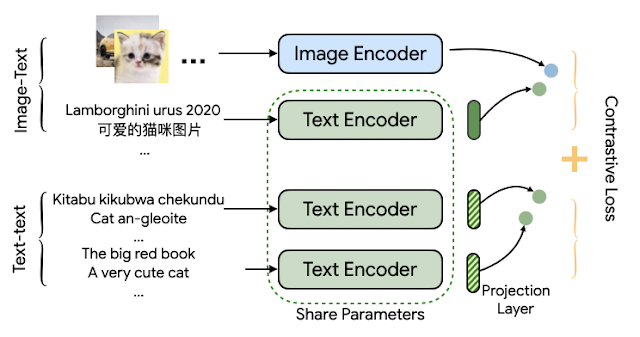
The MURAL architecture is based on the structure of ALIGN, but employed in a multitask fashion. Whereas ALIGN uses a dual-encoder architecture to draw together representations of images and associated text descriptions, MURAL employs the dual-encoder structure for the same purpose while also extending it across languages by incorporating translation pairs. The dataset of image–text pairs is the same as that used for ALIGN, and the translation pairs are those used for LaBSE.
MURAL solves two contrastive learning tasks: 1) image–text matching and 2) text–text (bitext) matching, with both tasks sharing the text encoder module. The model learns associations between images and text from the image–text data, and learns the representations of hundreds of diverse languages from the translation pairs. The idea is that a shared encoder will transfer the image–text association learned from high-resource languages to under-resourced languages. We find that the best model employs an EfficientNet-B7 image encoder and a BERT-large text encoder, both trained from scratch. The learned representation can be used for downstream visual and vision-language tasks.
| The architecture of MURAL depicts dual encoders with a shared text-encoder between the two tasks trained using a contrastive learning loss. |
Multilingual Image-to-Text and Text-to-Image Retrieval
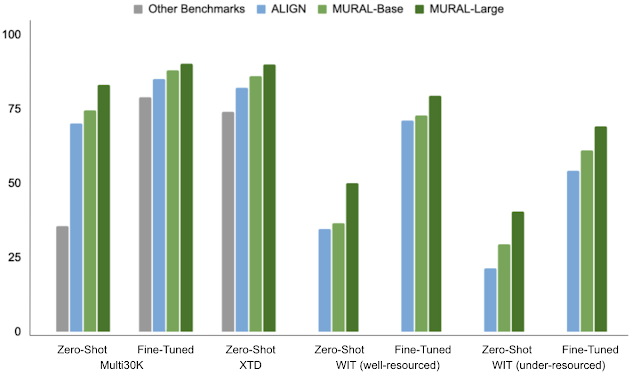
To demonstrate MURAL’s capabilities, we choose the task of cross-modal retrieval (i.e., retrieving relevant images given a text and vice versa) and report the scores on various academic image–text datasets covering well-resourced languages, such as MS-COCO (and its Japanese variant, STAIR), Flickr30K (in English) and Multi30K (extended to German, French, Czech), XTD (test-only set with seven well-resourced languages: Italian, Spanish, Russian, Chinese, Polish, Turkish, and Korean). In addition to well-resourced languages, we also evaluate MURAL on the recently published Wikipedia Image–Text (WIT) dataset, which covers 108 languages, with a broad range of both well-resourced (English, French, Chinese, etc.) and under-resourced (Swahili, Hindi, etc.) languages.
MURAL consistently outperforms prior state-of-the-art models, including M3P, UC2, and ALIGN, in both zero-shot and fine-tuned settings evaluated on well-resourced and under-resourced languages. We see remarkable performance gains for under-resourced languages when compared to the state-of-the-art model, ALIGN.
Retrieval Analysis
We also analyzed zero-shot retrieved examples on the WIT dataset comparing ALIGN and MURAL for English (en) and Hindi (hi). For under-resourced languages like Hindi, MURAL shows improved retrieval performance compared to ALIGN that reflects a better grasp of the text semantics.
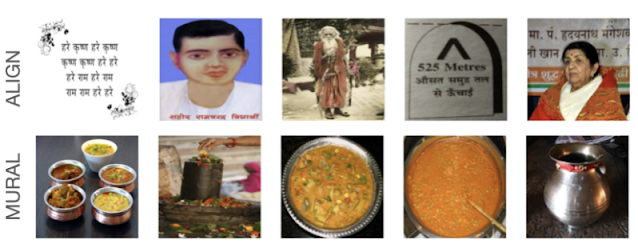
| Comparison of the top-5 images retrieved by ALIGN and by MURAL for the Text→Image retrieval task on the WIT dataset for the Hindi text, एक तश्तरी पर बिना मसाले या सब्ज़ी के रखी हुई सादी स्पगॅत्ती”, which translates to the English, “A bowl containing plain noodles without any spices or vegetables”. |
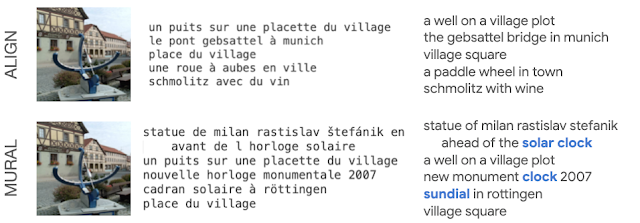
Even for Image→Text retrieval in a well-resourced language, like French, MURAL shows better understanding for some words. For example, MURAL returns better results for the query “cadran solaire” (“sundial”, in French) than ALIGN, which doesn’t retrieve any text describing sundials (below).
| Comparison of the top-5 text results from ALIGN and from MURAL on the Image→Text retrieval task for the same image of a sundial. |
Embeddings Visualization
Previously, researchers have shown that visualizing model embeddings can reveal interesting connections among languages — for instance, representations learned by a neural machine translation (NMT) model have been shown to form clusters based on their membership to a language family. We perform a similar visualization for a subset of languages belonging to the Germanic, Romance, Slavic, Uralic, Finnic, Celtic, and Finno-Ugric language families (widely spoken in Europe and Western Asia). We compare MURAL’s text embeddings with LaBSE’s, which is a text-only encoder.
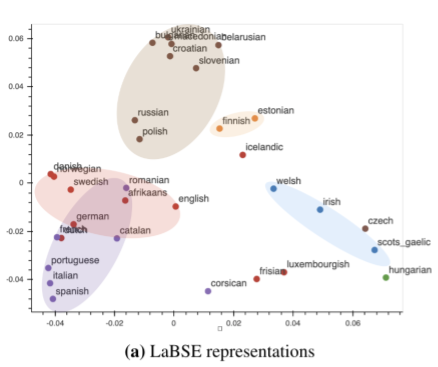
A plot of LabSE’s embeddings shows distinct clusters of languages influenced by language families. For instance, Romance languages (in purple, below) fall into a different region than Slavic languages (in brown, below). This finding is consistent with prior work that investigates intermediate representations learned by a NMT system.
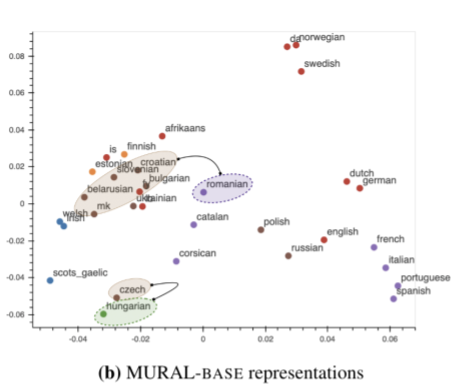
In contrast to LaBSE’s visualization, MURAL’s embeddings, which are learned with a multimodal objective, shows some clusters that are in line with areal linguistics (where elements are shared by languages or dialects in a geographic area) and contact linguistics (where languages or dialects interact and influence each other). Notably, in the MURAL embedding space, Romanian (ro) is closer to the Slavic languages like Bulgarian (bg) and Macedonian (mk), which is in line with the Balkan sprachbund, than it is in LaBSE. Another possible language contact brings Finnic languages, Estonian (et) and Finnish (fi), closer to the Slavic languages cluster. The fact that MURAL pivots on images as well as translations appears to add an additional view on language relatedness as learned in deep representations, beyond the language family clustering observed in a text-only setting.
| Visualization of text representations of MURAL for 35 languages. Color coding is the same as the figure above. |
Final Remarks
Our findings show that training jointly using translation pairs helps overcome the scarcity of image–text pairs for many under-resourced languages and improves cross-modal performance. Additionally, it is interesting to observe hints of areal linguistics and contact linguistics in the text representations learned by using a multimodal model. This warrants more probing into different connections learned implicitly by multimodal models, such as MURAL. Finally, we hope this work promotes further research in the multimodal, multilingual space where models learn representations of and connections between languages (expressed via images and text), beyond well-resourced languages.
Acknowledgements
This research is in collaboration with Mandy Guo, Krishna Srinivasan, Ting Chen, Sneha Kudugunta, Chao Jia, and Jason Baldridge. We thank Zarana Parekh, Orhan Firat, Yuqing Chen, Apu Shah, Anosh Raj, Daphne Luong, and others who provided feedback for the project. We are also grateful for general support from Google Research teams.
Smart Text Selection, launched in 2017 as part of Android O, is one of Android’s most frequently used features, helping users select, copy, and use text easily and quickly by predicting the desired word or set of words around a user’s tap, and automatically expanding the selection appropriately. Through this feature, selections are automatically expanded, and for selections with defined classification types, e.g., addresses and phone numbers, users are offered an app with which to open the selection, saving users even more time.
Today we describe how we have improved the performance of Smart Text Selection by using federated learning to train the neural network model on user interactions responsibly while preserving user privacy. This work, which is part of Android’s new Private Compute Core secure environment, enabled us to improve the model’s selection accuracy by up to 20% on some types of entities.
Server-Side Proxy Data for Entity Selections
Smart Text Selection, which is the same technology behind Smart Linkify, does not predict arbitrary selections, but focuses on well-defined entities, such as addresses or phone numbers, and tries to predict the selection bounds for those categories. In the absence of multi-word entities, the model is trained to only select a single word in order to minimize the frequency of making multi-word selections in error.
The Smart Text Selection feature was originally trained using proxy data sourced from web pages to which schema.org annotations had been applied. These entities were then embedded in a selection of random text, and the model was trained to select just the entity, without spilling over into the random text surrounding it.
While this approach of training on schema.org-annotations worked, it had several limitations. The data was quite different from text that we expect users see on-device. For example, websites with schema.org annotations typically have entities with more proper formatting than what users might type on their phones. In addition, the text samples in which the entities were embedded for training were random and did not reflect realistic context on-device.
On-Device Feedback Signal for Federated Learning
With this new launch, the model no longer uses proxy data for span prediction, but is instead trained on-device on real interactions using federated learning. This is a training approach for machine learning models in which a central server coordinates model training that is split among many devices, while the raw data used stays on the local device. A standard federated learning training process works as follows: The server starts by initializing the model. Then, an iterative process begins in which (a) devices get sampled, (b) selected devices improve the model using their local data, and (c) then send back only the improved model, not the data used for training. The server then averages the updates it received to create the model that is sent out in the next iteration.
For Smart Text Selection, each time a user taps to select text and corrects the model’s suggestion, Android gets precise feedback for what selection span the model should have predicted. In order to preserve user privacy, the selections are temporarily kept on the device, without being visible server-side, and are then used to improve the model by applying federated learning techniques. This technique has the advantage of training the model on the same kind of data that it sees during inference.
Federated Learning & Privacy
One of the advantages of the federated learning approach is that it enables user privacy, because raw data is not exposed to a server. Instead, the server only receives updated model weights. Still, to protect against various threats, we explored ways to protect the on-device data, securely aggregate gradients, and reduce the risk of model memorization.
The on-device code for training Federated Smart Text Selection models is part of Android’s Private Compute Core secure environment, which makes it particularly well situated to securely handle user data. This is because the training environment in Private Compute Core is isolated from the network and data egress is only allowed when federated and other privacy-preserving techniques are applied. In addition to network isolation, data in Private Compute Core is protected by policies that restrict how it can be used, thus protecting from malicious code that may have found its way onto the device.
To aggregate model updates produced by the on-device training code, we use Secure Aggregation, a cryptographic protocol that allows servers to compute the mean update for federated learning model training without reading the updates provided by individual devices. In addition to being individually protected by Secure Aggregation, the updates are also protected by transport encryption, creating two layers of defense against attackers on the network.
Finally, we looked into model memorization. In principle, it is possible for characteristics of the training data to be encoded in the updates sent to the server, survive the aggregation process, and end up being memorized by the global model. This could make it possible for an attacker to attempt to reconstruct the training data from the model. We used methods from Secret Sharer, an analysis technique that quantifies to what degree a model unintentionally memorizes its training data, to empirically verify that the model was not memorizing sensitive information. Further, we employed data masking techniques to prevent certain kinds of sensitive data from ever being seen by the model
In combination, these techniques help ensure that Federated Smart Text Selection is trained in a way that preserves user privacy.
Achieving Superior Model Quality
Initial attempts to train the model using federated learning were unsuccessful. The loss did not converge and predictions were essentially random. Debugging the training process was difficult, because the training data was on-device and not centrally collected, and so, it could not be examined or verified. In fact, in such a case, it’s not even possible to determine if the data looks as expected, which is often the first step in debugging machine learning pipelines.
To overcome this challenge, we carefully designed high-level metrics that gave us an understanding of how the model behaved during training. Such metrics included the number of training examples, selection accuracy, and recall and precision metrics for each entity type. These metrics are collected during federated training via federated analytics, a similar process as the collection of the model weights. Through these metrics and many analyses, we were able to better understand which aspects of the system worked well and where bugs could exist.
After fixing these bugs and making additional improvements, such as implementing on-device filters for data, using better federated optimization methods and applying more robust gradient aggregators, the model trained nicely.
Results
Using this new federated approach, we were able to significantly improve Smart Text Selection models, with the degree depending on the language being used. Typical improvements ranged between 5% and 7% for multi-word selection accuracy, with no drop in single-word performance. The accuracy of correctly selecting addresses (the most complex type of entity supported) increased by between 8% and 20%, again, depending on the language being used. These improvements lead to millions of additional selections being automatically expanded for users every day.
Internationalization
An additional advantage of this federated learning approach for Smart Text Selection is its ability to scale to additional languages. Server-side training required manual tweaking of the proxy data for each language in order to make it more similar to on-device data. While this only works to some degree, it takes a tremendous amount of effort for each additional language.
The federated learning pipeline, however, trains on user interactions, without the need for such manual adjustments. Once the model achieved good results for English, we applied the same pipeline to Japanese and saw even greater improvements, without needing to tune the system specifically for Japanese selections.
We hope that this new federated approach lets us scale Smart Text Selection to many more languages. Ideally this will also work without manual tuning of the system, making it possible to support even low-resource languages.
Conclusion
We developed a federated way of learning to predict text selections based on user interactions, resulting in much improved Smart Text Selection models deployed to Android users. This approach required the use of federated learning, since it works without collecting user data on the server. Additionally, we used many state-of-the-art privacy approaches, such as Android’s new Private Compute Core, Secure Aggregation and the Secret Sharer method. The results show that privacy does not have to be a limiting factor when training models. Instead, we managed to obtain a significantly better model, while ensuring that users’ data stays private.
Acknowledgements
Many people contributed to this work. We would like to thank Lukas Zilka, Asela Gunawardana, Silvano Bonacina, Seth Welna, Tony Mak, Chang Li, Abodunrinwa Toki, Sergey Volnov, Matt Sharifi, Abhanshu Sharma, Eugenio Marchiori, Jacek Jurewicz, Nicholas Carlini, Jordan McClead, Sophia Kovaleva, Evelyn Kao, Tom Hume, Alex Ingerman, Brendan McMahan, Fei Zheng, Zachary Charles, Sean Augenstein, Zachary Garrett, Stefan Dierauf, David Petrou, Vishwath Mohan, Hunter King, Emily Glanz, Hubert Eichner, Krzysztof Ostrowski, Jakub Konecny, Shanshan Wu, Janel Thamkul, Elizabeth Kemp, and everyone else involved in the project.
Despite considerable progress in robot learning over the past several years, some policies for robotic agents can still struggle to decisively choose actions when trying to imitate precise or complex behaviors. Consider a task in which a robot tries to slide a block across a table to precisely position it into a slot. There are many possible ways to solve this task, each requiring precise movements and corrections. The robot must commit to just one of these options, but must also be capable of changing plans each time the block ends up sliding farther than expected. Although one might expect such a task to be easy, that is often not the case for modern learning-based robots, which often learn behavior that expert observers describe as indecisive or imprecise.
| Example of a baseline explicit behavior cloning model struggling on a task where the robot needs to slide a block across a table and then precisely insert it into a fixture. |
To encourage robots to be more decisive, researchers often utilize a discretized action space, which forces the robot to choose option A or option B, without oscillating between options. For example, discretization was a key element of our recent Transporter Networks architecture, and is also inherent in many notable achievements by game-playing agents, such as AlphaGo, AlphaStar, and OpenAI’s Dota bot. But discretization brings its own limitations — for robots that operate in the spatially continuous real world, there are at least two downsides to discretization: (i) it limits precision, and (ii) it triggers the curse of dimensionality, since considering discretizations along many different dimensions can dramatically increase memory and compute requirements. Related to this, in 3D computer vision much recent progress has been powered by continuous, rather than discretized, representations.
With the goal of learning decisive policies without the drawbacks of discretization, today we announce our open source implementation of Implicit Behavioral Cloning (Implicit BC), which is a new, simple approach to imitation learning and was presented last week at CoRL 2021. We found that Implicit BC achieves strong results on both simulated benchmark tasks and on real-world robotic tasks that demand precise and decisive behavior. This includes achieving state-of-the-art (SOTA) results on human-expert tasks from our team’s recent benchmark for offline reinforcement learning, D4RL. On six out of seven of these tasks, Implicit BC outperforms the best previous method for offline RL, Conservative Q Learning. Interestingly, Implicit BC achieves these results without requiring any reward information, i.e., it can use relatively simple supervised learning rather than more-complex reinforcement learning.
Implicit Behavioral Cloning
Our approach is a type of behavior cloning, which is arguably the simplest way for robots to learn new skills from demonstrations. In behavior cloning, an agent learns how to mimic an expert’s behavior using standard supervised learning. Traditionally, behavior cloning involves training an explicit neural network (shown below, left), which takes in observations and outputs expert actions.
The key idea behind Implicit BC is to instead train a neural network to take in both observations and actions, and output a single number that is low for expert actions and high for non-expert actions (below, right), turning behavioral cloning into an energy-based modeling problem. After training, the Implicit BC policy generates actions by finding the action input that has the lowest score for a given observation.
To train Implicit BC models, we use an InfoNCE loss, which trains the network to output low energy for expert actions in the dataset, and high energy for all others (see below). It is interesting to note that this idea of using models that take in both observations and actions is common in reinforcement learning, but not so in supervised policy learning.
| Animation of how implicit models can fit discontinuities — in this case, training an implicit model to fit a step (Heaviside) function. Left: 2D plot fitting the black (X) training points — the colors represent the values of the energies (blue is low, brown is high). Middle: 3D plot of the energy model during training. Right: Training loss curve. |
Once trained, we find that implicit models are particularly good at precisely modeling discontinuities (above) on which prior explicit models struggle (as in the first figure of this post), resulting in policies that are newly capable of switching decisively between different behaviors.
But why do conventional explicit models struggle? Modern neural networks almost always use continuous activation functions — for example, Tensorflow, Jax, and PyTorch all only ship with continuous activation functions. In attempting to fit discontinuous data, explicit networks built with these activation functions cannot represent discontinuities, so must draw continuous curves between data points. A key aspect of implicit models is that they gain the ability to represent sharp discontinuities, even though the network itself is composed only of continuous layers.
We also establish theoretical foundations for this aspect, specifically a notion of universal approximation. This proves the class of functions that implicit neural networks can represent, which can help justify and guide future research.
One challenge faced by our initial attempts at this approach was “high action dimensionality”, which means that a robot must decide how to coordinate many motors all at the same time. To scale to high action dimensionality, we use either autoregressive models or Langevin dynamics.
Highlights
In our experiments, we found Implicit BC does particularly well in the real world, including an order of magnitude (10x) better on the 1mm-precision slide-then-insert task compared to a baseline explicit BC model. On this task the implicit model does several consecutive precise adjustments (below) before sliding the block into place. This task demands multiple elements of decisiveness: there are many different possible solutions due to the symmetry of the block and the arbitrary ordering of push maneuvers, and the robot needs to discontinuously decide when the block has been pushed far “enough” before switching to slide it in a different direction. This is in contrast to the indecisiveness that is often associated with continuous-controlled robots.
| Example task of sliding a block across a table and precisely inserting it into a slot. These are autonomous behaviors of our Implicit BC policies, using only images (from the shown camera) as input. |
| A diverse set of different strategies for accomplishing this task. These are autonomous behaviors from our Implicit BC policies, using only images as input. |
In another challenging task, the robot needs to sort blocks by color, which presents a large number of possible solutions due to the arbitrary ordering of sorting. On this task the explicit models are customarily indecisive, while implicit models perform considerably better.
| Comparison of implicit (left) and explicit (right) BC models on a challenging continuous multi-item sorting task. (4x speed) |
In our testing, implicit BC models can also exhibit robust reactive behavior, even when we try to interfere with the robot, despite the model never seeing human hands.
| Robust behavior of the implicit BC model despite interfering with the robot. |
Overall, we find that Implicit BC policies can achieve strong results compared to state of the art offline reinforcement learning methods across several different task domains. These results include tasks that, challengingly, have either a low number of demonstrations (as few as 19), high observation dimensionality with image-based observations, and/or high action dimensionality up to 30 — which is a large number of actuators to have on a robot.
| Policy learning results of Implicit BC compared to baselines across several domains. |
Conclusion
Despite its limitations, behavioral cloning with supervised learning remains one of the simplest ways for robots to learn from examples of human behaviors. As we showed here, replacing explicit policies with implicit policies when doing behavioral cloning allows robots to overcome the “struggle of decisiveness”, enabling them to imitate much more complex and precise behaviors. While the focus of our results here was on robot learning, the ability of implicit functions to model sharp discontinuities and multimodal labels may have broader interest in other application domains of machine learning as well.
Acknowledgements
Pete and Corey summarized research performed together with other co-authors: Andy Zeng, Oscar Ramirez, Ayzaan Wahid, Laura Downs, Adrian Wong, Johnny Lee, Igor Mordatch, and Jonathan Tompson. The authors would also like to thank Vikas Sindwhani for project direction advice; Steve Xu, Robert Baruch, Arnab Bose for robot software infrastructure; Jake Varley, Alexa Greenberg for ML infrastructure; and Kamyar Ghasemipour, Jon Barron, Eric Jang, Stephen Tu, Sumeet Singh, Jean-Jacques Slotine, Anirudha Majumdar, Vincent Vanhoucke for helpful feedback and discussions.
“The brain is able to use information coming from the skin as if it were coming from the eyes. We don’t see with the eyes or hear with the ears, these are just the receptors, seeing and hearing in fact goes on in the brain.”
People have the amazing ability to use one sensory modality (e.g., touch) to supply environmental information normally gathered by another sense (e.g., vision). This adaptive ability, called sensory substitution, is a phenomenon well-known to neuroscience. While difficult adaptations — such as adjusting to seeing things upside-down, learning to ride a “backwards” bicycle, or learning to “see” by interpreting visual information emitted from a grid of electrodes placed on one’s tongue — require anywhere from weeks, months or even years to attain mastery, people are able to eventually adjust to sensory substitutions.
| Examples of Sensory Substitution. Left: Tongue Display Unit (Maris and Bach-y-Rita, 2001; Image: Kaczmarek, 2011). Right: “Upside down goggles” initially conceived by Erismann and Kohler in 1931. (Image Wikipedia). |
In contrast, most neural networks are not able to adapt to sensory substitutions at all. For instance, most reinforcement learning (RL) agents require their inputs to be in a pre-specified format, or else they will fail. They expect fixed-size inputs and assume that each element of the input carries a precise meaning, such as the pixel intensity at a specified location, or state information, like position or velocity. In popular RL benchmark tasks (e.g., Ant or Cart-pole), an agent trained using current RL algorithms will fail if its sensory inputs are changed or if the agent is fed additional noisy inputs that are unrelated to the task at hand.
In “The Sensory Neuron as a Transformer: Permutation-Invariant Neural Networks for Reinforcement Learning”, a spotlight paper at NeurIPS 2021, we explore permutation invariant neural network agents, which require each of their sensory neurons (receptors that receive sensory inputs from the environment) to figure out the meaning and context of its input signal, rather than explicitly assuming a fixed meaning. Our experiments show that such agents are robust to observations that contain additional redundant or noisy information, and to observations that are corrupt and incomplete.
| Permutation invariant reinforcement learning agents adapting to sensory substitutions. Left: The ordering of the ant’s 28 observations are randomly shuffled every 200 time-steps. Unlike the standard policy, our policy is not affected by the suddenly permuted inputs. Right: Cart-pole agent given many redundant noisy inputs (Interactive web-demo). |
In addition to adapting to sensory substitutions in state-observation environments (like the ant and cart-pole examples), we show that these agents can also adapt to sensory substitutions in complex visual-observation environments (such as a CarRacing game that uses only pixel observations) and can perform when the stream of input images is constantly being reshuffled:
| We partition the visual input from CarRacing into a 2D grid of small patches, and shuffled their ordering. Without any additional training, our agent still performs even when the original training background (left) is replaced with new images (right). |
Method
Our approach takes observations from the environment at each time-step and feeds each element of the observation into distinct, but identical neural networks (called “sensory neurons”), each with no fixed relationship with one another. Each sensory neuron integrates over time information from only their particular sensory input channel. Because each sensory neuron receives only a small part of the full picture, they need to self-organize through communication in order for a global coherent behavior to emerge.
We encourage neurons to communicate with each other by training them to broadcast messages. While receiving information locally, each individual sensory neuron also continually broadcasts an output message at each time-step. These messages are consolidated and combined into an output vector, called the global latent code, using an attention mechanism similar to that applied in the Transformer architecture. A policy network then uses the global latent code to produce the action that the agent will use to interact with the environment. This action is also fed back into each sensory neuron in the next time-step, closing the communication loop.
Why is this system permutation invariant? Each sensory neuron is an identical neural network that is not confined to only process information from one particular sensory input. In fact, in our setup, the inputs to each sensory neuron are not defined. Instead, each neuron must figure out the meaning of its input signal by paying attention to the inputs received by the other sensory neurons, rather than explicitly assuming a fixed meaning. This encourages the agent to process the entire input as an unordered set, making the system to be permutation invariant to its input. Furthermore, in principle, the agent can use as many sensory neurons as required, thus enabling it to process observations of arbitrary length. Both of these properties will help the agent adapt to sensory substitutions.
Results
We demonstrate the robustness and flexibility of this approach in simpler, state-observation environments, where the observations the agent receives as inputs are low-dimensional vectors holding information about the agent’s states, such as the position or velocity of its components. The agent in the popular Ant locomotion task has a total of 28 inputs with information that includes positions and velocities. We shuffle the order of the input vector several times during a trial and show that the agent is rapidly able to adapt and is still able to walk forward.
In cart-pole, the agent’s goal is to swing up a cart-pole mounted at the center of the cart and balance it upright. Normally the agent sees only five inputs, but we modify the cartpole environment to provide 15 shuffled input signals, 10 of which are pure noise, and the remainder of which are the actual observations from the environment. The agent is still able to perform the task, demonstrating the system’s capacity to work with a large number of inputs and attend only to channels it deems useful. Such flexibility may find useful applications for processing a large unspecified number of signals, most of which are noise, from ill-defined systems.
We also apply this approach to high-dimensional vision-based environments where the observation is a stream of pixel images. Here, we investigate screen-shuffled versions of vision-based RL environments, where each observation frame is divided into a grid of patches, and like a puzzle, the agent must process the patches in a shuffled order to determine a course of action to take. To demonstrate our approach on vision-based tasks, we created a shuffled version of Atari Pong.
| Shuffled Pong results. Left: Pong agent trained to play using only 30% of the patches matches performance of Atari opponent. Right: Without extra training, when we give the agent more puzzle pieces, its performance increases. |
Here the agent’s input is a variable-length list of patches, so unlike typical RL agents, the agent only gets to “see” a subset of patches from the screen. In the puzzle pong experiment, we pass to the agent a random sample of patches across the screen, which are then fixed through the remainder of the game. We find that we can discard 70% of the patches (at these fixed-random locations) and still train the agent to perform well against the built-in Atari opponent. Interestingly, if we then reveal additional information to the agent (e.g., allowing it access to more image patches), its performance increases, even without additional training. When the agent receives all the patches, in shuffled order, it wins 100% of the time, achieving the same result with agents that are trained while seeing the entire screen.
We find that imposing additional difficulty during training by using unordered observations has additional benefits, such as improving generalization to unseen variations of the task, like when the background of the CarRacing training environment is replaced with a novel image.
| Shuffled CarRacing results. The agent has learned to focus its attention (indicated by the highlighted patches) on the road boundaries. Left: Training environment. Right: Test environment with new background. |
Conclusion
The permutation invariant neural network agents presented here can handle ill-defined, varying observation spaces. Our agents are robust to observations that contain redundant or noisy information, or observations that are corrupt and incomplete. We believe that permutation invariant systems open up numerous possibilities in reinforcement learning.
If you’re interested to learn more about this work, we invite readers to read our interactive article (pdf version) or watch our video. We also released code to reproduce our experiments.
1Quoted in Livewired, by David Eagleman. ↩