|
There is a way to get the Bias matrix like the Weights matrix? Or do you need to activate some function in the layers to get it out? submitted by /u/Filippo9559 |
Categories
How to get bias?
 DataBloom
|
|
There is a way to get the Bias matrix like the Weights matrix? Or do you need to activate some function in the layers to get it out? submitted by /u/Filippo9559 |
Hi,
I have a multi input model with a single target variable
After a lot of trial and error (and countless hours on SO) I’ve come this far
#reads in filepaths to images from dataframe train
images = tf.data.Dataset.from_tensor_slices(train.image.to_numpy())
#converts labels to one hot encoding vector
target = tf.keras.utils.to_categorical(
train.Label.to_numpy(), num_classes=n_class, dtype=’float32′
)
#reads in the image and resizes it
images= images.map(transform_img)
#zips the former according to
input_1 = tf.data.Dataset.zip((anchors, target))
dataset = tf.data.Dataset.zip((input_1, target))
and I think this is almost the solution, but the second input shape get’s distorted.
Because I get a warning that input expected is (None, n_class)
But it received an input of (n_class, 1)
And an error:
ValueError: Shapes (n_class, 1) and (n_class, n_class) are incompatible
I checked though, the shapes from to_categorical is correct, it’s num_examples, n_class
Could someone help an utterly confused me out?
Thanks a lot!
submitted by /u/obolli
[visit reddit] [comments]
NVIDIA today announced that its board of directors declared a four-for-one split of NVIDIA’s common stock in the form of a stock dividend …
Every day, vast amounts of geospatial imagery are being collected, and yet, until recently, one of the biggest potential users of that trove — property insurers — had made surprisingly little use of it. Now, CAPE Analytics, a computer vision startup and NVIDIA Inception member, seeks to turn that trove of geospatial imagery into better Read article >
The post Fighting Fire with Insights: CAPE Analytics Uses Computer Vision to Put Geospatial Data and Risk Information in Hands of Property Insurance Companies appeared first on The Official NVIDIA Blog.
 A team of NVIDIA artists released never-before-seen imagery and behind-the-scenes videos from the Omniverse RTX Racer playable sample project. The clips and imagery are the result of 3 weeks of progress, showcasing the Omniverse platform’s power in multi-GPU rendering, dynamic lighting, and real-time rendering.
A team of NVIDIA artists released never-before-seen imagery and behind-the-scenes videos from the Omniverse RTX Racer playable sample project. The clips and imagery are the result of 3 weeks of progress, showcasing the Omniverse platform’s power in multi-GPU rendering, dynamic lighting, and real-time rendering.
The racing demo consists of a loop level, where a player controls a dune buggy vehicle, with the ability to steer, accelerate, decelerate, and brake.
With no difference between editing and “play” mode within NVIDIA Omniverse, users can move the camera and control the vehicle, or change the lighting, simultaneously, in real time.
Creative and Collaborative Workflows in Omniverse
The photorealistic scenes, characters, and props were created using a variety of creative applications such as Pixologic ZBrush, Autodesk 3ds Max, Autodesk Maya and Blender, textured in Substance Painter, and rendered with Omniverse RTX Renderer. Using Omniverse Create, two artists worked collaboratively on the rocky, desert environment, leveraging the platform’s live sync abilities to adjust environment art, layout and lighting simultaneously. The Omniverse platform’s simulation suite, including NVIDIA PhysX 5, delivered physically accurate simulation, providing players with a true-to-reality experience as they raced their buggy across the rugged terrain.
The cheeky alien main character was sculpted entirely in ZBrush, refined in Autodesk Maya and textured in Substance Painter.

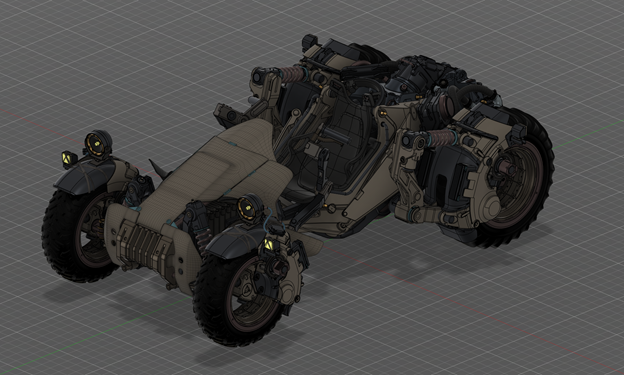
The dune buggy, a custom vehicle designed to race around desert dunes, was modeled in Autodesk Fusion 360 and textured in Substance Painter. The vehicle is physically based, and went through various iterations in size and dimensions to find the optimal racing balance in the physically accurate environment.
One Renderer, Dual Personalities
Omniverse RTX Renderer works in two different modes: real-time ray-traced mode and referenced path-traced mode. The demo is able to run in both modes without a significant difference in graphics quality — the materials and visual output are very similar.
At a high level, both modes implement the same rendering algorithm for path tracing, but with different optimization and approximations choices. The real-time ray-traced mode is typically used in real-time simulation applications such as games, while the reference path-traced mode is used for projects requiring ultra-high fidelity, final-frame quality results as it accumulates many samples over many frames, often requiring multiple GPUs.
Leveraging the power of four NVIDIA RTX 8000 GPUs, the NVIDIA team experimented with referenced path-traced mode, ultimately achieving offline film quality rendering at near real-time speeds.
Bringing it to Life with Omniverse Physics
The Omniverse RTX Racer project also showcases NVIDIA Omniverse’s advanced physics simulation suite including PhysX 5, exclusively available to the public as part of the platform, NVIDIA Flow, and Blast.
PhysX provides the powerful vehicle authoring technology that made the dune buggy come to life. The same vehicle authoring technology is used as part of the new NVIDIA DRIVE Sim platform for training and validating self-driving cars, now built entirely on Omniverse. With accurate steering, suspension, wheel collision, and tire friction behavior, users can easily create multiple instances of different styles of vehicles.
The team of artists and developers used this project to experiment with Flow, a sparse grid-based fluids simulation package for real-time applications that was recently integrated into the Omniverse platform. Flow was used to simulate the buggy’s blazing rocket engine and cloudy dust trail. This effect is written in Slang, the NVIDIA cross-platform shading language, and simulated entirely on NVIDIA GPUs.

The Omniverse RTX Racer sample is a living project with future iterations to come. Learn more about NVIDIA Omniverse and download the open beta today.
Dive further into Omniverse RTX Renderer, Omniverse Physics, and Collaborative Content Creation for Game Development in our exclusive, free-to-access GTC On-Demand sessions.
I am training a custom AnoVAEGAN model using mixed precision and mirror strategy.
I have usedAdam (with epsilon 1e-04), lr = 0.0001,MSE and BinaryCrossEntropy loss for generator.BinaryCrossEntropy for the discriminator.
For some reason, after some time, MSE loss becomes Nan which makes the overall generator loss also Nan.
Any advice from anyone who has also faced a similar issue, please help me out here.
Github repo: https://github.com/dhruvampanchal/AnoVAEGAN
Thanks!
Check comment for nan loss output.
submitted by /u/dhruvampanchal
[visit reddit] [comments]
Hi everyone,
I have a question about TFRecords and how to train tf.keras models with them. For this I built a toy example, loading the iris dataset, writing the the data to a TFRecord, reading it back in and trying to train a simple MLP I found in a tutorial.
For encoding/writing/reading/decoding the TFRecords I followed mostly the official [Tutorial](https://www.tensorflow.org/tutorials/load_data/tfrecord). As far as I am able to see I can recover the original data, so I thought I plug the dataset into the MLP as the [fit method](https://www.tensorflow.org/api_docs/python/tf/keras/Model#fit) should be able to work with tf.data datasets. In an example notebook with the MNIST dataset it worked fine, but in my case fit throws the following error:
TypeError: 'NoneType' object is not callable
I copied the notebook to gist.
Does anybody know, how to solve this problem or if I am doing something wrong?
P.S.: I already tried to reshape the tensors, as some posts mentioned that the shapes are not always recovered.
submitted by /u/fXb0XTC3
[visit reddit] [comments]
 Watch the replay of this joint session at GTC 21 to learn about achieving near-line rate speed of a next-generation firewall through the use of DPUs for a highly efficient 5G native security solution.
5G is unlike earlier generations of wireless networks. 5G offers many new capabilities such as lower latency, higher reliability and throughput, agile service deployment through cloud-native architectures, greater device density, and more. The adoption of 5G and its expanded capabilities drives the bandwidth requirements of mobile networks to 100Gbps and beyond.
With 5G and the increasingly frequent implementations of cloud computing, a new direction in cyber-security is required to maintain adequate protection. Today’s cyber-attack methods are demonstrating increased sophistication and going after larger attack surfaces. Coupling this with modern cloud environments – which are more vulnerable than on-premises deployments – makes proper security enforcement difficult. With 5G, a new approach to security is needed to achieve adequate protection.
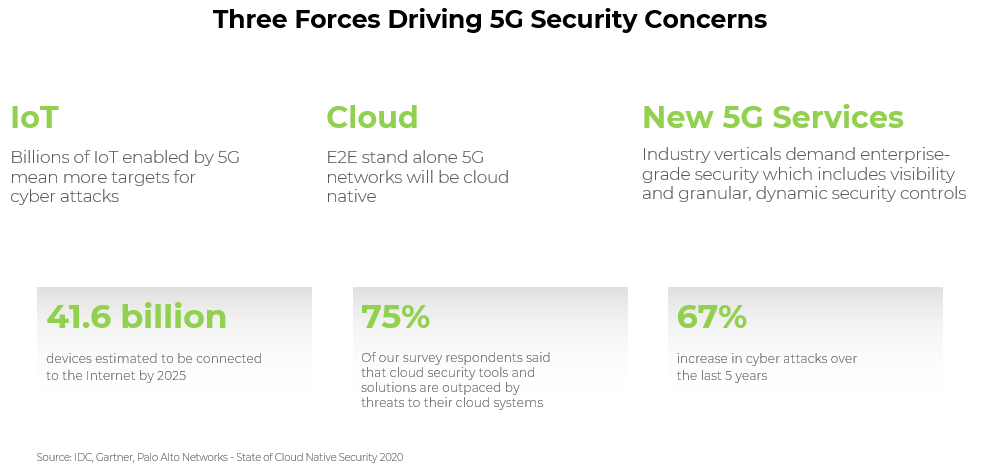
Palo Alto Networks and NVIDIA have collaborated to create a scalable, adaptive security solution that combines the Palo Alto Next-Generation Firewall with the NVIDIA BlueField-2 Data Processing Unit (DPU). Integrating these two raises the bar for high-performance security in virtualized software-defined networks. The NVIDIA BlueField-2 DPU provides a rich set of network offload engines designed to address evolving security needs within demanding markets such as 5G and the cloud. Palo Alto Networks has taken its expertise in securing enterprise and mobile networks and applied it to 5G. They used this knowledge to implement a 5G-native security initiative that includes a virtual firewall. The virtual firewall is designed to meet the stringent security needs of 5G cloud-native environments, offering scale, operational simplicity, and automation, enabling customers to gain unparalleled security protection.
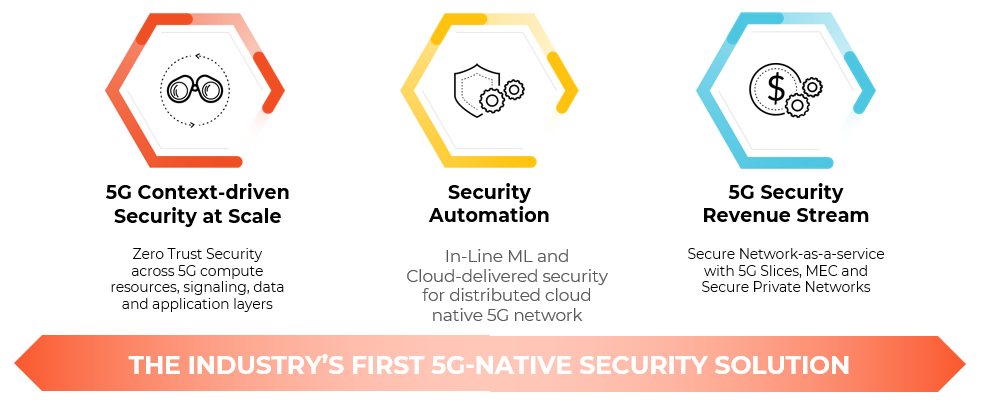
For data centers looking to modernize their security infrastructure within 5G and cloud environments, the power of a software-defined, hardware-accelerated security architecture from NVIDIA and Palo Alto Networks provides increased infrastructure efficiency, granular zero-trust security across the entire solution stack, and streamlined security and management operations.
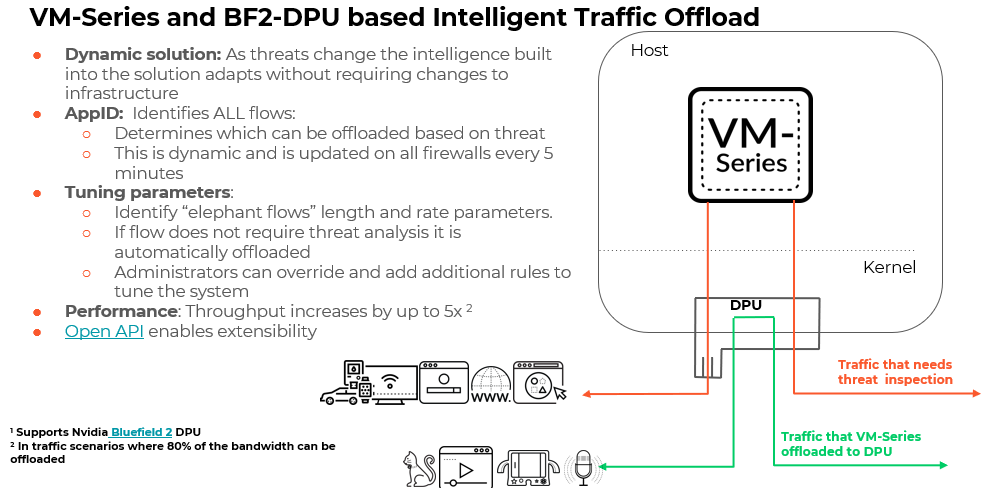
The dynamic nature of this solution has intelligent traffic offloads built in so that it adapts to real-time threats without requiring changes to the network infrastructure. The NVIDIA ASAP2 VNF offload technology filters or steers traffic for elephant flows identified based on AppID. Further, this AppID is used to inspect the first few packets to detect if it contains a threat or if it can offload the flow. If the packet is not suitable for offload, it is sent to the firewall for inspection. If the firewall determines the session is of no threat, it is sent to the PAN gRPCd process that calls the DPU daemon to add the session to the DPU session table for future offloading. The DPU will handle all subsequent packets in the flow without consuming any server CPU cycles for firewall processing. The solution provides up to 100Gb/s throughput with 80% of traffic offloaded to the DPU and ensures the highest performance without utilizing the CPU. This results in an throughput increase of 5X compared to host-based traditional firewall security solutions.
At GTC 21, NVIDIA and Palo Alto Networks jointly presented the intelligent traffic offload use-case for 5G native security. Watch the replay of this joint session to learn about achieving near-line rate speed of a next-generation firewall through the use of DPUs for a highly efficient 5G native security solution. Don’t miss the demonstration showcasing the flexibility, programmability, and agility of the Palo Alto Networks and NVIDIA joint cyber-security solution. The GA of this solution is targeted for May 2021. Please connect with your NVIDIA or Palo Alto Networks sales representatives to learn more.
Click here to watch the recorded session from GTC.
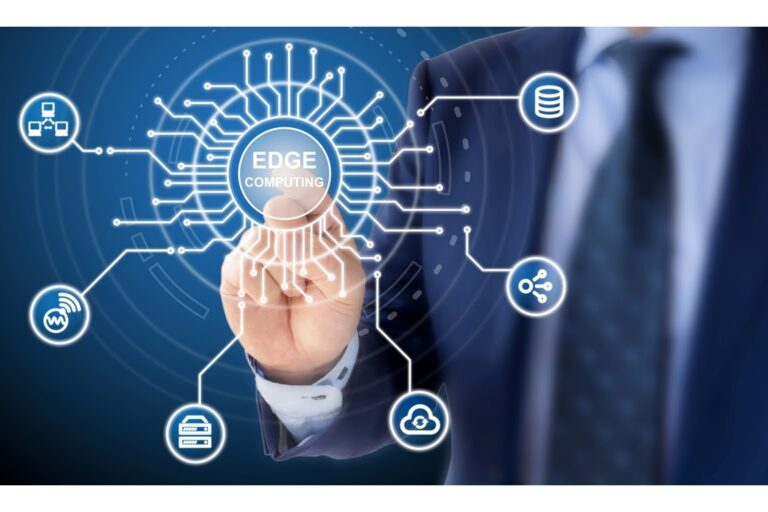 As computing power moves to edge computing, NVIDIA announces the EGX platform and ecosystem, including server-vendor certifications, hybrid cloud partners, and new GPU Operator software.
Demand for edge computing is growing rapidly because people increasingly need to analyze and use data where it’s created instead of trying to send it back to a data center. New applications cannot wait for the data to travel all the way to a centralized server, wait for it to be analyzed, then wait for the results to make the return trip. They need the data analyzed RIGHT HERE, RIGHT NOW!
To meet this need, NVIDIA just announced an expansion of the NVIDIA EGX platform and ecosystem, which includes server vendor certifications, hybrid cloud partners, and new GPU Operator software that enables a cloud-native deployment for GPU servers. As computing power moves to the edge, we find that smarter edge computing needs smarter networking, and so the EGX ecosystem includes NVIDIA networking solutions.
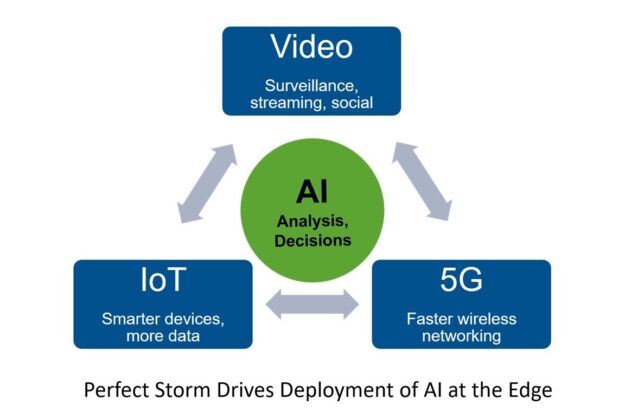
The growth of the Internet of Things (IoT), 5G wireless, and AI are all driving the move of compute to the edge. IoT means more—and smarter—devices are generating and consuming more data but in the field, far from traditional data centers. Autonomous vehicles, digital video cameras, kiosks, medical equipment, building sensors, smart cash registers, location tags, and of course phones will soon generate data from billions of end points. This data must be collected, filtered, and analyzed. Often, the distilled results are transferred to another data center or endpoint somewhere else. Sending all the data back to the data center without any edge processing not only adds much latency, it’s often too much data to transmit over WAN connections. Data centers often don’t even have enough room to store all the unfiltered, uncompressed data coming from the edge.
5G brings higher bandwidth and lower latency to the edge, enabling faster data acquisition and new applications for IoT devices. Data that previously wasn’t collected or which couldn’t be shared is now available over the air. The faster wireless connectivity enables new applications that use and respond to data at the edge, in real time. That’s instead of waiting for it to be stored centrally then analyzed later, if it’s analyzed at all.
AI means more useful information can be derived from all the new data, driving quick decisions. The flood of IoT data is too voluminous to be analyzed by humans. It requires AI technology to separate the wheat from the chaff (the signal from the noise). The decision and insights from AI then feed applications both at the edge and back in the central data center.
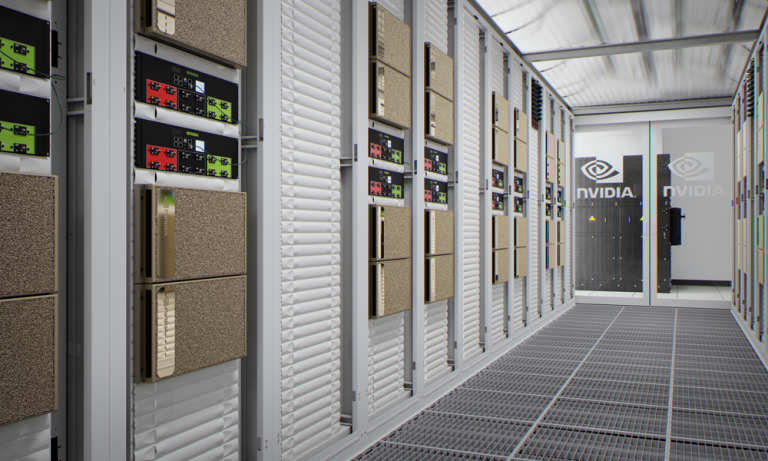
Many edge AI workloads—such as image recognition, video processing, and robotics—require massive parallel processing power, an area where NVIDIA GPUs are unmatched. To meet the need for more advanced AI processing at the edge, NVIDIA introduced the EGX platform. The EGX platform supports a hyper-scalable range of GPU servers, from a single NVIDIA Jetson Nano system up to a full rack of NVIDIA T4 or V100 Tensor Core servers. The Jetson Nano delivers up to half a trillion operations per second (1/2 TOPS), while a full rack of T4 servers can handle ten thousand trillion operations per second (10,000 TOPS).
NVIDIA EGX also includes container-based tools, drivers, and NVIDIA CUDA-X libraries to support AI applications at the edge. EGX is supported by major server vendors and includes integration with Red Hat OpenShift to provide enterprise-class container orchestration based on Kubernetes. This is all critical because so many of the edge computing locations—retail stores, hospitals, self-driving cars, homes, factories, cell phones, and so on— are supported by enterprises, local government, and telcos, not by hyperscalers.
Recently, NVIDIA announced new EGX features and customer implementations, along with strong support for hybrid cloud solutions. The NGC-Ready server certification program has been expanded to include tests for edge security and remote management, and the new NVIDIA GPU Operator simplifies management and operation of AI across widely distributed edge devices.

But there is another class of technology and partners needed to make EGX—and AI at the edge—as smart and efficient as it can be: networking. As the amount of GPU-processing power at the edge and the number of containers increases, the amount of network traffic can also increase exponentially.
Before AI, the analyzable edge data traffic, not counting streamed graphics, videos and music going out to phones, probably flowed 95% inbound. For example, data might flow from cameras to digital video recorders, from cars to servers, or from retail stores to a central data center. Any analysis or insight would often be human-driven, as people can only concentrate and observe a single stream of video. The data might be stored for a later date, removing the ability to make instant decisions.
Now, with AI solutions like EGX deployed at the edge, applications must talk with IoT devices, back to servers in the data center, and with each other. AI applications trade data and results with standard CPUs, data from the edge is synthesized with data from the corporate data center or public cloud, and the results get pushed back to the kiosks, cars, appliances, MRI scanners, and phones.
The result is a massive amount of N-way data traffic between containers, IoT devices, GPU servers, the cloud, and traditional centralized servers. Software-defined networking (SDN) and network virtualization play a larger role. This expanded networking brings new security concerns, as the potential attack surface for hackers and malware is much larger than before and cannot be contained inside a firewall.
As networking becomes more complex, the network must become smarter in many ways. Some examples of this are:
These increased network complexity and security concerns impose a growing burden on the edge servers as well as on the corporate and cloud servers that interface with them. With more AI power and faster network speeds, handling the network virtualization, SDN rules, and security filtering sucks up an expensive share of CPU cycles, unless you have the right kind of smart network. As the network connections get faster, that network’s smarts must be accelerated in hardware instead of running in software.
Smarter edge computing requires smarter networking. If this networking is handled by the CPUs or GPUs, then valuable cycles are consumed by moving the data instead of analyzing and transforming it. Someone must encode and decode overlay network headers, determine which packet goes to which container, and ensure that SDN rules are followed. Software-defined firewalls and routers impose additional CPU burdens as packets must be filtered based on source, destination, headers, or even on the internal content of the packets. Then, the packets are forwarded, mirrored, rerouted, or even dropped, depending on the network rules.
Fortunately, there is a class of affordable SmartNICs, such as the NVIDIA ConnectX family, which offload all this work from the CPU. These adapters have hardware-accelerated functions to handle overlay networks, Remote Direct Memory Access, container networking, virtual switching, storage networking, and video streaming. They also accelerate the adapter side of network congestion management and QoS.
The newest adapters, such as the ConnectX-6 Dx, can perform in-line encryption and decryption in hardware at high speeds, supporting IPsec and TLS. With these important but repetitive network tasks safely accelerated by the NIC, the CPUs and GPUs at the edge connect quickly and efficiently with each other and the IoT, all the while focusing their core cycles on what they do best—running applications and parallelized processing of complex data.
An even more advanced network option for edge compute efficiency is a DPU or data processing unit, such as the NVIDIA BlueField DPU. A DPU combines all the high-speed networking and offloads of a SmartNIC with programmable cores that can handle additional functions around networking, storage, or security.
On the security side, DPUs such as BlueField provide security domain isolation. Without isolation, any security software is running in the same domain as the OS, container management, and application. If an attacker compromises any of those, the security software is at risk of being bypassed, removed, or corrupted. With BlueField, the security software continues running on the DPU where it can continue to detect, isolate, and report malware or breaches on the server. By running in a separate domain—protected by a hardware root of trust—the security features can sound the alarm to intrusion detection and prevention mechanisms and also prevent malware on the infected server from spreading.
The newest BlueField-2 DPU also adds regular expression (RegEx) matching that can quickly detect patterns in network traffic or server memory, so it can be used for threat identification. It also adds hardware offloads for data efficiency using deduplication through a SHA-2 hash and compression/decompression.
With the increasing use of AI solutions at the edge, like the NVIDIA EGX platform, the edge becomes infinitely smarter. However, networking and security also get more complex and threaten to slow down servers, just when the growth of the IoT and 5G wireless requires more compute power. This can be solved with the deployment of SmartNICs and DPUs, such as the ConnectX and BlueField product families. These network solutions offload important network and security tasks, such as SDN, network virtualization, and software-defined firewall functions. This allows AI at the edge to run more efficiently and securely.
For more information, see the NVIDIA EGX Platform for Edge Computing webinar.
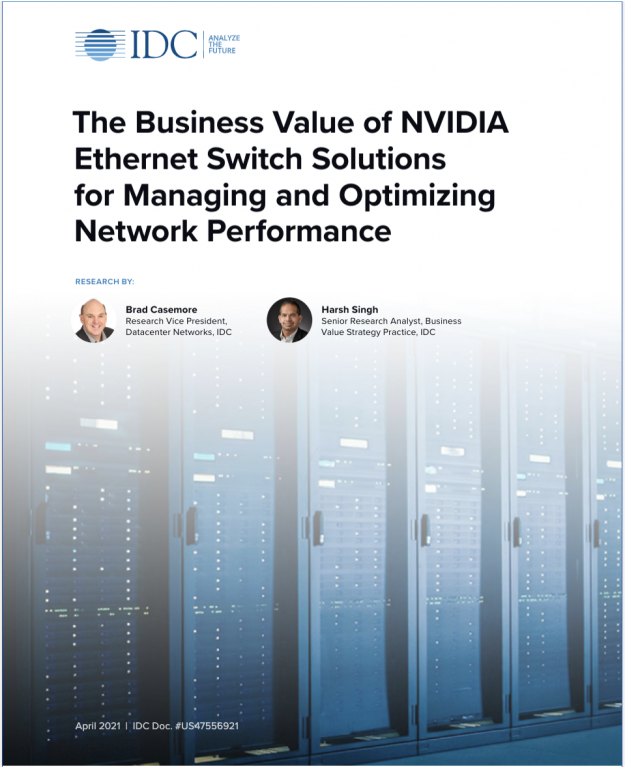
 IDC analysts Brad Casemore and Harsh Singh interviewed IT organizations with real world experience deploying and managing Cumulus Linux and NVIDIA Spectrum switches in mission critical data centers over a significant time period.
NVIDIA recently commissioned IDC to conduct research into the business value and technical benefits of the NVIDIA Ethernet switch solution. IDC analysts Brad Casemore and Harsh Singh interviewed IT organizations with real world experience deploying and managing Cumulus Linux and NVIDIA Spectrum switches in mission critical data centers over a significant time period. The research included interviews with organizations that were using the combined solution set and had first-hand knowledge about the costs and benefits of this solution.
During the interviews, companies were asked a variety of quantitative and qualitative questions about NVIDIA’s impact on their IT and network operations. The results highlighted several key benefits that NVIDIA customers are realizing, including:
“The biggest benefit is operational efficiencies — it’s easier to deploy and manage from an IT standpoint. Any time we need to make changes to the infrastructure, for whatever reason, we can do it more simply and quicker. And the raw IT budget has been reduced,” NVIDIA Ethernet Switching Solutions Customer
In this paper, IDC concluded that a modern data center can be a significant contributor to business value when the datacenter network combines all the traditional attributes of switch hardware — such as scalability, reliability, performance, and low latency — with a commensurate degree of software-based network automation, programmability, flexibility, and actionable analytics and insights.
In the IDC Business Value White Paper, IDC has documented the business value of NVIDIA Spectrum Ethernet Switches in conjunction with Cumulus Linux through the ease of overall network management and operations. Interviewees also reported they were able to support their business with a more cost-effective and better performing network by reducing the costs of the network itself but still providing enough bandwidth for their organization’s business users.
Join guests IDC analysts, Brad Casemore and Harsh Singh on May 27th at 10 am PT for a full readout on the details of their findings in a special webinar. Please register here.
All webinar attendees will get exclusive early access to the full IDC Business Value White Paper*, entitled “The Business Value of NVIDIA Ethernet Switch Solutions for Managing and Optimizing Network Performance”. You’ll also receive the IDC Executive Overview and IDC Snapshot/Infographic.
*IDC Business Value Whitepaper, Sponsored by NVIDIA, The Business Value of NVIDIA Ethernet Switch Solutions for Managing and Optimizing Network Performance, IDC Doc. #US47556921, April 2021
