I have extracted audio embeddings from Google Audioset corpus.
Now, I want to use these audio embeddings for training my own model (CNN). I have some confusion about these audio embeddings.
Should I extract STFT and MFCC from the audio embeddings? If so, how can I do that (any way to use librosa?)? Or, are the audio embeddings already transformed to MFCC?
What should be the best way to split the audio set corpus into train, test and validate datasets? They are if Tfrecord format and each tfrecord file contain various segment of audio clips having different class labels.
If I want to work on selective class labels (such as rowing, or car sound), what should be the best way to extract the selective audio segments?
Also, please share some helpful resources about working with Google audioset corpus if possible.
I am trying to build a program that will classify objects, and I want my clients to be able to add extra objects freely. However, from my knowledge, this requires the retraining of the entire neural network, and this is very expensive.
Is there a network where we would be able to add more options to the image classifier without retraining or little training?
Partnering with NVIDIA and the ICC, Photon Commerce is creating the world’s most intelligent financial AI platform for instant B2B payments, invoices, statements, and receipts.
The business-to-business (B2B) payments ecosystem is massive, with $25 trillion in payments flowing between businesses each year. Photon Commerce, a financial AI platform company, empowers fintech leaders to process B2B payments, invoices, statements, and receipts instantly.
Over two-thirds of B2B transactions are processed through automated clearing house payments (a type of electronic payment) and checks. Yet, these transactions can take up to 3 days to clear. This has created a need for real-time payments that are processed instantaneously and safely, eliminating the risk of delinquent payments.
Partnering with NVIDIA and the International Chamber of Commerce, Photon Commerce guides payment processors, neobanks, and credit card fintechs on how to train and invent the world’s most intelligent AI for payments, invoices, and commerce.
Why is the use of AI crucial in payment processing? Card-not-present payments, such as those made online or over the phone, are costly for merchants, requiring manual entry and approval. AI-powered payments also work remotely but are instantaneous and secure.
Additionally, two out of three merchants today do not accept credit cards due to fees. Not even Amazon is willing to pay these expenses at times. The solution lies in real-time payments and request-for-payment offerings. These low-cost payment systems provide fraud-free payment options for 30 million merchants in the US.
Figure 1: Faster payment processing has led to the increased adoption of AI in the B2B sector.
One-click checkout for B2B transactions
Photon’s AI offers one-click bill pay for customers’ credit card lenders and leading core payment processors. These entities handle trillions of dollars in payments for the majority of banks and merchants.
One such customer, Settle is a leader in receivables finance, payables finance, and bill pay for eCommerce merchants like Italic, Huron, Brightland, and Branch.
Pioneering a Buy-Now-Pay-Later solution for B2B and eCommerce merchants, Settle Founder and CEO, Alek Koenig claims Photon’s invoice automation technology is a ‘godsend.’
“Photon’s solution enabled us to improve user experience, capture greater revenues, and significantly reduce manual keying of invoice and payment data. Before Photon, we were just typing up each invoice manually,” said Koenig.
Settle’s AI-based financial services and solutions achieved meteoric growth, especially among small to midsized businesses. The company raised nearly $100M from top-tier investors, such as Kleiner Perkins, within only 2 years of its inception.
55x the performance over CPUs
AI accelerated processing forms the underpinning of Photon Commerce’s AI solution capable of tackling unstructured or semistructured data and serving their customers. Photon’s base models for enterprise workloads start with 16 NVIDIA V100 GPUs. Depending on throughput, bandwidth, and power factors, Photon’s deep learning machines readily scale to 64 NVIDIA V100 GPUs or more.
GPU-accelerated computing has been critical to Photon’s machine learning models, both for training and inference. Photon’s deep learning was trained on NVIDIA V100s, providing 55x faster performance than CPU servers and 24x faster performance during inference.
Custom development and production boxes or clusters are provisioned either in the cloud, hybrid cloud, or on-prem deployments. Docker containers use Kubernetes to provide container orchestration across clusters during the scaling of models. Photon’s API architecture runs through a data pipeline of file validation, document classification, computer vision, then NLP. Photon’s NLP transformer models are autoregressive in architecture, employing model and data parallelism.
Next generation payment systems using AI
AI payment solution concepts are key to enabling end-to-end traceability, visibility, and scaling to high-transaction volumes needed for eCommerce merchants, and logistics companies for trade finance solutions.
Below are three examples of Photon’s AI solutions improving payment systems.
Receipts and invoices are made easier with Computer Vision/NLP
The value of extracting information from documents, particularly in the context of finance, for unstructured and semistructured data is enormous. Companies and individuals can process invoices, receipts, and forms with little to no-human interaction, saving time and money. Photon Commerce’s AI technology solves this problem by automatically reading, understanding, approving, and paying any invoice using computer vision and NLP.
Creating global standards for payment, invoice, and trade finance documentation using AI
Business documents are messy and each company has different Enterprise resource planning systems, record portals, and formats. These systems often break down with disputes, errors, and fraud happening daily. Photon Commerce’s solutions standardize any invoice, bill, or payment document in the world, regardless of language or format. This facilitates instant approvals, payments, and straight-through-processing.
Worldwide trade partners can now speak the same language and collaborate
Businesses and trade partners can now speak the same language. Photon’s NLP understands that a “vendor”, “supplier”, “seller”, “beneficiary”, “merchant”, and “卖方” are generally synonyms, referring to the same “object” called as Named Entity Recognition. Photon’s reconciliation AI can instantly flip any purchase order into an invoice, or match purchase orders, invoices, receipts, remittances, shipping labels, bills-of-lading, proof-of-deliveries, and rate confirmations seamlessly together.
See AI in action
Reach out to nvidia@photoncommerce.com and learn more about how AI accelerates payments, invoicing, and trade collaboration between businesses.
I’m tuning the hyperparameters of a Tensorflow model in Google AI platform, but I have the following problem: For the evaluation metric I want to optimize, it seems like only the metric value at the end of the training is reported to the hyperparameter optimizer, instead of the best value achieved during training. Is it possible to create a metric, which will track the maximum value over the entire training?
I wanted to do a group project on tensorflow object detection for university, but, our teacher wanted us to use our own images instead of datasets. The project is a road safety app that can detect and label road signs, oncoming vehicles and pedestrians. Is this going to be too much to handle , is it possible to make a app that can detect these things using custom images or is it impossible?
(Side note : i can also reduce the project to just detection and recognition of road signs and vehicles)
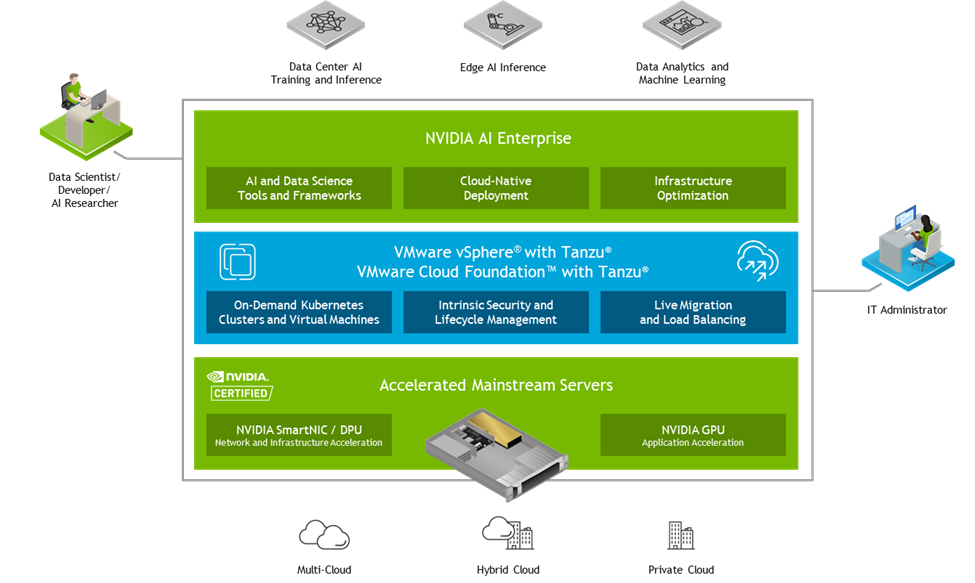
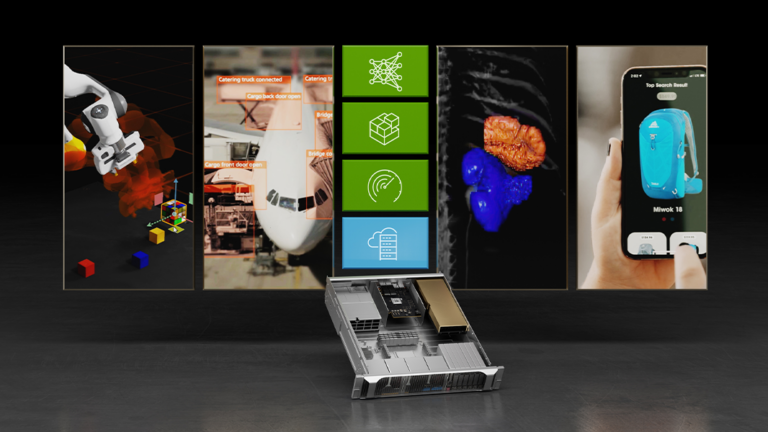
Get the latest on NVIDIA AI Enterprise on VMware Cloud Foundation, VMware Cloud Director, and new curated labs with VMware Tanzu and Domino Data.
The new year has been off to a great start with NVIDIA AI Enterprise 1.1 providing production support for container orchestration and Kubernetes cluster management using VMware vSphere with Tanzu 7.0 update 3c, delivering AI/ML workloads to every business in VMs, containers, or Kubernetes.
New LaunchPad labs
New NVIDIA AI Enterprise labs for IT admins and MLOps are available on NVIDIA LaunchPad:
VMware vSphere with Tanzu
Domino Enterprise MLOps platform
NVIDIA AI Enterprise with VMware vSphere with Tanzu
Enterprises can get started quickly with NVIDIA AI Enterprise running on VMware vSphere with Tanzu through the free LaunchPad program that provides immediate, short-term access to NVIDIA AI running on private accelerated compute infrastructure.
A newly added curated lab gives you hands-on experience using VMware Tanzu Kubernetes Grid service to manage a containerized workload using the frameworks provided in the NVIDIA AI Enterprise software suite. In this lab, you can configure, optimize, and orchestrate resources for AI and data science workloads with VMware Tanzu. You get experience using the NGC registry, NVIDIA operators, Kubernetes, and server virtualization, all by running vSphere with Tanzu on NVIDIA-Certified Systems.
NVIDIA AI Enterprise with the Domino Enterprise MLOps platform
MLOps administrators also have something to get excited about, with the addition of another new curated lab available soon on NVIDIA LaunchPad.
NVIDIA AI Enterprise provides validation for the Domino Data Lab Enterprise MLOps Platform with VMware vSphere. Enterprises can run through the lab and get hands-on experience on how to scale data science workloads with the Domino MLOps platform. Data scientists and AI researchers will be able to launch the Domino Workspaces on-demand with container images configured with the latest data science tools and frameworks, included in NVIDIA AI Enterprise, accelerated with NVIDIA GPUs.
The Domino MLOps Platform enables automatic storing and versioning of code, data, and results. When IT administrators try this lab, they use familiar management tools provided by VMware vSphere with Tanzu. Deployed on NVIDIA-Certified Systems, IT now has the confidence of enterprise-grade security, manageability, and support.
New AI Enterprise integrations with VMware
Service providers, telcos, and hybrid cloud enterprises using VMware now have access to NVIDIA AI on the following products:
VMware Cloud Foundation
VMware Cloud Director
Enterprise AI together with VMware Cloud Foundation
NVIDIA and VMware have expanded support for NVIDIA AI Enterprise to VMware’s flagship hybrid-cloud platform, VMware Cloud Foundation 4.4. Further democratizing AI for every enterprise, the AI-Ready enterprise platform combines the benefits of the full stack VMware Cloud Foundation environment with the NVIDIA software suite running on GPU accelerated mainstream servers that are NVIDIA-Certified. This provides you with the tools and frameworks you need for successfully developing and deploying AI, while enabling IT administrators with full control of infrastructure resources.
The integration of VMware Cloud Foundation with Tanzu and NVIDIA AI Enterprise enables enterprises to extend their software-defined private cloud platform to support a flexible and easily scalable AI-ready infrastructure. Administrators can deploy, configure, and manage IT infrastructure in an automated fashion, using powerful tools like vSphere Distributed Resource Scheduler for initial placement and VMware vMotion for migration of VMs running NVIDIA GPUs.
IT admins benefit from this integration, but so do AI practitioners who can now easily consume admin-assigned resources for their AI and data analytics workloads to get them from development and deployment to scaling quickly.
Addressing the growing demand for AI in the cloud with VMware Cloud Director
As cloud providers are seeing increased demand from customers for modern applications that require accelerated compute, VMware Cloud Director 10.3.2 has added support for NVIDIA AI Enterprise. These service providers can now leverage vSphere support to run AI/ML workloads on NVIDIA Ampere-based GPUs with capabilities like vMotion, multi-tenancy GPU services combined with the most fundamental AI tools and frameworks all managed through VMware Cloud Director.
NVIDIA AI Enterprise with VMware Cloud Director enables industries like cloud service providers and telcos to provide new services for their customers. One example is intelligent video analytics (IVA) using GPU-accelerated computer vision to provide real-time insights for boosting public safety, lowering theft, and improving customer experiences.
Start your AI journey
Get started with NVIDIA AI Enterprise on LaunchPad for free. Apply now for immediate access to the software suite running on NVIDIA-Certified Systems.
Come join us at GTC, March 21-24 to hear and see NVIDIA, VMware, and our partners share more details about these new and exciting integrations. Register today.
I noticed that in an epoch, the loss and dice_coef are equal. However, val_loss is never equal val_dice_coef. What is the reason behind that? I feel like something is being done (turned on/off) during validation.
I hope any of this makes sense. Thanks!
Edit: i am using segmentation-models library, using a unet with pretrained weights. I tried looking into the source code; but I couldn’t figure out what’s happening.

 Partnering with NVIDIA and the ICC, Photon Commerce is creating the world’s most intelligent financial AI platform for instant B2B payments, invoices, statements, and receipts.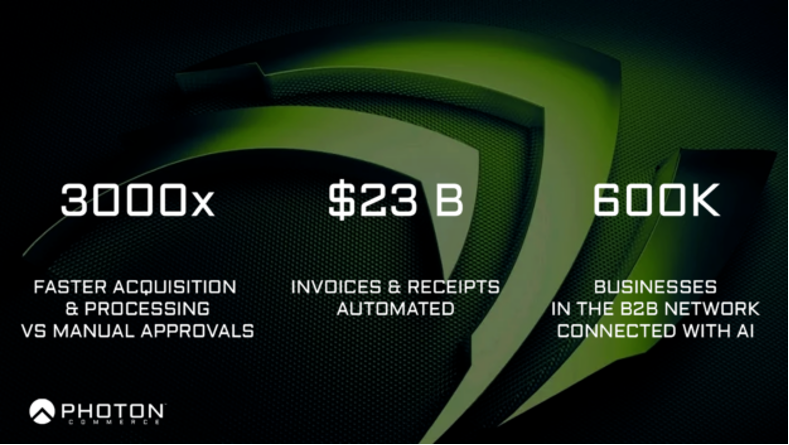
 Get the latest on NVIDIA AI Enterprise on VMware Cloud Foundation, VMware Cloud Director, and new curated labs with VMware Tanzu and Domino Data.