Categories
Misc

NVIDIA Announces Availability for Arm HPC Developer Kit with New HPC SDK v21.7

The DevKit is an integrated hardware-software platform for creating, evaluating, and benchmarking HPC, AI, and scientific computing applications for Arm server based accelerated platforms.

Today NVIDIA announced the availability of the NVIDIA Arm HPC Developer Kit with the NVIDIA HPC SDK version 21.7.  The DevKit is an integrated hardware-software platform for creating, evaluating, and benchmarking HPC, AI, and scientific computing applications for Arm server based accelerated platforms. The HPC SDK v21.7 is the latest update of the software development kit, and fully supports the new Arm HPC DevKit.

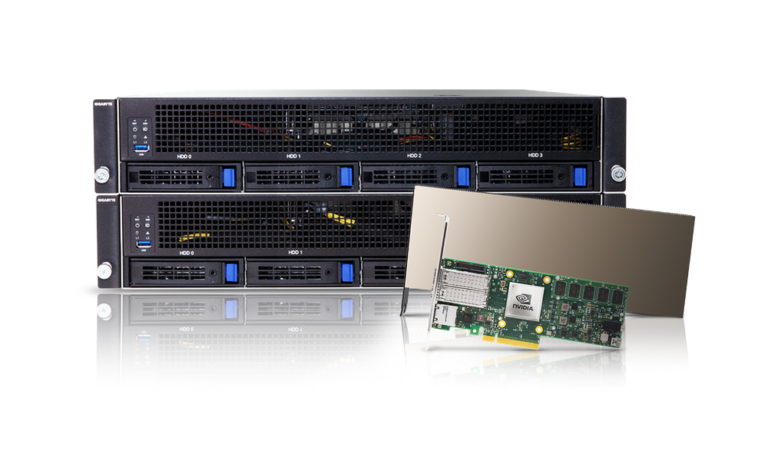
This DevKit targets heterogeneous GPU/CPU system development, and includes an Arm CPU, two NVIDIA A100 Tensor Core GPUs, two NVIDIA BlueField-2 data processing units (DPUs), and the NVIDIA HPC SDK suite of tools. 

The integrated HW/SW DevKit delivers:

  •  A validated system for quick and easy bring-up in a stable environment for accelerated computing code execution and evaluation, performance analysis, system experimentation, and system characterization.
  •  A stable hardware and software platform for development and performance analysis of accelerated HPC, AI, and scientific computing applications
  •  Experimentation and characterization of high-performance, NVIDIA-accelerated, Arm server-based system architectures 

The NVIDIA Arm HPC Developer Kit is based on the GIGABYTE G242-P32 2U server, and leverages the NVIDIA HPC SDK, a comprehensive suite of compilers, libraries, and tools for HPC delivering performance, portability, and productivity. The platform will support Ubuntu, SLES, and RHEL operating systems. 

HPC SDK 21.7 includes:

  • Full support for the NVIDIA Arm HPC Developer Kit 
  • CUDA 11.4 support
  • HPC Compilers with Arm-specific performance enhancements including improved vectorization and optimized math functions
  • Maintenance support and bug fixes

Previously HPC SDK 21.5 introduced support for:

  • A subset of Arm Neon intrinsics have been implemented in the HPC Compilers and can be enabled with -Mneon_intrinsics.

The NVIDIA HPC SDK C++ and Fortran compilers are the first compilers to support automatic GPU acceleration of standard language constructs including C++17 parallel algorithms and Fortran intrinsics.

Download the HPC SDK v21.7 for free today.

Contact our partner GIGABYTE about the hardware pricing and availability via the link on our DevKit web page.

Learn more about NVIDIA and Arm support:

Categories
Misc

Change the Rules of the Game: NVIDIA Omniverse Brings an Arsenal of RTX and AI-Powered Apps, Extensions and DIY Toolkits to Accelerate Game Development Pipelines

At GDC 2021, NVIDIA introduced a suite of Omniverse apps and tools to simplify and accelerate game development content creation pipelines.

Collaboration and simulation platform simplifies complex challenges like multi-app workflows, facial animation, asset searching, and building proprietary tools.

Content creation in game development involves multiple steps and processes, which can be notoriously complicated. To create the best experiences, game artists need to build massive libraries of 3D content while incorporating realistic lighting, physics and optimal game performance with AI. An explosion in the number of Digital Content Creation (DCC) tools to design different elements of a game leads to long review cycles, and difficulties in maximizing iteration. And often, studios are spending development hours creating their own proprietary tools to enable these workflows.

At GDC 2021, NVIDIA introduced a suite of Omniverse apps and tools to simplify and accelerate game development content creation pipelines. Developers can plug into any layer of the platform stack — whether at the top level, utilizing pre-built Omniverse Apps such as Create, Machinima, or Audio2Face; or the platform component level, to easily build custom extensions and tools to accelerate their workflow. 

USD Comes to Game Development

Universal Scene Description (USD), the foundation of NVIDIA Omniverse, is an easily extensible, open-source 3D scene description and file format developed by Pixar for content creation and interchange among different tools.

Because of its versatility, USD is now being widely adopted across industries like media and entertainment, architecture, robotics, manufacturing — and now, game development. 

Luminous and Embark Studios, two of the early evaluators of NVIDIA Omniverse for game development, have adopted USD to leverage the Omniverse-connected ecosystem and accelerate their workflows.

“Game development content pipelines are complex and require us to use the best aspects of multiple applications,” said Takeshi Aramaki, Studio Head and VP at Luminous. “By adopting Pixar’s Universal Scene Description (USD), we will leverage universal asset and application interoperability across our tools to accelerate time to production and optimize our workflows.” 

Accelerate Workflows with Live-Sync Collaboration and Intuitive Tools

When it comes to creating content, game developers must use various industry tools, many of which are often incompatible. Omniverse Connectors, which are plug-ins to popular applications, provide game developers with the ability to work live and simultaneously across their favorite applications, so they can easily speed up workflows.

And with Omniverse Create, developers can leverage simple, intuitive tools to build and test content, and rapidly iterate during creation pipelines. Use paint tools for set dressing, or tap into Omniverse Physics — like PhysX 5, Flow, and Blast — to bring realistic details to 3D models. NVIDIA RTX technology enables real-time ray tracing and path tracing for ground truth lighting. And users can easily stream content from Omniverse, so they can view models or assets on any device.

Simplify Asset Management Woes

Game developers are burdened with extremely large asset catalogs being built over several years, by thousands of artists and developers, across several studios. Accelerating and simplifying asset search and management is critical to maintaining productivity and limiting cost spent on duplicating assets that can’t be found. 

With Omniverse Nucleus, the core collaboration and database engine for ease of 3D asset interchange, assets are stored as ground truth, and can easily be passed from artist to artist, or studio to studio. 

Plus, with Omniverse’s AI and advanced rendering capabilities, developers can leverage Omniverse DeepSearch to easily search through thousands of 3D assets using still images or natural language, including adjectives or qualifiers. 


An AI-Powered Playground

Realistic facial animation is a notoriously tedious process, but game creators can add enhanced levels of detail to characters using Omniverse Audio2Face, an app that automatically generates facial animation using AI. Audio2Face allows developers to create realistic facial expressions and motions to match any voice-over track. The technology feeds the audio input into a pre-trained Deep Neural Network, and the output of the network drives the facial animation of 3D characters in real time. 

And Omniverse Machinima is a tool that helps game developers create cinematic animations and storytelling with their USD-based assets, or they can seed to their community to generate remixed User Generated Content to promote iconic characters or scenes. Today, Machinima includes notable assets from Mount & Blade II: Bannerlord and Squad, with more to come.

Kit Extensions System

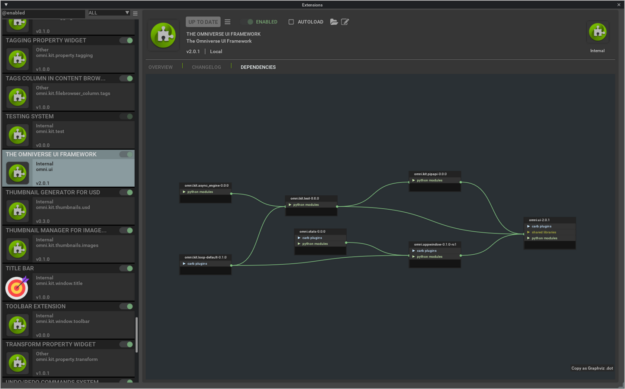
The Omniverse Kit Extensions system enables anybody with basic programming knowledge to build powerful tools quickly and distribute them to the content makers, or to package them into micro-services to empower new distributed workflows. Extensions are mostly authored in Python for ultimate usability and have source code provided, so developers can inspect, experiment and build to suit their needs using a Script Editor.

Image: Extension Manager in Omniverse Kit

Developers can also use the powerful Omni.UI system — an ultra-lightweight, GPU-accelerated user interface framework that is the foundational UI for all Omniverse Kit-based applications which is fully styleable, similar to HTML stylesheets, and works on Linux and Windows with DX12 and Vulkan-accelerated backends.

Graph Editing Framework
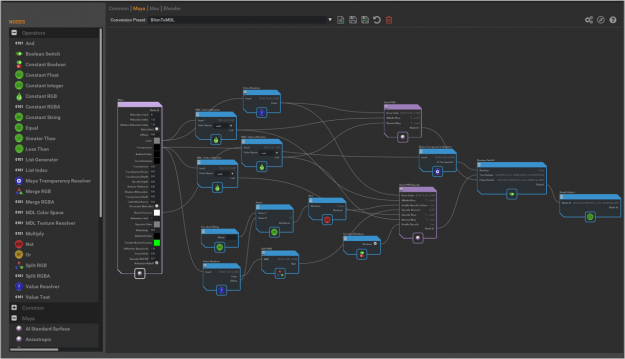
For team members without extensive scripting or coding experience, Omni.UI Graph is an easy-to-use graph editing framework to develop custom behaviors for extensions or apps. With Omni.UI Graph, Omniverse Kit and some skills in Python, users can intuitively create and customize extensions at runtime for fast iteration.

Image: Omni.UI Graph – graph editing framework

Dive further into NVIDIA Omniverse for Game Development with free access to our GTC On-Demand sessions, Omniverse Tutorials, and Twitch live streams. For technical questions, chat with our team in the Omniverse Forums, and connect with the community on the Omniverse Discord server.

Categories
Offsites

Multi-task Prediction of Organ Dysfunction in ICUs

The intensive care unit (ICU) of a hospital looks after the most medically vulnerable patients, many of whom require organ support, such as mechanical ventilation or dialysis. While always critical, the demand on ICU services during the COVID-19 pandemic has further underscored the importance of data-driven decision-making in healthcare. Furthermore, the ability to accurately predict the clinical outcomes of ICU patients has the potential to guide therapy and may inform decisions about most effective care, including staffing and triage support.

Applying machine learning (ML) to electronic health records (EHRs) has shown promise in predicting clinical outcomes. However, many of these ML models are based on single-task learning (ST), where the models are trained only to predict a specific adverse event, such as an organ dysfunction or the need for a life-support intervention. Of greater benefit would be to train multi-task models, which take into account a variety of competing risks along with the interdependencies between organ systems that factor into patient outcomes in a realistic setting.

In “Multi-task prediction of organ dysfunction in the ICU using sequential sub-network routing”, we propose a multi-task learning (MTL) architecture, called Sequential Sub-Network Routing (SeqSNR), that better captures the complexity of a realistic setting. Inspired by a clinician’s holistic approach to diagnosing problems, SeqSNR is designed to use flexible parameter sharing and routing to find related tasks and encourage cross-learning between them. We successfully applied SeqSNR to the task of continuous adverse event prediction in an ICU setting and showed advantages over single-task and naïve multi-tasking, especially in low training data scenarios.

Data and Labels
In this study, we used the freely available, open access, de-identified MIMIC-III EHR dataset, which includes a patient cohort consisting of 36,498 adults across 52,038 critical care admissions at the Beth Israel Deaconess Medical Center between 2001 and 2012. Similar to our previous studies, we employed a version of the MIMIC-III dataset that was mapped to the Fast Healthcare Interoperability Resource (FHIR) standard and used a comprehensive set of features, including a sequence of vital signs, laboratory results, past medications, procedures, diagnoses, and more.

The MIMIC-III database contains multi-modal recordings from ICU patients. Unlike most datasets in ML, the input and targets are often not explicitly defined and must be inferred from the data. So, using a combination of automated rule-based methods and clinical review, we defined a suite of diverse endpoints, including critical care interventions, specific organ dysfunctions, and overall patient outcomes.

The task given to the model was to predict the onset of a selection of adverse events within 24–48 hours for every hour after a patient’s admission into the ICU. The defined adverse events included acute kidney injury (AKI), continuous renal replacement therapy (CRRT) dialysis, administration of vasopressors and inotropes, mechanical ventilation (MV), mortality, and remaining length of stay (LoS).

The SeqSNR Algorithm
While multi-task learning captures the interdependencies between organ systems and balances competing risks, it can be challenging to implement successfully. In practice, jointly-trained tasks often impair one another, an effect called “negative transfer”. The intuition behind SeqSNR was that modular ‘sub-networks’ would mitigate this issue by automatically optimizing how information is shared across multiple tasks.

SeqSNR is a time series adaptation of the SNR architecture and is a combination of a deep embedding layer followed by stacked recurrent neural network (RNN) layers. Modularisation is achieved by splitting both the embedding layer and the RNN stack into multiple modules connected by routing variables that are learned during the training phase. The routing connections are always created between blocks in one layer and the next. This approach minimizes negative transfer by ensuring that data of low relevance to a particular task layer is filtered out. In essence, this means that each task utilizes a different path through the model.
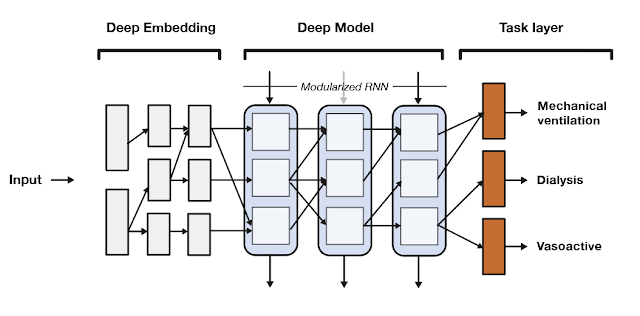
A high-level overview of the SeqSNR architecture.

Findings
SeqSNR shows a modest improvement in discriminative performance overall relative to single-task and naïve multitasking. However, it’s performance improvement is more significant in scenarios with few training labels.

Because the prevalence of different outcomes varied widely in the dataset (e.g. ~38% of patients had MV, but CRRT dialysis is present for only ~3%), many accuracy metrics are not suitable. Instead, we report the area under the precision recall curve (AU PRC), which is more reliable given imbalanced data. Moreover, we performed the Wilcoxon Signed Rank Tests to draw statistically significant conclusions for pairwise comparisons of ST learning, shared-bottom (SB) multi-task learning (i.e., naïve multi-task learning), and SeqSNR across bootstrapped samples from the held-out test set. The performance differences between the three architectures were modest, but SeqSNR outperformed both ST and SB in four out of six tasks (p-values are reported in the paper).
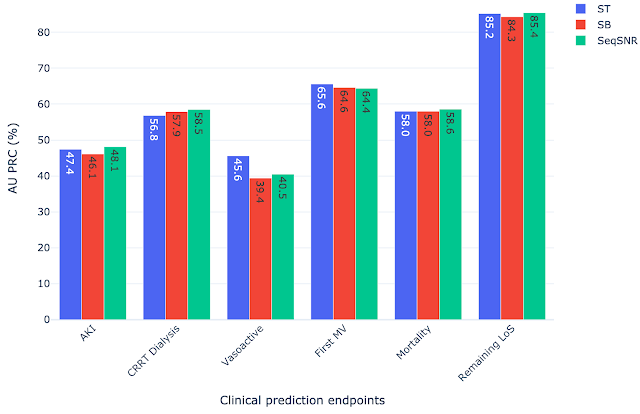
Comparison of single task (ST), shared bottom (SB) and SeqSNR performance on the MIMIC-III dataset.

Label Efficiency
We hypothesized that multi-task learning could assist in low-data scenarios by using easy-to-label auxiliary tasks to boost the performance of the main tasks. We formulated prediction tasks with only a portion of the training labels available for the primary prediction task, but kept the entire dataset for the “helper tasks”. The latter are chosen because they are reliably encoded in the EHR and are straightforward to timestamp. An example of such a helper task is length of stay, since the start and end of admissions are accurately timestamped in MIMIC-III. On the other hand, the start and end of mechanical ventilation events are not reliably timestamped. So, we defined a set of rules based on expert-defined heuristics to determine the ventilation times using multiple sources of mechanical ventilator–related settings along with physiological measurements in the EHR dataset that are indicative of MV.

The development of these rules for a new clinical endpoint was time-consuming and involved manual review of the dataset by experts. The difficulty in exhaustively labeling the dataset led us to test the model performance with only 1–10% of the data labeled, which resulted in a decline in model performance. The “helper tasks” are useful in this scenario since they are 100% labeled and can be used with the primary tasks (1–10% labeled) to jointly train the multi-task model for improved overall performance.

We chose AKI, mechanical ventilation, CRRT Dialysis, and vasoactive medications as primary endpoints using 1%, 5%, and 10% of the training labels, along with 100% of labels for the helper tasks — labs and vitals, mortality, and LoS. Performance of both ST and SeqSNR decreased as the percentage of labels for the primary endpoint was reduced, but SeqSNR outperformed ST across all tasks and all training data reduction percentages, with a statistically significant boost in performance for all cases.
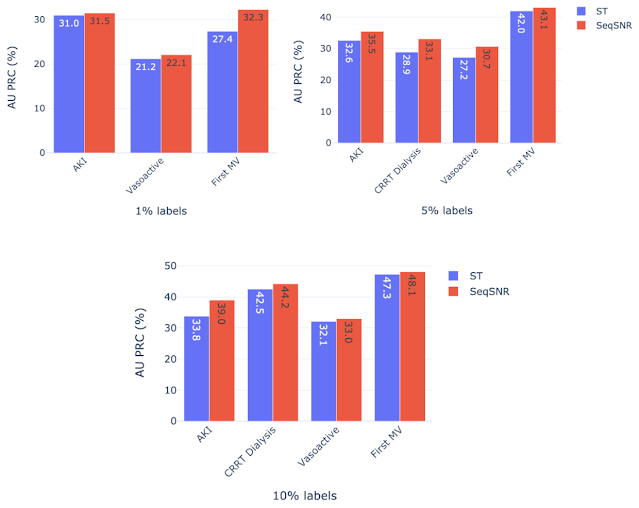
Label efficiency results showing the discriminative performance when the training dataset for the primary endpoint is reduced to 1%, 5% and 10% while the helper tasks have access to all training labels.

This is a useful finding, given the difficulties of annotating endpoint labels in EHR datasets, which frequently necessitates human evaluation by doctors. The ability to use numerous endpoints, some of which may be easier to label (like duration of stay or mortality), could lessen the need for manual curation on more difficult endpoints that are annotated differently (like mechanical ventilation).

Subgroup Performance
While the version of the MIMIC-III dataset used contained labels for gender and age, it did not contain information on race and the information on ethnicity was limited. We computed the performance of all selected models across age and gender subgroups. We observed that in the scenarios with few instances in the dataset, the MTL models (both SB models and SeqSNR) often outperform ST. Even though there are exceptions, on average all models seem to be relatively balanced across age and gender subgroups. We invite the reader to refer to the supplemental section of our paper for a detailed performance breakdown.

Next Steps
This work is a proof of concept for SeqSNR on a set of canonical EHR prediction tasks. The code for this architecture is publicly available here. And will hopefully stimulate further research in EHR multi-tasking and other deep learning architectures inspired by clinical reasoning.

In future, it will be important to evaluate the performance of SeqSNR on different combinations of tasks, different time horizons and different datasets. One other area of potential growth in this project is to expand subgroup analysis by including datasets with additional population information, race, ethnicity, etc. Another area we are exploring is expanding subgroup analysis by including datasets with additional population information, such as race, ethnicity, etc. We also emphasize that these are prototype models designed to showcase methodologies, and more rigorous evaluation would be needed to bring these tools into deployment.

Acknowledgements
This work involved collaborative efforts from a multidisciplinary team of researchers, software engineers, clinicians, and cross-functional contributors. We thank our co-authors: Eric Loreaux, Anne Mottram, Ivan Protsyuk, Natalie Harris, Sebastien Baur, Yuan Xue, Jessica Schrouff, Ali Connell, Alan Karthikesalingam, Martin Seneviratne from Google, Nenad Tomasev from Deepmind, and Hugh Montgomery from University College London. We also thank Zhe Zhao from Google Research and Kathryn Rough, Cian Hughes, Megumi Morigami and Doris Wong from Google Health for their input and review, and the MIMIC team for curating this open access dataset for the research community.

Categories
Misc

On-Demand Session: Accelerating Kubernetes with NVIDIA Operators

NVIDIA Operators streamline installing and managing GPUs and NICs on Kubernetes to make the software stack ready to run the most resource-demanding workloads, such as AI, ML, DL, and HPC, in the cloud, data center, and at the edge.

Kubernetes is an open-source container-orchestration system for automating computer application deployment, scaling, and management. It’s an extremely popular tool, and can be used for automated rollouts and rollbacks, horizontal scaling, storage orchestration, and more. For many organizations, Kubernetes is a key component to their infrastructure. 

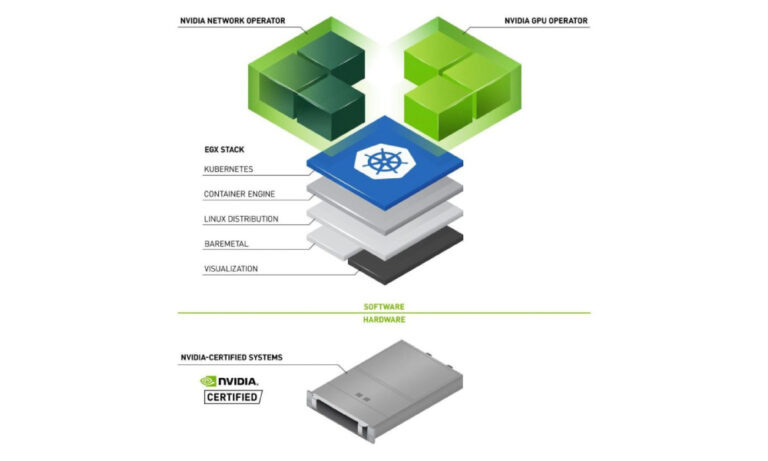
A critical step to installing and scaling Kubernetes is ensuring that it is properly utilizing the other components of the infrastructure. NVIDIA Operators streamline installing and managing GPUs and NICs on Kubernetes to make the software stack ready to run the most resource-demanding workloads, such as AI, ML, DL, and HPC, in the cloud, data center, and at the edge. NVIDIA Operators consist of the GPU Operator and the Network Operator, and are open source and based on the Operator Framework. 
NVIDIA GPU Operator

The NVIDIA GPU Operator is packaged as a Helm Chart and installs and manages the lifecycle of software components so that the GPU-accelerated applications can be run on Kubernetes. The components are the GPU feature discovery, the NVIDIA Driver, the Kubernetes Device Plugin, the NVIDIA Container Toolkit, and DCGM Monitoring. 

The GPU Operator enables infrastructure teams to manage the lifecycle of GPUs when used with Kubernetes at the Cluster level, therefore eliminating the need to manage each node individually. Previously infrastructure teams had to manage two operating system images, one for GPU nodes and one CPU nodes. When using the GPU Operator, infrastructure teams can use the CPU image with GPU worker nodes as well.

NVIDIA Network Operator

The Network Operator is responsible for automating the deployment and management of the host networking components in a Kubernetes cluster. It includes the Kubernetes Device Plugin, NVIDIA Driver, NVIDIA Peer Memory Driver, and the Multus, macvlan CNIs. These components were previously installed manually, but are automated through the Network Operator, streamlining the deployment process and enabling accelerated computing with enhanced customer experience.

Used independently or together, NVIDIA Operators simplify GPU and SmartNIC configurations on Kubernetes and are compatible with partner cloud platforms. To learn more about these components and how the NVIDIA Operators solve the key challenges to running AI, ML, DL, and HPC workloads and simplify initial setup and Day 2 operations, check out the on-demand webinar “Accelerating Kubernetes with NVIDIA Operators“.

Categories
Misc

GFN Thursday Slays with ‘Orcs Must Die! 3’ Coming to GeForce NOW

This GFN Thursday brings in hordes of fun — and a whole lot of orcs. Orcs Must Die! 3, the newest title from the action-packed, orc-slaying series from Robot Entertainment, is joining the GeForce NOW library when it releases tomorrow, Friday, July 23.   In addition, 10 more games are coming to the service this Read article >

The post GFN Thursday Slays with ‘Orcs Must Die! 3’ Coming to GeForce NOW appeared first on The Official NVIDIA Blog.

Categories
Misc

Confidential multi-stakeholder AI with TensorFlow

Learn how to up a confidential AI inference service. Using TensorFlow Serving, we’ll showcase a multi-stakeholder scenario including cloud service provider, model owner, inference service provider, and users.

Blog Post

GitHub

submitted by /u/m1gh7ym0
[visit reddit] [comments]

Categories
Misc

Question about Tutorial: Build, Train, and Deploy a Book Recommender System Using Keras, TensorFlow.js

Hi!

I stumbled upon this Medium article – Build, Train, and Deploy a Book Recommender System Using Keras, TensorFlow.js, Node.js, and Firebase – in order to get started with machine learning in general. One could say, I’m quite new to the field, so please excuse my stupid questions 😀

What would be a good way to continuously add user ratings to the model, instead of training it from scratch with the complete dataset every time there is an update? What I would like to avoid is having to fetch and process the complete dataset every time there are only a few new user ratings. Is this even possible?

Or, in other words: What are options for doing this in real time? Re-training the model from scratch every time a user rates something seems a bit of an overkill for whatever server that processes this data.

I would be very thankful for some insights and/or somebody pointing me in the right direction with this. Thanks!

submitted by /u/skizzoat
[visit reddit] [comments]

Categories
Misc

What to use in place of Estimators and other Session-less issues

I am trying to learn Tensorflow, but most of the courses and tutorials focus on the v1.Session style code. Specifically I am looking at the estimators. When consulting the Tensorflow documentation there is a big red notice:

Warning: Estimators are not recommended for new code. Estimators run

v1.Session

-style code which is more difficult to write correctly, and can behave unexpectedly, especially when combined with TF 2 code. Estimators do fall under compatibility guarantees, but will receive no fixes other than security vulnerabilities. See the migration guide for details.

Looking at the migration guide, they only mention estimators in the capacity that they are still compatible.

My question

  • What are we to use in place of the estimators?
  • A secondary question, where can I get some good training material on purely v2.5 stuff that outlines a “clean” way to code networks without Session or anything that is going to be imminently deprecated?

submitted by /u/LittleGremlinguy
[visit reddit] [comments]

Categories
Misc

Why are the ear keypoints in the wrong place in BlazePose?

Example image

If you take a look at the above image and even on this real-time demo you’ll see that the ears keypoints are closer to the eyes than the ears.

Is this the expected result? Shouldn’t the ear keypoint be on the ear?

submitted by /u/whazaam
[visit reddit] [comments]

Categories
Misc

Predicting Protein Structures with Deep Learning

Solving a mystery that stumped scientists for decades, last November a group of computational biologists from Alphabet’s DeepMind used AI to predict a protein’s structure from its amino acid sequence.  Not even a year later, a new study offers a more powerful model, capable of computing protein structures in as little as 10 minutes, on … Continued
Solving a mystery that stumped scientists for decades, last November a group of computational biologists from Alphabet’s DeepMind used AI to predict a protein’s structure from its amino acid sequence. 

Not even a year later, a new study offers a more powerful model, capable of computing protein structures in as little as 10 minutes, on one gaming computer.

The research, from scientists at the University of Washington (UW), holds promise for faster drug development, which could unlock solutions for treating diseases like cancer.

Present in every cell in the body, proteins play a role in many processes such as blood clotting, hormone regulation, immune system response, vision, and cell and tissue repair. Made from long chains of amino acids that interact to form a folded three-dimensional structure, the shape of a protein determines its function.

Unfolded or misfolded proteins are also thought to cause degenerative disorders including cystic fibrosis, Alzheimer’s disease, Parkinson’s disease, and Huntington’s disease. Understanding and predicting how a protein structure develops could help scientists design effective interventions for many of these diseases. 

The researchers at UW developed the RoseTTAFold model by creating a three-track neural network that simultaneously considers the sequence patterns, amino acid interaction, and possible three-dimensional structure of a protein. 

To train the model, the team used discontinuous crops of protein segments, with 260 unique amino acid elements. With the cuDNN-accelerated PyTorch deep learning framework, and NVIDIA GeForce 2080 GPUs, this information flows back and forth within the deep learning model. The network is then able to deduce a protein’s chemical parts along with its folded structure.

“The end-to-end version of RoseTTAFold requires about 10 minutes on an RTX 2080 GPU to generate backbone coordinates for proteins with less than 400 residues. The pyRosetta version requires 5 minutes for network calculations on a single NVIDIA RTX 2080 GPU, and an hour for all-atom structure generation with 15 CPU cores,” the researchers write in the study.  

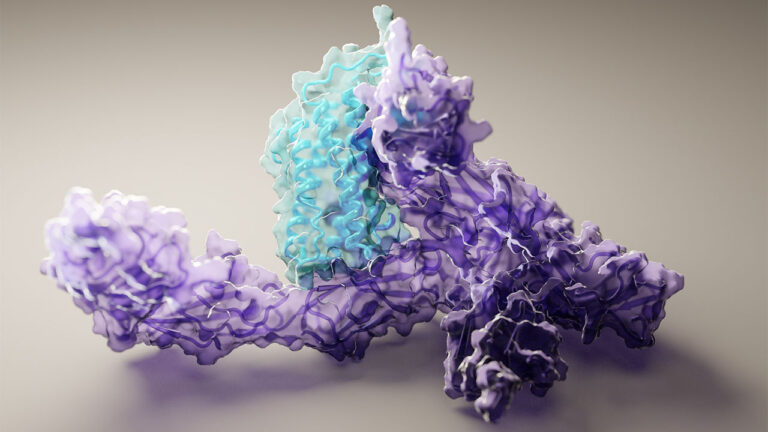
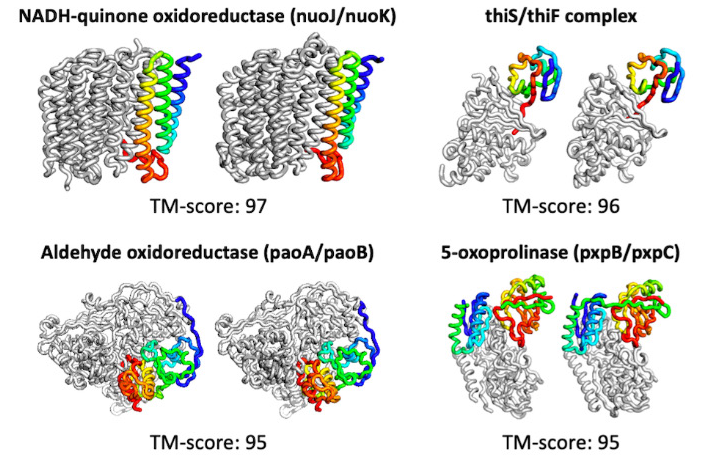
Illustration of predicted protein structures
Predicted protein structures and their ground truth score. Credit: UW/Baek et al

The tool not only quickly predicts proteins, but can do so with limited input. It also has the ability to compute beyond simple structures, predicting complexes consisting of several proteins bound together. More complex models are computed in about 30 minutes on a 24G NVIDIA TITAN RTX.

A public server is available for anyone interested in submitting protein sequences. The source code is also freely available to the scientific community.

“In just the last month, over 4,500 proteins have been submitted to our new web server, and we have made the RoseTTAFold code available through the GitHub website. We hope this new tool will continue to benefit the entire research community,” said lead author Minkyung Baek, a postdoctoral scholar at the University of Washington, Institute for Protein Design. 


Read more >>>
Read the full article in Science >>>